

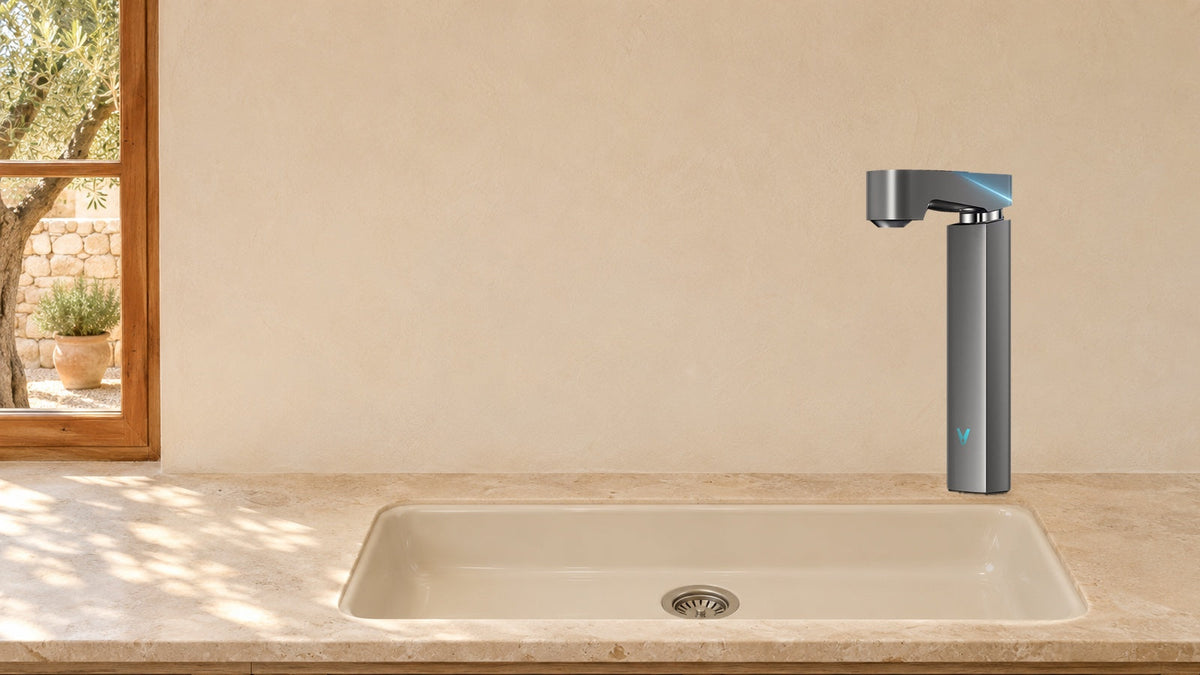
Remineralization built into the purifier's own cartridges suits a home that wants mineral-added water from the first glass and a single cartridge set to look after. That household is well matched by the Viomi M1, whose PCB cartridge puts minerals back after purification as part of the system itself.
The Waterdrop G3P800 treats minerals as an option. Its base configuration (WD-G3P800-W-FC) is an 800 GPD tankless reverse osmosis system with three cartridges and a UV sterilizer, and Waterdrop sells it separately as a remineralization bundle with an inline MNR35 cartridge and as an alkaline bundle with an ALK35 cartridge. The two share a tankless design, a 3:1 pure-to-drain rating and a faucet screen for TDS and filter life.
Configurations Side by Side
Two G3P800 configurations sit beside the Viomi M1 in the table: the base system and its remineralization bundle.
| Configuration | How minerals are added | Faucet display | Cartridges and rated life |
|---|---|---|---|
| Viomi M1 | Built in: the M1-PCB composite cartridge adds six minerals back after RO purification | Touchscreen with purified-water TDS, tap-water TDS and PCB/RO filter life | M1-PCB up to 24 months; M1-RO1000 up to 48 months |
| Waterdrop G3P800 base (WD-G3P800-W-FC) | Not part of the base system | TDS and CF/CB/RO filter life | CF up to 6 months; CB up to 12 months; RO up to 24 months |
| Waterdrop G3P800 Remineralization Filter Bundle (WD-G3P800-W-MZ) | Separate inline MNR35 cartridge with 1/4-inch quick-connect ends | Same faucet as the base system | Base cartridges as above, plus MNR35 at 12 months or 1,100 gallons, whichever comes first |
On output, the Viomi M1's membrane is rated at 1000 GPD, while Waterdrop gives 800 GPD as the G3P800's maximum daily production rate under the test conditions printed in its manual. Both are daily production figures, so neither describes how fast a glass fills at the faucet. Stage counts differ as well, with 9 stages in the Viomi M1 and 10 in the G3P800, though each brand groups its stages inside a small number of cartridges.
Minerals Inside the Purifier or in an Inline Cartridge
On the Viomi M1, remineralization is handled by one of the system's two cartridges. The M1-PCB composite cartridge removes sediment, chlorine and organic matter ahead of the RO membrane, protecting the membrane, and it also reintroduces six selected, naturally sourced minerals after purification, among them calcium, magnesium and potassium. What reaches the faucet is low alkaline water. Since the mineral stage shares a housing with the pre-filtration, a single cartridge swap renews both, and the cabinet holds one main unit with two cartridges inside it.
The G3P800 base system purifies through three cartridges: a CF cartridge that combines pre-sediment filtration with a carbon block, a 0.0001-micron RO membrane and a CB coconut carbon block after the membrane. Waterdrop's own comparison chart marks alkaline mineralization as outside the base model. Minerals come from a cartridge added to the setup. The MNR35 in the G3P800 Remineralization Filter Bundle restores calcium, magnesium, sodium and potassium and is rated for 12 months or 1,100 gallons. For a household that cares more about pH, the alkaline bundle's ALK35 raises it to a range of 7.5 to 9.5 and is rated for up to 6 months. Both sit outside the main unit as separate cartridges, with the MNR35 built for 1/4-inch quick-connect tubing, and the pair gives a G3P800 owner a choice between a mineral profile and a more alkaline one.
For upkeep, the difference shows in how the mineral stage is tracked and replaced. On the Viomi M1 it shares the PCB cartridge's filter-life readout, while a G3P800 bundle adds a fourth cartridge on its own interval beside the three in the main unit. Our guide to built-in and add-on remineralization covers the general differences between those two designs in more depth.

What Each System Shows You
The Viomi M1's touchscreen faucet carries two TDS readings, one for the tap water coming in and one for the purified water going out, along with the remaining life of the PCB and RO cartridges. TDS, or total dissolved solids, is the combined amount of minerals and salts dissolved in the water, so the two figures show the tap water's starting point as well as the water in the glass. The same faucet handles one-touch dispensing.
Filter life on the Viomi M1 appears in three places: the faucet, the main unit and the Viomi app. The app adds water usage, inlet water temperature and replacement reminders, and when a cartridge reaches the end of its rated life, the app sends a notification while the main unit's RO lamp glows orange.

The G3P800 splits its readout between the sink and the cabinet. Its smart faucet shows TDS and filter status for the CF, CB and RO cartridges, and a display on the front panel of the main unit repeats the TDS reading with electronic indicators for each cartridge. For more on reading the numbers these screens produce, our explainer on interpreting an RO faucet's TDS display walks through each readout.
A Four-Year Look at Cartridge Changes
Laid out from installation day using each brand's published month ratings, the two systems follow quite different rhythms. At the Viomi M1's rated intervals, the first change comes at month 24, when the M1-PCB cartridge is replaced, and the second at month 48, when the M1-PCB and the M1-RO1000 are replaced together. Across four years, that is two change days and three cartridges.
The G3P800 base system works on shorter cycles. Its CF cartridge is rated for up to 6 months, its CB cartridge for up to 12 and its RO cartridge for up to 24, so a change falls every six months, with the CB joining once a year and the RO every second year. Over four years that comes to eight change days and 14 cartridges. Adding the remineralization bundle brings the MNR35 into the 12-month changes, for 18 cartridges across the same eight days if it is counted by months (Waterdrop also rates it for 1,100 gallons, whichever comes first), and the alkaline bundle's 6-month ALK35 joins every change day, for 22 cartridges.
Replacement on the Viomi M1 is tool-free: each cartridge twists to unlock and pulls out by hand, and the new one twists in. For households that like to plan these months ahead, our filter-life replacement planner shows how rated intervals turn into a schedule.
Kitchens That Suit the Viomi M1
Mineral water at the faucet, with no separate cartridge to place, order or track, is the main reason to choose the Viomi M1. The six added minerals are part of every glass, kettle and pot from the first day, and those added minerals count toward the purified TDS reading on the faucet.
For day-to-day upkeep, tap and purified TDS appear on the faucet, filter reminders arrive on a phone, and cartridge ratings of up to two and four years keep changes infrequent. With a 1000 GPD membrane rating and no storage tank, the Viomi M1 purifies and mineralizes water as it is drawn for pitchers, coffee makers, stockpots and reusable bottles.
What Draws Some Households to the G3P800
Some households will lean toward the G3P800, and one reason is its UV stage. The base box includes a UV sterilizer that sits between the main unit's filtered-water outlet and the faucet, is powered by the system and switches on only when water flows through it. For a household that specifically wants a UV step after reverse osmosis, the G3P800 builds one in.
Choice of finishing cartridge is another draw. Between the MNR35 and the ALK35, a buyer can pick a mineral profile or a higher pH range, and either one is replaced on its own, apart from the three main cartridges.
A household that wants the TDS reading shown on the main unit as well as at the faucet will find that on the G3P800's front panel.
Getting Either System Under the Sink
Both systems install under a kitchen sink, taking feed water from the standard cold-water supply line and sending the drain line to the sink drain. For the G3P800, Waterdrop's manual notes that an existing soap-dispenser opening can serve as the faucet hole.
The Viomi M1 ships with its installation parts in the box, and a step-by-step installation video walks through the faucet, feed-water and drain connections in order, so the whole setup can be followed one connection at a time. Its main unit measures 17.1 inches deep, 6.4 inches wide and 15.9 inches high. The G3P800 measures about 18.1 by 5.7 by 17.7 inches, and a remineralization or alkaline bundle adds its inline cartridge to the space around it.
FAQ
Can the MNR35 mineral cartridge be added to a G3P800 later?
Waterdrop sells the MNR35 on its own product page and describes it as an independent filter made for 1/4-inch quick-connect tubing. Paired with the G3P800, it is offered as the G3P800 Remineralization Filter Bundle (WD-G3P800-W-MZ), and its rated life is 12 months or 1,100 gallons.
Why does the Viomi M1's purified TDS read higher than a plain RO screen?
Minerals are added back on purpose after purification, and those dissolved minerals count toward TDS. A higher purified reading on the Viomi M1 is expected and reflects the remineralization stage at work. It also means the Viomi M1's purified figure and the reading on a G3P800 base system describe two different kinds of water, mineral-added and plain RO, so the numbers are not meant to match.
What changes between the G3P800 mineral bundle and the alkaline bundle?
The two bundles differ in their finishing cartridge. The remineralization bundle adds the MNR35, which restores calcium, magnesium, sodium and potassium and is rated for 12 months or 1,100 gallons. The alkaline bundle adds the ALK35, which raises pH to 7.5 to 9.5 and is rated for up to 6 months. The base purifier, faucet and three main cartridges are the same in both.
What role does UV light play after reverse osmosis?
On the G3P800, the UV stage is a separate step from the filtration cartridges. Waterdrop says its UV sterilizer reduces up to 99.9% of bacteria and uses a long-life LED part that needs little to no maintenance. In the G3P800, the UV sterilizer sits after the filtration cartridges, just before the faucet, and turns on whenever water flows to the tap.
Matching the Mineral Setup to Your Kitchen
Built-in minerals with long cartridge intervals point to the Viomi M1. A UV stage after the membrane, together with a mineral or alkaline cartridge chosen and replaced on its own, is what the G3P800 and its bundles offer instead.
Share:
Las Vegas RO and Scale Control: Defining Each Project's Scope
Viomi V8 PRO vs Waterdrop G3P600: Daily Output, Drain Ratio and Cartridge Changes