

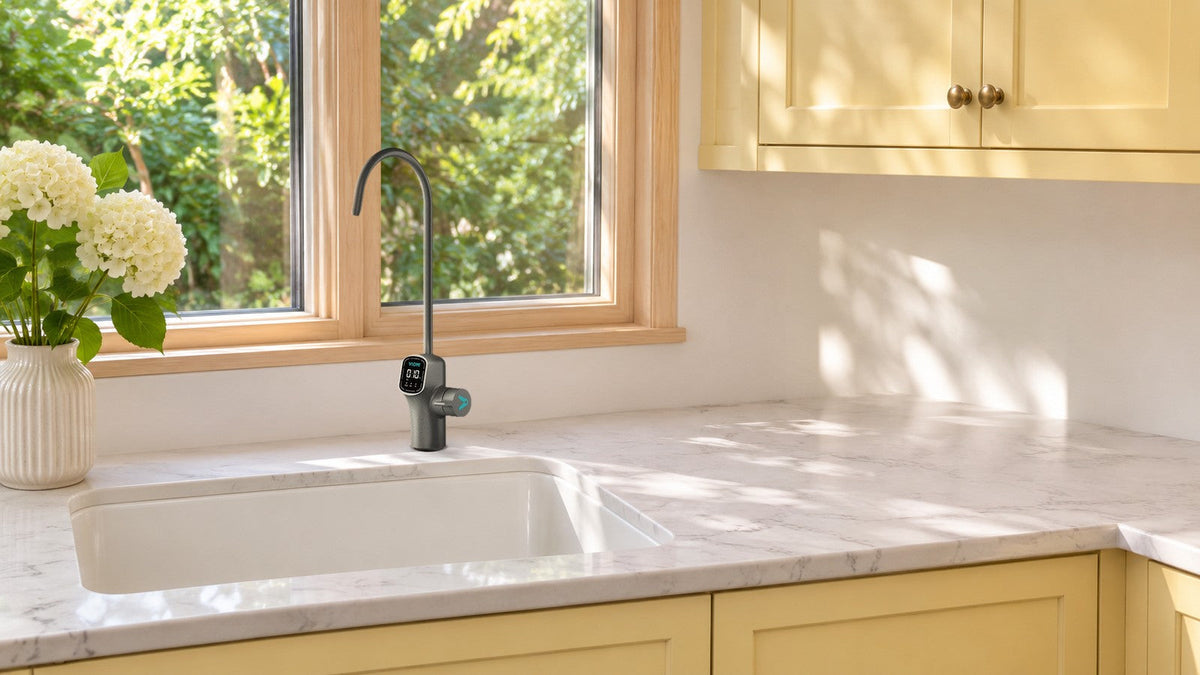
A cartridge rated in both months and gallons is due at whichever limit arrives first, so a replacement plan starts with the number of gallons a household actually draws through it each day. Light users reach the month limit first, while heavy users can use up the gallons months earlier. A system that tracks its own cartridges shows that count on its own display.
The Viomi M1 suits a household that wants long gaps between changes and nothing to calculate: its two cartridges are rated for up to two and up to four years, and the faucet and app count each one down. For cartridges rated in both months and gallons, a daily-use figure and a short calculation give a planning estimate of when each one will come due, which helps when ordering ahead.
Gallons per Day: The Household Input Table
Only water that passes through the filter counts toward its gallon rating. For an under-sink RO system, that means water drawn from the dedicated RO faucet, plus a refrigerator or ice maker line if one is connected to the system. Water from the main kitchen faucet, the dishwasher and the shower stays out of the total.
The quickest way to fill in the table is to measure each container once with a measuring cup, then count fills on an ordinary weekday. The two example households below show how the numbers add up.
| Use from the filtered faucet | Example household A (oz per day) | Example household B (oz per day) | Your household (oz per day) |
|---|---|---|---|
| Drinking glasses and refillable bottles | 64 | 160 | |
| Coffee maker | 40 | 80 | |
| Kettle for tea | 32 | 64 | |
| Cooking pots, rice and soup | 56 | 160 | |
| Pet water bowls | 0 | 48 | |
| Total ounces per day | 192 | 512 | |
| Gallons per day (total ÷ 128) | 1.5 | 4.0 |
Household A is two adults who drink filtered water and make one pot of coffee. Household B is a family of four that also cooks pasta and rice with filtered water and fills two pet bowls. A refrigerator dispenser or ice maker fed from the RO line belongs in the total as well; one way to count it is to note how many glasses come from the door on a normal day. Weekends often run higher than weekdays, so a household that cooks big meals on Saturday and Sunday gets a fairer daily figure by counting a weekend day too and weighting it: five weekday totals plus two weekend-day totals, divided by seven.
A family's daily volume also shapes which system size makes sense in the first place, and this guide to choosing an RO purifier for a family home works through that side of the decision.
Which Limit Arrives First
To turn a gallon rating into a date, divide it by the household's gallons per day; the result is the number of days until the gallons run out, and dividing again by 30.4, the average length of a month, puts it in months. Compare that figure with the month rating, and the smaller number is the replacement point. For household B and a 550-gallon cartridge, 550 divided by 4 gives 137.5 days, and 137.5 divided by 30.4 gives about 4.5 months, which comes well before a six-month rating.
It also helps to know where the switch happens. The gallon rating divided by the number of days in the month rating gives the daily use at which both limits land on the same day. Under the published ratings, households below that figure reach the month limit first and households above it reach the gallon limit first. Feed-water quality and the system's own indicator can call for a change sooner, so a calculated date works as a planning estimate.
The table applies both steps to the three cartridges of the Waterdrop G3P600, which carry both a month and a gallon rating. Waterdrop states those capacities as gallons of clean water provided, which matches a count of filtered water taken at the faucet.
| Cartridge | Published rating | Daily use where both limits meet | Due for household A (1.5 gal/day) | Due for household B (4 gal/day) |
|---|---|---|---|---|
| Waterdrop G3P600 CF | 6 months or 550 gal | 3.0 gal/day | Month 6 (month limit) | Month 4.5 (gallon limit) |
| Waterdrop G3P600 CB | 12 months or 1,100 gal | 3.0 gal/day | Month 12 (month limit) | Month 9.0 (gallon limit) |
| Waterdrop G3P600 RO | 24 months or 2,200 gal | 3.0 gal/day | Month 24 (month limit) | Month 18.1 (gallon limit) |
Months use 30.4 days. Ratings are taken from Waterdrop's product and replacement-filter pages.
For household A, every cartridge in the table is governed by its month rating, so its plan simply follows the published month ratings. For household B, every cartridge is governed by gallons: the CF pre-filter comes due around month 4.5 instead of month 6, and the RO cartridge around month 18 instead of month 24. All three cartridges share a meeting point near 3 gallons a day, so on these ratings a household just above that level sees every estimated due date move forward together.
The same two divisions work for any cartridge sold with a months-or-gallons rating, as long as its gallon figure counts filtered water delivered.
The gallon limit never works in the other direction. A household that draws half a gallon a day does not earn a longer life for a 550-gallon cartridge; the six-month limit still applies whatever the gallon count shows.
Cartridges the System Counts Down for You
Some under-sink systems take the gallon arithmetic off the household's list. Each cartridge in a Viomi tankless RO system has a rated life in months, and the system follows it for the household, from the one-year PCB pre-filter on the Viomi V6 PRO and Viomi V8 PRO up to four years for the RO cartridge in the Viomi M1. The Viomi B6W pairs a 12-month PPC pre-filter with a 24-month RO cartridge on the same principle.
Day to day, every one of these models puts remaining filter life where the household already looks: on the faucet display for the Viomi V6 PRO and Viomi V8 PRO, and on the main unit, the touchscreen faucet and the app for the Viomi M1. Ahead of a change, the Viomi V6 PRO and Viomi V8 PRO reminder system monitors use and turns the control-panel light orange 10 to 15 days before a cartridge is due, which leaves time to order one, and a reset after the swap brings the display back to 100%. The Viomi M1 app goes a step further for planning, listing the percentage used and the number of days left for each cartridge, then sending a notification when one reaches the end of its life.

For these systems, the input table still has a use: it tells a family how much filtered water it draws, which helps when choosing between models. The schedule below lays out the rated intervals as a planning view, and the system's own countdown sets the timing in practice.
A Four-Year Replacement Schedule
The schedule starts on installation day and is built from each model's rated intervals. It lists only the months in which a change falls at those intervals; months not listed have none.
| Month after installation | Viomi V6 PRO | Viomi V8 PRO | Viomi B6W | Viomi M1 |
|---|---|---|---|---|
| 12 | PCB | PCB (the spare that ships in the box) | PPC | No change |
| 24 | PCB and RO | PCB and RO | PPC and RO | PCB |
| 36 | PCB | PCB | PPC | No change |
| 48 | PCB and RO | PCB and RO | PPC and RO | PCB and RO |
The Viomi V8 PRO ships with one RO cartridge and two PCB cartridges, one installed and one spare, so its first pre-filter change at month 12 uses a cartridge the household already has. On the Viomi M1, the first change at its rated interval falls at month 24.
Months 24 and 48 are where both cartridges fall due together on the Viomi V6 PRO, Viomi V8 PRO and Viomi B6W, which makes them easy to order as a pair.
For comparison with brand-by-brand filter life across pitchers, faucet filters and whole-house systems, Which Water Filter Brands Have the Longest-Lasting Filters? lays out the ranges by format.
FAQ
Can a household that uses little water keep a 550-gallon cartridge past six months?
The six-month limit still applies. A gallon rating sets the latest point for heavy users; it does not extend the month rating for light users, so a cartridge with both ratings is replaced at whichever comes first.
Which water counts toward the daily gallons?
Only water that flows through the cartridge. On an under-sink RO system, that is water from the RO faucet and, if the system feeds one, a refrigerator or ice maker line. Kitchen faucet water that bypasses the filter does not count.
Does the spare PCB in the Viomi V8 PRO box change the plan?
It covers the first pre-filter change. The month-12 PCB is already in the household, so the first cartridge that needs ordering is the next PCB at month 24, together with the RO cartridge due that month.
Does a larger household need a different schedule?
For time-rated cartridges tracked by the system, the household follows the system's countdown and reminders. For cartridges rated in months or gallons, a larger household can rerun the division with its new daily figure to update its planning estimate. Once the new figure passes the point where the gallon limit arrives first, the estimated dates move forward; below that point, the month ratings still set them.
Setting Up Your Own Replacement Plan
- Measure each container once and count fills over a normal weekday, then count a weekend day too if cooking habits change on Saturdays and Sundays, and combine them as five weekdays plus two weekend days divided by seven.
- Convert the total to gallons per day by dividing the ounces by 128.
- For any cartridge rated in months or gallons, divide the gallon rating by the daily figure and compare the result in months with the month rating.
- Write down the earlier of the two dates for each cartridge, and mark the months where two cartridges fall due together so both replacements are on hand that month.
- On a system that counts down each cartridge and warns in advance, let the reminder set the timing and keep the input table only for comparing models.
- Repeat the calculation whenever the household changes size or starts using filtered water for something new, such as a refrigerator line or daily soup making.
Share:
Reading Microplastic Filter Tests: Particle Size, Challenge Counts and Conditions
Connecting a Refrigerator to an RO Line: Branch, Route and Filter Checks