

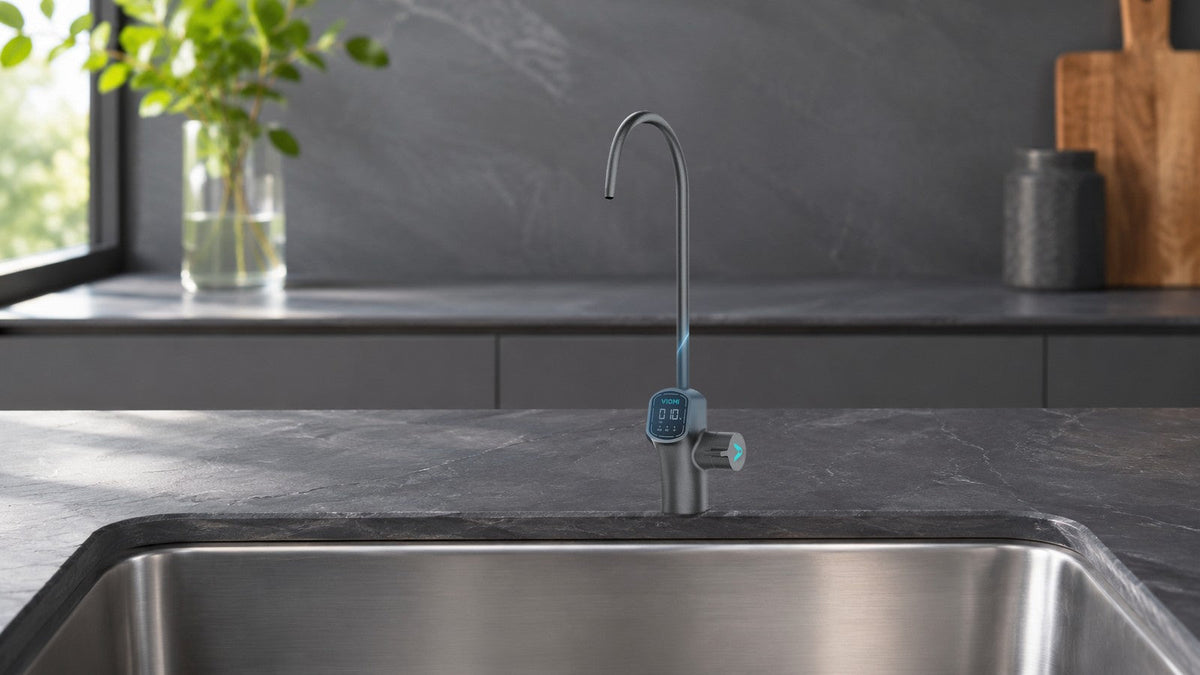
An RO faucet's TDS display is most useful read as a pair: the inlet number describes the water coming into the system, and the purified number describes the water reaching your glass, including any minerals the system adds back. Read together and set beside the household's own earlier readings, the two numbers give context for any change you notice. The Viomi M1 puts that pair in front of you, since its touchscreen faucet shows tap-water TDS and purified-water TDS on the same screen every time you pour.
Which RO brands offer built-in TDS monitoring is compared in which RO brands include reliable TDS monitoring.
Inlet and Purified: Reading the Two Numbers as a Pair
Both numbers rest on conductivity. The U.S. Geological Survey describes specific conductance as water's ability to transmit an electrical current, an ability that increases with the amount of dissolved ions in the water (USGS). A TDS display converts that conductivity into an estimate in ppm, the same principle behind the handheld meters explained in what is TDS.
The inlet number belongs to the supply. It shows what the system is being asked to treat, and it can move when the incoming water changes. The purified number belongs to the water you drink. It reflects what passes the RO stage, plus anything the system adds afterward, which on a mineralizing system includes the minerals put back on purpose. Seeing the two side by side shows at once whether the inlet number moved along with the purified one.
A ratio of the two screen readings is a quick way to set them side by side. In a hypothetical example, an inlet reading of 300 with a purified reading of 15 is a ratio of 20 to 1, and a later hypothetical pair of 360 and 18 keeps the same ratio even though both numbers rose. Watching the ratio alongside the raw numbers keeps a change in the incoming water in view whenever the purified number moves. A purified number that climbs while the inlet number holds steady is the situation worth setting beside the filter-life readout.
TDS is an overall measure of dissolved ions, so it sits alongside a system's contaminant-specific test results as an everyday view of how the water is running.
What Each Readout on the Screen Describes
A smart RO faucet shows more than one kind of number, and each describes a different thing. Knowing which state the screen is in tells you which numbers belong in a day-to-day comparison.
| Readout | What it describes | How it fits a day-to-day look |
|---|---|---|
| Tap-water TDS on the Viomi M1 faucet | The TDS of the incoming tap water before RO filtration | Read together with the purified number during normal dispensing |
| Purified-water TDS on the Viomi M1 faucet | The TDS of the water the system delivers, with minerals added back | During normal dispensing, once flushing is complete |
| Purified-water TDS on the Viomi V6 PRO and Viomi V8 PRO LCD faucet | The TDS of the purified water the system delivers | During normal dispensing, once flushing is complete |
| Rinse progress from 1 to 100 on the Viomi V6 PRO and Viomi V8 PRO | How far an initial or cartridge-replacement rinse has run | Not a water-quality number; daily comparisons start after it finishes |
| Filter-life percentage on the faucet, with days left in the app | How much service life remains for each cartridge | Read beside the TDS pair when a trend appears |
| Before-and-after TDS in the Viomi app | Tap-water and purified-water TDS on the phone | The same pair, viewed away from the sink; compared like the faucet pair, in normal use |
During a rinse on the Viomi V6 PRO and Viomi V8 PRO, the faucet shows progress from 1 to 100, and in the output status the display shows the TDS of the water coming out. The rinse exists to clear new cartridges, so the readings worth keeping start once it has finished and the system is back in ordinary use.

When an RO system sits unused, with no pressure on the membrane, dissolved solids can drift toward the purified side, so the first water after a rest may read a little higher before fresh water flows through, an effect a Water Quality Association column in PM Engineer describes for RO systems generally (PM Engineer). On the Viomi M1, the TDS reading is also naturally higher than standard RO water because minerals are intentionally added back, and that higher number reflects the remineralization stage.
Getting to Know Your Own Normal
Everyday glances build up the household's own normal. A good moment to look is after water has already been flowing that day, such as just after the morning kettle fill, with the screen in normal dispensing. With ordinary use, the pair tends to settle into a range that becomes familiar, and later readings keep refining it.
Anyone who likes a note to look back on can jot down the date and the two numbers from a normal draw. Read against the hypothetical pairs above, the two kinds of movement give different information. In the first pattern, both numbers rise or fall together and the ratio stays near 20 to 1, so the purified reading is moving in step with the inlet reading. In the second, the inlet reading holds still while the purified reading moves, which is the situation where the filter-life percentage, read alongside, adds maintenance context to the pair. On the Viomi M1, both numbers sit on the faucet screen at once, and on the Viomi V6 PRO and Viomi V8 PRO the before-and-after pair is in the Viomi app.
On the Viomi M1, the app also shows the feed-water temperature beside the TDS readings, which adds context when a winter reading is set beside a summer one. Conductivity rises with temperature, and most modern meters correct for that automatically, so the temperature works as background when seasons are compared.
Several higher readings in a row, taken in the same screen state, form a trend worth setting beside the inlet number and the filter-life percentage. A single higher reading after the system has been resting fits the idle-time effect described above when it settles back as water flows, and a later look during normal use shows where the pair has returned to.
No single number serves as normal for every home. Supplies start in different places, and a mineralizing system and a plain RO system produce different purified readings by design, so the household's own familiar range is the yardstick that fits.
Filter-Life Readouts Beside the TDS Number
The filter-life percentage that sits next to the TDS numbers is the maintenance readout. On the Viomi M1, the faucet shows the remaining life of each filter as a percentage, and the app shows the percentage along with the number of days left. As a filter approaches the end of its life, its PCB or RO label on the faucet flashes orange, then stays orange once that filter's life is used up, and the app sends a notification when replacement is due.
Replacement is tool-free, and once the new cartridge is in and its life is reset, the filter lifespan displays as 100% in both the app and on the faucet. The TDS pair seen once normal use resumes then shows where the water sits with the new cartridge in place.
FAQ
Which readout should I look at right after replacing a filter?
The filter-life display shows 100% once the new cartridge's life has been reset. For the TDS pair, the useful look comes once the system is back in normal use, since that is the state the earlier readings were taken in.
How can I tell whether the screen is showing a rinse or normal dispensing?
On the Viomi V6 PRO and Viomi V8 PRO, a rinse is marked by the progress count running from 1 to 100, which is shown while an initial or cartridge-replacement rinse is under way. Once the count has finished and water is drawn as usual, the purified-water TDS on the faucet is the everyday number to read beside the household's familiar range.
Is there a single TDS number that means a filter needs replacing?
Supplies differ too much from home to home for one number to work everywhere. The filter-life readout and its reminders handle replacement timing, and the TDS pair is best read against the range your own system usually shows.
Why is my inlet number different from a friend's in another town?
Each supply starts with its own mineral content. The U.S. Geological Survey notes that groundwater that has been in an aquifer a long time has had more time to react with and weather aquifer materials, which is one reason dissolved solids differ from one source to the next. A different inlet number often reflects a different source, which is one reason each household's own readings make the best comparison.
Does water temperature change the reading?
Temperature affects conductivity, which rises by 0.5 to 3 percent per degree Celsius according to the U.S. Geological Survey, and most modern meters correct for it automatically (USGS Techniques and Methods 9-A6.3). The feed-water temperature shown in the Viomi M1 app is useful background when readings from different seasons are compared.
Reading the Pair as a Habit
A TDS display is most useful as two numbers read together, taken in the same screen state each time and set beside the range the household has come to know. Knowing which readouts are water-quality numbers, which describe a rinse in progress and which track filter life turns a glance at the faucet into a quick, confident read of how the water is running from one week to the next.
Share:
Reading Austin's Water Reports Before Choosing a Filter
Sizing a Home RO System Around Peak Water Use