

Rated output and pure-to-drain ratio come to 800 GPD and 3:1 on the Viomi V8 PRO and 600 GPD and 2:1 on the Waterdrop G3P600. For a family that wants the higher rated output and a simple two-cartridge upkeep routine, the Viomi V8 PRO is the better fit of the two.
The Waterdrop G3P600 is also a tankless under-sink system, built around three cartridges and a display faucet of its own. It appeals to kitchens with a lighter daily draw and to households drawn to the add-on bundles Waterdrop sells for it.
Which Versions Are Being Compared
The Viomi V8 PRO compared here ships with the main unit, its smart faucet, an RO800 membrane cartridge already installed, and two PCB composite cartridges, one fitted in the unit and one packed as a spare. Under normal household use, that spare covers the first scheduled pre-filter change, so no extra pre-filter purchase is needed for up to two years of ownership.
Waterdrop sells the G3P600 in several bundles, and this comparison uses the base model, WD-G3P600. Its box contains the system, a set of three cartridges (the G3-N1CF composite pre-filter, the G3P600-RO membrane and the G3-N3CB carbon post-filter), the RO faucet and a power adapter. The other G3P600 listings pair the same system with an external MNR35 remineralization filter, an ALK35 alkaline filter, a UV unit, or a small PMT pressure tank. The output, ratio and cartridge figures here are for the base system.
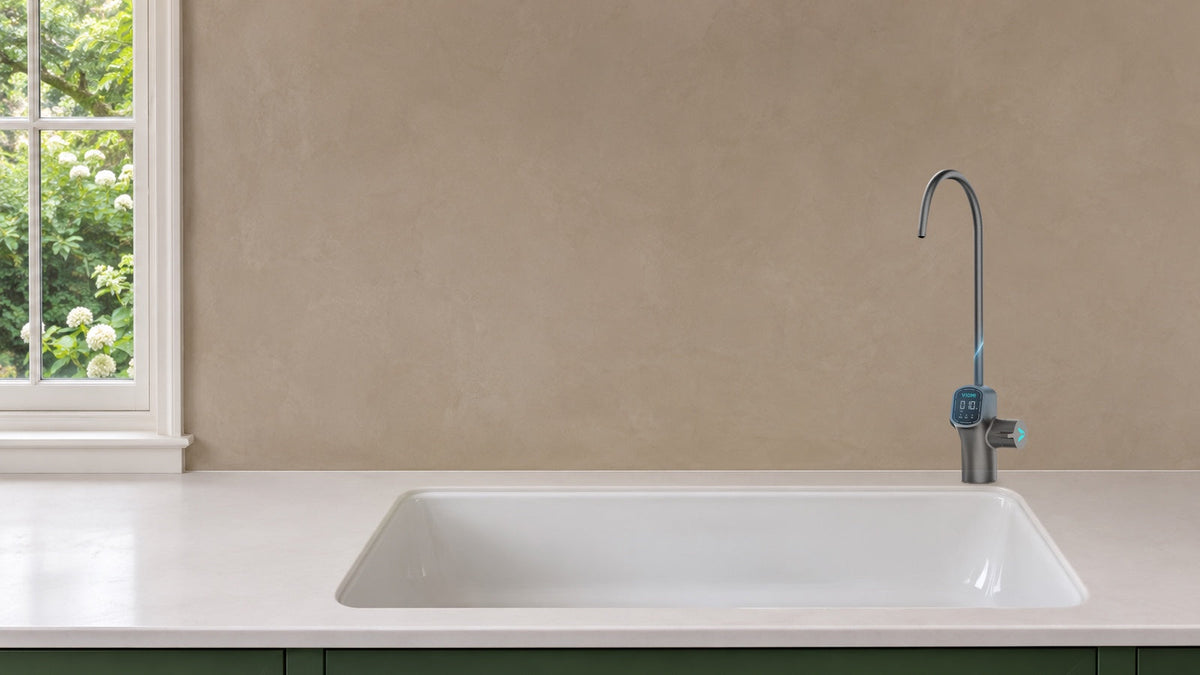
Both units are tankless reverse osmosis systems with a built-in pump, and both come with a display faucet; on the Viomi V8 PRO, the smart faucet shows real-time TDS and filter life, and the Viomi app tracks the same cartridges from a phone. Each one makes purified water on demand as the faucet runs.
Output, Ratio and Cartridges at a Glance
| Spec | Viomi V8 PRO | Waterdrop G3P600 |
|---|---|---|
| Rated output | 800 GPD | 600 GPD |
| Rated output converted to gallons per minute | About 0.56 | About 0.42 |
| Pure-to-drain ratio (nominal) | 3:1 | 2:1 |
| Filtration stages | 9 | 8 |
| Cartridges | 2: PCB composite and RO800 | 3: CF composite, RO and CB carbon |
| Rated cartridge life | PCB 12 months; RO 24 months | CF 6 months or 550 gallons; CB 12 months or 1,100 gallons; RO 24 months or 2,200 gallons |
Both output figures are rated values, and Waterdrop measures the G3P600's daily production at 30 psi of dynamic feed pressure and 77°F water. The per-minute row divides each daily rating by the 1,440 minutes in a day, which puts the two ratings in the same units; it is a conversion of the rating and not a measured faucet flow.
What 800 and 600 GPD Mean During a Busy Kitchen Hour
A GPD rating describes how much purified water a membrane system is built to make across a full day. A household rarely draws anything close to that total, so the rating is best read as a capacity figure for comparing systems, especially for kitchens where several containers get filled back to back, such as a pasta pot, the kettle and a row of school water bottles while dinner is underway.
Both systems make water on demand as it is drawn, and the Viomi V8 PRO's rating is a third higher, a useful figure for kitchens where a pot, a pitcher and a coffee-maker reservoir often come due at once.
The higher rating is the figure to watch for households that batch-cook on weekends, boil pasta or soup several nights a week, or refill a set of bottles for everyone before school and work. A smaller household that mostly pours glasses and fills one kettle in the morning has a lighter peak, which puts less weight on the higher rating. Our guide to sizing a home RO system around peak water use shows how to add up the busiest half hour task by task, which is a more useful input than the number of people at the table.
Reading a 3:1 or 2:1 Ratio
The pure-to-drain ratio describes how a reverse osmosis system splits its feed water. Part of the water passes through the membrane and comes out of the faucet; the rest carries the rejected minerals away through the drain line. At 3:1, the Viomi V8 PRO is rated to send one part to the drain for every three parts of purified water. At 2:1, the G3P600 is rated to send one part to the drain for every two parts it delivers.
For families who care about drain water as much as output, the two figures point the same direction as the GPD ratings. Our look at low-waste reverse osmosis brands puts more published ratios side by side for anyone comparing beyond this pair.
Two Cartridges or Three: The Change Schedule Over Two Years
The Viomi V8 PRO runs on two cartridges. The PCB composite cartridge is rated for 12 months and the RO800 membrane for 24 months, and the first PCB replacement is already in the box. The system keeps track for the household: the faucet shows filter life, and orange lights on the control panel come on 10 to 15 days before a change is due, so the next cartridge can be ordered ahead of time.
Changes are tool-free, with a simple twist-and-pull cartridge. Our guide to matching PRO replacement cartridges by model shows which cartridge fits which system.
The G3P600 runs on three cartridges, each rated in months and gallons, with whichever limit arrives first setting the change. The CF composite pre-filter is rated for 6 months or 550 gallons, the CB carbon post-filter for 12 months or 1,100 gallons, and the RO cartridge for 24 months or 2,200 gallons. Going by the month limits alone, the CF comes out at months 6, 12, 18 and 24, the CB at months 12 and 24, and the RO at month 24. As a rough guide, a household averaging more than about 3 gallons a day through the system can reach the CF's 550-gallon limit before the six-month mark, which moves those dates earlier.
Over the rated two-year cycle, counting the month-24 changes, the Viomi V8 PRO uses three replacement cartridges, one of them the spare already in the box, at two change points (months 12 and 24). On its month limits the G3P600 uses seven replacement cartridges at four change points (months 6, 12, 18 and 24).
Fitting Either System Under the Sink
The Viomi V8 PRO's main unit measures 16.3 inches long, 5 inches wide and 12.8 inches high, a slim profile for a crowded cabinet. The G3P600 measures about 18.1 by 5.7 by 17.7 inches, and Waterdrop asks for about an inch of space between the unit and the cabinet wall.
Both follow the familiar under-sink RO layout, connecting to the standard cold-water supply and the sink drain, with the main unit in the cabinet and the display faucet on the counter; for the G3P600, Waterdrop notes that an existing soap-dispenser hole can hold the faucet. Installation parts come in the Viomi V8 PRO box, and a step-by-step installation video walks through the setup.

Households That Lean Toward the Waterdrop G3P600
Kitchens with a lighter daily pattern are a natural home for the G3P600. When the busiest moment is a kettle and a few glasses, a higher rated output ranks lower on the list of priorities.
Buyers who already know they want minerals added after the RO stage can order the G3P600 with an external MNR35 remineralization filter or an ALK35 alkaline filter, and Waterdrop also sells a G3P600 bundle that adds a UV unit. A small PMT pressure tank is offered as another bundle for kitchens that want a little stored water on hand.
For households attached to a particular faucet, Waterdrop's FAQ notes that the G3P600 can work with a third-party RO faucet fitted with a 1/4 inch quick connect, with the trade-off that the filter-life indicator on the original faucet no longer applies. A household that wants to keep a faucet finish it already owns may value that option.
For mineralized water inside a single unit, Viomi offers the Viomi M1, its RO system with remineralization built in.
FAQ
What do 800 GPD and 600 GPD work out to per minute?
Divided across the 1,440 minutes in a day, 800 GPD converts to about 0.56 gallons per minute and 600 GPD to about 0.42 gallons per minute. These are conversions of each brand's daily rating, which put the two systems in the same units for comparison.
How many cartridges come out at each change?
Within its rated two-year cycle, the Viomi V8 PRO calls for the PCB alone at the first change, using the spare from the box, and the PCB with the RO800 at the second, with the faucet and the panel lights signaling each one. On the G3P600, going by month limits, one comes out at month 6 (CF), two at month 12 (CF and CB), one at month 18 (CF) and three at month 24 (CF, CB and RO). Heavy daily use can bring the G3P600's gallon limits forward.
Is 600 GPD or 800 GPD the better size for a family?
Household size and cooking habits work together here, and the busiest stretch of the day tells the most. Families that cook in large pots several nights a week, refill a row of bottles at once, or plan to run a refrigerator or ice maker from the purified-water line lean toward the higher 800 GPD rating; the Viomi V8 PRO connects to a compatible refrigerator or ice maker with standard tubing. For a household whose peak is a kettle and a few glasses, output carries less weight in the choice than cartridge layout or add-on bundles.
What to Settle Before Ordering
- Picture a normal weeknight dinner and the containers that get filled around it, and set that picture next to the 600 and 800 GPD ratings.
- Compare the two-year cartridge counts side by side: three replacement cartridges at two change points for the Viomi V8 PRO, with one already in its box, and seven at four change points for the G3P600 on its month limits.
- Decide whether water with minerals added back after RO matters to the household, since that preference shapes which configuration fits best.
- Think about whether the purifier will also supply a compatible refrigerator or ice maker, a hookup the Viomi V8 PRO makes with standard tubing.
- Measure the cabinet's width, depth and height, leaving the inch of space between the unit and the cabinet wall that Waterdrop asks for if the G3P600 is the pick.
Share:
Viomi M1 vs Waterdrop G3P800: Built-In Minerals or a Mineral Bundle
Viomi V6 PRO vs Waterdrop G5P500A: Small-Cabinet Fit and Filter Upkeep