

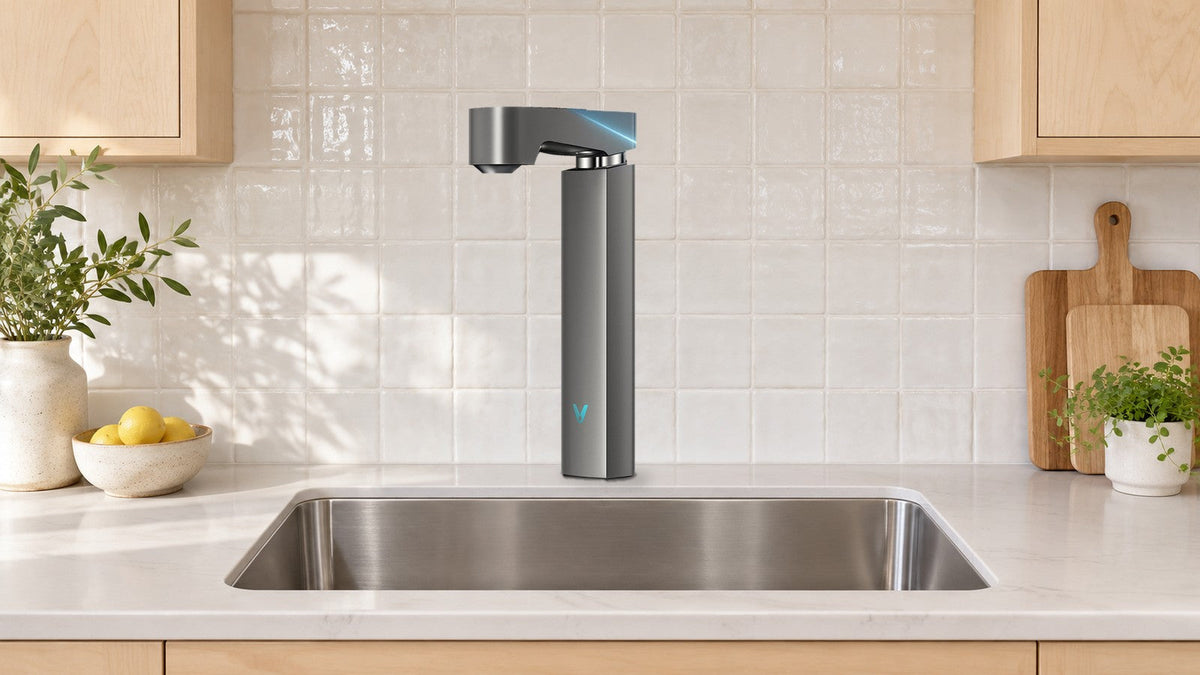
A built-in mineral stage is part of the purifier's own cartridge set, while an add-on is a separate inline cartridge spliced into the tubing between an existing RO system and its faucet. Both put minerals back after the membrane; the differences lie in where the stage sits, how its replacement is tracked and how much of the setup the owner manages. For a household that wants remineralization handled inside one tankless unit, the Viomi M1 is a strong fit, because its mineral stage is one of the system's own cartridges and shows up in the same filter-life readout on the faucet and in the app.
An add-on makes more sense when a plain RO system is already installed and working, and the only change wanted is mineral content. Choosing a brand from the overview of which brands offer alkaline reverse osmosis systems settles which product to buy; living with it day to day is where the two designs part ways.
Where the Mineral Stage Sits in the Water Path
In every design compared here, minerals go in after the RO membrane has done its work. The membrane removes most dissolved ions, and mineral media then dissolve into the purified stream. What changes from one design to the next is how many parts the water passes through between the membrane and the glass, and who decided their order.
| Route | Order the water follows | Where the minerals come from |
|---|---|---|
| Viomi M1 (built in, tankless) | Tap water, RO purification, minerals reintroduced, then the smart faucet | Mineral media housed in the system's own Viomi M1-PCB cartridge |
| iSpring RCC7AK (built in, tank) | Sediment, granular carbon, carbon block, RO membrane, fine carbon post filter, then the sixth-stage alkaline filter | FA15 alkaline remineralization cartridge |
| APEC ROES-PH75 (built in, tank) | Three pre-filters, RO membrane, storage tank, stage-5 carbon, then the stage-6 calcium carbonate filter before the faucet | High-purity calcium carbonate cartridge |
| Add-on on a plain RO | The existing system's full sequence, then a separate inline mineral cartridge on the faucet line | Whichever add-on is chosen, from calcium carbonate only to a mixed-mineral blend |
The factory layouts come from the makers' own descriptions. APEC states that product water from the tank passes through the stage-5 filter and then the stage-6 filter before reaching the faucet (APEC ROES-PH75), and iSpring adds its alkaline remineralization filter as a sixth stage after the standard five, describing it as the stage that remineralizes the RO water and neutralizes the pH (iSpring RCC7AK). An add-on recreates that final position by hand, so its placement becomes the owner's decision.
In the Viomi M1, minerals are reintroduced after purification inside the same tankless unit, and the water goes from treatment to the faucet without a storage stop in between. The mineral stage's position is part of the system design, so it arrives already in the right place in the water path.

How Much Control Each Design Gives You
Control over remineralization involves two choices: which mineral media the water runs through, and how that media fits the rest of the system.
With an add-on, the media choice belongs to the owner. APEC's pHPlus inline cartridge adds only high-purity calcium carbonate, while Waterdrop's MNR35 is described as restoring minerals like calcium, magnesium, sodium and potassium (Waterdrop MNR35). A household can choose between a calcium carbonate cartridge and one made to restore several minerals. The fit has to be matched as well. APEC sells its pHPlus cartridge as a standard quick-connect model and as a separate model with 3/8-inch quick connects (APEC pHPlus, 3/8-inch), and the MNR35 is designed for 1/4-inch quick-connect tubing, so the cartridge has to suit the tubing already in place.
A built-in stage places that choice in the design. The Viomi M1 reintroduces selected, naturally sourced minerals from media that come as part of its own Viomi M1-PCB filter, which uses a dual-stage activation that creates stable micropores for a slow, consistent release of minerals. The owner's control then shifts to timing: the faucet and app show how much filter life remains, so the replacement happens when the system calls for it.
Trying different media is easiest with an add-on, within the limits of tubing size and cabinet space. A built-in stage arrives matched to the system and already in position, and on the Viomi M1 it is tracked by the system's own filter-life display from the first day.
The Maintenance Chain Behind Each Route
An add-on carries its own rating. Waterdrop rates the MNR35 at 12 months or 1,100 gallons, and that interval runs separately from the RO system's other filters. Some factory tank systems supply the mineral cartridge in packs with their other stages. iSpring's one-year F9K set includes two alkaline filters along with the sediment, carbon and post-carbon cartridges (iSpring F9K), and APEC sells the stage-6 calcium carbonate filter in its replacement sets for the ROES-PH75.
The Viomi M1 keeps the chain short. The system uses two cartridges, the RO filter and the Viomi M1-PCB filter, and the mineral stage belongs to the Viomi M1-PCB, rated for up to 2 years. When that filter nears the end of its life, its indicator on the faucet flashes orange, the app shows the percentage and days remaining, and an app notification arrives when replacement is due. The replacement Viomi M1-PCB filter is sold on its own and swaps in with a tool-free twist and pull, followed by a flush and a reset of the filter-life count.

Supply follows the same split: add-on owners buy the cartridge that matches their tubing, and built-in owners buy the cartridge made for their system. A year-by-year cost view of both routes is in the comparison of remineralizing under-sink RO filter costs, and the hands-on steps for each brand's replacements are compared in RO filter replacement by brand.
Keeping an Eye on Each Route
pH, alkalinity, mineral content and TDS each describe something different, so a change in one does not stand in for the others. pH is a measure of how acidic or basic water is, and alkalinity is the water's buffering capacity, its ability to neutralize acids and so keep pH fairly stable, according to the U.S. Geological Survey's Water Science School (USGS, Alkalinity and Water). Mineral content refers to specific minerals such as calcium and magnesium. A household TDS meter estimates total dissolved solids from conductivity, which rises with the amount of dissolved ions (USGS); its single figure cannot tell which minerals are present or how much of each.
For owners who like to keep an eye on things, the Viomi M1's own monitoring and a few optional observations at the faucet each have a place, and they look different on each route.
| What to look at | Built-in stage on the Viomi M1 | Add-on on a plain RO |
|---|---|---|
| TDS | Device monitoring: the Viomi M1 faucet displays tap-water TDS and purified-water TDS every day, alongside each filter's remaining life | A handheld meter reading at the RO faucet, before and after the cartridge is first installed |
| pH | A test strip at the Viomi M1 faucet, for households that want a pH observation | A test strip before and after first installing a calcium carbonate cartridge such as APEC's pHPlus, which APEC describes as neutralizing acidity and raising pH |
| Taste | A side-by-side glass at the same temperature | A side-by-side glass at the same temperature |
| Cartridge age | Remaining life shown as a percentage on the faucet and with days left in the app | The add-on's install date, tracked by the household |
Remineralization changes what TDS means for finished water. On the Viomi M1, minerals are intentionally added back, so the finished water's TDS is naturally higher than standard RO water, a difference that reflects the remineralization stage. Owners who compare readings over time get the clearest picture from readings taken the same way, from the same faucet, during ordinary use.
A pH strip reading describes the water at that moment; contaminant reduction is the RO stage's job and is documented separately.
FAQ
Why does the TDS number go up after adding a mineral stage?
TDS meters estimate dissolved solids from electrical conductivity, and the minerals a cartridge adds are dissolved ions. On a mineralizing system, a reading above plain RO water is the expected result.
Is a higher pH the goal of remineralization?
For most households the goal is a finished water they enjoy drinking every day. Calcium carbonate media are described by APEC as neutralizing acidity and raising pH, so a pH change can accompany that kind of stage. It works best as one observation next to taste and TDS.
How do replacement reminders differ between the two routes?
An add-on cartridge carries its own rating, such as 12 months or 1,100 gallons for the Waterdrop MNR35, and its replacement is tracked by the household. On the Viomi M1, the mineral stage sits in the Viomi M1-PCB filter, so its remaining life appears on the faucet and in the app along with the RO filter, and the app sends a notification when replacement is due.
What does replacing the mineral stage involve?
For the Waterdrop MNR35, the cartridge sits in a fixed support and connects with 1/4-inch tubing at its inlet and outlet, following Waterdrop's installation steps. On the Viomi M1, replacing the Viomi M1-PCB filter renews the mineral stage along with the rest of that cartridge: it twists out and a new one twists in without tools, followed by a flush and a filter-life reset.
Where Each Route Fits a Household
For a household setting up RO for the first time or replacing an older system, a built-in mineral stage comes matched and in position, and on the Viomi M1 it shares the system's filter-life display and app reminders. A working plain RO system can gain mineral water through an add-on instead, with the owner choosing the media, matching the tubing and keeping one more replacement date. Which of those maintenance patterns fits the household's routine is usually what settles the choice.
Share:
Tankless vs. Tank RO: A Peak-Demand Comparison
How to Build an RO Evidence File for Multiple Water Goals