

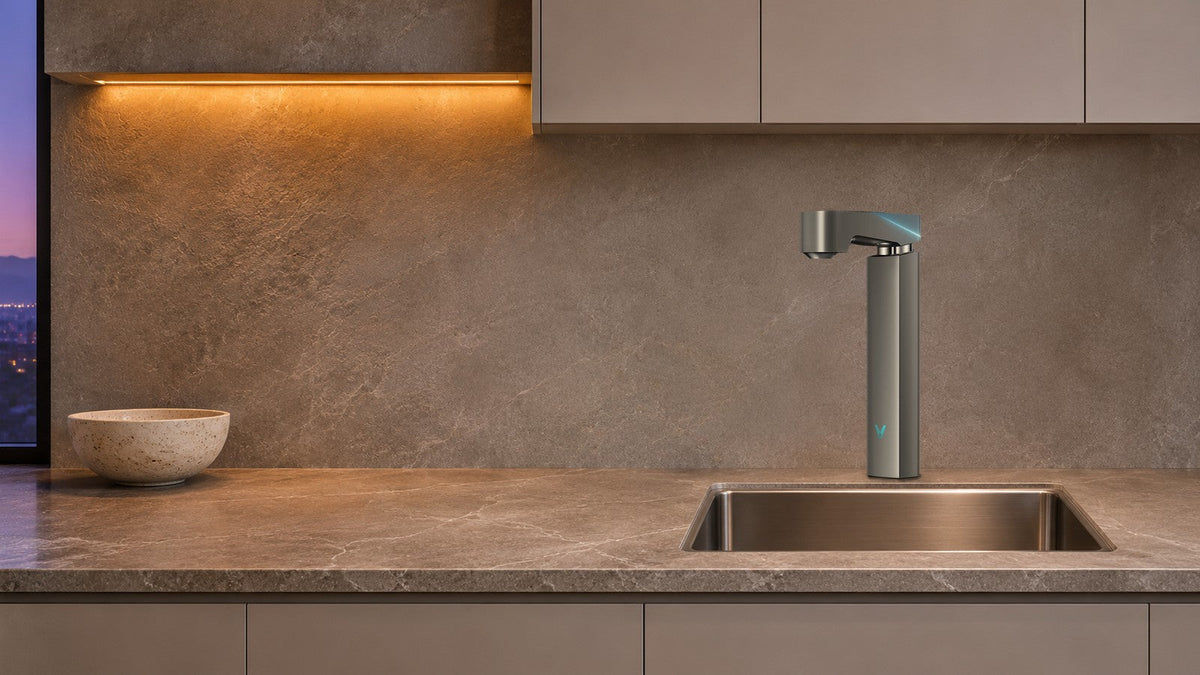
The water poured into a glass and the scale building up on a showerhead belong to two separate projects in a Las Vegas house, each scoped and quoted on its own. A reverse osmosis (RO) system under the kitchen sink takes care of drinking and cooking water, along with the refrigerator if the household wants it, while scale on the water heater, showers and fixtures is the job of a whole-home softener installed on the main line. Each quote then lists only the work for its own project.
Brands for the valley's water are compared in the earlier overview of water filter brands for Las Vegas.
What LVVWD's Numbers Mean for Each Project
The Las Vegas Valley Water District's 2026 Water Quality Report, based on 2025 data, puts the valley's hardness at 280 parts per million, or 16 grains per gallon. About 90 percent of the water comes from Lake Mead and carries calcium and magnesium from the Colorado River, which the report says make the water hard but "pose NO health risk". The district's water quality summary lists calcium at 75 ppm and magnesium at 24 ppm, the two minerals behind that hardness figure, and the district states that its water "meets or surpasses all State of Nevada and Federal Safe Drinking Water Act standards".
The district's FAQ puts the same point plainly: hardness "may be a nuisance, but it doesn't compromise your drinking water". Those figures describe the district's service areas. Valley communities served by other water providers, such as Henderson and North Las Vegas, publish their own reports.
The Southern Nevada Water Authority's page on home treatment systems supports splitting the work in two. Softening "is not a necessity to protect your health", and some people prefer softened water "for bathing, cleaning and washing clothes". RO filters are "usually installed below the kitchen sink", and SNWA describes RO as the only type of filter that removes calcium and magnesium.
Chlorine taste is a separate matter from hardness. The district disinfects with chlorine as water leaves its treatment facilities, and its water quality FAQ notes that an inexpensive activated carbon filter, like those in carafe systems, can improve taste and odor linked to chlorine, while adding that such filters do not remove hardness, minerals, sodium or fluoride.
The Two Scopes Side by Side
For a salt-based ion exchange softener, the two scopes look like this.
| Scope item | Kitchen RO project | Whole-home softener project |
|---|---|---|
| Taps and appliances covered | A dedicated drinking faucet, plus an optional refrigerator or ice maker line | Water heater, showers, tubs, laundry, sinks and fixtures on the softened lines |
| Where the equipment goes | Inside the kitchen sink cabinet | On the main water line where it enters the house |
| Work items to include | Installing the RO system and its faucet, plus an optional refrigerator branch | Equipment placement, main-line connection, bypass valve, drain line for regeneration water, setting the hardness |
| Where it connects in the house | Under the kitchen sink | The main line, a nearby drain and floor space for the brine tank |
| Choices written into the scope | Whether a refrigerator branch is included | Which taps, if any, stay unsoftened |
| Handover when the work is done | A leak check and the first flush of the new system | A leak check at the main-line connection, the bypass valve returned to its service position, and the hardness setting entered |
| Household's ongoing role | Cartridge changes when the system signals they are due | Restocking salt and keeping the setting at the report's hardness |
Where the two scopes touch, such as an existing pipe, drain or outlet that both projects might use, the work is written into one quote and the order of the two jobs is agreed. If the softener project leaves some taps unsoftened, that choice belongs in the softener quote, and if the refrigerator is to receive RO water, the branch belongs in the kitchen quote.
Inside the Kitchen RO Project
Most of the kitchen project happens in one cabinet, and a refrigerator branch extends it to the appliance. The result is drinking water with most of the valley's dissolved minerals removed at that tap.
For Las Vegas kitchens, the Viomi M1 brings a mineral stage into the RO project. After its membrane removes most dissolved minerals, the Viomi M1 adds selected naturally sourced minerals back, giving purified water a smoother, rounded taste. Its tankless design fills pitchers and stock pots without waiting for a tank to refill. The guide to RO remineralization filter brands explains how added minerals change RO water.

The Viomi V8 PRO is the tankless alternative for a household that likes to see the TDS reading on an LED faucet each time it pours. Either system can supply a compatible refrigerator or ice maker through standard tubing, and on the Viomi M1 the app's Multi-device Mode handles that setup.
Day to day, each faucet shows remaining filter life, and the Viomi M1's app also sends a reminder when a cartridge is due. Each Viomi model has step-by-step installation videos that run from unboxing through setup.
Inside the Whole-Home Project
The whole-home project protects plumbing and appliances. NDSU Extension's water softening guide (WQ1031) explains why the water heater sits at its center: heated hard water deposits calcium and magnesium carbonate on heating elements and tank walls, a large buildup slows heating and takes more energy to heat water, and heaters with heavy buildup have shorter life spans.
SNWA lists what households tend to gain from it: an improved feel of the water when bathing, cleaner and softer clothes, longer appliance life and fewer water spots and deposits. Those benefits are spread across the house, which is why the project is scoped at the main line.
Two decisions shape this quote. The first is the type of equipment. SNWA describes ion exchange softeners, which trade calcium and magnesium for sodium or potassium, and notes that salt-free systems condition the water but do not soften it, so a quote for a conditioner and a quote for a softener describe different projects with different upkeep. The second is which lines the softener serves. NDSU notes that sodium intake from softened water can be avoided "by leaving one kitchen tap unsoftened for drinking and cooking", and leaving outdoor faucets or other taps unsoftened is part of the same decision. NDSU also advises against softened water for steam irons and evaporative coolers, naming distilled water or water from a reverse osmosis unit as the best choice for those appliances, so an evaporative cooler's water supply is worth addressing as its own line item when the scope is written.
For a salt-based softener on LVVWD water, the district's report advises setting it to the district's published hardness of 280 parts per million, or 16 grains per gallon. Ongoing upkeep is mostly salt, which NDSU describes as "largely confined to restocking the salt supply for the brine solution", and SNWA reminds households to keep any home treatment system maintained. The main-line connection itself is plumbing work, which the softener quote should name as an item of its own.
Home Details to Gather for Each Project
For the kitchen RO project:
- Which sink the system will serve, if the kitchen has more than one
- What already sits in that sink cabinet, such as a disposal, an existing filter or stored items
- Whether the sink or counter already has a spare faucet hole, such as one used by a soap dispenser
- Where the cabinet's outlet and the sink drain pipe are located
- Where the drinking faucet should sit on the sink or counter
- Whether ice and chilled water should come from the RO system, and where the refrigerator stands
Any work at these spots belongs in the kitchen quote.
For the whole-home softener project:
- Location of the main shutoff and where the line enters the house
- Whether the house was built with a softener loop or bypass already in place
- The nearest drain and outlet to that location
- Household size and the number of bathrooms
- Which taps should stay unsoftened, such as outdoor faucets or a kitchen tap
- The hardness figure from the water provider's latest report
Two Projects, Two Separate Quotes
Two line items sit at the edge between the projects when a Las Vegas home takes on both: an unsoftened kitchen cold tap, which is plumbing on the softener side and belongs in that quote, and a refrigerator branch, which belongs with the RO system. Naming each one in the quote it belongs to settles who installs it and who checks it at handover.
FAQ
Can both projects happen in the same week?
Scheduling them together is the household's choice. The work takes place at the main line and under the kitchen sink, and the decisions that touch both, such as which taps stay unsoftened and which quote covers any shared pipe or drain, are best settled before either crew starts.
Which parts of the house does each project change?
The core of the kitchen RO project is the system in the sink cabinet and its dedicated faucet, plus a refrigerator branch where one is chosen. A whole-home softener changes the building's main line and adds equipment near where water enters, which in a rented home is a decision for the property owner.
Is a salt-free conditioner quoted the same way as a softener?
Salt-free systems describe a different project. SNWA notes that salt-free systems condition the water but do not soften it, so the brine tank, the salt and the 16-grain setting from the district's report belong to a salt-based softener. A conditioner quote describes its own equipment, placement and upkeep, and comparing it with a softener quote means comparing two different scopes.
Does the softener quote need to include anything at the kitchen?
A kitchen tap left unsoftened is plumbing work on the softener side, so it belongs in that quote when the household wants one. The RO system, its faucet and any refrigerator branch are written into the kitchen quote.
Is the refrigerator line part of the kitchen quote?
When the household wants ice and chilled water from the RO system, the refrigerator branch is written into the kitchen quote and included in that project's handover.
Share:
RO Water Path Hygiene: Filters, Storage Tanks and Faucets
Viomi M1 vs Waterdrop G3P800: Built-In Minerals or a Mineral Bundle