

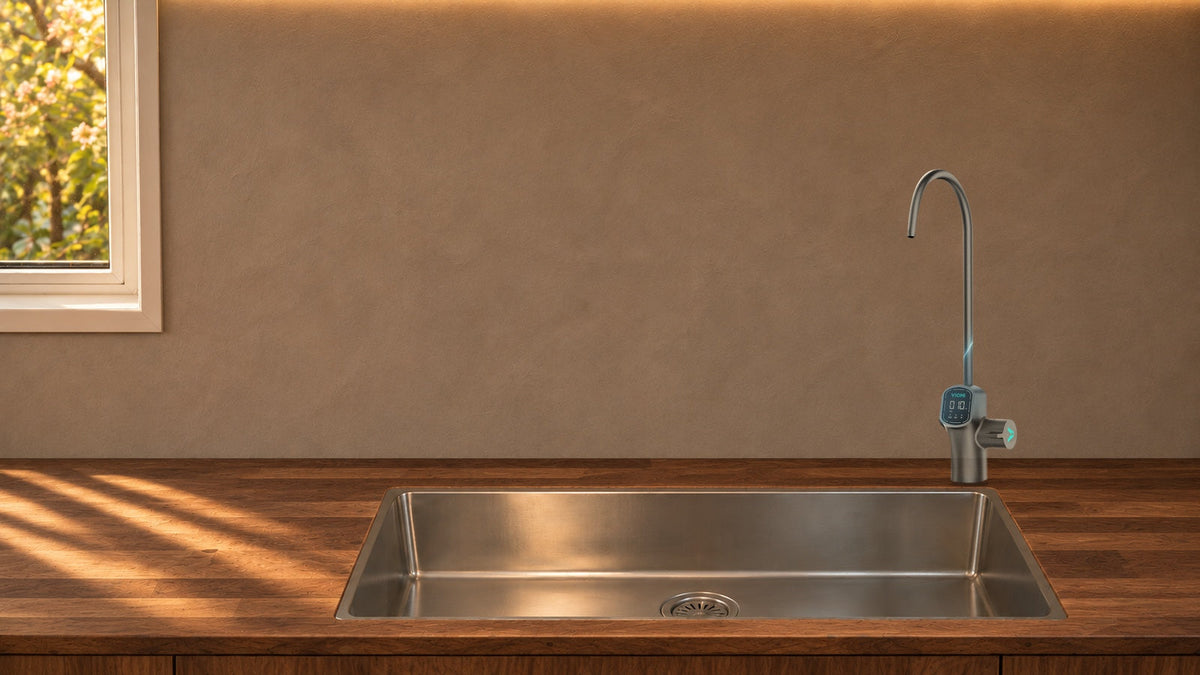
A family kitchen's busiest stretch for filtered water usually lands around dinner, when a stockpot, a kettle and the next morning's water bottles are filled within a few minutes of one another. Households that like to see the water's TDS while they pour can rely on the Viomi V8 PRO, a tankless system that produces purified water the moment the faucet opens and shows its status right on the faucet.
The standard five-stage APEC ROES-50, the version compared here, is built the other way around. Its membrane fills a pressurized storage tank between uses, so a reserve of RO water is already waiting when someone reaches for the faucet. Both are under-sink reverse osmosis systems for drinking and cooking water.
How Each System Supplies Water at Dinnertime
Tankless and tank-based RO draw on different sources when the faucet opens. On the Viomi V8 PRO, the RO membrane produces the water while the tap is open, so there is no stored amount to top up between fills. On the ROES-50, the evening's first fills come out of the tank, and the membrane refills it during the quieter hours that follow.
| What is compared | Viomi V8 PRO | APEC ROES-50 |
|---|---|---|
| How water reaches the faucet | Made by the RO membrane while the faucet is open (tankless) | Drawn from a pressurized tank that the membrane refills between uses |
| Rated output | 800 GPD (membrane rating) | 50 GPD at 60 psi and 77°F; 30 GPD at 50 psi |
| Filters and lifespans | 2 cartridges: PCB composite, 12 months; RO, 24 months | 5 filters: stages 1 to 3, 6 to 12 months; RO membrane, 2 to 4 years on city water; post-filter, 2 to 4 years |
| Under-sink pieces | One unit, 16.3 x 5 x 12.8 in | Filter assembly, 15.5 x 5.25 x 17 in, plus tank, 11 x 11 x 15 in |
The output figures in the table are daily production ratings, each on its maker's stated basis, and a daily rating is not the same thing as the flow at the faucet, so dividing one by the other does not show how fast either faucet pours.
Stored Reserve Versus Water Made at the Tap
The ROES-50 keeps its RO water in a pressurized tank beside the filter assembly, and the membrane refills that tank between uses, so the supply is topped up in the hours when the kitchen is quiet. How much the tank holds at a given time follows the home's supply pressure. Where there is room for the tank beside the filters and the household likes knowing a supply of RO water is already made, that reserve is the system's central appeal.
The Viomi V8 PRO works on demand: opening the faucet starts its pump and membrane, and purified water is made for each container as it is filled, from a single housing under the sink, which keeps the cabinet layout simple. How the two supply styles handle back-to-back fills is covered in more depth in this peak-demand comparison of tankless and tank RO.
What the Viomi V8 PRO Faucet Shows During the Rush
The Viomi V8 PRO's smart faucet displays a real-time TDS reading for the purified water along with the remaining life of both filters. Whoever is filling the pot sees the system's status at the moment they use it, without opening the cabinet or looking anything up. TDS, short for total dissolved solids, is the total amount of solids dissolved in water, such as minerals and salts, and it is the figure RO filtration brings down.
On a phone, the Viomi app adds TDS before and after filtration, a water-usage report and filter-life tracking with replacement reminders. The usage report records how much RO water the household draws over time, so a family can see how its busy evenings add up.

APEC's manual handles water monitoring as a periodic task for the ROES-50. It suggests testing the water once or twice a year and replacing the membrane when the purified water's TDS creeps up to 15 to 20 percent of the incoming water's TDS, a check done with a handheld TDS meter. In practice, that percentage works as a trigger: with incoming water at 200 ppm, for example, the membrane is due once the purified reading reaches about 30 to 40 ppm.
Filters and Cabinet Room
The Viomi V8 PRO runs on two cartridges: a PCB composite filter rated for 12 months and an RO filter rated for 24 months. A spare PCB filter ships in the box alongside the installed one, so under normal household use the system runs up to two years without buying another pre-filter. On the rated schedule, that spare goes in at month 12, and at month 24 the PCB and RO cartridges come due together, so both can be bought and changed in one sitting. Orange lights on the control panel come on 10 to 15 days before a change is due. Replacing a cartridge takes no tools, since each one twists to unlock and pulls straight out, and the full routine, cartridge by cartridge, is set out in the replacement filter guide.
Five stages make up the ROES-50: a sediment filter, two carbon blocks, an RO membrane and a coconut-shell carbon post-filter. APEC groups the first three stages into one set (FILTER-SET-ES) to be replaced every 6 to 12 months, which keeps the routine pre-filter change to a single order. The membrane lasts 2 to 4 years on city water and about 2 years on a private well, and the post-filter also lasts 2 to 4 years, with APEC advising that it be changed together with the membrane, so the two longer-cycle replacements can be handled in one session.
Under the sink, the Viomi V8 PRO keeps its filters, pump and controls in a single housing. The fittings for connecting to a standard cold-water line and the sink drain come in the box, and a step-by-step installation video covers each stage of the setup.
The ROES-50 has two pieces to place, the filter assembly and the tank, and APEC's manual suggests leaving an area of about 17 x 6 x 18 inches for the system and about 11 inches across by 18 inches tall for the tank. Its standard faucet uses a 1/2 inch hole, the optional air-gap faucet a 1 inch hole, and the drain connection a 1/4 inch hole in the drain pipe.
Households Better Matched to Each System
Readings on the faucet and reminders on the phone make the Viomi V8 PRO a good match for a busy family that wants the system's status shown without asking for it. The app's usage report adds a running record of how much filtered water the household goes through, and the spare PCB filter in the box means the first pre-filter change needs no extra order. Its single unit is 5 inches wide, and a compatible refrigerator or ice maker can be connected over standard tubing, which brings ice and chilled water into the same filtered supply. Larger households weighing other RO systems by size and daily routine can compare more options in choosing an RO water purifier for a family home.
Families who like having a supply of RO water already made will find that in the ROES-50's tank, and owners who prefer standard-sized parts get industry standard-sized filters. APEC also offers an air-gap faucet as an option for homes that want one, and an ice-maker kit can be added when ordering. Owners who already keep a handheld TDS meter will find APEC's once-or-twice-a-year water check easy to fit into that routine.
FAQ
Does the ROES-50 have an automatic shut-off valve?
It does. The ROES-50 is a storage-tank system fitted with an automatic shut-off valve, and its pressurized tank sits beside the five-stage filter assembly under the sink.
What does the 4-gallon figure on the ROES-50 tank refer to?
The "4-gallon" label describes the tank's total volume, air space included. The amount of water the tank actually takes on follows the home's supply pressure, and APEC's manual lists fills ranging from about 1.9 gallons to about 3.1 gallons across the pressures it covers. The label is best read as the size of the tank, and the fill figures as the water it actually holds.
Where does the drain water go on each system?
Both systems send the water that carries away rejected minerals to the sink drain line under the counter. The Viomi V8 PRO has a 3:1 pure-to-drain ratio, meaning three parts of purified water for each part sent to the drain. In kitchen terms, filling a 3-quart stockpot at that rating sends about 1 quart to the drain.
APEC states the ROES-50's water use with two NSF/ANSI 58 performance figures in its manual: an efficiency rating of 11.80% and a recovery rating of 25.40%. Both percentages describe how much of the incoming water ends up as RO water for the user, the efficiency rating under conditions close to typical daily use and the recovery rating with no storage tank or with the tank bypassed. They are a different measure from a pure-to-drain ratio.
Can either system supply a refrigerator or ice maker?
Both can. The Viomi V8 PRO can feed a compatible refrigerator or ice maker over standard tubing, using the tee fitting that comes in the box, so the faucet and the appliance draw from the same filtered supply. For the ROES-50, APEC offers an ice-maker kit at checkout, and its manual notes that a non-pumped system needs at least 50 psi of incoming water pressure to give an ice maker enough pressure.
What comes in the box with each system?
The Viomi V8 PRO arrives with its smart faucet, the RO filter already installed, two PCB filters (one installed and one spare) and the fittings for a standard cold-water line, including a tee for a refrigerator or ice-maker connection. The APEC ROES-50 includes its lead-free drinking faucet and the 4-gallon pressurized tank along with the five-stage filter assembly, while the ice-maker kit and the air-gap faucet are optional additions. Both packages cover the drinking faucet, so neither system calls for a separate faucet purchase before installation.
Matching the System to Your Dinner Rush
At the dinner rush, the two systems differ in where the water comes from and what the faucet shows. The Viomi V8 PRO makes each fill on demand and keeps TDS and filter life in view as the pot fills. The APEC ROES-50 pours from a tank of purified water it has already made, ready before anyone reaches the sink.
Share:
Viomi V6 PRO vs APEC ROES-50: One Box Under the Sink or a Filter Assembly Plus a Tank
Viomi M1 vs APEC ROES-50: Mineralized Tankless RO or a Basic Five-Stage Tank System