

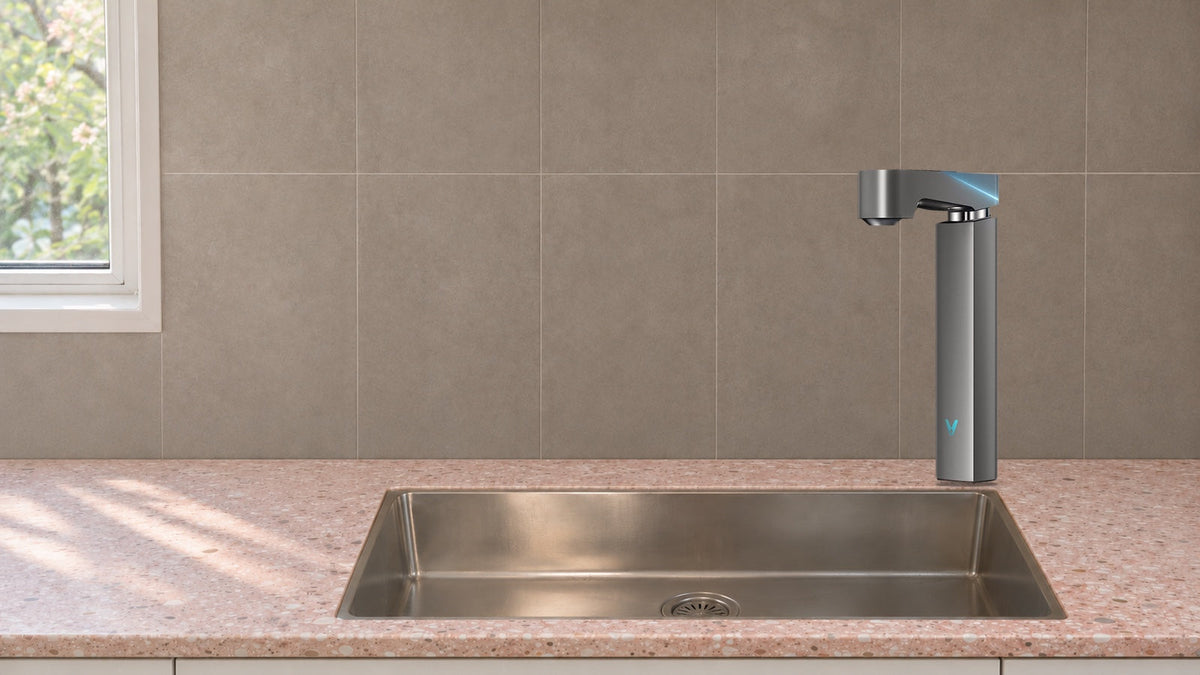
For mineralized water straight from the faucet, the Viomi M1 is the stronger fit, since this tankless purifier adds minerals back inside its own cartridge set. The APEC ROES-50 suits a household that wants plain reverse osmosis (RO) water held in a storage tank.
The APEC system covered here is the ROES-50 itself, the five-stage version of APEC's Essence line, which finishes with a carbon post filter. APEC sells mineral versions, such as the ROES-PH75, as separate models. Both systems sit under the sink and feed a dedicated drinking-water faucet. The two systems also take up the space under the sink in quite different ways, as the table shows.
Installation and Layout, Side by Side
| Viomi M1 | APEC ROES-50 | |
|---|---|---|
| System type | Tankless RO that makes water as it is drawn | Non-pumped RO with a storage tank, 4 gallons total volume (11 x 11 x 15 in) |
| Main unit size | 17.1 x 6.4 x 15.9 in (D x W x H) | 15.5 x 5.25 x 17 in (L x W x H) |
| Installation | Parts in the box and a step-by-step video; connects to the standard cold-water line and drain | Standard faucet in a 1/2 in hole or an existing spare sink hole; optional air-gap faucet |
| Filtration stages | 9, in two cartridges (PCB composite and RO) | 5: sediment, two carbon blocks, RO membrane, coconut-shell carbon post filter |
| Published output | 1000 GPD membrane rating | 50 GPD nominal, at 60 psi and 77°F |
| Cartridges and rated life | 2: PCB up to 24 months, RO up to 48 months | 5: stages 1 to 3 every 6 to 12 months; membrane every 2 to 4 years on city water; stage 5 every 2 to 4 years |
The Viomi M1 keeps everything in one main unit: its pump makes water on demand, and its filtration and mineral stages sit inside the same housing, with no storage tank beside it. It connects to the standard cold-water line and the drain, the installation parts come in the box, and a step-by-step installation video follows each connection from the cold-water line to the faucet.
APEC built the ROES-50 as a non-pumped system whose tank fills under the household's own water pressure. Its manual suggests setting aside an area of about 17 by 6 by 18 inches for the filter assembly and about 11 inches across and 18 inches high for the tank. The standard faucet needs a 1/2-inch hole, and an existing spare hole in the sink can be used instead of drilling a new one; APEC also offers an optional air-gap faucet, which takes a 1-inch hole. The faucet supplied with the system is a lead-free designer faucet.
Mineralized Water at the Tap Versus a Plain RO Pour
Reverse osmosis removes most dissolved minerals along with the other dissolved solids in tap water, which is why plain RO water reads low on a TDS meter and why some systems put minerals back afterward. Remineralization on the Viomi M1 is part of the purifier itself: the mineral media sit in the Viomi M1-PCB composite filter, which also handles the pre-filtration ahead of the membrane. After purification, six minerals go back into the water, including calcium and magnesium, and the faucet delivers low-alkaline water. When the PCB filter is changed, the mineral stage is renewed with it, so there is no separate mineral cartridge to buy or fit.
Day to day, the Viomi M1 faucet handles one-touch dispensing and preset volumes, including 10 oz and 40 oz, for a glass or a pot without watching the level. Its screen shows purified-water TDS, and because minerals are added back on purpose, that reading runs higher than standard RO water would show.

The ROES-50 delivers RO water as it leaves the membrane and storage tank. Before that, the water passes a sediment filter that removes dust, particles and rust, two carbon block filters for chlorine, taste and odor, and a high-rejection FILMTEC membrane. On its way to the faucet, it then passes the fifth stage, a 10-inch coconut-shell carbon filter that APEC describes as removing any residual taste from the tank. Some households want exactly that: purified water with nothing added back. Those who would like minerals in an APEC system choose a different model from the same line, and our overview of alkaline reverse osmosis system brands covers the wider range of mineral-stage designs.
What 1000 GPD and 50 GPD Each Measure
A tankless purifier and a tank system use their membrane ratings in different ways. In the Viomi M1, purified water is made as the faucet runs, so its 1000 GPD membrane rating is the production capacity behind each pour.
In the ROES-50, the membrane fills the tank between uses, and the water a person draws comes from that tank. APEC rates this production at 50 GPD with 60 psi feed water at 77°F, which its manual describes as about 2.08 gallons of filtered water per hour; with 50 psi feed water, the rating is 30 GPD. Those two figures show how a non-pumped design works: household water pressure drives the membrane, so the rate at which the tank refills follows the pressure in the home's supply line. The tank's 4-gallon figure is its total volume including the air space, and APEC's manual says it fills to between about 1.9 and 3.1 gallons depending on input pressure.
A third number comes from testing. WQA's NSF/ANSI 58 listing gives the ROES-50 a daily production rate of 34.8 GPD, measured under the standard's test conditions. The Water Quality Association records that result for the specific model it tested, which is why it sits alongside APEC's own rating rather than replacing it.
Keeping Each System on Schedule
Reminders do the tracking on the Viomi M1. The faucet screen and the Viomi app show how much life each filter has left, and the app sends a notification when one is due. With the RO filter rated for up to 4 years and the Viomi M1-PCB filter for up to 2 years, those notifications come around rarely, and each swap, including the Viomi M1-PCB replacement filter that carries the mineral media, is tool-free, since a cartridge twists out and the new one twists in.
Between changes, the same faucet screen shows tap-water and purified-water TDS as water is drawn, and the app adds inlet water temperature and a record of water usage, which helps a household see how much purified water it uses over a week or a month.
The ROES-50 runs on five cartridges, and APEC builds the system around industry-standard filters and parts. APEC's manual calls for replacing the three pre-filters every 6 to 12 months (sold together as FILTER-SET-ES), the RO membrane every 2 to 4 years on city water, and the stage-5 carbon filter every 2 to 4 years, ideally at the same time as the membrane. Across four years on city water, those published intervals add up to four to eight pre-filter set changes and one or two membrane-and-post-filter changes on the ROES-50, while the Viomi M1's rated lives give two PCB changes and one RO change over the same stretch.
The Case for a Basic Tank System
The ROES-50 is a natural choice for owners who want a reserve of purified water held in a tank, and those who like working with industry-standard filters and parts, with the three pre-filters sold together as one set so the routine replacement is a single order.
Plain RO water is the other reason. A household that simply prefers purified water with nothing added back gets exactly that from the five-stage design. APEC's optional air-gap faucet and an ice-maker kit offered at checkout round out the setup for kitchens that need them; APEC notes that feeding an ice maker from its non-pumped system calls for at least 50 psi of input pressure.
FAQ
Does APEC make a remineralizing version of this system?
It does. APEC's Essence line includes the ROES-PH75, which APEC sells separately from the ROES-50. Our article on the APEC ROES-PH75 looks at that model in more detail.
Why does the ROES-50 have both a 50 GPD and a 34.8 GPD figure?
The two numbers come from different conditions. APEC's 50 GPD rating assumes 60 psi feed water at 77°F, and the same page gives 30 GPD at 50 psi. The 34.8 GPD figure is the daily production rate in WQA's NSF/ANSI 58 listing for the ROES-50, recorded under that standard's test protocol. Each figure is accurate for the conditions it describes, and none of them is a faucet flow rate.
Can the Viomi M1 feed a refrigerator or ice maker?
The Viomi M1 connects to a compatible refrigerator or ice maker through standard tubing, and the box includes a tee fitting for the branch line. Once the line is in place, turning on Multi-device Mode in the Viomi app sets the system up to supply both the faucet and the appliance. For general planning, our guide to connecting a refrigerator to an RO system covers the tubing route.
Does the Viomi M1 flush itself?
It does. Automatic flushing is part of the Viomi M1's normal operation, so routine rinsing happens on its own during everyday use, while the faucet and app keep track of filter life.
Can the ROES-50 faucet use a hole that is already in the sink?
APEC's manual notes that no new hole is needed if the sink already has a spare one available. Its standard faucet uses a 1/2-inch opening, and the optional air-gap faucet needs a 1-inch hole.
How does each system signal that cartridges are due?
On the Viomi M1, the signal comes to the owner: remaining life shows on the faucet and in the app, and an app notification arrives when a filter is due. The ROES-50 relies on APEC's replacement intervals plus a simple check, since its manual suggests testing the water with a TDS pen once or twice a year and replacing the membrane once the product water's TDS climbs to 15 to 20 percent of the input water's TDS.
What Ends Up in the Glass
Both systems end at a dedicated drinking-water faucet, and the biggest difference is what reaches the glass. The Viomi M1 delivers mineral water made on demand by one compact unit, with filter life shown on the faucet and reminders sent to the phone. The ROES-50 delivers plain RO water from a tank, and its industry-standard filters suit owners used to replacing a pre-filter set once or twice a year.
Share:
Viomi V8 PRO vs APEC ROES-50: On-Demand Output or a Stored Reserve for Family Peaks
Viomi V8 PRO vs Waterdrop G3P800: Matching 800 GPD Ratings, Different Cartridges and Extras