

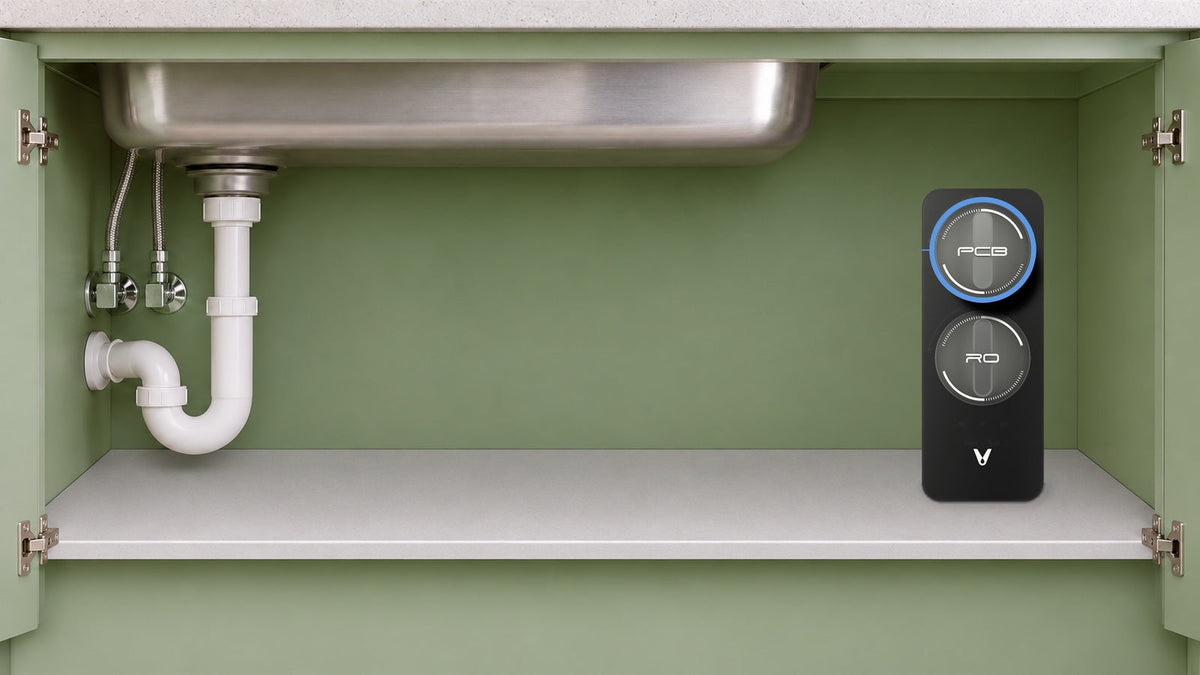
The pieces that have to fit under the sink differ between these two systems: a tankless reverse osmosis (RO) system stands in the cabinet as a single unit, while a conventional tank system needs room for a filter assembly and a separate storage tank. Tight cabinets that should stay free of a storage tank are where the Viomi V6 PRO makes the most sense, because its filters, pump and controls all live in one body just 5 inches wide.
The APEC ROES-50 belongs in a different kitchen: one with open floor beside the drain for its 4-gallon tank, since this five-stage system stores its water in that tank and fills it under household water pressure. Its filters come in industry-standard 10-inch sizes.
What Each System Puts in the Cabinet
The filtration side of the Viomi V6 PRO sits in one box: both cartridges, and with them all 9 stages of filtration, are inside the unit, so no separate storage tank needs a place on the cabinet floor.
The ROES-50, the basic five-stage model in APEC's Essence series, places two main components in the cabinet: the filter assembly and the pressurized storage tank that ships with it. For planning the layout, its manual suggests an area slightly larger than the parts themselves, about 17 by 6 by 18 inches for the system and a spot about 11 inches across and 18 inches high for the tank.
| Under-sink requirement | Viomi V6 PRO | APEC ROES-50 |
|---|---|---|
| Pieces placed in the cabinet | One tankless unit | Filter assembly plus a storage tank |
| Published size | 16.3" L × 5" W × 12.8" H | System 15.5" L × 5.25" W × 17" H; tank 11" × 11" × 15" |
| Rated output and its basis | 600 GPD membrane rating | 50 GPD nominal rating |
| Filters and rated replacement | Two cartridges: PCB every 12 months, RO every 24 months | Five filters: stages 1 to 3 every 6 to 12 months; membrane every 2 to 4 years on city water; stage 5 every 2 to 4 years |
The two filter bodies are close in width, 5 inches against 5.25 inches, so the difference in floor space comes almost entirely from the tank, an 11-inch-square footprint that needs its own place on the cabinet floor. Worked out as floor area from the published sizes, each filter body covers a rectangle of roughly 81.4 to 81.5 square inches, and the tank adds a rectangle of 121 square inches, more than the filter assembly itself. Height differs as well. At 12.8 inches, the Viomi V6 PRO stays well under the 17-inch ROES-50 assembly, which helps beneath a deep single-bowl sink, where the bowl drops several inches into the cabinet right where a unit would stand.

Production Ratings on a Tankless and a Tank System
A tankless system makes water at the moment the faucet opens, and a tank system makes it ahead of time and stores it. Their daily production ratings are published on different bases, and neither one translates into how quickly the faucet pours.
On the Viomi V6 PRO, 600 GPD is the rating of the membrane that makes water while the faucet is open, pushed by the internal pump. Water is made on demand, and the 3:1 pure-to-drain ratio means three cups of purified water for every cup sent to the drain.
Between uses, the ROES-50's membrane fills the storage tank, and the faucet pours from that stored water. APEC gives the system a nominal 50 GPD under its standard rating conditions and 30 GPD at lower household pressure. A third figure, 34.8 GPD, is the daily production rate recorded in the Water Quality Association's test listing for the system.
The tank itself has two sizes worth knowing. The 4-gallon figure is the tank's total volume, air space included, and the manual puts the water it actually holds at roughly 1.9 to 3.1 gallons, depending on the home's water pressure. That stored supply is ready the moment the faucet opens. Households weighing the two designs across other brands as well can find them compared model by model in our tankless vs. tank-based RO comparison.
Filter Changes: Two Cartridges or Five Staged Filters
Upkeep on the Viomi V6 PRO involves two cartridges, each with a rated interval. Counted from installation, the PCB composite cartridge is rated for 12 months and the RO cartridge for 24, so on the rated schedule a PCB change is planned at the one-year mark and both cartridges are planned together at the two-year mark. The old cartridge twists to unlock and pulls straight out, the new one goes in the same way, and a filter-life reset completes the change. No tools are involved at any point. Because each countdown starts on installation day, the replacement cartridge can be ordered ahead of time, before the orange light comes on.
Keeping track of the due date is handled by the system. Every time the faucet is used, its display shows the remaining filter life beside the live TDS reading. When a change gets close, the control panel turns orange 10 to 15 days ahead, and the Viomi app sends its own replacement reminder.
The ROES-50 groups its five filters into two kinds of change. The frequent one swaps the three pre-filters, a sediment filter and two carbon blocks, as a single set every 6 to 12 months. The less frequent one pairs the membrane with the coconut-shell carbon filter in stage 5, which the manual suggests changing together every 2 to 4 years on city water, with about 2 years for the membrane on private well water. All of these are built to industry-standard sizes.
For timing the membrane, APEC's manual relies on a water test: it suggests checking the water with a TDS meter once or twice a year and replacing the membrane when the TDS of the purified water climbs to 15 to 20 percent of the TDS coming in. Households that prefer to time membrane changes by their own test readings will find that routine suits them.
Faucet, Drain and Appliance Connections
The Viomi V6 PRO comes with its smart faucet, the fittings for the cold-water line and the drain, and a tee fitting that opens a second supply line. A step-by-step installation video walks through the setup. The system draws its feed from a standard cold-water line and connects to the sink drain. Through that second line, a compatible refrigerator or ice maker can be fed with standard tubing, so one unit serves both the faucet and the appliance. Our under-sink RO installation and maintenance guide covers what the connections look like in a typical kitchen.
On the ROES-50, the lead-free faucet and the 4-gallon tank come in the box. The standard faucet mounts in a 1/2-inch hole, and an existing spare hole in the sink deck can take it without drilling. APEC also offers an optional air-gap faucet, which needs a 1-inch hole. Its drain line connects at a 1/4-inch hole in the drain pipe, and an ice-maker kit is available as an option when ordering.
Cabinet Layouts That Favor Each System
The Viomi V6 PRO fits a cabinet where the free space is a narrow strip beside the drain trap or the disposer, or where a deep sink bowl leaves little height. It also suits a household that would like the system to keep track of its own upkeep, so that a glance at the faucet while filling a glass is enough to know where the filters stand. Where the refrigerator should get purified water too, the same single unit can supply it.
A wide cabinet with open floor on both sides of the drain is where the ROES-50 settles in most easily, since an 11-inch-square tank has a natural place there. Households that like having two to three gallons of purified water already waiting, or that want filters in standard 10-inch sizes, will find those built into its design.
FAQ
Where does the ROES-50 storage tank go in the cabinet?
The tank stands on the cabinet floor next to the filter assembly, connected by tubing, so it can sit on whichever side of the drain has room. APEC's manual suggests leaving a spot about 11 inches across and 18 inches high for it, a little more than the tank's own 11 by 11 by 15 inches.
How does the ROES-50 tank fill?
The ROES-50 is a non-pumped system, and its tank fills using the pressure of the incoming water. Between uses, the membrane sends purified water into the tank until it is full, and the system's automatic shut-off valve then stops production. When the faucet opens, the stored water passes the stage-5 coconut-shell carbon filter on its way out.
Does the ROES-50 come with an air-gap faucet?
The faucet in the box is a standard, non-air-gap model that mounts in a 1/2-inch hole. APEC offers an air-gap faucet as an option, and the manual covers its installation separately; it takes a 1-inch hole in the sink deck or countertop instead of the standard 1/2-inch one, so the choice is worth making before any drilling starts.
What runs inside a tankless unit like the Viomi V6 PRO?
Inside its single body, a booster pump pushes water through the membrane while the faucet is open, and the system runs an automatic rinse every 12 hours. Up on the counter, the faucet display shows live TDS and filter-life readings, while the orange light on the control panel and, once the unit is connected to Wi-Fi, the Viomi app take care of filter reminders.
A Short Checklist for the Sink Cabinet
- Floor space beside the drain trap matters most in a tight cabinet: a single 5-inch-wide unit fits a narrow strip, while a filter assembly and an 11-inch-square tank each need their own spot. Our guide to measuring a small kitchen for RO goes further into how sink cabinets are laid out.
- Two to three gallons of purified water standing ready in a tank is part of the ROES-50 design, while the tankless unit makes each glass as it is drawn.
- Maintenance timing works differently on the two systems: the Viomi unit shows filter life on its faucet and lights orange before a change, while the ROES-50 follows APEC's published intervals, with a TDS test once or twice a year to judge the membrane.
- A refrigerator or ice maker on the same water line is easiest to plan for at the start, while the spot for the system is still open.
Share:
Viomi M1 vs Waterdrop G5P700A: Pot Fills, Ice Makers and Mineral Cartridges
Viomi V8 PRO vs APEC ROES-50: On-Demand Output or a Stored Reserve for Family Peaks