

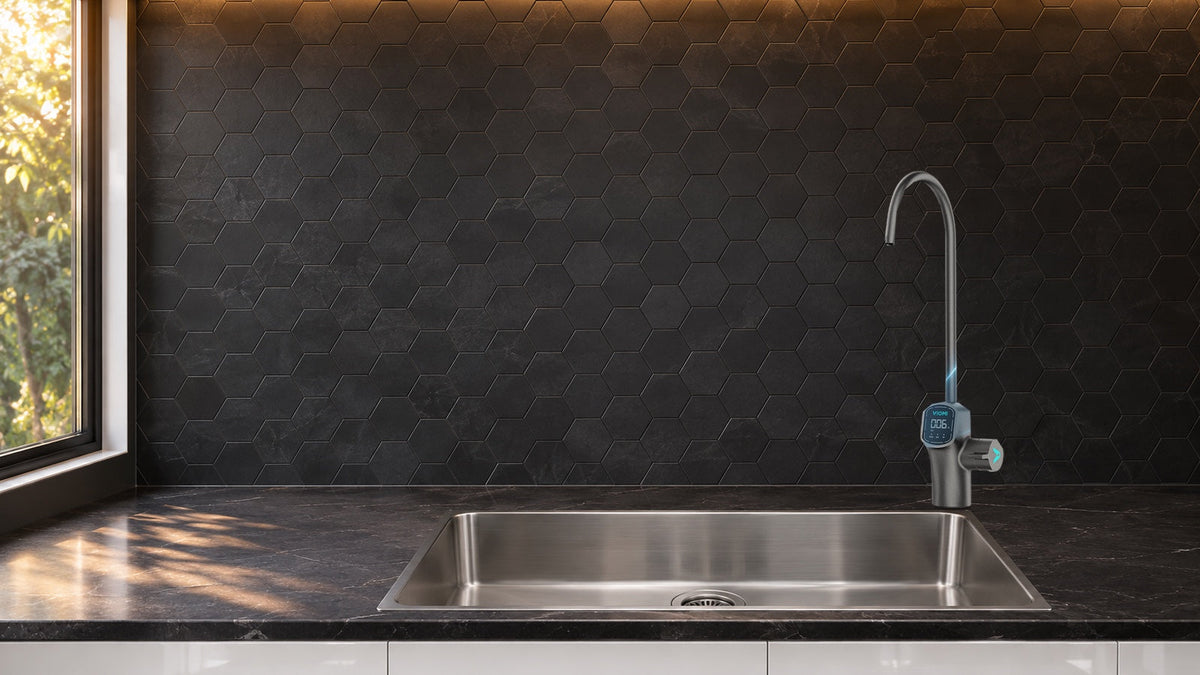
The 600 GPD and 800 GPD ratings on these two tankless reverse osmosis (RO) systems give a household two figures to weigh: the lower one on a compact unit, the higher one on a taller system that also carries a UV stage. For a compact kitchen used for everyday drinking and cooking, the Viomi V6 PRO fits well, with a body 5 inches wide and a smart faucet that shows TDS and filter life.
The Waterdrop G3P800 carries the higher rating, and its standard package includes a UV sterilizer that sits between the purified-water outlet and the faucet.
Daily Demand Behind 600 and 800 GPD
Both figures are rated daily output published by each brand. The Viomi V6 PRO figure is the rating of its RO600 membrane, and Waterdrop's manual describes 800 GPD as the G3P800's maximum daily production rate, measured at 30 psi dynamic feed pressure and 77°F water temperature.
The two systems share the same 3:1 pure-to-drain ratio, which means each is rated to send about one quarter of its incoming water to the drain, or about a third of a gallon for every gallon of purified water.
In many households the RO faucet fills drinking glasses and bottles, a coffee maker, a kettle and the pot for the evening meal. Other kitchens cook in volume, fill several big containers back to back or run the RO faucet for long stretches at once, and a household in that second group may put more weight on the G3P800's additional 200 GPD of rated output.
For a household that likes this compact design but would rather have an 800 GPD rating, Viomi's own option is the Viomi V8 PRO, which shares the Viomi V6 PRO's 16.3 by 5 by 12.8 inch body.
Published Specs for Both Systems
| Spec | Viomi V6 PRO | Waterdrop G3P800 |
|---|---|---|
| Model compared | VM-V6 Pro | WD-G3P800-W-FC (standard package) |
| Rated output | 600 GPD | 800 GPD |
| Pure-to-drain ratio | 3:1 | 3:1 |
| Filtration stages | 9 | 10 |
| Cartridges | 2: PCB composite and RO | 3: CF, RO and CB |
| Rated cartridge life | PCB 12 months; RO 24 months | CF 6 months; CB 12 months; RO 24 months |
| Faucet display | TDS and filter life | TDS and filter life |
| Unit size (L × W × H) | 16.3 × 5 × 12.8 in | About 18.1 × 5.7 × 17.7 in |
The ratio and faucet display rows are the same on both, so on paper neither design sends a larger share of its water to the drain, and both show TDS and filter life where the water is poured. The 9 and 10 stage counts are each brand's published figures, and the number of stages alone is not a score for the water that comes out.
The UV Stage Packed With the G3P800
The G3P800's standard package ships with a preinstalled UV sterilizer assembly, and it is the feature that most clearly sets this Waterdrop system apart. In Waterdrop's manual, the sterilizer connects between the system's filtered-water port and the faucet. It draws power from the main unit and switches on only when the faucet is open and water is flowing. It is part of the standard WD-G3P800-W-FC package, so the version compared here includes it.
Waterdrop says the sterilizer reduces up to 99.9% of bacteria and uses a long-life LED that needs little to no maintenance. A household that wants a UV step at the end of the line, after the RO membrane and the carbon block, gets it in the G3P800 box.
Filter Schedule: Two Cartridges Against Three
The Viomi V6 PRO is a 9-stage system that runs on two cartridges, a PCB composite filter and an RO600 membrane. The PCB filter is rated for 12 months and the membrane for 24 months. At those rated lifespans, the first year brings one cartridge change, at month 12, and the second year a single visit at month 24 when both cartridges are replaced together. Orange lights on the control panel come on 10 to 15 days before each change, the faucet shows remaining filter life, and the Viomi app sends a replacement reminder. The same app shows TDS before and after filtration and keeps a water usage report, which shows how much purified water the household draws and how that use changes over time.
The G3P800 uses three cartridges in sequence: a CF filter that combines pre-sediment and carbon block stages, the RO membrane, and a CB activated-carbon block after it. Waterdrop rates the CF for up to 6 months, the CB for up to 12 months and the RO membrane for up to 24 months. Planned at those lifespans from the filters installed on day one, the first year brings a CF change at month 6 and a CF and CB change at month 12. In the second year, the CF comes due again at month 18, and month 24 brings all three together. Each cartridge has a distinct job in that sequence: the CF catches sediment and treats the water before the membrane, the RO membrane does the main purification, and the CB carbon block polishes the water on its way out. The faucet and the front panel both track the life of each cartridge, so the three schedules stay visible from the sink and the main unit. Both RO membranes carry a 24-month rating, so over two years the difference between the two routines comes from the pre-filter and carbon stages.
Over two years, that adds up to two change dates on the Viomi V6 PRO and four on the G3P800. Our look at the maintenance workload of different water filters breaks down what each kind of routine involves.
Viomi V6 PRO cartridges use a tool-free twist-lock design, and a filter-life reset after each change restarts the countdown on the faucet and in the app.
Setup Needs in a Compact Kitchen
Both systems are tankless, purifying water as the faucet runs, so neither one needs cabinet room for a storage tank. Both connect to the cold-water line under the sink and to the sink drain, and Waterdrop notes that the G3P800 faucet can use an existing soap-dispenser opening. On the G3P800, the main unit also powers the UV sterilizer.
The smart faucet and a tee fitting come in the Viomi V6 PRO box, and the tee lets the system also feed a compatible refrigerator or ice maker over standard tubing. A step-by-step installation video covers its setup from the cold-water connection to the first flush.
Cabinet height is where compact kitchens feel the size difference most. The Viomi V6 PRO stands 12.8 inches high and the G3P800 about 17.7 inches, so a cabinet with a deep sink bowl or a low-hanging disposer may have room for one and not the other. Our overview of compact reverse osmosis systems by footprint compares the footprints of more slim units.

Higher Rated Output and UV on the G3P800
The G3P800 is rated at 800 GPD, the higher of the two ratings, which matters to households that weigh rated output first. Anyone who wants UV treatment built into the package will also find it here, since the sterilizer comes in the box and runs from the main unit's power.
The G3P800 also has a front-panel screen that shows TDS and filter-life indicators on the main unit, in addition to the faucet display. Waterdrop says its faucet has a quantitative dispensing function, so a set amount of water can be drawn without standing at the tap. Its three cartridges can each be replaced on their own schedule, the CB carbon block every 12 months and the CF pre-filter every 6. For households that want mineral-added or alkaline water, Waterdrop sells the system in bundles with its external MNR35 remineralization filter or ALK35 alkaline filter. Waterdrop rates the MNR35 for 12 months or 1,100 gallons and the ALK35 for up to 6 months, with a pH range of 7.5 to 9.5. Within Viomi's lineup, the same need is met by the Viomi M1, an RO system whose PCB composite filter handles remineralization.
FAQ
Is 600 GPD enough for cooking?
Divided across the 1,440 minutes in a day, 600 GPD works out to about 0.42 gallons per minute, and 800 GPD to about 0.56 gallons per minute. Both figures are converted from the rated daily output. For everyday drinking and cooking, including the pot for the evening meal, those converted figures give a sense of scale, though neither is a measured faucet flow. Our guide to filling a cooking pot from an RO faucet looks at how the rating relates to pot filling in a real kitchen.
Does the UV sterilizer change the G3P800's filter schedule?
The cartridge schedule stays with the CF, CB and RO filters at 6, 12 and 24 months. The UV sterilizer is a separate preinstalled assembly between the main unit and the faucet, powered by the main unit and switched on only while water is flowing.
What separates the Viomi V6 PRO from the Viomi V8 PRO?
Many specifications match. Both use the same 16.3 × 5 × 12.8 inch body, the same smart faucet with TDS and filter-life display, the same app, a 3:1 ratio and nine stages, and both rate the PCB filter at 12 months and the RO filter at 24 months. The difference sits in the membrane, 600 GPD on the Viomi V6 PRO and 800 GPD on the Viomi V8 PRO, and in the Viomi V8 PRO box, which includes a spare PCB filter. Both models also take the same PCB filter, so the pre-filter is the same replacement part on either one.
Which dimension separates the two boxes most?
Using the published figures, the G3P800 is about 1.8 inches longer, 0.7 inches wider and 4.9 inches taller than the Viomi V6 PRO. On the cabinet floor, that means about 18.1 by 5.7 inches for the G3P800 against 16.3 by 5 inches for the Viomi V6 PRO. Length and width differ by less than 2 inches each, which makes height the dimension most likely to decide the fit.
Modest Demand and a Compact Cabinet, in Brief
In a compact kitchen with modest daily use, the deciding numbers are height and demand. The Viomi V6 PRO stands 12.8 inches tall and is rated for 600 GPD, with one cartridge change in its first year. The G3P800 brings an 800 GPD rating and a UV sterilizer in the box, and its taller body needs a cabinet with the height for it.
Share:
Viomi M1 vs Waterdrop G5P500A: Matching Output and Monitoring to Your Household
Viomi V8 PRO vs iSpring RCC7AK: Filter Reminders at the Faucet or a Tank System With a Mineral Stage