

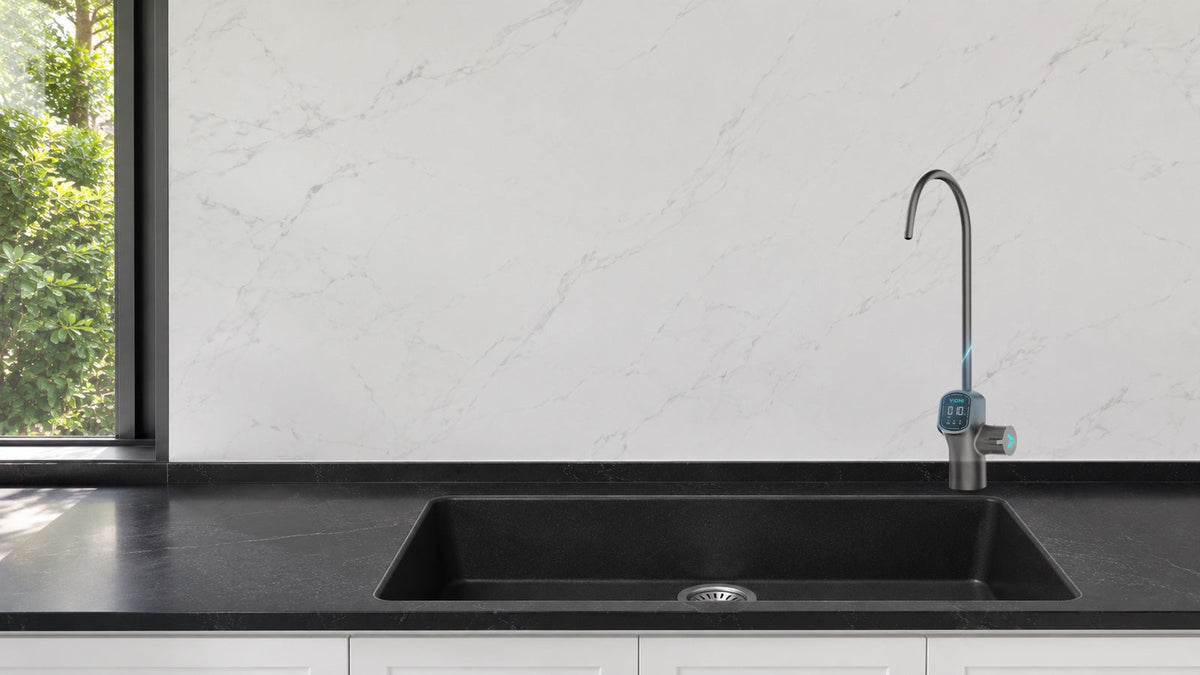
Someone in every RO household has to know when the filters are due. Families that want filter life and the water's TDS shown right on the faucet, with replacement reminders on a phone, will find the Viomi V8 PRO a good choice, because the tankless system counts down its own filter life and flags each change well ahead of time.
The iSpring RCC7AK adds calcium and magnesium back in a sixth, alkaline stage, and keeps a 3.2-gallon tank of RO water ready, filled by household water pressure. The model compared here is the standard RCC7AK with no suffix; iSpring sells the RCC7AK-UV, the pumped RCC7P-AK and other variants as separate models.
A Filter Countdown From the Faucet to the Phone
On the Viomi V8 PRO, the smart faucet shows a real-time TDS reading for the purified water together with the remaining life of the PCB and RO filters, so anyone filling a glass sees both at the same moment. Each of the two filters has its life counted against its own rated interval. Inside the cabinet, orange lights on the control panel come on 10 to 15 days before a change is due, which leaves enough time to have the new cartridge on hand and ready. In practice, whoever is at the sink reads filter life on the faucet, family members away from the kitchen can follow it in the app, and the panel's orange lights give the advance signal inside the cabinet.
The Viomi app carries the same information beyond the kitchen. On a phone, it shows TDS before and after filtration, keeps a water-usage report and tracks filter life with replacement reminders. Seeing the incoming and purified TDS side by side shows how much the system is bringing the reading down, and the usage report shows how much purified water the household draws, so the family can look back over its use from week to week and month to month as the usage record builds.
Behind the countdown are the rated lifespans: the PCB filter is rated for 12 months and the RO filter for 24 months. The Viomi V8 PRO also ships with a second PCB filter in the box, one installed and one spare, ready for the first scheduled change. The first PCB change is therefore covered from day one, and the system runs up to two years without buying another pre-filter under normal household use. A wider look at how replacement dates line up across a year is in the filter-life replacement planner.

Output and Filters Side by Side
| What is compared | Viomi V8 PRO | iSpring RCC7AK |
|---|---|---|
| Published output | 800 GPD (membrane rating) | 75 GPD (stated daily capacity) |
| Filters and lifespans | 2 cartridges: PCB composite, 12 months; RO, 24 months; spare PCB in the box | 6 cartridges: sediment, GAC, carbon block, post-carbon and alkaline stages every 6 to 12 months; RO membrane every 2 to 3 years |
The Viomi V8 PRO uses two cartridges, with the PCB composite filter handling pre-filtration in a single unit ahead of the RO filter. The RCC7AK gives each of its six stages a cartridge of its own. In iSpring's description, the sediment, granular carbon and carbon block stages deal with particles, chlorine, taste and odor ahead of the RO membrane, a post-carbon filter removes any residual taste from the tank, and the alkaline stage adds minerals back at the end.
Between changes, the Viomi V8 PRO also handles its own routine rinsing. Every 12 hours it opens the inlet valve for a 70-second flush without running the pump, and the rinse water goes out through the drain line, so the system keeps up this step with nobody at the sink.
Tankless Production Versus a Pressurized Tank
The Viomi V8 PRO is tankless: its pump and RO membrane make purified water on demand when the faucet opens. The RCC7AK pours from its 3.2-gallon pressurized tank, and the membrane refills that tank between uses; once the tank is full, the system shuts off automatically until water is drawn again.
On output, the Viomi V8 PRO carries an 800 GPD membrane rating, while iSpring states that the RCC7AK can filter up to 75 gallons per day. GPD stands for gallons per day, the amount of purified water a membrane or system is rated to produce over 24 hours on its maker's stated basis. Both are daily production figures, so their ratio is not a comparison of how fast either faucet pours.
In daily terms, the tank layout means a supply of RO water is already made when the faucet opens, with the tank taking its own place in the cabinet beside the filter assembly. The tankless layout keeps the filters, pump and controls in one housing under the sink, and what reaches the glass does not depend on how much water was stored beforehand. For a closer look at how the two layouts compare across brands, see the comparison of tankless and tank-based RO brands.
Minerals and Stored Water on the RCC7AK
The RCC7AK's sixth stage, the FA15 alkaline filter, sits after the RO membrane and post-carbon filter and comes pre-installed on the machine head. iSpring puts the calcium and magnesium it adds at about 30 to 60 mg/L. For a household that prefers a mineral taste after RO, that stage is part of the system from the first day, with nothing extra to fit, so the mineral stage is a standard part of every RCC7AK instead of an add-on. Other brands' mineral stages are compared in RO remineralization filter brands. For a family that wants minerals together with readings on the faucet, the Viomi M1 is Viomi's tankless model that adds minerals back after RO purification.
iSpring describes the 3.2-gallon tank as a pressurized holding tank. It gives the RCC7AK a reserve of RO water that is ready before anyone opens the faucet. After installation, the first full tank is drained, and from then on the membrane keeps it filled between uses.
What Each Installation Involves
Filters, pump and controls share one housing on the Viomi V8 PRO, and the fittings for a standard cold-water line and the sink drain come in the box, with an installation video that walks through each step.
The RCC7AK's faucet kit fits a range of existing holes: the bottom-mount kit is made for holes from 1/2 to 1-1/2 inches, and the top-mount kit for holes from 3/4 to 1-1/4 inches. A faucet bracket is also enclosed for homes that would like to avoid drilling the counter. The drain saddle takes a 1/4 inch hole in the drain pipe, placed before the P-trap, and the tank sits beside the filter assembly in the cabinet.
Who Each System Is Built For
For a family that would like the filter schedule handled by the system itself, with the countdown and the TDS reading shown on the faucet and reminders sent to a phone, the Viomi V8 PRO is the closer match in a single slim tankless unit. The spare PCB in the box also means the first pre-filter change needs no separate order.
The RCC7AK makes more sense where the priorities are minerals added back after RO and a stored reserve of water. Its replacement schedule is laid out by interval, with iSpring's filter sets grouped by timeframe, which suits owners who like to plan changes on a fixed schedule. Because each of its six stages has a cartridge of its own, every stage can be replaced on its own interval, and the 1-, 2- and 3-year sets let a household buy filters for a longer stretch in one larger order. It also suits a cabinet where the tank has room to sit beside the filters, and its alkaline stage arrives already installed on the machine head.
FAQ
How do RCC7AK owners know when filters are due?
For the RCC7AK, iSpring publishes a replacement interval for each stage: every 6 to 12 months for the sediment, GAC, carbon block, post-carbon and alkaline filters, and every 2 to 3 years for the RO membrane. iSpring also sells filter sets named by timeframe, covering 6 months, 1 year, 2 years and 3 years, and its manual recommends testing the water's TDS periodically to confirm the system is performing properly. The sets describe a period of supply, while each cartridge inside still follows its own published interval.
What comes in the box for installing each system?
The Viomi V8 PRO ships with its smart faucet and the fittings for a standard cold-water line, including a tee for connecting a compatible refrigerator or ice maker, and Viomi's step-by-step installation video follows each stage of the setup. The RCC7AK comes with faucet mounting kits for a range of existing sink holes, a faucet bracket for counters that will not be drilled, a drain saddle and its 3.2-gallon tank, and iSpring sells an ice-maker kit separately.
Why does the RCC7AK have both a 75 GPD and a 21.04 gpd figure?
The 75 GPD figure is iSpring's stated daily capacity. The 21.04 gpd figure is the daily production rate in the NSF listing for the RCC7AK under NSF/ANSI 58, which comes from testing under the standard's conditions. The two are different measurements of the same system, and neither describes how fast water leaves the faucet.
What happens if more than 3.2 gallons are drawn at once from the RCC7AK?
According to iSpring, the tank holds 3.2 gallons, and if more than that is used at one time, the flow slows down but water still comes out. The membrane then refills the tank, and the system shuts off automatically once the tank is full.
How does each system connect to a refrigerator or ice maker?
The Viomi V8 PRO connects to a compatible refrigerator or ice maker over standard tubing, using the tee fitting that comes in the box, so the faucet and the appliance share the same filtered supply. For the RCC7AK, iSpring describes the system as compatible with most fridges and sells an ice-maker kit (ICEK) for the connection.
Is the RCC7AK's mineral cartridge replaced along with the other filters?
The FA15 alkaline filter follows the same 6 to 12 month interval as the sediment and carbon stages, so it can be changed in the same session. Only the RO membrane runs on a longer cycle, at 2 to 3 years, which makes it the one cartridge that is left in place during most routine changes.
Share:
Viomi V6 PRO vs Waterdrop G3P800: Which Fits a Compact Kitchen With Modest Water Demand?
Viomi V6 PRO vs iSpring RCC7AK: Two Cartridges With Advance Alerts or Six Stages on Their Own Schedules