

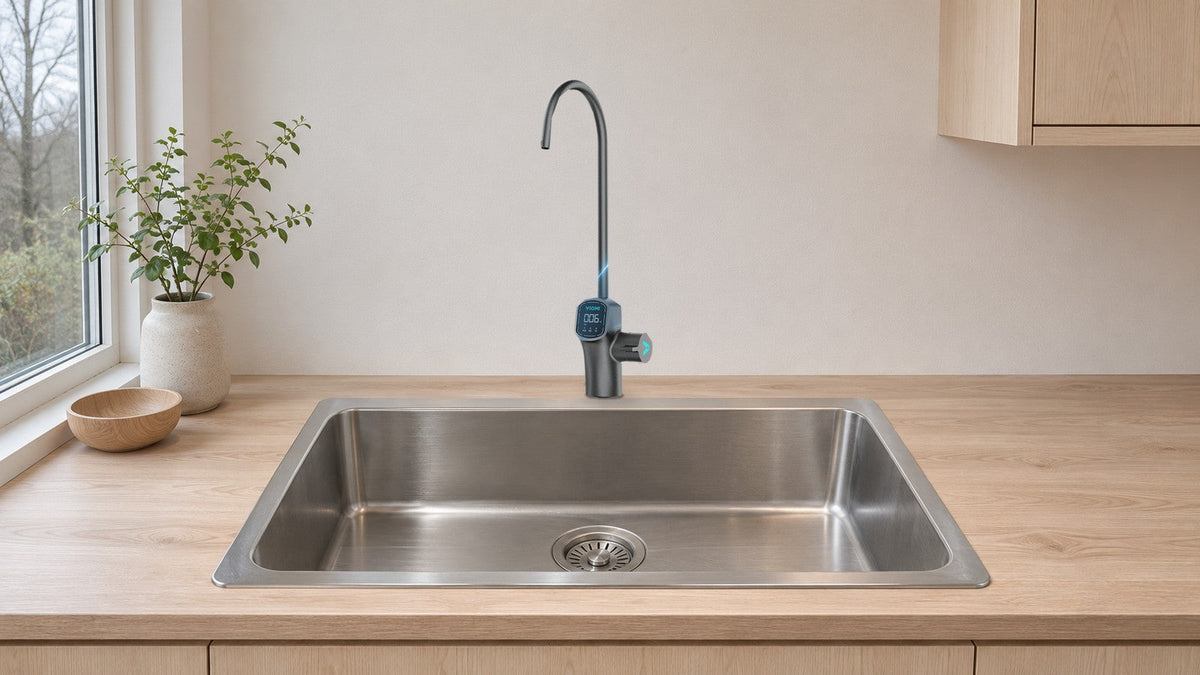
A cartridge change on a quick-change tankless RO system is a few tool-free steps at the cabinet followed by a rinse the system runs on its own, and around those changes sits the job of knowing when the next one is due. On the Viomi V8 PRO, that job is handled by the system: the faucet shows filter life, and an orange control-panel indicator comes on 10 to 15 days before a change, so nobody has to keep a date in mind.
The work therefore splits three ways: hands-on steps, waiting while the system rinses, and keeping track between changes. Each one can be measured separately.
Hands-On Work, Waiting and Keeping Track
Anything that needs a person at the cabinet counts as hands-on work: closing the water supply, releasing pressure, removing the old cartridge, seating the new one, pressing a reset button. How long it runs depends on how the filter is built. A cartridge that unlocks with a twist takes a few motions. A system built from screw-on housings adds a wrench, a sink full of parts to wash and a seal to inspect each time.
Then comes time the system spends working on its own, such as the rinse that follows a new cartridge or a storage tank refilling. It shows up on the clock but asks almost nothing of the person standing nearby. A kettle can boil or a dishwasher can be emptied while it runs.
Between changes sits the quiet work of keeping track: knowing which cartridge is next, when it falls due, and having the replacement in the house on the day. A filter with no signal of its own leaves that job with the household all year, while a system that counts down filter life and warns in advance takes most of it over.
The three kinds of effort rarely line up. A pitcher cartridge is quick to swap and comes due several times a year, which keeps the tracking job busy. An RO membrane comes due rarely, which puts a long gap between one change and the next. Brand-by-brand differences in reminders and replacement frequency are laid out in Which Water Filter Brands Are Easiest to Maintain?.
One Cartridge Change: Which Steps Are Hands-On
The Viomi V6 PRO and the Viomi V8 PRO share a cartridge design and a manual, so the same sequence covers both models and both of their cartridges, the PCB and the RO.
| Step | What happens | Hands-on or waiting |
|---|---|---|
| 1 | Close the feed water adapter and switch off power to the main unit | Hands-on |
| 2 | Open the purified-water faucet for about five seconds to release pressure and let residual water out | Hands-on |
| 3 | Twist the old cartridge to unlock it and pull it out | Hands-on |
| 4 | Insert the new cartridge, press it in and rotate it 90 degrees until the handle locks | Hands-on |
| 5 | Restore water and power, select the indicator for that cartridge and hold Reset for three seconds | Hands-on |
| 6 | The system runs its 70-second rinse and shows progress from 1 to 100 on the faucet | Waiting |
| 7 | The flush continues until the water runs clear, and then the faucet is turned off | Waiting while it runs; turning it off is hands-on |
Five of the seven steps are fully hands-on, the seventh ends with turning the faucet off, and none of them needs a tool. Nothing has to be washed or resealed, because the filter media and its shell come out as one piece. The waiting stretch starts on its own after the reset, so the person doing the change can step away while the system rinses. What each indicator light means after a change is covered, along with other common questions, in this under-sink RO troubleshooting guide.
The reset in step 5 also restarts the countdown. After the three-second press, the app and the faucet indicator show 100% for the new cartridge, and the next advance warning will arrive on schedule without anyone writing anything down.
The Viomi M1 uses the same twist-and-pull motion for its PCB and RO cartridges. Its filter life appears in three places, on the main unit, in the app and on the touchscreen faucet, and the app counts down the days left for each cartridge, so the date of the next change is visible well ahead of time.

Where Housing-Style Systems Add Hands-On Work
Many tank-based RO systems hold their pre-filters in separate 10-inch housings, and the hands-on share of a change grows with the number of housings. The owner's manual for the APEC ROES-50 makes a useful example because it spells the pre-filter change out step by step.
That change starts with closing both the cold-water supply and the tank valve and opening the RO faucet to release pressure. A plastic wrench goes onto each of the three housings to open them. The three used cartridges come out, the empty housings are washed with mild soap and rinsed, and each housing gets its O-ring checked before the new cartridges go in. The housings are hand-tightened and then finished with the wrench. Once the supply is back on, the manual calls for letting purified water run for 10 to 15 minutes before the tank valve is reopened, followed by a leak check (APEC ROES-50 manual). The membrane is a separate procedure with its own tubing to disconnect.
The difference shows up in the count: three housings opened, washed and closed with a wrench in one session, then a flow of 10 to 15 minutes, compared with a single cartridge twisted out and a flush the system starts on its own. Over several years, those extra hands-on steps repeat at every pre-filter change.
Timing Your Own Filter Change
A program time such as a 70-second rinse describes one stage of a change. The whole change in your own kitchen, from opening the cabinet to closing it, is easiest to see by timing it and writing the numbers down.
A phone and a scrap of paper are enough. Jot down the clock time whenever the work switches between your hands and the system. Hands-on time covers closing valves, switching off power, swapping and locking cartridges, pressing reset, checking connections and putting things away. Waiting time covers stretches when the system or the faucet is doing the work and nothing needs touching, even if you leave the room. Add up each kind at the end, then note how you found out the change was due and whether the new cartridge was already in the house.
| Date of change | Cartridge or cartridges changed | Hands-on minutes | Waiting minutes | How you knew it was due | Replacement already on hand? |
|---|---|---|---|---|---|
Read across a few entries, the log shows which kind of work takes most of your time and whether that shifts from one change to the next. The last two columns show whether the tracking job is being handled by the system or is still sitting with someone in the household.
The same log helps when more than one person shares the job. Anyone picking it up can see what the last change involved and how the time split between hands-on steps and waiting.
A Twelve-Month Maintenance Timeline
The timeline below follows each design's rated intervals through the first year, with the APEC pre-filters set at 12 months, the long end of the range in its manual.
| Month after installation | Viomi V6 PRO | Viomi M1 | 10-inch housing RO (APEC ROES-50) |
|---|---|---|---|
| 0 | Installation; filter life starts counting on the faucet and in the app | Installation; filter life shows on the main unit, app and faucet | Installation |
| 1 to 10 | No scheduled change | No scheduled change | No scheduled change |
| 11 | Orange control-panel light 10 to 15 days before the PCB change | No scheduled change | No scheduled change |
| 12 | PCB change: one twist-and-pull session plus the automatic rinse | No scheduled change; the first one is the PCB at month 24 | Pre-filter change: three housings opened, washed and refitted |
| Maintenance sessions in year one, installation not counted | 1 | 0 | 1 |
The rows with no scheduled change are where the tracking job either runs on its own or does not. The Viomi V6 PRO carries that load with its faucet display and control-panel light, and the Viomi M1 app shows the percentage of each cartridge already used and the number of days left, so the date of the first change is visible from day one. A housing-style system works from the schedule printed in its manual; a household that picks the 6-month end of the APEC range adds a second pre-filter session at month 6.
Year two looks similar on the Viomi V6 PRO, with one difference: the 12-month PCB and the 24-month RO fall due together at month 24, so a single session covers both cartridges.
FAQ
Does waiting time still count if you leave the kitchen during the rinse?
It does. The waiting column measures how long the rinse and flush run, so the timer keeps running while you do something else. The two columns separate how long the rinse and flush take from how much of your own time the change took.
Where does installation day fit in the log?
Installation is a one-time job and belongs in its own note rather than in the maintenance rows. Starting the log with the first cartridge change keeps the numbers comparable from one change to the next.
Can both cartridges be changed in one session?
On the Viomi V6 PRO, both cartridges fall due together at month 24. Each cartridge uses the same twist-and-pull motion and gets its own reset, so a double change fits into a single visit to the cabinet and goes into the log as one row.
Does the Viomi M1 need fewer maintenance sessions than the Viomi V6 PRO?
It does over the first two years, because its cartridges are rated for longer. The timeline above shows the Viomi M1's first change at month 24, a year after the Viomi V6 PRO's first, and the Viomi M1 app shows the days left for each cartridge in the meantime.
Fitting Filter Care Into an Ordinary Month
For a household weighing two filters, the useful measures are how many change sessions a year holds and how many minutes of each one need a person at the cabinet. The timeline gives the first number for each design, and a single timed change gives the second. On a two-cartridge tankless system with a one-year pre-filter, the first number is one session in year one, and none of the hands-on steps in that session needs a tool.
Share:
Lead Reduction Certification: Check the System and the Replacement Cartridge
Los Angeles Water Reports and Home Plumbing: What Each One Can Tell You