

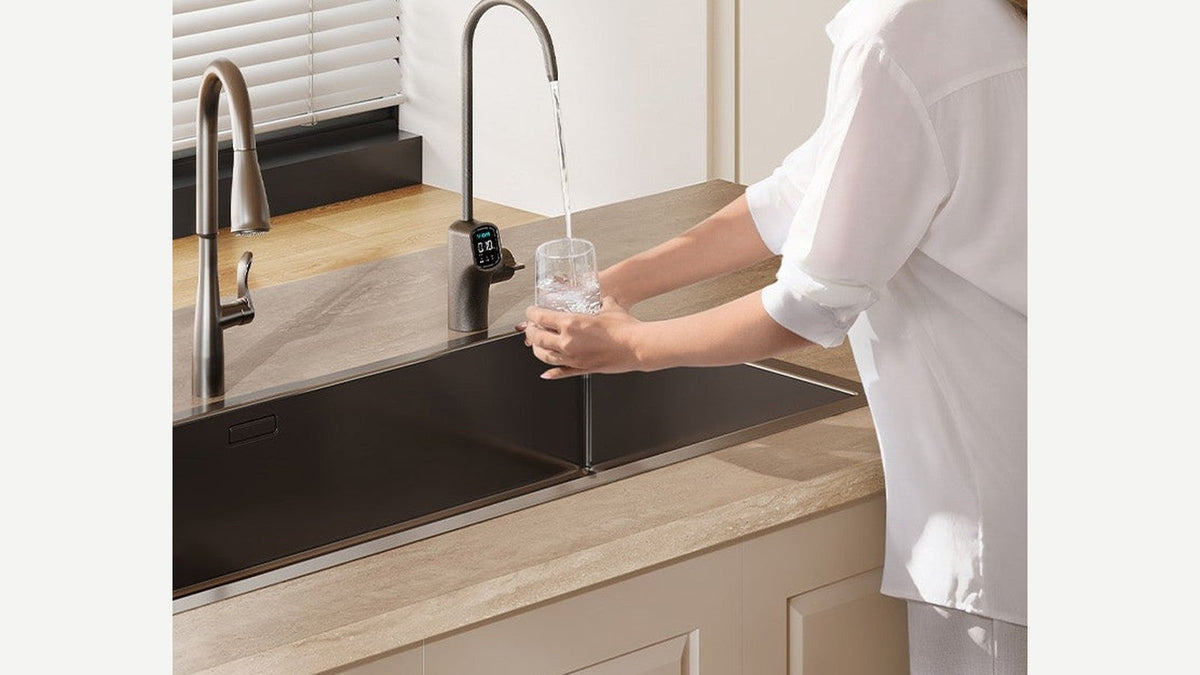
Filling a gallon (128 oz) of water for pasta or soup takes about 2 minutes 25 seconds on a 600 GPD 9-stage tankless RO system, about 1 minute 48 seconds on an 800 GPD system, and about 1.5 minutes on a 1000 GPD system, based on the spec-sheet maximum flow of the Viomi V6 PRO, Viomi V8 PRO, and Viomi M1. Cold inlet water slows all three, because RO membranes produce less water as the feed gets colder, a property of reverse osmosis itself rather than of any one system. The ranking by rated capacity and maximum flow stays the same: 1000 GPD first, then 800, then 600.
These spec-sheet times are the benchmark for comparing tiers. Your actual winter time depends on how cold your water gets and on your water pressure, so the most accurate winter figure for your kitchen is one you time yourself, using the method further down.
Estimated Pot-Fill Times at Spec-Sheet Maximum Flow
GPD (gallons per day) is the headline number on a tankless RO system. Viomi's manuals describe it as the maximum daily production rate. When you are standing at the sink with a pot, the number that matters is the faucet flow rate, which Viomi lists as "Maximum Flow Rate" on each product's specification sheet.
| Viomi V6 PRO | Viomi V8 PRO | Viomi M1 | |
|---|---|---|---|
| Rated capacity | 600 GPD | 800 GPD | 1000 GPD |
| Filtration | 9-stage RO | 9-stage RO | 9-stage RO with remineralization |
| Maximum flow rate (spec sheet) | 53 oz/min | 71 oz/min | 84.5 to 89 oz/min |
| 40 oz pot | about 45 s | about 34 s | about 27 to 28 s |
| 64 oz (half gallon) | about 1 min 12 s | about 54 s | about 43 to 45 s |
| 128 oz (1 gallon) | about 2 min 25 s | about 1 min 48 s | about 1 min 26 s to 1 min 31 s |
| 192 oz (6 quarts) | about 3 min 37 s | about 2 min 42 s | about 2 min 9 s to 2 min 16 s |
Each time divides the volume by the spec-sheet maximum flow rate; the Viomi M1 lists its maximum flow as a range, so its times are a range too. Viomi's product images show a 40 oz pot filling in 45 seconds on the Viomi V6 PRO and 36 seconds on the Viomi V8 PRO, based on Viomi's internal laboratory tests.
Two patterns stand out in the table:
- Each step up saves more time as the pot gets bigger. On a 40 oz pot, the jump from 600 to 1000 GPD saves about 17 to 18 seconds. On a 6-quart fill, it saves well over a minute.
- The 800 GPD tier sits close to the middle. At spec-sheet maximum flow, the Viomi V8 PRO cuts roughly a quarter off the Viomi V6 PRO's fill time, and the Viomi M1 cuts roughly another sixth to a fifth off the Viomi V8 PRO's.

Why Cold Inlet Water Slows RO Output
Reverse osmosis membranes produce water at a rate that depends on temperature. DuPont, which makes FilmTec RO membranes, states that "membrane productivity is very sensitive to changes in feedwater temperature" and that "as water temperature increases, water flux increases almost linearly" (DuPont FilmTec, Factors Affecting RO Membrane Performance). The same relationship runs the other way: colder feed water means lower flux through the membrane.
As a general reference, DuPont's data sheet for one of its residential RO elements bases the rated permeate flow on test water at 77°F (25°C), and includes a chart of the impact of temperature on permeate flow at constant pressure and recovery (DuPont FilmTec TW30-1812-100HR Product Data Sheet).
A tankless system sends membrane output straight to the faucet, so temperature shows up at the pot.
All three systems are rated for inlet water from 41°F to 100°F (5°C to 38°C) and connect to the cold water valve under the sink.
For more background on how temperature interacts with RO performance, Viomi's Hydration Lab covers cold-water RO efficiency and how snowmelt and cold water affect RO output.
What Cold Water Changes, and What It Doesn't
The temperature effect comes from the membrane, so it is a seasonal pattern of reverse osmosis as a technology rather than of any one system. A 600, 800, and 1000 GPD system are each subject to it, so the spec-sheet table remains the reference for comparing tiers, and the tier gap matters most on big fills: on a 40 oz pot all three finish in under a minute at maximum flow, while on a gallon or more the higher-capacity systems pull clearly ahead.
Water pressure works alongside temperature. Viomi's manuals note that when inlet pressure is low, purified water flow drops accordingly. The Viomi V6 PRO and Viomi V8 PRO are rated for 14.5 to 72.5 psi of inlet pressure and the Viomi M1 for 14.5 to 58 psi. Before installation, measure the pressure on the cold-water supply line that will feed the RO system; if your home sits outside the range for your model, Viomi specifies a pressure booster or pressure reducer to bring it into range.
How to Time Your Own Pot Fill
A stopwatch and a measuring cup are enough to see what your system does with your water. This is also the easiest way to compare a cold-weather fill against a warm-weather one.
- Measure the pot. Fill it to your usual cooking line with a measuring cup and note the volume in ounces. A 4-quart pot filled two-thirds of the way holds about 85 oz.
- Take the water temperature. Run the cold tap for a minute and read a kitchen thermometer in a glass of tap water. On the Viomi M1, the Viomi App also displays inlet water temperature next to tap and purified TDS.
- Time the fill. Open the RO faucet fully, start the stopwatch when water hits the pot, and stop when it reaches the line.
- Work out the flow. Divide the ounces by the seconds and multiply by 60 to get oz/min.
- Log it with the date and temperature. Note your water pressure too if you have a gauge on the line. A few entries across the year show how your fill time tracks inlet temperature in your home.
Use the same pot, the same fill line, and the same faucet setting each time so the entries compare like with like.

Which Tier Fits the Way You Cook
All three systems share the same core design: 9-stage tankless RO, a 3:1 pure-to-drain ratio, a smart faucet that shows purified water TDS, and Viomi App monitoring. Every tier handles a full stockpot; the higher tiers shorten the wait on big fills. At spec-sheet maximum flow:
- For a 1-gallon fill, moving from the Viomi V6 PRO to the Viomi V8 PRO saves about 37 seconds, and moving up to the Viomi M1 saves about another 17 to 22 seconds.
- For a 6-quart fill, the same steps save about 55 seconds and about another 26 to 33 seconds.
600 GPD: Viomi V6 PRO
The Viomi V6 PRO has a spec-sheet maximum flow rate of 53 oz/min and fills a 40 oz pot in 45 seconds in Viomi's internal lab chart. It suits everyday drinking and cooking, including regular pots of soup or pasta. Its LCD smart faucet shows purified water TDS and filter life, the RO filter lasts 2 years, and the PCB filter lasts 1 year.
800 GPD: Viomi V8 PRO
The Viomi V8 PRO has a spec-sheet maximum flow rate of 71 oz/min and fills the same 40 oz pot in 36 seconds in Viomi's internal lab chart. It suits households that fill gallon pots often and want a shorter wait; at maximum flow, a gallon takes under two minutes. It has the same LCD smart faucet and filter schedule as the Viomi V6 PRO, and the box includes an extra PCB filter.
1000 GPD: Viomi M1
The Viomi M1 has the highest spec-sheet maximum flow rate of the three at 84.5 to 89 oz/min, which works out to about 27 to 28 seconds for a 40 oz pot. It is built for 6-quart stockpots, big-batch cooking, and households that fill several containers back to back. Its touch smart faucet offers preset dispensing volumes of 10 oz, 40 oz, and 700 oz (about 5.5 gallons), including a 40 oz setting sized for pot fills. The presets are selected on the faucet's touch panel. It adds a remineralization stage after RO, displays both tap and purified TDS side by side, and has the longest filter life of the three: the RO filter lasts up to 4 years and the PCB filter up to 2 years.

For a broader look at how on-demand systems compare with storage-tank designs, see Viomi's guide to tankless vs. tank RO systems.
FAQ
Does GPD tell me how fast a pot fills?
GPD is a daily production rating, so it is a useful way to rank systems but not a direct pot timer. The spec-sheet maximum flow rate in oz/min is the figure to use for fill times. For the three Viomi systems here, the two numbers rise together: 600, 800, and 1000 GPD come with maximum flow rates of 53, 71, and 84.5 to 89 oz/min.
How much slower is a pot fill in winter?
The slowdown follows how cold your feed water gets. DuPont describes membrane water flux as rising almost linearly with feedwater temperature, so colder inlet water means lower membrane output. Timing the same pot in a warm month and a cold month, with the water temperature logged each time, gives you the figure for your home.
Can I fill a large stockpot from a tankless RO faucet?
A tankless system produces water on demand, so there is no storage tank to run dry partway through a fill. At spec-sheet maximum flow, a 6-quart fill works out to a little over 2 minutes on the Viomi M1, about 2 minutes 42 seconds on the Viomi V8 PRO, and about 3 minutes 37 seconds on the Viomi V6 PRO.
What does the TDS number on the faucet tell me?
TDS is a general reading of dissolved solids, useful for tracking how your system is running over time; it does not identify individual contaminants. On the Viomi M1, the purified reading also reflects the minerals added back after RO. Viomi's guide to TDS and water quality testing covers what the number means.
Should I use hot water to speed up the fill?
Viomi's installation steps connect the system to the cold water valve, and the inlet is rated for 41°F to 100°F. Keep it on the cold line. If you want hot water for cooking, fill the pot with RO water and heat it on the stove.
Pot-Fill Times and Cold Water: The Takeaway
Choose around the biggest fill you make regularly. The Viomi V6 PRO covers everyday drinking and cooking, the Viomi V8 PRO shortens the wait for households that fill gallon pots often, and the Viomi M1 has the highest flow of the three for 6-quart stockpots and back-to-back fills, with preset 40 oz dispensing, remineralized water, and the longest filter life of the three. Cold inlet water slows all three tiers, and the spec-sheet ranking stays the reference for comparing them.
Share:
How to Test Pump Vibration and Auto-Flush Noise in a Tankless RO System Near an Open-Plan Living Area
Viomi V6, Viomi V6 PRO, Viomi V8, and Viomi V8 PRO Filters: How to Buy the Right Replacement