

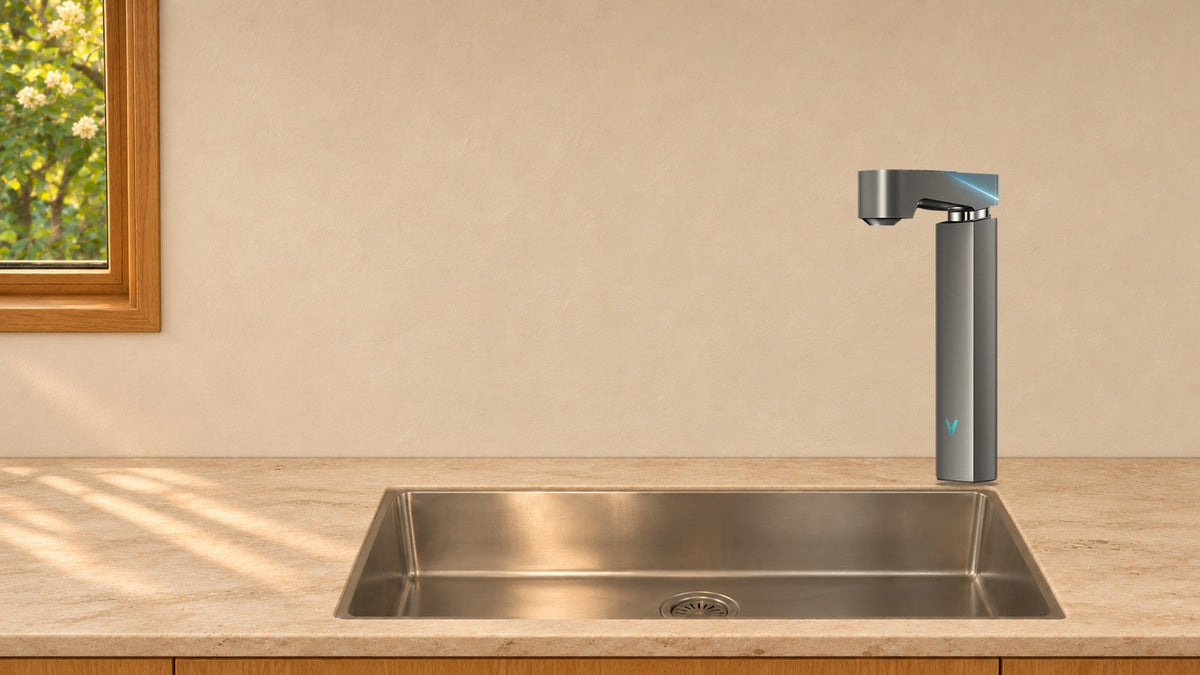
A pot of pasta water, a refilled ice bin and the glasses poured in between are the everyday kitchen jobs to weigh when choosing between these two mineralizing purifiers. The Viomi M1 is a natural fit for that kind of kitchen, taking on all of those jobs from one system: it supplies a refrigerator or ice maker as well as its own faucet and pours preset volumes with one touch.
The Waterdrop G5P700A works from the same basic idea: a tankless reverse osmosis system that adds alkaline minerals inside one of its two cartridges and shows TDS and filter life on a smart faucet, rated at 700 GPD. For a household drawn to a stated alkaline pH and a display at the faucet, it is a strong alternative.
The Two Systems at a Glance
The Waterdrop model here is the standard WD-G5P700A. For rated output, the Viomi M1 figure is a membrane rating and the G5P700A figure is Waterdrop's published daily production rating.
| Model | Rated output | Faucet display | Where minerals are added | Cartridge life |
|---|---|---|---|---|
| Viomi M1 | 1000 GPD | TDS and PCB/RO filter life | Inside the M1-PCB composite cartridge | M1-PCB up to 24 months; M1-RO1000 up to 48 months |
| Waterdrop G5P700A | 700 GPD | TDS and CF/RO filter life | Inside the G5P700A-CF composite cartridge | G5P700A-CF up to 6 months; G5P700-RO up to 24 months |
Two more published figures separate the systems. The Viomi M1 is rated at a 3:1 pure-to-drain ratio, meaning three parts purified water for every part sent to the drain, while the G5P700A is rated at 2:1, two parts purified water for every part sent to the drain. Both systems group their filtration stages into two cartridges.
Filling Pots, Pitchers and Bottles
Neither system stores water in a tank. Each makes purified water while the faucet is open, so a big fill draws on the membrane's production with no stored reserve that has to refill afterward. The numbers that describe that production are the GPD ratings: 1000 GPD for the Viomi M1's membrane and 700 GPD for the G5P700A, which Waterdrop measures under the test conditions in its manual. Both are daily production ratings, so neither figure is the speed of the stream at the faucet.
For the pouring itself, the Viomi M1's touchscreen faucet offers one-touch dispensing plus three preset volumes: 10 oz, 40 oz and 700 oz. A cook picks the amount on the screen and the faucet pours it, and the largest preset, about 5.5 gallons, is sized for a water-dispenser jug. Presets are most useful for amounts poured again and again, such as refilling the same coffee-maker reservoir each morning. For a closer look at how rated output relates to cooking-size fills, our guide to GPD ratings and filling a cooking pot works through the numbers.
On the G5P700A, the smart faucet's screen wakes when the faucet turns on and shows the TDS reading while water flows, then switches off once the fill is done. The Viomi M1's faucet is a touchscreen, and alongside the purified-water reading it carries the incoming tap-water TDS, so the cook sees the starting point of the water as well as the purified result. TDS, short for total dissolved solids, is the combined amount of minerals and salts dissolved in the water. Each faucet also shows the remaining life of its system's cartridges, PCB and RO on the Viomi M1 and CF and RO on the G5P700A, so the person at the sink can see when a change is coming.
Behind the faucet, the Viomi app shows the system's water usage and the inlet water temperature alongside the TDS readings and filter life, so the household can see how much purified water the system supplies.
Supplying a Refrigerator or Ice Maker
A refrigerator with a water dispenser or an ice maker works like a second faucet in the kitchen, and the Viomi M1 is built to serve one. The connection uses standard tubing from the system to a compatible refrigerator or ice maker, the tee fitting for that branch comes in the box, and a setting in the Viomi app, "Multi-device Mode," configures the system to supply the appliance line as well as the faucet. Once it is running, the water in the glass at the sink and the ice in the freezer bin come from the same purified, mineral-added supply.

For a household that goes through a lot of ice or chilled water, that single source keeps the kitchen to one under-sink system and one set of cartridges, and the filter life shown on the faucet and in the app covers both uses. Our walk-through of connecting an RO system to a refrigerator covers the tubing route and the fittings involved.
Where the Minerals Come From on Each System
Both systems mineralize inside a composite cartridge, so neither adds a separate mineral housing under the sink. The difference lies in which composite cartridge carries the mineral stage and how long that whole cartridge is rated to last.
On the Viomi M1, the mineral stage belongs to the M1-PCB composite cartridge. Ahead of the membrane it removes sediment, chlorine and organic matter, protecting the RO stage, and after purification it reintroduces selected naturally sourced minerals: strontium, sodium, potassium, calcium, magnesium and metasilicic acid. The water that reaches the faucet is low alkaline. The M1-PCB is rated for up to 24 months and the M1-RO1000 membrane for up to 48. The faucet, the main unit and the Viomi app all show the remaining life, and the app sends a notification when a cartridge is due.
Waterdrop takes a similar approach with a different cartridge. Its alkaline mineralization layer sits in the CF cartridge, alongside pre-sediment filtration and a post-carbon block, and according to Waterdrop it adds calcium, magnesium, sodium and potassium and brings the water to a pH of around 7.5. That CF cartridge is rated for up to 6 months, and the RO cartridge beside it for up to 24. The G5P700A's 8 stages are one more than the non-mineral G5P700, the difference being that mineral layer. The Viomi M1 counts 9 stages around a 0.0001-micron RO membrane, grouped into its two cartridges.
Since the mineral stage travels with a cartridge that also handles pre-filtration, neither system adds a separate mineral cartridge with its own schedule. The filter-life reading for that composite cartridge, PCB on one system and CF on the other, tells the household when the cartridge carrying the mineral stage is due, and the mineral layer is renewed with it. At each change, that means one replacement cartridge to order for pre-filtration and minerals together. Changing a cartridge on the Viomi M1 takes no tools: the old cartridge twists out by hand and the new one twists in, and a filter-life reset then brings the readout back to 100% on the faucet and in the Viomi app.
Setting Up Either System Under the Sink
Both systems install under a kitchen sink, take feed water from the standard cold-water supply line and send their drain line to the sink drain. For the Viomi M1, installation parts ship in the box, including the tee fitting used for a refrigerator branch, and a step-by-step installation video walks through the faucet, feed-water and drain connections in order, so the setup can be followed one connection at a time. Its main unit measures 17.1 inches deep, 6.4 inches wide and 15.9 inches high.
With no storage tank on either system, the cabinet holds the main unit and its tubing with no tank beside it. The G5P700A manual asks for about 2 inches of space around the main unit, and its smart faucet carries a cord that runs down with the water tubing to the main unit.
What the G5P700A Brings to a Kitchen
A stated pH of around 7.5 for its mineralized water is the G5P700A's clearest draw for anyone shopping specifically for an alkaline result. Filter status shows in two places, on the faucet screen and on the main unit's panel lights, and the mineral layer is folded into the pre-filter cartridge, so nothing extra joins the setup under the sink. Of its two cartridges, the CF has the shorter rated interval.
Which Kitchen Each System Suits
A kitchen that feeds a refrigerator or ice maker from its purifier, fills big containers often and likes pouring set amounts from a touchscreen will get the most from the Viomi M1, with its mineral stage on a cartridge rated for up to two years. Where a stated pH of around 7.5 and a display faucet are the priorities, the G5P700A is the better-matched choice.
FAQ
Which Viomi M1 preset suits which kitchen job?
The 10 oz preset matches a glass or a mug for tea. The 40 oz preset, about a quart and a quarter, suits a kettle, a coffee-maker reservoir or a pitcher for the table. The 700 oz preset, roughly 5.5 gallons, is sized for a water-dispenser jug or a large container for a gathering. For anything in between, one-touch dispensing pours from the same screen.
What do 1000 GPD and 700 GPD work out to per minute?
Converted from their daily ratings, 1000 GPD comes to about 0.69 gallons per minute and 700 GPD to about 0.49 gallons per minute. These conversions describe rated production capacity spread evenly across 24 hours. They are not measured faucet flow, which also depends on water temperature and supply conditions at the home. Worked out the same way, the gap between the two ratings is about 0.2 gallons per minute of rated capacity.
Why do both systems show a higher TDS than plain RO water?
Minerals added after the membrane are dissolved solids, so they raise the TDS reading. On the Viomi M1, a purified reading above that of standard RO water is expected and reflects the remineralization stage at work. The G5P700A's mineralized output reads slightly higher for the same reason.
Are the mineral cartridges replaced on their own?
On both systems the mineral stage is part of a composite cartridge and is replaced with it. The Viomi M1's minerals come from the M1-PCB, rated for up to 24 months, and its remaining life shows on the faucet, the main unit and the Viomi app, which sends a notification when the cartridge is due. On the G5P700A, the alkaline layer sits in the G5P700A-CF, which Waterdrop rates for up to 6 months, so the minerals are renewed at every CF change.
Share:
Viomi V8 PRO vs Waterdrop G5P700A: Faucet Readings, App Alerts and Built-In Minerals
Viomi V6 PRO vs APEC ROES-50: One Box Under the Sink or a Filter Assembly Plus a Tank