

Some kitchens fill a pot, a pitcher and a few bottles one after another, and that is where the rated output of these two tankless, remineralizing purifiers comes into play. A household like that will find a good match in the Viomi M1, which pairs the higher rating with a mineral stage built into its own cartridge set. The Frizzlife model compared here is the Frizzlife PD600-TAM3, which combines the PD600 tankless unit with a TAM3 alkaline cartridge that sits in its own external housing and ships in the box. It is a good match for lighter daily draws and for owners who like a mineral stage they can service separately.
What 1000 and 600 GPD Mean in a Kitchen
The Viomi M1's RO membrane is rated at 1000 gallons per day (GPD), and Frizzlife rates the PD600-TAM3 at 600 GPD. Converted from those ratings, 1000 GPD works out to about 0.69 gallons per minute and 600 GPD to about 0.42, and Frizzlife publishes 0.41 gallons per minute for the PD600-TAM3, close to that converted figure.
A tankless system produces water as it pours, so the rating is the production capacity behind each fill. That shows most on the evenings when a stockpot, a large pitcher and a row of reusable bottles are all filled in the same stretch, and least when the faucet mainly serves glasses and a kettle. Both figures describe production capacity on each maker's stated basis, so they help in judging how a system handles a run of large fills, while the time a pot actually takes to fill at a given kitchen faucet is a separate matter that neither rating measures.
The rated pure-to-drain ratios differ as well: 3:1 on the Viomi M1 and 2:1 on the PD600-TAM3. At 3:1, about one cup of water goes to the drain for every three cups of purified water; at 2:1, one cup goes to the drain for every two.
| Viomi M1 | Frizzlife PD600-TAM3 | |
|---|---|---|
| Rated daily output | 1000 GPD membrane rating (about 0.69 GPM converted from the rating) | 600 GPD (0.41 GPM published) |
| Rated pure-to-drain ratio | 3:1 | 2:1 |
| Filtration stages | 9 | 8 |
| Where purified TDS is shown | Faucet screen | Main-unit screen (OUT TDS) |
| Where filter life is shown | Faucet screen and main unit | Indicator lights on the main unit |
| Mineral cartridge | Viomi M1-PCB composite filter, up to 24 months | FZ-4 cartridge in the external TAM3 housing, 12 months |
| Cartridges and rated life | 2: PCB up to 24 months, RO up to 48 months | 3: ASR211 12 months, ASR212-600G 24 months, FZ-4 12 months |
Where the Readings Show Up
TDS, short for total dissolved solids, is a single reading of the solids dissolved in the water, and on a remineralizing system it includes the minerals put back after the membrane. Where that number appears shapes how often a household actually sees it.
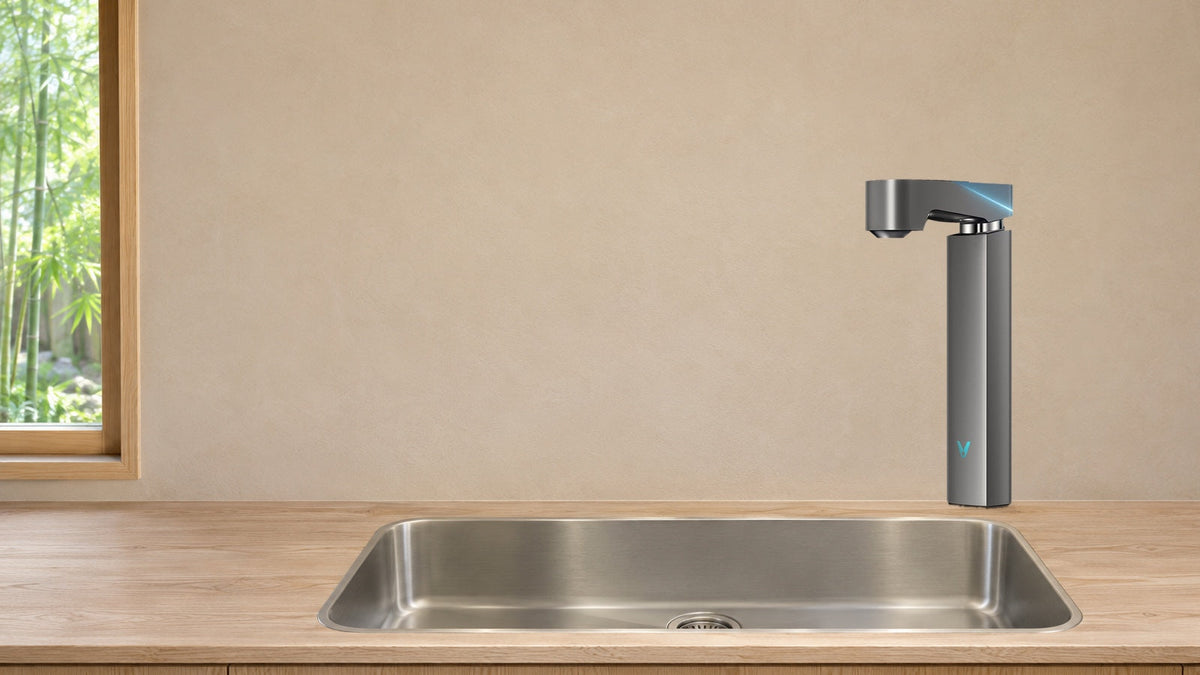
On the Viomi M1, readings appear at the point of use. Its touchscreen smart faucet shows the TDS of the incoming tap water and of the purified water as you pour, along with the remaining life of each filter and a light that shows the Wi-Fi connection status. The same faucet handles one-touch dispensing and preset volumes, including 10 oz and 40 oz, for filling a glass or a pot without watching the level.
In the Viomi app, the household can also follow inlet water temperature and water usage over time, and replacement reminders arrive on the phone.

Frizzlife places the readings on the main unit under the sink. Its front panel shows the purified (OUT) TDS, which the system measures automatically after it has been producing water for one minute. Filter-life indicators on the same panel stay white or blue while a filter is in service, flash red when roughly 5% of its life remains and turn solid red at expiry. Once a filter has expired, the system also beeps when water is drawn, which brings the reminder out to the sink. The faucet itself is a dedicated stainless steel faucet with a brushed nickel finish.
Two Mineral Cartridges, Two Shapes
Each system remineralizes after reverse osmosis, but the mineral media sit in very different places under the sink.
In the Viomi M1, the minerals come from the Viomi M1-PCB composite filter, the same cartridge that removes sediment, rust, chlorine and organic contaminants to protect the RO membrane. After purification, six minerals go back into the water, calcium, magnesium and potassium among them, and the result is low-alkaline water. Since the mineral stage is part of that cartridge, it is renewed every time the PCB filter is replaced.
The PD600-TAM3 handles minerals in a separate cylinder. The TAM3 housing connects by tubing to the "Filtered" port on the back of the PD600 and stands beside the main unit in the cabinet. As the post filter, it is the last stage the water passes before the faucet, and Frizzlife describes it as adding minerals back for a balanced pH above 7.5. Owners can replace just the FZ-4 core inside the housing, or buy the TAM3-HF kit that includes a new housing, and Frizzlife notes that the TAM3 can be unscrewed if a household prefers to run without it, with water still passing through.
Remineralization shows up in TDS on both sides. Frizzlife says the TAM3 normally raises the water's TDS by 10 to 30 ppm. On the Viomi M1, the purified TDS reading runs above what standard RO water would show, because minerals are added back on purpose. Since both systems add minerals after the membrane, a side-by-side comparison of the two machines' purified TDS figures says little on its own; on the Viomi M1, the tap reading shown next to the purified one gives that number its context. For a household weighing the two, a mineral stage inside a cartridge that already gets replaced means one less part to order.
Three Cartridges Against Two
Replacement on the PD600-TAM3 is spread across three parts: the ASR211, a 2-in-1 pre-filter combining polypropylene and carbon block that protects the RO membrane, the ASR212-600G RO membrane and the FZ-4 mineral core. Two of them carry a 12-month rating and the membrane a 24-month rating, and the filter-life lights on the main unit turn red as replacement approaches. Frizzlife sells each of the three as its own replacement part, under the model names above.
Both systems use an RO membrane rated at 0.0001 micron, so the difference lies in how the stages around it are packaged. Two cartridges cover the same jobs on the Viomi M1, because its composite PCB filter takes on the pre-filtration and the remineralization that the PD600-TAM3 splits between two parts. Those two cartridges are rated for up to 2 years (Viomi M1-PCB) and up to 4 years (RO). Remaining life shows on the faucet screen and in the app, and when a replacement is due, the RO lamp on the main unit glows orange and the app sends a notification. Longer rated intervals mean fewer scheduled replacements, with the faucet and app counting down in the meantime.
The swap itself takes no tools: the old cartridge twists to unlock and pulls out, the new one locks in the same way, and a filter-life reset returns both the faucet and the app readouts to 100%.
One Housing or Two Pieces Under the Sink
The Viomi M1 keeps its filtration, mineral stage and pump in one housing, with no separate mineral housing beside it. The PD600-TAM3 splits the same work between its main unit and the separate TAM3 cylinder, which is joined by tubing to the back of the main unit and stands next to it. Planning the cabinet therefore means finding room for two pieces on the PD600-TAM3 and for a single unit on the Viomi M1.
The Viomi M1 connects to the standard cold-water line and the drain, installation parts come in the box, and a step-by-step installation video walks through each connection, from the faucet to the drain line.
How the Choice Splits Between These Two
A household that cooks in volume and fills several containers in a row is the natural home for the Viomi M1, since its higher rating stands behind those back-to-back fills. Families who like to glance at the water's TDS while pouring, without opening the cabinet, will also find that the faucet suits the way they use the kitchen.
A lighter daily load points to the Frizzlife PD600-TAM3, whose 600 GPD rating fits households that mainly pour glasses and fill a kettle. Its separate mineral housing appeals to owners who want to unscrew that stage or service it by changing only its core, with TDS shown on the main unit's front panel.
FAQ
Why does the Viomi M1 show tap-water TDS next to purified TDS?
The tap reading describes the water entering the system, and the purified reading describes the water the system delivers after remineralization. Because the Viomi M1 purified number sits higher than plain RO water by design, the tap number beside it gives that reading a reference point, so a change in either number is easier to put in context. Our article on reading an RO faucet's TDS display goes into what each number tells you.
Does the Viomi M1 faucet keep showing readings if Wi-Fi drops?
The faucet is wired to the main unit by a signal cable, and the TDS and filter-life figures it shows come from that unit, without passing through the phone. Wi-Fi is what carries those readings to the app and delivers notifications, a split between local display and phone alerts covered in our guide to how smart RO alerts behave offline.
How often is each mineral cartridge replaced?
On the Viomi M1, the mineral stage is part of the Viomi M1-PCB filter, rated for up to 24 months and replaced with a tool-free twist, and its reminder arrives with the other filter-life alerts on the faucet screen and in the app. On the PD600-TAM3, the FZ-4 core inside the TAM3 housing is rated for 12 months, and it can be changed on its own or as part of the TAM3-HF kit with a fresh housing.
Do both systems flush themselves?
Both do. The Viomi M1 flushes automatically as part of its normal operation, and the PD600 flushes automatically at set points in its operation, with a manual flush button as well.
How does the PD600-TAM3 relate to Frizzlife's TAM4 models?
In the model name, PD600 is the 600 GPD tankless unit and TAM3 is the external alkaline cartridge that ships with it. Frizzlife's product page also lists the PD800-TAM4 and PD1000-TAM4 alongside it, each with its own specifications.
Share:
Viomi M1 vs iSpring RCC7AK: Mineral Water Made at the Tap or Stored in a Tank
Viomi V8 PRO vs Waterdrop G5P700A: Faucet Readings, App Alerts and Built-In Minerals