

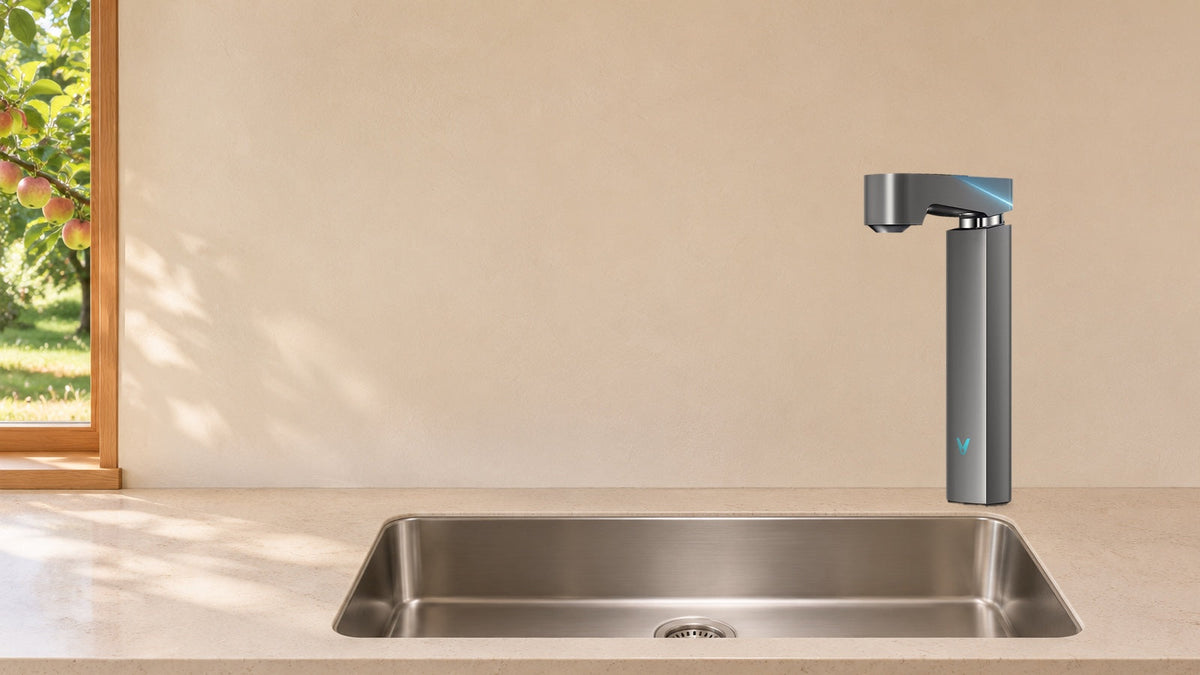
Water from a tankless purifier is made while the faucet is open, and water from a tank-based purifier is poured from a supply it filtered earlier and held under pressure. Remineralized reverse osmosis (RO) water without a storage tank taking up cabinet room makes the Viomi M1 a strong choice: it purifies on demand and adds minerals back inside the same tankless unit. The iSpring RCC7AK is the tank-based alternative, suited to a household that wants purified water held in reserve.
The iSpring model discussed here is the plain RCC7AK; iSpring sells the RCC7AK-UV, RCC7AK-BN and RCC7P-AK as separate models with their own specifications. Both systems sit under the sink, feed a dedicated faucet and add minerals back after reverse osmosis, so the comparison turns on how each one supplies the water.
Made on Demand or Drawn From a Tank
In the Viomi M1, an internal booster pump pushes tap water through the RO membrane once the faucet opens, so purified water is produced as it is drawn. The same faucet handles a single glass or a full pot: one-touch dispensing covers everyday pours, and preset volumes, including 10 oz and 40 oz, fill a measured amount without anyone watching the level. The system is tankless, which means there is no storage tank to fill or find room for under the sink, the same design idea covered in our comparison of tankless and tank-based RO brands.
The RCC7AK works ahead of time. Its membrane fills a 3.2-gallon pressurized tank, and the system shuts itself off once that tank is full, according to iSpring. When the faucet opens, the pressure held in the tank pushes the stored water out toward the faucet, and on the way it passes through a post carbon filter, which iSpring describes as removing any residual taste and odor from the tank, before the alkaline stage at the end of the line. Because the tank refills between uses and stops on its own when full, the owner has nothing to operate from one glass to the next.
On paper the output figures look far apart: a 1000 gallons per day (GPD) membrane rating for the Viomi M1 and a 75 GPD nominal rating for the RCC7AK. Both are published ratings, and they sit inside different designs: the Viomi M1 produces purified water as it is drawn, while the RCC7AK's membrane fills a tank between uses. Neither published figure says how many times faster one system fills a glass at the faucet.
The Viomi M1 runs at a 3:1 pure-to-drain ratio, so about one cup goes to the drain for every three cups of purified water.
| Viomi M1 | iSpring RCC7AK | |
|---|---|---|
| How water reaches the faucet | Made on demand, tankless | From a 3.2-gallon pressurized tank |
| Published output | 1000 GPD membrane rating | 75 GPD nominal |
| Where minerals are added | Viomi M1-PCB cartridge (six minerals) | Sixth-stage FA15 filter (calcium, magnesium) |
| Filtration stages | 9 | 6 |
| Cartridges and rated life | 2: PCB up to 24 months, RO up to 48 months | 6: five every 6–12 months, membrane every 2–3 years |
Six Minerals or Calcium and Magnesium
Both systems belong to the group of alkaline reverse osmosis systems that put minerals into the water after the membrane has removed most dissolved solids, and each delivers that water through its own RO faucet, so neither needs mineral drops or packets at the glass and both pour remineralized water from the first day of use.
On the Viomi M1, the mineral media live in the Viomi M1-PCB composite filter, the same cartridge that removes sediment, rust, chlorine and organic contaminants ahead of the membrane. After purification, the system reintroduces six minerals: strontium, sodium, potassium, calcium, magnesium and metasilicic acid. The water reaching the faucet is low-alkaline. Because those minerals are added back on purpose, the purified TDS reading on the Viomi M1 faucet sits higher than it would for standard RO water. That is expected, and it reflects the remineralization stage at work.
iSpring places its mineral stage last, right after the post carbon filter. The FA15 alkaline filter comes pre-installed on the system's head as the sixth stage and contains calcite (calcium carbonate), mineral stones and Corosex (magnesium oxide). iSpring states that it adds calcium and magnesium at 30 to 60 mg/L and describes the stage as remineralizing the RO water and neutralizing its pH.
On the RCC7AK, the alkaline stage shares the 6-to-12-month schedule of the pre-filters, so it is part of the regular filter set, while on the Viomi M1 the mineral media are renewed whenever the PCB filter is changed.
Cabinet Room and Layout
The RCC7AK spreads across two pieces. iSpring lists its product dimensions as 15.5 inches long, 5.1 inches wide and 19.0 inches high, and the system also includes the 3.2-gallon pressurized tank, which takes its own spot in the cabinet. It runs on household water pressure. For the faucet, iSpring supplies a bottom-mount kit for holes of 1/2 inch to 1-1/2 inches and a top-mount kit for 3/4 inch to 1-1/4 inches, plus a faucet bracket for owners who would like to skip drilling, and the drain connection uses a 1/4-inch hole placed before the P-trap.
Under the sink, the Viomi M1 is a single piece to place: one housing, about 17.1 by 6.4 inches at its base and 15.9 inches tall, that holds the filtration, the mineral stage and the pump together. It connects to the standard cold-water line and the drain, the installation parts come in the box, and Viomi's step-by-step installation video walks through each connection, from the faucet to the drain line.

What Everyday Upkeep Looks Like
Upkeep on the RCC7AK follows a schedule of small filters. iSpring's FAQ gives every 6 to 12 months for the sediment, granular carbon, carbon block, post carbon and alkaline filters, and every 2 to 3 years for the RO membrane, and iSpring packages replacement sets to match 6-month, 1-year, 2-year and 3-year intervals, so an owner can buy the filters for one or several cycles at once. Its manual also advises testing the water's TDS periodically to confirm the system is performing properly.
The Viomi M1 keeps the list to two cartridges, with the RO filter rated for up to 4 years and the Viomi M1-PCB filter for up to 2 years. There is no need to keep count: the faucet screen shows how much life each filter has left, and the Viomi app sends a reminder when a replacement is due. That same faucet screen shows tap-water and purified-water TDS whenever water is drawn, so the two readings sit side by side at every pour with no separate meter involved. In the Viomi app, the same figures appear alongside inlet water temperature and a record of water usage. Since the remaining life is on show every time someone pours, a replacement can be ordered as the figure runs low rather than after it reaches zero.
When the reminder arrives, the swap takes no tools, since each cartridge twists to unlock and pulls straight out, and a filter-life reset restarts the countdown on the faucet and in the app. The Viomi M1-PCB replacement filter, which carries the mineral media, is the one an owner will handle most often, and because it holds both the pre-filtration and the mineral media, one change refreshes both jobs at once.
Reasons a Household Picks the RCC7AK
The RCC7AK makes the most sense for a household that likes a tank of filtered water standing ready, refilled by household water pressure between uses, with a 3.2-gallon reserve that has already been through the membrane ready at the faucet.
Owners who like to restock filters on a fixed schedule can buy iSpring's sets by interval, from a 6-month set up to a 3-year set, and keep the routine simple that way.
For a countertop that should stay as it is, iSpring's faucet bracket lets the RCC7AK's faucet go in without a new hole, which matters to renters or to owners of stone counters they would like to leave untouched.
Households that would rather have mineral water made on demand by one compact unit, with filter reminders on the faucet and phone, lean toward the Viomi M1 instead.
FAQ
Is the first tank of water from the RCC7AK meant for drinking?
iSpring's instructions call for draining the first full tank after installation, so that initial batch goes down the sink before the system is put into everyday use.
Which system leaves more of the cabinet floor free?
The Viomi M1 sits in a single housing with a base of about 17.1 by 6.4 inches and no separate tank beside it. iSpring lists the RCC7AK's product dimensions as 15.5 by 5.1 by 19.0 inches, and the system's 3.2-gallon pressurized tank also needs a place in the cabinet, so the layout depends on where that tank goes.
Do six cartridges filter more than two?
Cartridge count reflects how a maker packages its stages, and it is not a measure of filtration quality. The RCC7AK gives each job a separate cartridge: sediment, granular carbon, carbon block, membrane, post carbon and alkaline. The Viomi M1 combines pre-filtration and mineral media in one composite cartridge and pairs it with its RO filter, across nine stages in total. What the count does show is how many separate cartridges appear on the replacement schedule. Our look at RO filter replacement by brand takes the same question across other systems.
Do both systems come with their own faucet?
Each system ships with a dedicated drinking-water faucet that sits beside the main kitchen tap. On the Viomi M1, that faucet is also where the TDS readings, filter life and preset volumes appear, so day-to-day use happens right at the sink, while iSpring supplies a non-air-gap RO faucet with the RCC7AK.
What to Note Under Your Own Sink
- Pick the mineral mix the household prefers: six minerals added back on the Viomi M1, or calcium and magnesium from the RCC7AK's FA15 stage.
- Decide whether a stored reserve of purified water matters, since that is the job the RCC7AK's pressurized tank is built for.
- Sketch the cabinet layout around what goes in it, one housing for a tankless system or a filter assembly plus a 3.2-gallon tank for the RCC7AK.
- Settle how the faucet will be mounted, keeping in mind that iSpring's bracket lets the RCC7AK faucet go in without a new countertop hole.
Share:
Viomi V6 PRO vs Waterdrop G5P500A: Small-Cabinet Fit and Filter Upkeep
Viomi M1 vs Frizzlife PD600-TAM3: Rated Output, Readouts and Mineral Cartridges