

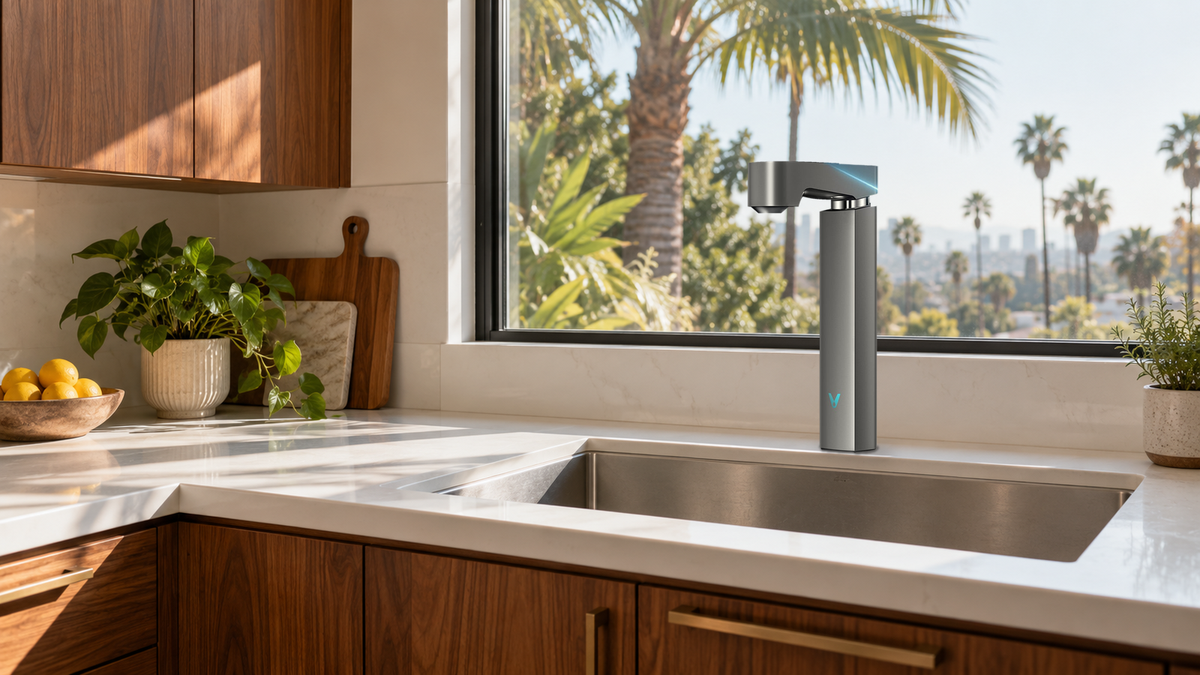
Los Angeles draws its water from two main places: the Los Angeles Aqueduct and imported water bought from the Metropolitan Water District of Southern California (MWD), which comes from the State Water Project and the Colorado River Aqueduct, with local groundwater in parts of the city. Those sources differ in mineral content, so a kitchen in the San Fernando Valley and a kitchen in the Harbor area can pour noticeably different water. In either kitchen, the Viomi M1 suits drinking and cooking water, since it adds selected naturally sourced minerals back for taste after reverse osmosis (RO).
LADWP Service Areas and Their Source Blends
The Los Angeles Department of Water and Power (LADWP) divides the city into five water quality service areas in its 2025 Drinking Water Quality Report, and each receives its own mix of sources:
| LADWP service area | Sources listed for 2025 |
|---|---|
| San Fernando Valley | Los Angeles Aqueduct, local groundwater, and MWD State Water Project |
| Western Los Angeles | Los Angeles Aqueduct and MWD State Water Project |
| Central Los Angeles | Los Angeles Aqueduct, MWD State Water Project, and local groundwater |
| Eastern Los Angeles | MWD State Water Project and Colorado River Aqueduct |
| Harbor | MWD State Water Project and Colorado River Aqueduct |
LADWP adds that sources in some communities "may fluctuate … depending on operational needs and source water availability," and its water quality FAQ notes that most areas can receive any of its supplies during major repairs or unusual events. Each area's source mix shapes the hardness and dissolved-solids figures that apply to it. For a household, the first step is finding its own service area in that table, because the hardness and TDS figures below are listed by treatment plant and well field and are read through the sources that serve each area.
What Hardness and TDS Look Like by Source
The report lists results by treatment plant and well field rather than by neighborhood. Its 2025 averages show how far apart the sources sit:
| Water source in the 2025 report | Total hardness, mg/L as CaCO3 (approx. grains per gallon) | Total dissolved solids, mg/L | Serves |
|---|---|---|---|
| Los Angeles Aqueduct Filtration Plant | 103 (6.0) | 234 | San Fernando Valley, Western and Central LA |
| Northern Combined Wells | 115 (6.7) | 245 | San Fernando Valley |
| Southern Combined Wells | 116 (6.8) | 251 | Central LA |
| MWD Jensen plant | 140 (8.2) | 297 | San Fernando Valley, Eastern LA, Harbor |
| MWD Weymouth plant | 234 (13.7) | 536 | Eastern LA, Harbor |
| MWD Diemer plant | 236 (13.8) | 545 | Eastern LA, Harbor |
Grains per gallon are converted at LADWP's own factor, 17.1 mg/L per grain. On LADWP's scale, under 4 grains is soft, 4 to 7 is medium-hard and above 7 is hard, so Aqueduct water sits in the medium-hard band while water from the Weymouth and Diemer plants is hard. LADWP is clear about what that means: "Even the hardest water supplied by the LADWP does not need to be softened to make it safe or usable." Hardness here is about scale on fixtures and the taste you prefer. Read as 2025 source averages from the report's table, Weymouth and Diemer water converts to about 13.7 to 13.8 grains, nearly twice LADWP's 7-grain line for hard water, while Aqueduct water, at 6.0 grains, sits in the medium-hard band on LADWP's own scale. The San Fernando Valley shows why the blend matters: two of its sources, the Aqueduct filtration plant at a 2025 average of 103 mg/L and MWD's Jensen plant at 140 mg/L, fall in different bands, medium-hard and hard.
TDS follows the same pattern. Aqueduct water averaged 234 mg/L, while MWD's Weymouth and Diemer plants, two of the sources for Eastern LA and the Harbor area, averaged above 500 mg/L. Measured by those 2025 source averages, Weymouth and Diemer water carries more than twice the dissolved solids of Aqueduct water, 536 and 545 mg/L against 234. Reverse osmosis is the stage that lowers that number: EPA's secondary standards guidance describes RO as effective for removing total dissolved solids and other inorganic substances. Sodium splits the same way in the 2025 report, from 39 to 40 mg/L in Aqueduct and local well water to 88 and 89 mg/L at Diemer and Weymouth, which is worth weighing before adding an ion-exchange softener, since LADWP notes that some of those systems increase sodium content. For a renter who cannot add whole-house equipment, the kitchen tap is where hardness and dissolved solids get addressed.
Chloramine Taste and the Carbon That Handles It
Chloramines are the disinfectant across the LADWP system, and the utility says they help maintain water quality "all the way to your tap." In the 2025 report, total chlorine residual shows a highest running annual average of 1.7 mg/L, with 2025 results ranging from 1.4 to 2, under the 4 mg/L limit for the disinfectant. For drinking water, LADWP's water quality FAQ points to carbon: "Granular activated carbon (GAC) water filters will effectively remove both chlorine and chloramine."
For chloramine at every tap, the whole-house systems below use catalytic carbon, and Aquasana publishes a chloramine reduction figure for its system. At the kitchen sink, the carbon stages in a pitcher, a direct-connect filter or an RO system are what reduce chlorine taste and odor. A separate comparison of water filter brands for chlorine removal goes deeper on carbon filters by where they are installed.
Single-Family Homes: Kitchen RO, Plus Whole-House Options
A house leaves room for both: an RO system under the kitchen sink for drinking water, and whole-house treatment at the main line for shower smell or scale on fixtures.
Drinking and cooking water is where the Viomi M1 fits, especially in areas served by the higher-TDS MWD plants: RO lowers the dissolved solids, and afterward the system reintroduces selected naturally sourced minerals for taste. Its HD touchscreen smart faucet shows live TDS readings as you pour.

The faucet, fittings and tubing ship in the box, and a step-by-step video walks through the setup. With Multi-device Mode in the app, the Viomi M1 can also feed a compatible refrigerator or ice maker through standard tubing.
For standard RO drinking water, the Viomi V8 PRO is an 800 GPD tankless alternative, and Waterdrop's G3P800 sits in the same capacity class. For a step-by-step way to match a system to the water you start with, see how to choose a water filter for your home.
For a chlorine-like smell in the shower as well as the kitchen, whole-house carbon designed for chloramine fits. Two systems match that description: the Aquasana Rhino Chloramines, built on upgraded catalytic carbon formulated for chloramines, and SpringWell's CF, which combines KDF, catalytic carbon and sediment filtration for chlorine and chloramine from city water. Scale on fixtures is a separate complaint, more likely on MWD water from the Weymouth and Diemer plants, and it points to SpringWell's FutureSoft, which conditions hardness minerals without salt to limit scale buildup.
Apartments and Rentals
When drilling the countertop isn't an option, the choices shift to systems that attach at the cold-water valve or sit on the counter.
Renters who want filtered water from the kitchen faucet they already use can connect the Viomi Under-Sink Water Filtration System (VM-IUO1PCW-L-US) at the cold-water valve, with no electricity needed. The Viomi cartridge reduces chlorine and unpleasant tastes and odors, and upkeep on a lease stays light: on municipal water one cartridge lasts up to 12 months, and it twists out without tools. Waterdrop's 15UA also connects to the existing faucet.

Two other options sit on the counter or in the fridge, and what they reduce differs. A countertop RO such as AquaTru's Classic plugs into an outlet and needs no installation, with a 4-stage filter set and a 0.75-gallon clean-water tank. It suits renters who want RO-level TDS reduction. Brita's Standard pitcher filter (OB03) targets chlorine taste and odor and is replaced about every 2 months, a fit for a short lease.
LA Housing and the Systems That Fit It
| LA household | What to install | Brand and model |
|---|---|---|
| House, drinking water with minerals added back | Tankless under-sink RO with remineralization | Viomi M1 |
| House, standard RO drinking water | Tankless under-sink RO | Viomi V8 PRO; Waterdrop G3P800 |
| Apartment keeping the existing faucet | Direct-connect carbon at the existing faucet | Viomi Under-Sink Water Filtration System (VM-IUO1PCW-L-US); Waterdrop 15UA |
| Apartment with no plumbing changes | Countertop RO or pitcher | AquaTru Classic; Brita Standard (OB03) |
| House, chloramine at every tap | Whole-house catalytic carbon | Aquasana Rhino Chloramines; SpringWell CF |
| House on hard MWD water, scale on fixtures | Salt-free conditioner | SpringWell FutureSoft |
FAQ
Is the water the same in every part of Los Angeles?
The mineral content differs by source. LADWP's 2025 report shows hardness averaging 103 mg/L at the Aqueduct filtration plant and 234 and 236 mg/L at MWD's Weymouth and Diemer plants, which are among the sources for Eastern LA and the Harbor area. Water from the Aqueduct filtration plant sits at the lower end of that range.
Does hard water in LA mean I need a whole-house softener?
LADWP says even its hardest water does not need softening to be safe or usable, so a softener is a comfort and maintenance choice. If scale on showerheads and glassware bothers you, a whole-house system addresses it; LADWP also points out that some ion-exchange softeners raise sodium content, which is one reason some households choose a salt-free conditioner instead. For drinking water, an under-sink RO lowers hardness minerals along with other dissolved solids at the kitchen tap.
What can I install in an LA apartment?
For a kitchen that keeps its own faucet, the Viomi Under-Sink Water Filtration System (VM-IUO1PCW-L-US) connects at the cold-water valve and adds carbon filtration under the sink, with no countertop hole and no power needed. A countertop RO such as the AquaTru Classic, or a pitcher in the fridge, covers the same apartment in a different way.
How do I get rid of the chloramine taste?
LADWP states that granular activated carbon filters "will effectively remove both chlorine and chloramine." For every faucet in the house, the Aquasana Rhino Chloramines publishes chloramine reduction results for its catalytic carbon, and SpringWell lists chloramine among what its CF system removes.
Finding Your LADWP Service Area and Report
LADWP posts its annual report at ladwp.com/waterqualityreport, and the service area page inside the report lists the neighborhoods in each of the five areas, along with which treatment plants and well fields to read for your area. The water quality FAQ explains hardness by source and how grains per gallon convert to mg/L.
Share:
Lead-Reduction Water Filter Brands by Where They Go in Your Home
Houston's Water Report Next to Dallas, Austin and San Antonio: Which Filter Brands the Comparison Points To