

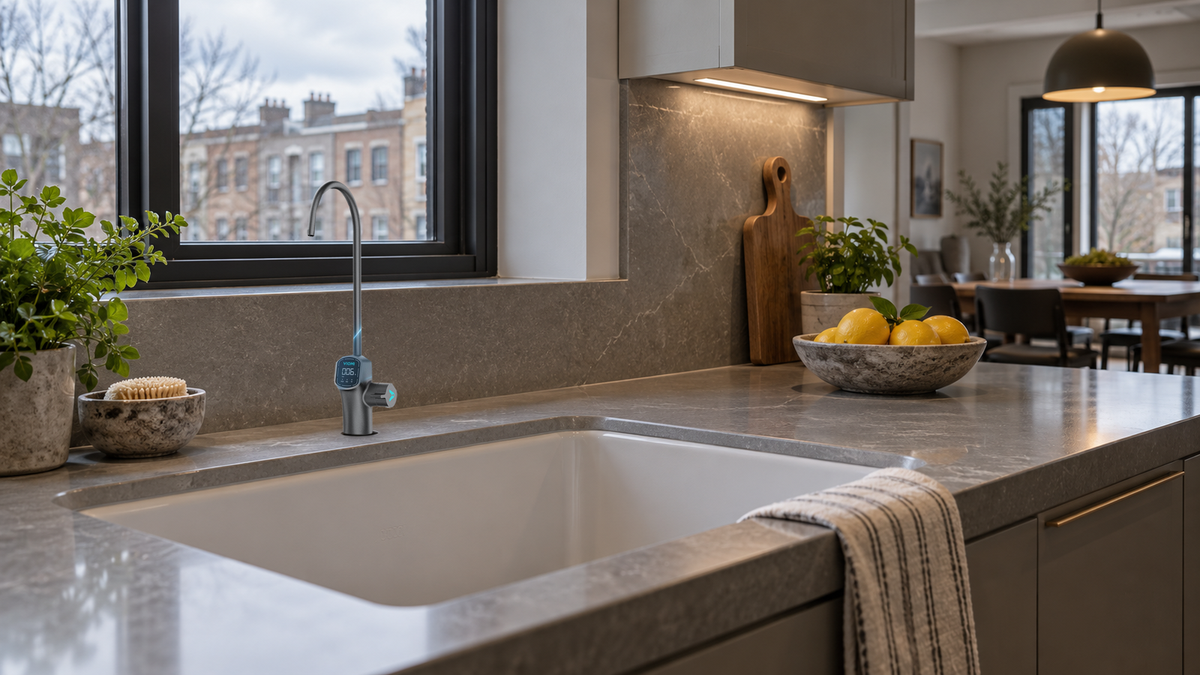
Houston shares its disinfectant with Dallas and Austin, since all three use chloramine, but its main system blends in some groundwater, while the other two draw on surface water alone. Houston's 2025 report also lists an average hardness of 135.5 ppm, above Austin's 93 ppm average, and an average TDS of 260 ppm. San Antonio differs in another direction, drawing on aquifer groundwater, with Canyon Lake surface water in some areas, and disinfecting with free chlorine. For lower dissolved solids in Houston drinking water, a reverse osmosis (RO) system fits, such as the Viomi V8 PRO, whose LCD faucet shows purified-water TDS, or the Viomi M1 for minerals added back after purification.
Houston, Dallas, Austin and San Antonio Reports Side by Side
Each city publishes an annual Consumer Confidence Report, but they don't print the same items, so every figure here comes from the utility's current report or its official water quality page.
| Utility and report | Where the water comes from | Disinfectant (2025 average) | Hardness | TDS |
|---|---|---|---|---|
| Houston Public Works, Main System (2025 report) | 90.3% surface water (Lake Livingston, Lake Conroe, Lake Houston); 9.7% groundwater (Chicot and Evangeline aquifers) | Chloramines, 2.8 ppm | 43.5 to 229 ppm, average 135.5 | 146 to 331 ppm, average 260 |
| Dallas Water Utilities (2025 report) | Surface water: Elm Fork of the Trinity River and six lakes | Chloramine; total chlorine residual 2.97 ppm | Not printed in the report | Not printed in the report |
| Austin Water (2025 report) | Surface water: Lower Colorado River through Lake Travis and Lake Austin | Chloramines, 2.3 ppm | 70 to 126 ppm, average 93 (5.4 grains per gallon) | Posted in monthly and quarterly summaries |
| San Antonio Water System (2026 report, 2025 data) | Groundwater from the Edwards, Carrizo, Simsboro, Trinity and Wilcox aquifers; Canyon Lake surface water in some areas | Free chlorine, 1.46 ppm | Typically 15 to 20 grains per gallon (SAWS FAQ) | Secondary results referred to Texas Drinking Water Watch |
Houston, Dallas and Austin all carry chloramine to the tap, while San Antonio uses free chlorine. Houston's annual report prints both hardness and TDS for its main system. And among the three utilities that publish hardness figures, Austin's average is lowest, Houston's is higher, and San Antonio's typical range sits above Houston's highest 2025 reading. Because 9.7 percent of the main system's water comes from the Chicot and Evangeline aquifers, a Houston blend carries some groundwater that Dallas and Austin supplies do not.
Houston and Dallas: Same Disinfectant, Different Report Contents
Houston's main system averaged 2.8 ppm chloramines in 2025; Dallas reported an average total chlorine residual of 2.97 ppm and says on its water quality page that it combines chlorine and ammonia to make chloramine. For taste at the tap, the two cities call for the same tool. The Water Quality Association's chloramine fact sheet states that "the most effective nonchemical method for removing chloramines is by activated carbon."
The difference is in what the reports publish. Dallas draws entirely from surface water and its report covers regulated contaminants, the disinfectant and byproducts, without a hardness or TDS line. Houston prints both: an average of 135.5 ppm hardness and 260 ppm TDS for the main system, with a wide range across the year. The same table lists an average pH of 7.8 and chloride at 38.4 ppm. In both cities, activated carbon is what reduces chloramine taste and odor. Houston's report also prints a TDS average, which helps a household decide whether it wants RO for drinking water. Chloride counts toward TDS, and EPA's secondary standards guidance names RO as effective for removing chloride as well as total dissolved solids, so Houston's chloride figure points to the same kitchen RO decision. The report also covers systems beyond Main, including Kingwood and Willow Chase, and a household outside the Main System reads its own section of the same report.
Houston and Austin: Lake Water on Both Sides, Different Hardness
Austin draws from the Lower Colorado River through Lake Travis and Lake Austin and averaged 2.3 ppm chloramines in 2025. Its report puts hardness at an average of 93 ppm, or 5.4 grains per gallon, with a high of 126. Houston's main-system average of 135.5 ppm works out to about 7.9 grains per gallon, and its maximum of 229 ppm is well above Austin's top reading.
Austin Water defines the conversion itself: "One grain of calcium carbonate dissolved in one U.S. gallon equals approximately 17.1 ppm." On that basis, Houston's average sits higher on the hardness scale than Austin's, though the two cities' ranges overlap. Converted the same way, Houston's main-system readings ran from about 2.5 to about 13.4 grains per gallon across 2025. In either city, carbon handles chloramine taste in drinking water and RO lowers dissolved solids.
Houston and San Antonio: Chloramine Versus Free Chlorine
Groundwater from the Edwards, Carrizo, Simsboro, Trinity and Wilcox aquifers supplies San Antonio Water System, with Canyon Lake water in some areas. At its production facilities, SAWS adds about 1 ppm of chlorine, according to its water quality FAQ, and the 2026 report lists free chlorine at an average of 1.46 ppm. That is the main disinfectant difference among the four utilities: SAWS customers receive water with free chlorine, while Houston's main system carries chloramine. SAWS's report lists a 2025 free chlorine range of 0.16 to 3.7 ppm, and for a household moving between the two cities, carbon remains the stage that addresses disinfectant taste and odor at the kitchen tap.
Hardness is the other gap. San Antonio's typical hardness, 15 to 20 grains per gallon according to SAWS (roughly 257 to 342 ppm when converted), sits above Houston's main-system maximum. Because "hard water is not a health hazard," as SAWS states plainly, the reason to treat it is scale, soap and appliance care. Between the two cities, whole-house scale control carries more weight on San Antonio's harder water, while a kitchen RO serves the same drinking-water purpose in both.
Brands the Differences Point To
| Difference you noticed | System that addresses it | Brands and models to compare |
|---|---|---|
| Dissolved solids in drinking water (Houston's 260 ppm average TDS) | Under-sink RO, tankless or with a tank | Viomi V8 PRO; Viomi M1; iSpring RCC7 (tank); Aquasana SmartFlow RO (tank) |
| Chloramine taste at every tap (Houston, Dallas, Austin) | Whole-house catalytic carbon | Aquasana Rhino Chloramines; SpringWell CF |
| Hard water and scale on fixtures | Salt-based softener or salt-free conditioner | SpringWell SS softener; SpringWell FutureSoft |
| Wanting a water test and dealer service | Local dealer system | Culligan of Houston; Kinetico authorized dealers |
With Houston's main system averaging 260 ppm TDS, households that want lower dissolved solids in drinking water can turn to a kitchen RO. Both Viomi options here are tankless, and the choice between them is about minerals. A household that wants plain RO water for drinking and cooking fits the Viomi V8 PRO, which filters on demand at a rated 800 GPD and uses pre-activated carbon to absorb chlorine and unpleasant odors. One that prefers selected naturally sourced minerals returned after purification fits the Viomi M1, which was also tested by SGS for lead reduction above 99.87%.

The Viomi V8 PRO's faucet, fittings, tubing and a spare PCB filter are in the box, and a step-by-step installation video covers the process. The Viomi V8 PRO can also send purified water through standard tubing to a compatible refrigerator or ice maker. Intertek has authorized the NSF/ANSI/CAN 372 mark for the Viomi V8 PRO, covering the lead content of the materials that touch your water.
Day to day, the TDS reading and filter life sit on the faucet in real time, so the dissolved-solids level of your drinking water is visible at every pour, and the Viomi M1's HD touchscreen also dispenses with one touch. On a phone, the Viomi app shows consumption patterns and system performance for the Viomi V8 PRO and sends filter replacement reminders for the Viomi M1.

Storage-tank designs remain an option: the iSpring RCC7 is a 5-stage tank RO, and Aquasana's SmartFlow RO adds a remineralizer stage to its tank. Households that want their water tested before choosing can book Culligan of Houston's in-home testing, which covers items including chlorine, TDS and water hardness, or go through Kinetico's authorized dealers, who recommend equipment after a water test.
What the Comparison Settles for a Houston Kitchen
For the house, chloramine at every tap makes catalytic carbon from Aquasana or SpringWell the whole-house option, and softening or scale control is worth adding where scale on fixtures, glassware or the water heater is the complaint. For drinking and cooking water, a kitchen RO lowers dissolved solids, with tankless options such as the Viomi V8 PRO and Viomi M1 and tank-style systems from iSpring and Aquasana. Dallas and Austin households face the same carbon decision, and San Antonio households face a bigger scale question with a different disinfectant. Two statewide guides, one on Texas water by utility and source and one on Texas filtration brands matched to the job, add the well-water and dealer side of the picture.
FAQ
Why don't the four reports list the same items?
The reports center on regulated contaminants and the disinfectant, and each utility handles taste-and-appearance measures in its own way. SAWS's report explains that taste and odor constituents are called secondary constituents and are regulated by the State of Texas, not the EPA, and that they are not required in that document, pointing readers to Texas Drinking Water Watch instead. Austin posts total hardness, pH and TDS in monthly and quarterly summaries, and Houston prints hardness, TDS, chloride, sulfate and pH in the report itself.
I'm moving to Houston. Should I change my water filter?
Coming from Dallas or Austin, carbon for chloramine taste stays relevant, since Houston's main system uses chloramine too. For lower dissolved solids at the kitchen tap, a kitchen RO is the addition to consider; Houston's main system averaged 260 ppm TDS in 2025. From San Antonio, the disinfectant changes from free chlorine to chloramine, and a kitchen RO serves the same purpose in both cities.
Can I compare reports from different years?
Yes, with care. Houston and Austin's figures here come from 2025 sampling and SAWS's 2026 report covers 2025 data, so the numbers in this comparison line up by year. A single year is a snapshot within a range that moves from year to year.
How do I convert hardness between ppm and grains per gallon?
Divide ppm by 17.1 to get grains per gallon, the factor Austin Water gives in its report, or multiply grains by 17.1 to get ppm. Houston's 135.5 ppm average is about 7.9 grains per gallon, Austin's 93 ppm is 5.4, and SAWS's typical 15 to 20 grains is about 257 to 342 ppm.
Share:
Home Water Filtration Brands for Los Angeles, Chosen by Where Your Water Comes From
Home Water Filtration Brands for Florida, Sorted by the Water Source Behind Your Tap