

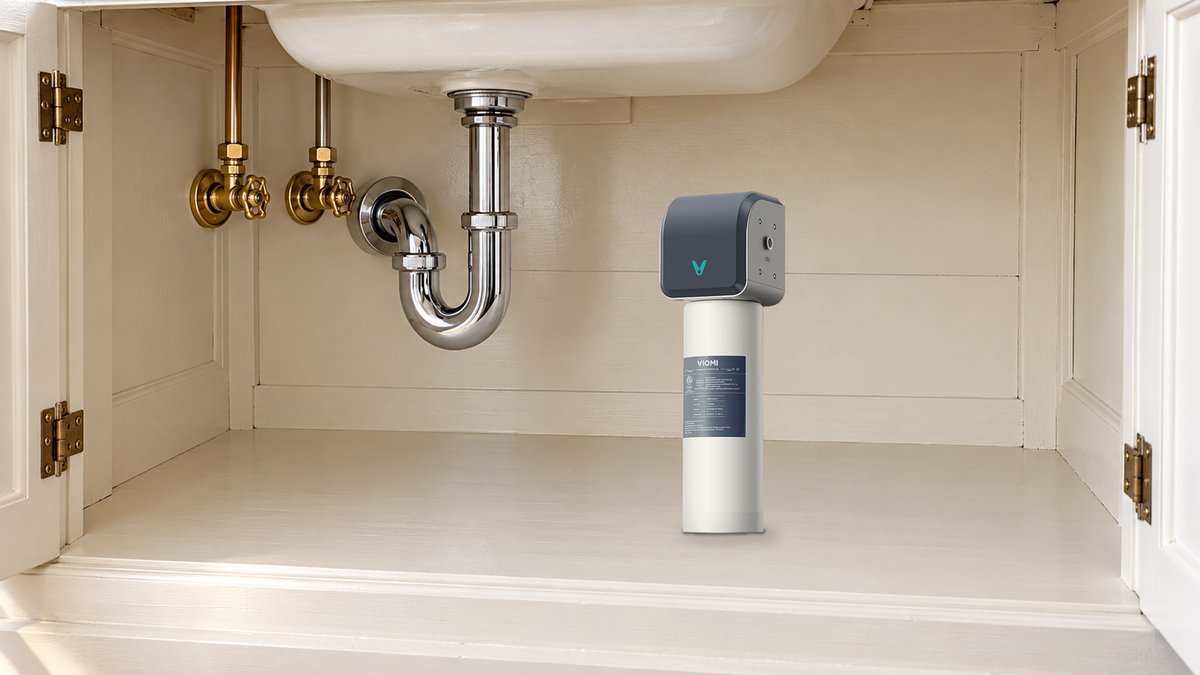
Lead-reduction filters come as pitchers, faucet mounts, refrigerator filters and two kinds of under-sink system, carbon and reverse osmosis (RO), and where the filter sits decides which brands are in play. For lead at the kitchen tap, the Viomi Under-Sink Water Filtration System (VM-IUO1PCW-L-US) brings lead filtering to the faucet already in place, and the Viomi M1 RO system reduces lead by more than 99.87% in testing by SGS.
The placement decides how much of the household's water gets filtered. A pitcher covers what you pour from it, a faucet mount and an under-sink system on the existing faucet cover cold water at the main kitchen tap, a dedicated faucet or an RO system gives drinking and cooking water its own spout, and a refrigerator filter covers the water and ice from the door. Pitchers and refrigerator filters need no plumbing work, a faucet mount screws onto the spout, and under-sink systems connect at the cold water valve below the sink.
| Where it sits | Water it treats | Brands and models that reduce lead |
|---|---|---|
| Under-sink, on the existing faucet | Cold water from the main kitchen faucet | Viomi Under-Sink Water Filtration System (VM-IUO1PCW-L-US), Aquasana Claryum Direct Connect (AQ-MF-1) |
| Under-sink reverse osmosis | Drinking and cooking water from the RO faucet | Viomi M1, Aquasana SmartFlow (AQ-SFRO2), Waterdrop G3P600 and G3P800, Culligan Aquasential RO, Kinetico K5 |
| Under-sink, dedicated faucet | Water from a separate filtered-water faucet | Viomi Under-Sink Carbon Filter, Aquasana Claryum 2-Stage (AQ-6200) |
| Pitcher | Water poured from the pitcher | Brita Elite filter (OB06), PUR PLUS pitcher filter (PPF951K), ZeroWater 5-stage filter |
| Faucet mount | Water from the main faucet when the filter is switched on | PUR PLUS faucet filter (RF-9999), Brita faucet system filter (FR-200) |
| Refrigerator | Water and ice from the refrigerator dispenser | everydrop Filter 1 (EDR1RXD1), Samsung HAF-QIN/EXP |
Pitchers: Lead Filtering for the Water You Pour
Three pitcher filters are certified to reduce lead, all by IAPMO R&T, and for a pitcher that is the household's main drinking water, cartridge life decides how often someone has to swap it. The Brita Elite filter (OB06) runs 120 gallons, about six months for most households by Brita's estimate, while the PUR PLUS pitcher filter (PPF951K) and the ZeroWater 5-stage filter are rated at 40 and 15 gallons. In everyday terms, 15 gallons comes to about 240 eight-ounce glasses before the ZeroWater cartridge needs replacing.
Faucet-Mount Filters on the Spout
A faucet mount screws onto the end of the kitchen faucet and filters when it is switched on, while switching it off sends regular tap water through for washing dishes, which also saves the cartridge's rated gallons for drinking and cooking. Both faucet mounts here carry NSF/ANSI 53 lead certification and a 100-gallon cartridge. The Brita faucet system filter (FR-200) lasts about four months against three for the PUR PLUS faucet filter (RF-9999), and its built-in electronic filter change indicator resets and starts each time a new filter goes in.
Refrigerator Filters for Water and Ice
Some refrigerator filters carry a lead claim too. Two appear in NSF's listings under NSF/ANSI 53 with lead reduction, the everydrop Filter 1 (EDR1RXD1), and Samsung's HAF-QIN/EXP. Capacity is where they differ: the Samsung cartridge is listed at 316 gallons, while the everydrop performance data sheet gives a 200-gallon rated capacity for the version with a filter indicator. A larger rating means more water and ice between cartridge changes.
Under the Sink, on the Faucet You Already Have
An under-sink filter on the cold line treats the water that comes out of the main kitchen faucet, so cooking water and drinking water get the same filter without a new spout. It also leaves the countertop and the faucet's look unchanged, which matters in kitchens with stone counters or a faucet the household wants to keep.
The Viomi Under-Sink Water Filtration System (VM-IUO1PCW-L-US) keeps the existing faucet in use. Its direct-connect hoses attach at the standard 3/8" feed water valve, with an included adapter for 1/2" lines. It runs without electricity and needs no new hole in the countertop. Its cartridge pairs PP cotton with a carbon rod and filters to 0.5 micron. Lead, chlorine and PFOA/PFOS are the contaminants it is built to reduce. Cartridge changes use a twist-and-lock design that takes seconds and no tools, and the same replacement cartridge fits both Viomi under-sink carbon systems, so one cartridge type serves either kitchen setup.

In the same spot, the Aquasana Claryum Direct Connect (AQ-MF-1) reduces lead along with PFOA/PFOS and mercury. It is designed for cold water and rated at 784 gallons or six months.
Under the Sink With a Dedicated Filtered-Water Faucet
Adding a second faucet beside the main one changes how the kitchen uses filtered water: drinking water and kettle water come from one spout while the main faucet keeps handling dishes and washing up. That separate spout comes with the Viomi Under-Sink Carbon Filter, which runs the same cartridge as the direct-connect system above.
Aquasana's Claryum 2-Stage (AQ-6200) takes the same separate-tap approach, with one variation on the faucet itself: Aquasana also sells it with a "No Faucet" option for owners who supply their own faucet. Its reduction list of lead, PFOA, PFOS and mercury matches Aquasana's direct-connect model. The cartridge, replaced with AQ-C2-R, is rated at 500 gallons or six months, and the system is rated at 0.5 gpm.
Reverse Osmosis Systems That Reduce Lead
An RO system pushes water through a membrane fine enough to reject dissolved metals, then sends it to its own faucet for drinking and cooking. The RO models here come in tankless designs, such as the Viomi M1 and the Waterdrop G3 models, and in tank-based designs from Aquasana, Culligan and Kinetico.
Lead drops by more than 99.87% through the Viomi M1 in independent testing by SGS, which has also granted the M1 its "SGS Performance Tester" mark for PFOS and PFOA reduction. Its tankless design makes water on demand from a 1000 GPD membrane. Selected minerals are added back after filtration for a smoother taste. At the faucet, an HD touchscreen shows live TDS readings and the remaining life of each filter. The Viomi app sends replacement reminders, and the filters last up to 2 years for the PCB and up to 4 years for the RO.

Among the other RO systems that reduce lead, Waterdrop's G3P600 and G3P800 are tankless like the M1, while the Aquasana SmartFlow (AQ-SFRO2), which has a remineralizer stage, uses a tank. Culligan and Kinetico sell their tank-based systems, the Culligan Aquasential RO and the Kinetico K5 Drinking Water Station, through their own dealers.
Our earlier guide to how effective lead-removal filters are by brand compares rated capacity and lead test results for several of these models.
FAQ
Which placement fits an older house with lead plumbing?
Lead can enter drinking water when service pipes that contain lead corrode, according to the EPA, and an older home may also have lead in solder or fixtures between the street and the tap, so the filter belongs where people take drinking and cooking water. An under-sink system on the kitchen faucet or an RO faucet covers that water every time for the whole household, while a pitcher covers only what is poured from it.
Can a refrigerator filter reduce lead?
Some can. The everydrop Filter 1 (EDR1RXD1) and Samsung HAF-QIN/EXP each appear in NSF's listings under NSF/ANSI 53 with lead reduction, so the water and ice from those refrigerators pass through a lead-reducing cartridge. The EPA's consumer tool for lead filters covers refrigerator cartridges along with faucet-mount and pitcher filters, and it uses lead reduction to 5 ppb or less under NSF/ANSI 53, together with particulate reduction (Class I) under NSF/ANSI 42, as its criteria.
Can hot water run through a lead filter?
Fill from the cold tap and heat afterward. The EPA advises against running hot water through a filter and recommends using "only cold water for drinking, cooking and making baby formula," noting that boiling water does not remove lead. For a kettle or a pot of pasta, that means drawing filtered cold water first and heating it on the stove.
Can one home use more than one placement?
Placements can be combined, since each covers a different outlet. A kitchen can run an under-sink carbon system or an RO faucet for drinking and cooking water while a refrigerator filter such as the everydrop Filter 1 (EDR1RXD1) or Samsung HAF-QIN/EXP handles the door dispenser. The Viomi M1 can also send its RO water to a compatible refrigerator or ice maker over standard tubing through Multi-device Mode, so one system covers both. A pitcher can stay in use in a room away from the kitchen, such as a home office or a bedroom.
Which lead-reduction products also cover PFAS?
Several products in this list cover PFAS alongside lead. What differs is how much of the household's water gets that coverage. Every glass and pot drawn from the Viomi M1's faucet has passed through a system that reduces PFOS by more than 99.67% and PFOA by more than 99.42% in SGS testing. Under-sink carbon from Viomi or Aquasana brings PFOA/PFOS reduction to the kitchen tap, while a pitcher such as the ZeroWater 5-stage filter or the PUR PLUS pitcher filter (PPF951K) covers PFAS only in what is poured from it. A household that wants both from one product can pick from pitchers, under-sink carbon or RO, and our guide to matching a filter to common drinking water contaminants covers other contaminants by filter type.
How often does a lead filter need replacing?
Each cartridge's rated life sets the schedule, and the EPA notes that using a cartridge after it has expired "can make it less effective at removing lead." Among the products here, pitcher cartridges run from 15 to 120 gallons, the faucet mounts about three to four months, and the Aquasana under-sink carbon cartridges six months. The Viomi M1's PCB filter lasts up to 2 years and its RO filter up to 4 years, and its touchscreen faucet shows the remaining life of each.
Placement Decides Which Lead Filter Fits
Families who cook with filtered water every day get the most coverage from an under-sink or RO placement, because pasta water, coffee and baby formula all start at the kitchen tap. Households that mainly want cold drinking water and ice from the refrigerator door can lean on a lead-reducing refrigerator filter, and a pitcher stays the option that needs no plumbing work at all, which suits renters and short stays.
Share:
Water Treatment Brands in Texas: Local Dealer Networks and Direct-Ship Lines
Home Water Filtration Brands for Los Angeles, Chosen by Where Your Water Comes From