

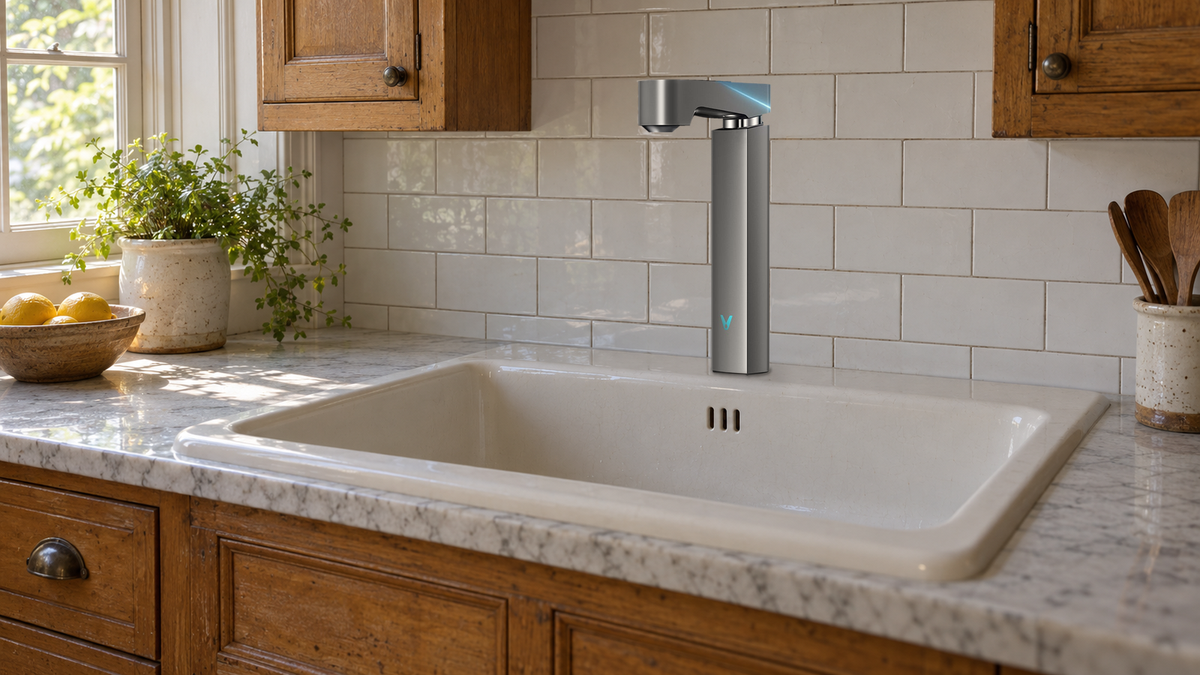
Lead-removal filters are effective to a defined, tested level, and the format decides how much of your kitchen water they cover. For drinking and cooking water from one dedicated faucet, the Viomi M1 under-sink reverse osmosis (RO) system covers that job: it reduced lead by more than 99.87% in independent testing by SGS, and its RO filter lasts up to 4 years. Pitchers and faucet filters from Brita, PUR and ZeroWater, along with the Aquasana Claryum Direct Connect on the cold line, carry certified lead claims, each tested at pH 6.5 and pH 8.5 against a fixed limit for the filtered water.
For the Brita Elite, PUR PLUS and ZeroWater filters, that test started with about 150 µg/L of lead and allowed no more than 5 µg/L after filtering. Each claim holds up to the cartridge's rated capacity, from 15 gallons on the ZeroWater 5-stage filter to 784 gallons on the Aquasana, so past the pass line, the comparison that changes a household's routine is the format and how long each cartridge stays within its rating.
The Pass Line Every Certified Lead Claim Has to Meet
A lead claim under NSF/ANSI 53, the standard for health-related contaminants, is a pass-or-fail test against a fixed target. The performance data sheets for the Brita Elite, PUR PLUS and ZeroWater filters show the setup:
- Challenge water: about 150 µg/L of lead (written as 150 ±15 ppb on Brita's Elite data sheet and 0.15 mg/L ±10% on PUR's and ZeroWater's).
- Two pH levels: the test runs at pH 6.5 and again at pH 8.5, so the claim covers both slightly acidic and alkaline water.
- A maximum for the filtered water: 5 µg/L (0.005 mg/L) on the Brita Elite, PUR PLUS and ZeroWater sheets.
Going from a nominal 150 µg/L to 5 µg/L works out to a reduction of about 96.7%, and the certified claims on those sheets are tied to that line. Brita's Elite sheet summarizes the result in plain terms: the concentration of each listed substance "was reduced to a concentration less than or equal to the permissible limit for water leaving the systems." For context, EPA's health goal for lead in drinking water is zero.
Each data sheet and laboratory report records its own test runs and influent levels, so a reduction percentage reads best as a measure of that model against its own test conditions.
Capacity Decides How Long a Filter Stays Effective
A lead claim is rated up to the cartridge's capacity, under the use conditions on its data sheet. EPA's guidance on lead filters is direct about the other side of that: "Using the cartridge after it has expired can make it less effective at removing lead" (EPA, Basic Information about Lead in Drinking Water).
Converting each rating into days shows how different the routines are. Daily use here means all the water that passes through the filter, for drinking and cooking alike. The day counts divide rated gallons by that volume and stop at the brand's calendar limit if it comes first; a replacement signal such as ZeroWater's meter reading can call for a new filter sooner.
| Model | Format | Rated capacity | Time limit or replacement signal | Capacity or calendar limit at 1 gal/day | Capacity or calendar limit at 2 gal/day |
|---|---|---|---|---|---|
| ZeroWater 5-stage filter | Pitcher | 15 gallons | Meter reading of 006 | 15 days | 7.5 days |
| PUR PLUS pitcher filter (PPF951K) | Pitcher | 40 gallons | 2 months | 40 days | 20 days |
| Brita Elite filter (OB06) | Pitcher | 120 gallons | about 6 months | 120 days | 60 days |
| PUR PLUS faucet filter (RF-9999) | Faucet mount | 100 gallons | 3 months | about 3 months | 50 days |
| Brita faucet filter (FR-200) | Faucet mount | 100 gallons | about 4 months | 100 days | 50 days |
| Aquasana Claryum Direct Connect (AQ-MF-1) | Under-sink, feeds existing faucet | 784 gallons | 6 months | 6 months | 6 months |
The pattern is clear. Low-capacity pitcher cartridges reach their rating in days or weeks in a household that filters a gallon or two a day, while a larger cartridge on the cold line runs until its time limit. Daily volume also matters for pitchers in another way: Brita advises processing "no more than 2 gallons/7.5 liters daily" through the Elite pitcher filter, and PUR rates its pitcher filters at 2 gallons per day.
Pitchers and Faucet-Mount Filters
Pitchers and faucet filters are the simplest way to put a certified lead claim on a glass of water.
Brita Elite (OB06). IAPMO R&T lists the Elite filter under NSF/ANSI 53 for lead with Brita's listed pitchers, NSF lists it with the Pacifica and Tidal pitchers, and WQA lists it as well. Brita rates it at 120 gallons, about 6 months for most households, and specifies cold water only (maximum 85°F).
PUR PLUS pitcher filter (PPF951K) and PUR PLUS faucet filter (RF-9999). Both carry lead under NSF/ANSI 53 in IAPMO R&T's listing, along with Total PFAS. The pitcher filter is rated at 40 gallons or 2 months; the faucet filter at 100 gallons or 3 months, with a maximum water temperature of 82°F.
ZeroWater 5-stage filter. IAPMO R&T certifies the 5-stage filter and compatible pitchers for lead, mercury, PFOA, PFOS and hexavalent chromium at a 15-gallon capacity. ZeroWater's own guidance is to replace the filter when its meter reads 006 on filtered water, while noting that the meter measures total dissolved solids and "is not intended to measure lead."
Brita faucet system (FF-100 / SAFF-100 with FR-200 filter). WQA certifies the system under NSF/ANSI 53 for lead. The FR-200 filter is rated for 100 gallons, about 4 months, and the faucet system has a built-in filter replacement indicator.
Under-Sink Carbon on the Existing Faucet
An under-sink carbon filter that feeds the existing kitchen faucet covers cooking water as well as drinking water, without a separate spout. The Aquasana Claryum Direct Connect (AQ-MF-1) is certified by IAPMO R&T under NSF/ANSI 53 for lead along with PFOA/PFOS, mercury and other claims, is rated at 784 gallons or 6 months, and is designed for cold water only.
The larger capacity changes the routine more than the result: each cartridge runs up to 6 months, or until it reaches 784 gallons if that comes first, instead of a few weeks, at a rated flow of 1.5 gpm. Because it treats the cold line feeding the main faucet, the same cartridge covers cold water for the pasta pot, the kettle and the drinking glass.
Reverse Osmosis at the Kitchen Sink: Viomi M1
For households that want RO-treated water for everything they drink and cook, the Viomi M1 brings model-specific lead evidence together with a long filter schedule.

- Lead reduction above 99.87% in SGS testing. The Viomi M1 reduces lead by more than 99.87%, PFOS by more than 99.67% and PFOA by more than 99.42%, independently tested by SGS.
- Nine stages around a 0.0001-micron RO membrane, rated at 1000 GPD, tankless, with a 3:1 pure-to-drain ratio and a remineralization stage for taste.
- A filter schedule that is easy to keep: the PCB filter lasts up to 2 years and the RO filter up to 4 years. The touchscreen smart faucet shows filter life, and the Viomi app sends replacement reminders.
Installation parts come in the box, along with a step-by-step video for the model, and the setup fits a standard kitchen: municipal tap water, a standard outlet (its own always-on outlet if the disposer uses a switched one), a 1" to 1.5" hole for the smart faucet and a 1/4" hole in the drain pipe. It works with inlet pressure from as low as 14.5 psi.

For filtration at the faucet you already have, the Viomi Under-Sink Water Filtration System (VM-IUO1PCW-L-US) connects to the cold water line with no electricity, uses a 0.5-micron PP cotton and carbon rod cartridge designed to reduce lead, chlorine and PFOA/PFOS, and lasts up to 12 months per cartridge.
Where household lead comes from and how testing works are covered in lead in tap water: testing and removal.
FAQ
What happens when a lead filter reaches its rated capacity?
The claim is rated up to the cartridge's gallons or time limit, whichever comes first. Past that point the cartridge is beyond its rated use, and EPA notes that an expired cartridge can be less effective at removing lead. Some filters also show when a cartridge change is due, such as the Brita faucet system's replacement indicator or the Viomi M1's filter-life display and app reminders.
Can I run hot tap water through a lead filter?
Use cold water. EPA's lead guidance says "Do not run hot water through the filter," and the data sheets agree: Brita's Elite pitcher filter is rated for a maximum of 85°F, PUR's faucet filter for 82°F, and Aquasana's AQ-MF-1 for cold water only.
Does a filter replace running the tap after water has been sitting?
They do different jobs. Running the cold tap clears water that has stood in the pipes overnight; New York City's DEP, for example, suggests flushing the tap in the morning until the water turns colder, which usually takes about 1 to 2 minutes (NYC DEP). A filter treats whatever passes through it, so the two habits work well together.
Should I choose a pitcher or an under-sink system for lead?
Choose by how much water you use and where. A pitcher with a certified lead claim suits one or two people drinking from the fridge, within the 2-gallons-a-day guidance Brita and PUR give for their pitcher filters. An under-sink filter or RO system covers drinking and cooking water at the tap and runs months between cartridge changes.
Lead Filter Effectiveness, Summed Up
Every certified lead claim from Brita, PUR, ZeroWater and Aquasana rests on the same kind of test: lead-spiked water at two pH levels, brought to or below the limit printed on the data sheet. For the Brita Elite, PUR PLUS and ZeroWater filters, a nominal 150 µg/L challenge and a 5 µg/L limit mean a reduction of about 96.7%. Beyond that, the routine is a matter of capacity and use. A 15- or 40-gallon pitcher cartridge reaches its rating in days or weeks, a 100- to 120-gallon cartridge in a few months at most, the 784-gallon Aquasana cartridge at up to 6 months, and an RO system like the Viomi M1 runs up to 2 years on its PCB filter and up to 4 years on its RO filter. With each model's evidence read against its own test, the deciding questions are which format matches the water you use and whether the cartridge stays within its rating.
Share:
RO Water for Plants: Flow Rate, Drain Ratio and Putting Nutrients Back
Water Filter Brands for Chlorine Removal, Sorted by Where the Filter Goes