

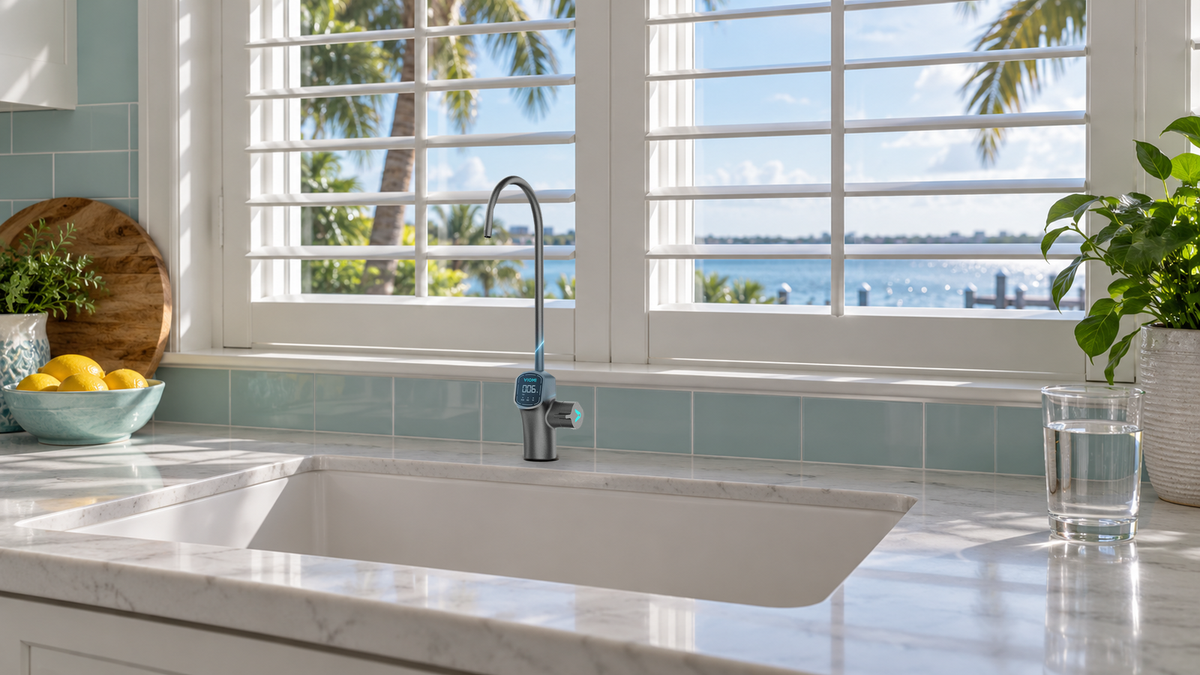
In its 2015 water-use survey, the U.S. Geological Survey found that 92 percent of Florida's population drank groundwater from wells, public or private, and the limestone Floridan aquifer system supplied almost 62 percent of the state's groundwater withdrawals, with the Biscayne aquifer serving South Florida. For a city-water kitchen drawing on that mineral-rich groundwater, a reverse osmosis (RO) system at the drinking-water tap lowers dissolved minerals, and the Viomi V6 PRO is a well-matched choice for its long-acting scale inhibitor stage.
Homes on a private well base their choice on a lab test of the well.
Limestone Aquifers and Hard Water
Florida's groundwater picks up minerals from the rock it moves through. The Florida Department of Environmental Protection's aquifer geology overview explains that carbonate minerals such as calcite and dolomite dissolve readily, so the state's groundwater carries calcium, magnesium and bicarbonate. FDEP classifies water between 150 and 300 mg/L as calcium carbonate as hard and notes that very hard water "leaves scale inside pipes, boilers and tanks."
Utilities treat that water before it reaches you, and how much hardness remains varies by city. Gainesville Regional Utilities, which pumps from the Floridan aquifer, treats it through oxidation, lime softening, recarbonation, filtration and disinfection, according to its 2025 water quality report, and lists its water at approximately 140 mg/L, or 8.2 grains per gallon, on its water quality page. Other systems deliver harder water, as the Tampa Bay example below shows. Treatment for that hardness can sit at the kitchen tap for drinking water, at the main water line for the whole house, or at both. Gainesville's disinfectant is chlorine, averaging 0.98 ppm in its 2025 report, so the taste a carbon stage addresses at a Gainesville tap is plain chlorine rather than chloramine.
Blended Supplies Around Tampa Bay
Tampa Bay Water, the wholesale supplier for the region's member utilities, describes itself as the only U.S. utility that blends three sources. Its current sources page showed this mix for September 2026: 74.1 percent groundwater, 19.8 percent surface water and 6.1 percent desalinated seawater. The blend shifts through the year: seawater is used more in the dry season, typically October to June, according to Tampa Bay Water, and river water takes the lead in summer when rains raise river flows.
Pinellas County Utilities, one of the member utilities, shows what that blend looks like at the tap; eleven regional wellfields pumping from the Floridan aquifer are its primary source. Its 2025 water quality report lists total hardness at 217 ppm, within a range of 189 to 244, and gives a "water softener setting for hardness" equivalent to 11.1 to 14.3 grains per gallon. Read against FDEP's scale, which classes water between 150 and 300 mg/L as calcium carbonate as hard, that 217 ppm average sits well inside the hard band, while Gainesville's approximately 140 mg/L falls just below it. The report's softener setting gives a Pinellas household a reference range when programming a softener. Chlorine is the primary disinfectant in Tampa Bay Water's supply, with monochloramine as the secondary disinfectant, so carbon filtration is part of the picture for taste here too.
South Florida on the Biscayne Aquifer
The Biscayne aquifer is the source of 98 percent of South Florida's public water supply, according to the USGS. In Miami-Dade, wells draw primarily from the Biscayne Aquifer, with a limited number drawing from the Floridan Aquifer, according to the Miami-Dade Water and Sewer Department's 2025 water quality report. The department's Hialeah reverse osmosis plant uses brackish water from the Upper Floridan Aquifer. At the Alexander Orr, Jr. plant, the water "receives lime treatment to reduce hardness," and the department adds ammonia "to combine with chlorine and form chloramine," reported at an average of 2.5 ppm in the main system.
For a Miami-Dade home, catalytic carbon at the main line treats chloramine at every faucet, and RO at the kitchen tap lowers dissolved minerals in drinking water.
City Water in the Kitchen: Under-Sink RO
Florida city water arrives treated and disinfected, so a kitchen system is there to improve taste and lower the dissolved solids and minerals that leave scale in kettles and coffee makers. EPA's secondary standards guidance describes reverse osmosis as effective for removing total dissolved solids and other inorganic substances.
On Florida's mineral-rich groundwater, the Viomi V6 PRO's long-acting scale inhibitor suits that water because it helps keep scale from building up inside the system, the kind of buildup FDEP describes inside pipes, boilers and tanks. Its pre-activated carbon handles the taste side of the kitchen job, absorbing chlorine and unpleasant odors.
Its faucet, fittings and tubing arrive in the box, with a step-by-step installation video to follow. Intertek has authorized the NSF/ANSI/CAN 372 mark for the Viomi V6 PRO, covering the lead content of materials in contact with water.

Households that like some minerals in their drinking water can choose the Viomi M1 instead, which reintroduces selected naturally sourced minerals after purification and was tested by SGS for lead reduction above 99.87%.

Both faucets keep TDS and filter life in view: the Viomi V6 PRO on an LCD smart faucet, the Viomi M1 on an HD touchscreen that also offers one-touch dispensing. Replacement reminders for both come through the Viomi app, and with Multi-device Mode in that app, the Viomi M1 can also supply a compatible refrigerator or ice maker through standard tubing.
Other kitchen RO systems Florida shoppers compare include Waterdrop's G3P600, a 600 GPD tankless model, and the iSpring RCC7, a 5-stage tank system. A wider comparison of under-sink reverse osmosis brands sets tanked, tankless and remineralizing models side by side.
The Whole House: Scale and Disinfectant
Scale on showerheads, glass doors and water heaters is handled where water enters the home, and the main choice there is whether to use salt. A salt-based softener such as SpringWell's SS removes calcium and magnesium hardness minerals, and it needs salt refills and a drain line and adds a little sodium, a point FDEP also makes about some hardness filters. Conditioning without salt, as SpringWell's FutureSoft does, limits scale buildup instead. When a household would rather have equipment chosen after a test of its own water, Kinetico's authorized dealers sell, install and service its systems and recommend equipment after conducting a water test.
Disinfectant taste is a separate main-line job in chloramine areas such as Miami-Dade and the Tampa Bay region, where whole-house catalytic carbon handles shower and laundry water as well. Catalytic carbon formulated for chloramines is the basis of Aquasana's Rhino Chloramines, while SpringWell's CF combines catalytic carbon with KDF and sediment filtration for chlorine and chloramine from city water.
Testing Private Well Water
The Florida Department of Health's private well page says about 88 percent of residents are served by public water systems, and the other 12 percent get their water from limited-use systems and private wells. For those wells, responsibility sits with the owner: the department "strongly recommends that you test your water for bacteria and nitrate at least once per year." Your county health department can explain how to collect samples, and state-certified private laboratories also run tests. For a private well owner, that annual bacteria-and-nitrate test comes before choosing any treatment.
Some Florida wells also bring signs you can see or smell, such as iron staining or a rotten-egg odor, and a water treatment professional can match main-line equipment to what a particular well shows. A step-by-step guide on how to choose a water filter for your home starts from the water source, wells included, and works toward the filter type.
Matching Florida Water to a System
| Water source | What it tends to bring | System that fits | Brands and models |
|---|---|---|---|
| City water from aquifer groundwater | Hardness and dissolved minerals at the kitchen tap | Under-sink RO, tankless or with a tank | Viomi V6 PRO; Viomi M1; Waterdrop G3P600; iSpring RCC7 (tank) |
| City water with chloramine (Miami-Dade, Tampa Bay region) | Disinfectant taste at every faucet | Whole-house catalytic carbon | Aquasana Rhino Chloramines; SpringWell CF |
| Hard city water throughout the house | Scale on fixtures and appliances | Softener or salt-free conditioner | SpringWell SS; SpringWell FutureSoft; Kinetico authorized dealers |
| Private well | Results that vary well by well | Lab test, then professional pretreatment | County health department; state-certified laboratory; local water treatment dealer |
FAQ
What testing does a private well need before choosing treatment?
Bacteria and nitrate results come first: the Florida Department of Health recommends testing well water for both every year, through the county health department or a state-certified laboratory. Iron staining and a rotten-egg odor are separate signs, and a water treatment professional can match main-line equipment to them.
What causes a sulfur or rotten-egg smell?
The Department of Health's odor and staining fact sheet explains that hydrogen sulfide gas "can occur in wells anywhere in Florida" and can be produced by sulfur bacteria, which it describes as not harmful. If the smell comes only from the hot water tap, the source is likely the water heater. For smells from every tap, the same fact sheet lists aeration, oxidation and activated carbon adsorption among the ways odor compounds are treated, so a water treatment professional can match the method to your well.
What should a household do after a hurricane or a boil-water notice?
Follow the notice from your utility or county until it is lifted; the CDC's drinking water advisory guidance explains what each type of advisory asks households to do. If flood waters reach a private well, the Department of Health's flooded well guidance says to boil drinking water or use bottled water and to contact the county health department for bacteriological testing and disinfection of the well.
How much sodium is in Florida city water?
Among the 2025 reports from Miami-Dade, Pinellas County and Gainesville, sodium is lowest in Gainesville's, at 21.1 ppm from 2024 sampling, and highest in Miami-Dade's, at 33 ppm in its main system, with Pinellas County in between at 29.7 ppm. All three sit well under the 160 ppm figure listed in the MCL column of the Pinellas County and Gainesville tables.
Florida Water Reports and Agencies
On city water, the source, disinfectant and detected contaminants all appear in your utility's annual water quality report, and some reports, like Pinellas County's, include hardness and a softener setting; Tampa Bay Water also posts its monthly source mix online. Private well owners get testing guidance from the Florida Department of Health's private well page and their county health department, and FDEP maintains the list of certified laboratories.
Share:
Houston's Water Report Next to Dallas, Austin and San Antonio: Which Filter Brands the Comparison Points To
Under-Sink RO Rated Well Above 0.25 GPM, and What a Pump Actually Speeds Up