

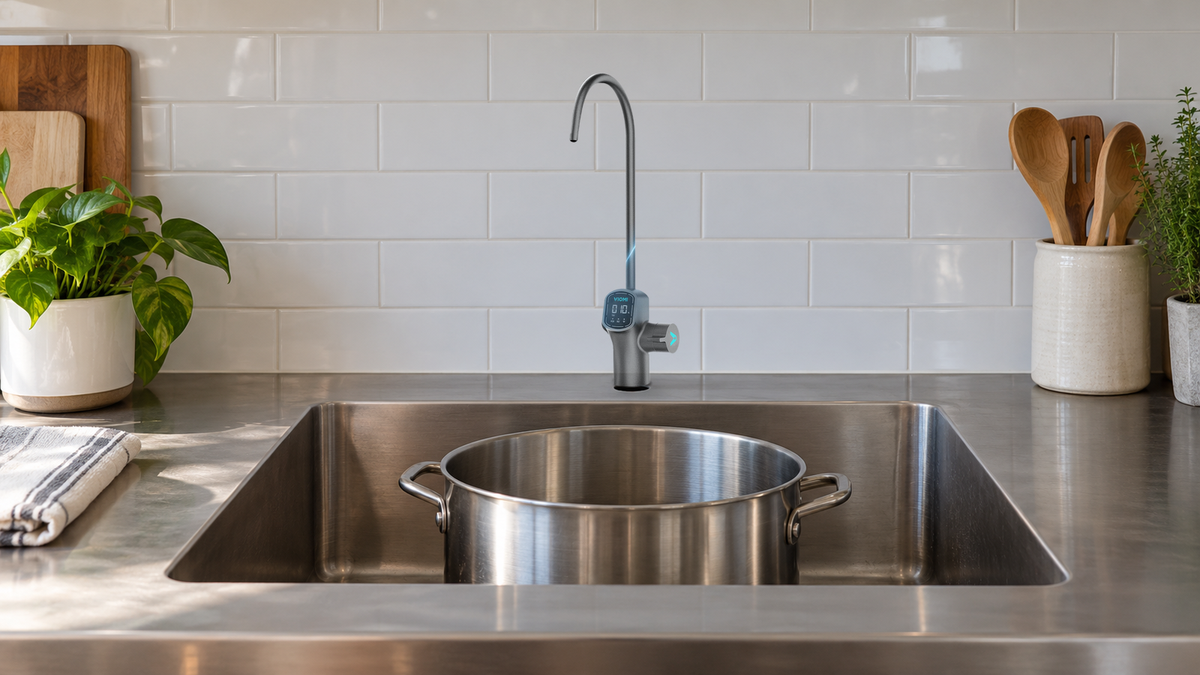
A booster pump raises the pressure on an RO membrane, and more pressure means more purified water; that gain reaches the faucet directly only on a tankless system, where purified water goes from the membrane to the tap with no tank in between. Among the models compared here, the ones rated well above 0.25 gallons per minute (GPM) on a rated-output basis are tankless under-sink systems with a high-output membrane. For a kitchen that wants a faster pour, the Viomi M1 fits that need, with a 1000 GPD rating that works out to more than double the 0.25 GPM baseline.
On a tank system, a pump's effect on the pour runs through the tank. A booster pump raises feed pressure at the membrane and a permeate pump helps the tank fill faster, and the speed at the faucet comes from the pressure stored in the tank, which falls as the tank empties.
Models Rated Well Above 0.25 GPM
A flow of 0.25 GPM, running all day, equals 360 gallons per day (0.25 × 1,440 minutes). Dividing a GPD rating by 1,440 gives the per-minute rate that rating implies. In kitchen terms, 0.25 GPM means about four minutes to fill a 1-gallon pitcher and about eight minutes for a 2-gallon stockpot, the wait that every system in the table below is measured against.
| Model | Design | Rated output | Per-minute equivalent (GPD ÷ 1,440) |
|---|---|---|---|
| Viomi M1 | Tankless, built-in booster pump, remineralization | 1000 GPD | about 0.69 GPM |
| Viomi V8 PRO | Tankless, built-in booster pump | 800 GPD | about 0.56 GPM |
| Viomi V6 PRO | Tankless, built-in booster pump | 600 GPD | about 0.42 GPM |
| iSpring RO1200 / RO1200AK | Tankless | 1200 GPD | about 0.83 GPM |
| iSpring RO1000-BN | Tankless | 1000 GPD | about 0.69 GPM |
| iSpring RO800G | Tankless | 800 GPD | about 0.56 GPM |
| iSpring RO600-BN | Tankless, built-in booster pump | 600 GPD | about 0.42 GPM |
| iSpring RO500-BN | Tankless | 500 GPD | about 0.35 GPM |
Every model above works out to more than 0.25 GPM, and six of them (Viomi M1, Viomi V8 PRO, iSpring RO1200, iSpring RO1200AK, iSpring RO1000-BN and iSpring RO800G) come out above 0.5 GPM. For a broader look at how the two designs differ beyond flow, see our comparison of tankless and tank-based RO brands.
Pressure Drives Membrane Output
Pushing harder on the membrane makes it produce more water. In the words of DuPont, which makes FilmTec RO membranes, "water flux across the membrane increases in direct relationship to increases in feedwater pressure" (DuPont FilmTec, Factors Affecting RO Membrane Performance).
Manufacturers' own ratings show the same relationship. The GPD figures for APEC's tank systems are "based on 60 psi input water pressure at 77 degree F water temperature," and for its countertop RO-CTOP, the manual lists output by house pressure:
| Feed pressure | APEC RO-CTOP output |
|---|---|
| 30 psi | 45 GPD |
| 40 psi | 60 GPD |
| 50 psi | 75 GPD |
| 60 psi | 90 GPD |
On this APEC unit, doubling the pressure from 30 to 60 psi doubles the rated output. That is the job a booster pump does on the membrane side: it supplies pressure the house line doesn't. How much of that gain reaches the faucet depends on whether a storage tank sits between the membrane and the tap.
The dissolved minerals in the feed water work in the opposite direction. Osmotic pressure rises with salt concentration, so at a constant feed pressure, saltier water produces less permeate; as DuPont puts it, "higher salt concentration results in lower membrane water flux." That is one reason the same pump and membrane can make a little more or a little less water from one city's tap to the next.
On a Tank System, the Faucet Runs on Tank Pressure
A tank system makes water slowly and stores it in a pressurized tank, and the faucet draws from that tank. How delivery pressure from a 4-gallon tank falls as it empties is laid out in APEC's manual for its ROES-PH75:
| Water in the tank | Delivery pressure |
|---|---|
| 3.0 gallons | 50 psi |
| 2.0 gallons | 24 psi |
| 1.0 gallon | 14 psi |
| Empty | 5 psi (pre-charge) |
"The RO's delivery pressure depends on how full the tank is," the manual says, and it lists sluggish flow at the dispensing faucet among the problems that follow from low house pressure, since the tank never fills enough to build pressure. Tank fill also follows feed pressure: on a non-pumped APEC system, the same tank holds about 1.9 gallons at 40 psi and about 3.1 gallons at 70 psi and above.
Tank pressure matters for appliances too. An ice maker needing 20 to 30 psi at its inlet calls for at least 50 psi of house pressure on a non-pumped system, according to the same APEC manual, which suggests a permeate pump to boost the pressure of the purified water the tank delivers.
So on a tank system, a pump helps dispensing speed indirectly, through a tank that fills faster and fuller.
Booster Pump or Permeate Pump for a Tank System
Two kinds of pump are added to tank systems, and the difference between them is which side of the membrane they work on.
An electric booster pump sits before the membrane and raises feed pressure. That is the design of iSpring's RCC7P, a 5-stage, 75 GPD tank system with an electric booster pump, and a pumped system "does require power," in the words of iSpring's support team. The same answer credits the pump with helping "to cut down on the amount of drain water used," adding that it "will always improve the efficiency of the system, even if your pressure is above 45 psi." For owners with house pressure below 30 psi, APEC's manual points to a booster-pumped model.
A permeate pump works on the tank side instead. APEC's version, by the company's description, fills the tank faster, saves waste water and helps in low-pressure areas, with a minimum input pressure of 30 psi. Raising the pressure of the purified water the tank delivers is another reason APEC's tank-system manual gives for adding one. Home Master publishes figures for two versions of its Artesian Full Contact system: the TMAFC at 50 GPD with a 4:1 waste-to-pure ratio, and the TMAFC-ERP, the version with a permeate pump, at 75 GPD and 1:1.
On a Tankless System, the Pump Serves the Faucet Directly
A tankless system has no tank between the membrane and the faucet. On the Viomi M1, Viomi V8 PRO and Viomi V6 PRO, the booster pump is built in and supplies the membrane pressure itself, so purified water flows to the faucet as it is made. All three share 9 stages and a 3:1 pure-to-drain ratio, and all three install with the parts in the box and a step-by-step installation video.
Inside the M1, filtration centers on a 0.0001-micron RO membrane and ends with a remineralization stage that adds selected minerals back for taste.
Inlet pressure is the other side of the pump's job. The M1 works with inlet pressure from as low as 14.5 psi, because its pump supplies the membrane pressure itself, and the V8 PRO also works from 14.5 psi.
The faucets differ in what they put on screen. The M1's touchscreen shows tap and purified TDS and pours three one-touch preset volumes (10 oz, 40 oz and 700 oz), while the LCD smart faucet on the V8 PRO and V6 PRO shows real-time TDS and filter life. On all three, the Viomi app tracks water usage and sends filter replacement reminders.


FAQ
How do a booster pump and a permeate pump differ?
They work on opposite sides of the membrane. An electric booster pump raises the pressure of the feed water before it reaches the membrane, which is why a system with one needs power. A permeate pump works on the tank side, helping the tank fill faster and saving waste water, and APEC's version needs at least 30 psi of input pressure to do that job. On the tankless Viomi M1, Viomi V8 PRO and Viomi V6 PRO, the booster pump is built in, so the faucet draws straight from the membrane with no tank to fill.
Does cold water slow an RO faucet?
Feed-water temperature affects how much a membrane produces. DuPont notes that water flux rises almost linearly as water temperature increases, which is why ratings are stated at a standard test temperature, such as the 77°F APEC uses. Our article on cold-water RO efficiency looks at the seasonal side.
Is a tank system's quick first pour down to tank pressure?
Largely, it is. APEC's ROES-PH75 manual ties delivery pressure to how full the tank is, from 50 psi with 3 gallons stored down to the 5 psi pre-charge when it is empty, so the first glasses from a full tank pour briskly and the stream eases as the reserve is drawn down. A booster or permeate pump helps by refilling the tank fuller and faster between uses.
Which pump suits low house pressure on a tank system?
For APEC's tank systems, the line is 30 psi: its permeate pump needs at least 30 psi of input pressure, and below 30 psi APEC recommends switching to a booster-pumped model. Other brands set their own minimums, so the pump choice follows the pressure range each brand lists for its system.
Does a pump still help when house pressure is already good?
It still improves efficiency, by iSpring's account: its support team says a pump "will always improve the efficiency of the system, even if your pressure is above 45 psi," and that it reduces drain water.
Does adding a pump change the pure-to-drain ratio?
It can on a tank system. Home Master's TMAFC-ERP, the permeate-pump version, is listed at 1:1 waste-to-pure against 4:1 for the TMAFC, and iSpring describes its booster pump as cutting drain water. Tankless systems publish their ratio with the pump already part of the design: 3:1 for the Viomi M1, the Viomi V8 PRO and the iSpring RO1200.
A Flow-Focused Checklist for Your Sink
- The first call is whether the faucet draws from a tank or from the membrane. A tankless model sends water to the tap as the membrane makes it, and a tank system serves stored water at the pressure the tank holds.
- If the tank system stays, a pressure reading points to the pump. For its tank systems, iSpring names 45 psi as the minimum it recommends and suggests a pumped version to head off pressure issues. A gauge that threads onto a sink or garden faucet gives the number, and for APEC's systems, its permeate pump needs at least 30 psi of input pressure, and below 30 psi APEC points to a booster-pumped model.
- Among tankless models, rated output is the figure to compare. For kitchens that fill stockpots and large pitchers, the higher-rated models in the table offer the most production capacity.
Share:
Home Water Filtration Brands for Florida, Sorted by the Water Source Behind Your Tap
Which RO Brands Document What Their Systems Remove, and What the Documents Show