

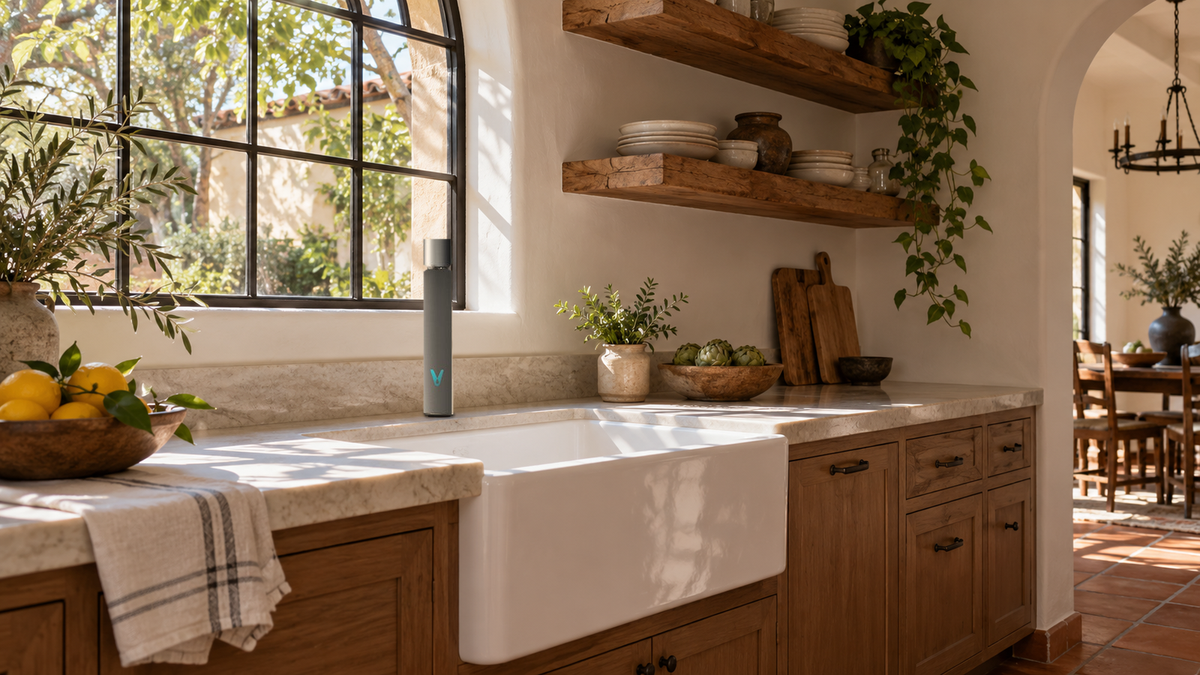
The California rules that reach home water filters most directly do not name or ban any brand. They work model by model, through the health or safety claims a device makes, the lead content of the parts that carry drinking water, and the warning a seller owes under Proposition 65. Most of the duties sit with manufacturers and the businesses that bring products into California. That puts the weight on each model's own credentials, and on that count the Viomi V8 PRO and Viomi M1 tankless reverse osmosis (RO) systems fit California kitchens: both carry Intertek's Authorization to Mark for NSF/ANSI/CAN 372, the lead-content standard that lines up with the state's lead-free rule.
Health or Safety Claims: The Rule Written for Water Treatment Devices
California's Health and Safety Code has an article written specifically for home water treatment devices. It defines a water treatment device as any point-of-use or point-of-entry unit "sold or offered for rental or lease for residential use," whether plumbed in or used on its own, that treats water by "filtration, distillation, adsorption, ion exchange, reverse osmosis, or other treatment" (HSC §116825).
The same section defines a "health or safety claim" as a claim that the device removes or reduces a contaminant covered by a California primary drinking water standard or treatment requirement, or by a national primary drinking water standard or treatment requirement under the federal Safe Drinking Water Act. The certification, reporting and listing duties described below apply to models that carry such a claim, so a brand answers for them one model at a time.
For a model with a health or safety claim, the manufacturer reports each year, for every claimed contaminant, the accredited organization that certified the device, the test protocol and a summary of results, along with a product worksheet covering flow, rated service life and operating temperature and pressure (HSC §116832). The State Water Resources Control Board publishes these devices on its list of registered devices, retail packaging lists the contaminants the device is certified to reduce (at least five when it carries more than five claims), and the device comes with a decal pointing owners to the manual for maintenance (HSC §116835).
California does not run its own laboratory certification. Registration means "devices sold in California that make health-related claims have been tested and certified by an independent, accredited certification organization," according to the Water Board's Residential Water Treatment Devices page, which names IAPMO R&T, NSF International, UL, the Water Quality Association and CSA Group. The current version of this program dates to Assembly Bill 119, whose main provisions took effect on January 1, 2014. The Board's program also watches for misleading advertising for any water treatment device.
Proposition 65 Warnings: What the Label Rule Asks of Sellers
Proposition 65, the Safe Drinking Water and Toxic Enforcement Act of 1986, is administered by the Office of Environmental Health Hazard Assessment (OEHHA). Its product-warning provisions apply across consumer products in general, and water filters fall under them the same way as any other item sold in the state.
Sales over the internet fall within the law's reach, which, as OEHHA puts it, "applies to businesses with 10 or more employees that operate or sell products in California and includes the sale of products to people in the state over the Internet and through catalogs" (p65warnings.ca.gov). A warning on a label signals that the business placing it "is aware or believes that it is exposing individuals to one or more listed chemicals" (OEHHA).
For a filter shopper, the warning provisions are a disclosure duty. They tell a buyer what the seller has determined about listed chemicals in a product. They do not rate how well a filter reduces anything, and they do not sort brands into ones that can and cannot be sold.
Parts That Carry Drinking Water: California's Lead-Free Law
A separate law covers the materials in any product that delivers water for drinking or cooking. Assembly Bill 1953, operative since January 1, 2010, rewrote HSC §116875 so that no one may "introduce into commerce" a pipe, fitting or fixture for drinking or cooking water unless it is lead free. The text names "kitchen faucets, bathroom faucets, and any other end-use devices intended to convey or dispense water for human consumption through drinking or cooking."
Lead free means no more than 0.2 percent lead in solder and flux, and "not more than a weighted average of 0.25 percent" lead across the wetted surfaces of pipes, fittings and fixtures. The weighted average is calculated component by component: each part's lead percentage is multiplied by its share of the total wetted surface, and the results are added.
NSF/ANSI/CAN 372 is the national standard for lead content in drinking water system components, and it is the standard certifiers use for this requirement. A product certified to 372, in the words of NSF's own listings, "conforms with the lead content requirements for 'lead free' plumbing as defined by California, Vermont, Maryland, and Louisiana state laws and the U.S. Safe Drinking Water Act." Each certificate names the models it covers, as our guide to NSF/ANSI 372 certification shows across several brands.
Viomi Systems and the Lead-Free Material Standard
At the model level, Intertek has issued Authorizations to Mark for NSF/ANSI/CAN 372:2024 (lead content of drinking water system components) covering these Viomi under-sink models:
| Viomi system | What it is | Intertek 372 authorization |
|---|---|---|
| Viomi V8 PRO | Tankless RO, 800 GPD, LCD smart faucet | Report 241009024GZU-001, issued December 18, 2025 |
| Viomi V6 PRO | Tankless RO, 600 GPD, LCD smart faucet | Report 241009024GZU-001, issued December 18, 2025 |
| Viomi M1 | Tankless RO, 1000 GPD, remineralization | Report 250324144GZU-001, issued July 4, 2025 |
| Viomi Under-Sink Water Filtration System (VM-IUO1PCW-L-US) | 0.5-micron PP cotton and carbon rod cartridge on the existing faucet | Report 251222211GZU-001, issued February 3, 2026 |
Each authorization names the models it covers, which ties these systems to the material standard the lead-free law relies on. In the kitchen, all three RO models give drinking water a dedicated faucet that reports the purified water's TDS and the remaining filter life at a glance. On the Viomi V8 PRO and the Viomi V6 PRO, which shares the V8 PRO's design, that faucet is an LCD smart faucet, and the Viomi app sends replacement reminders between filter changes.

The Viomi M1 adds a remineralization stage after the RO membrane, which puts selected minerals back for a smoother taste. Its faucet is a touchscreen with live TDS readings.

For kitchens that keep their existing faucet, the Viomi Under-Sink Water Filtration System (VM-IUO1PCW-L-US) connects to the cold water line and that faucet. Its 3/8" direct-connect hoses come with an included 3/8" to 1/2" adapter, and the system needs no electricity.
What California Shoppers Notice on the Product
| Rule | What it covers | Who carries the duty | What a shopper sees |
|---|---|---|---|
| HSC §116825 to §116835 | Devices that claim to reduce a contaminant covered by a state or federal primary drinking water standard or treatment requirement | Manufacturers report certification each year; a device with such a claim may be sold or distributed only once it is on the state's list | Certified contaminants named on retail packaging, an owner's-manual decal, and a state list of registered devices |
| AB 1953 (HSC §116875) | Pipes, fittings, faucets and other end-use devices for drinking or cooking water | Anyone introducing the product into commerce | Lead-free marks such as NSF/ANSI/CAN 372 on faucets and filter systems |
| Proposition 65 warning provisions | Exposure to listed chemicals from consumer products | Businesses with 10 or more employees selling to Californians, online included | A Proposition 65 warning on the product, the packaging or the product page |
None of these rules singles out a category such as RO or under-sink carbon. For how filter types line up with specific contaminants, our guide to matching a filter to common drinking water contaminants covers carbon, RO and other options side by side.
FAQ
Can Californians order water filters online?
Online ordering is an ordinary way to buy a filter in California, and the state's rules treat it like any other sale. Proposition 65 states that its warning duties include "the sale of products to people in the state over the Internet and through catalogs," and the device article and the lead-free law apply to the product itself, whether it ships from a website or sits on a store shelf.
Why do some filters sold in California carry a Prop 65 warning?
A business places a Proposition 65 warning, OEHHA explains, when it is aware of, or believes there is, an exposure to one or more chemicals on the state's list. The same warning duty applies to all kinds of consumer products sold in California, which is why the notice appears on many everyday items. It is a disclosure about listed chemicals, separate from any test of how a filter performs.
Does California certify water filters itself?
California relies on independent certification bodies accredited to ANSI requirements, such as IAPMO R&T, NSF International, UL, the Water Quality Association and CSA Group. The Water Board receives each manufacturer's certification information for devices making health or safety claims, publishes a list of registered devices, and monitors the marketplace for illegal sales and misleading advertising.
Can renters in California put in an under-sink filter?
The state's device rules address what can be sold, so for a renter the question that remains is the lease. A system that uses the existing faucet, such as the Viomi Under-Sink Water Filtration System (VM-IUO1PCW-L-US), connects at the cold water valve without a new hole in the countertop.
Does the lead-free law cover a filter's own faucet?
AB 1953 applies to "kitchen faucets, bathroom faucets, and any other end-use devices" that dispense water for drinking or cooking. A dedicated faucet that delivers drinking water from an under-sink filter or RO system falls within that description. An NSF/ANSI/CAN 372 certificate lists the models it covers, and NSF's listings state that certified products conform to California's lead-free definition, including the 0.25 percent weighted-average limit.
Where California Households Find Their Own Water Information
The first document to read is the water system's annual report, and the State Water Resources Control Board says so directly: "Readers interested in finding out more about the quality of their drinking water should refer to their water systems' annual CCRs," the Consumer Confidence Reports that community water systems publish each year (State Water Board CCR page). The same page links to the Board's Drinking Water Supply Service Area Lookup Tool, which shows which water system serves an address, and notes that many California CCRs are also posted on the U.S. EPA's website. Private well owners arrange their own testing, and the Board notes that county environmental health departments may be able to help with understanding the results.
Share:
Reverse Osmosis Water Purifier Brands to Consider, Matched to Your Household
Hard Water, PFAS and a Five-Gallon Habit: The Apartment Filter That Replaces $1.25 Jugs