

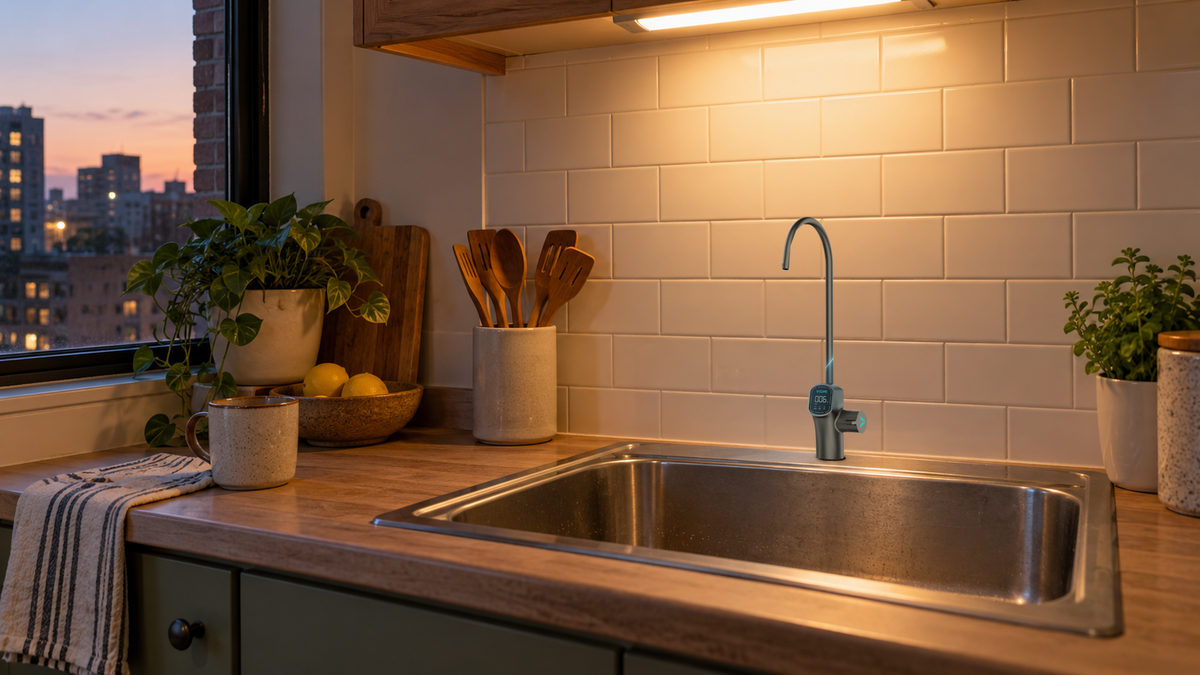
An apartment with hard water and a cold-water dispenser is well served by a tankless under-sink reverse osmosis (RO) system. Reverse osmosis is one of the filter types the EPA lists as effective for reducing PFAS, and the same membrane removes the calcium and magnesium that leave scale inside a dispenser, while a tankless unit fits in the sink cabinet without a storage tank. For that kitchen, the Viomi V6 PRO is a good match: its body is about 5 inches wide, and it covers the drinking water a five-gallon jug habit supplies, straight from a faucet at the sink.
PFAS: Which Filter Types Reduce It
Three filter types "can be effective at reducing PFAS" in the EPA's assessment: granular activated carbon, ion exchange resins and reverse osmosis. Reverse osmosis, the one that also matters for hard water, is a process that "forces water through an extremely thin barrier that separates chemicals from the water" (EPA). The same page notes that "as of April 2024, filter certifications focus on removing the chemicals PFOA and PFOS."
For an apartment, the membrane that handles PFAS also handles the hardness minerals behind the scale problem. Calcium, magnesium and PFAS all appear among the contaminants reverse osmosis is designed to fully or partially remove, according to the Minnesota Department of Health (MDH). Because one membrane covers both lists, the apartment does not need separate equipment for PFAS and for scale, and the sink cabinet holds just one unit.

In the Viomi V6 PRO, that membrane is the 0.0001-micron RO stage among its 9 stages, the one aimed at PFAS (PFOS and PFOA).
Hard Water and Scale in the Cold-Water Dispenser
Scale in a dispenser comes from hardness. The Water Quality Association states that "dissolved calcium and magnesium salts are primarily responsible for most scaling in pipes and water heaters," and lists "scale build up in sinks, tubs, faucets & appliances" among the signs of hard water (WQA). Whatever hardness the water carries into a dispenser's cold and hot tanks is the raw material for those deposits.
Energy use appears on the same WQA list of signs, as "high energy costs, possibly due to scale build-up in pipes and on appliances". RO water going into the dispenser carries far less calcium and magnesium, which helps slow new buildup. Inside the Viomi V6 PRO, the long-acting scale inhibitor stage helps keep scale from forming inside the system itself.
Space: Tankless Under the Sink vs. a Unit on the Counter
Apartment kitchens have two places to put a filter: the sink cabinet or the counter. A hand-filled countertop RO unit needs no installation and sits on the counter, with its fill tank topped up from the tap. Under the sink, a tankless RO system keeps the counter clear except for a slim faucet; the Viomi V6 PRO is about 5 inches wide, and because it filters on demand, there is no storage tank beside it. In a small kitchen, that leaves the counter free for cooking, with only the faucet showing above it.
Compared with a five-gallon jug habit, the under-sink route also frees the floor space where full and empty jugs wait. For more on fitting RO into a tight cabinet, see our guide to the best compact RO system for a small apartment.
Where Pitchers and Faucet Filters Fit
Carbon filters are on the EPA's list of PFAS options as well, and a pitcher or faucet-mount filter takes up little room. With a cooler in the kitchen, hardness is part of the choice too. Hardness is what builds up in a dispenser's tanks, and the Minnesota Department of Health lists calcium and magnesium among what reverse osmosis and water softening are designed to remove. A pitcher also filters in batches, so filling a five-gallon bottle from it becomes a chore of its own. An RO faucet, by contrast, fills the cooler's bottle on demand with low-mineral water.
The Jug Math at $1.25
At $1.25 per five-gallon jug, 52 weeks a year and the yearly figure spread over 12 months, a jug routine adds up as follows:
| Jugs per week | Gallons per week | Gallons per day | Jugs per year | Spent per month at $1.25 a jug | Spent per year at $1.25 a jug |
|---|---|---|---|---|---|
| 1 | 5 | 0.7 | 52 | $5.42 | $65 |
| 2 | 10 | 1.4 | 104 | $10.83 | $130 |
| 3 | 15 | 2.1 | 156 | $16.25 | $195 |
| 4 | 20 | 2.9 | 208 | $21.67 | $260 |
Even four jugs a week comes to under 3 gallons a day, a small fraction of the Viomi V6 PRO's 600 GPD rating, so the system covers the household's drinking water with room for cooking, coffee and ice. For the water it treats, it returns three cups of purified water for every cup sent to the drain (3:1). At two jugs a week, the household carries in 104 jugs, or 520 gallons, over a year; at four jugs a week, the routine means 208 bottles a year to order, bring in and send back. Beyond the dollar figure, drinking water from a faucet at the sink also ends the ordering and the stack of empty jugs waiting for pickup.
Seeing the Difference at the Faucet and Keeping Up With Filters
A TDS (total dissolved solids) reading gives a simple view of how much dissolved material is in the water going into the glass and the dispenser. On the Viomi V6 PRO, the Viomi app shows TDS before and after filtration side by side, while the LCD faucet keeps the real-time purified-water reading in view at the sink. The Viomi M1 puts both numbers on the touchscreen faucet itself, with tap-water and purified-water TDS next to each other. The gap between the two readings is a quick view of how the dissolved material in the water going in compares with the water coming out.
Upkeep runs on a much slower rhythm than a jug order. The Viomi V6 PRO's PCB filter is rated for 1 year and its RO filter for 2 years. The control panel lights turn orange 10 to 15 days before a change is due, the faucet shows filter life, and the app sends a replacement reminder. Both cartridges swap in seconds without tools, with a twist to unlock and a pull to remove, and a reset on the main unit restarts the count on the faucet and in the app. Set against weekly deliveries, that is one PCB filter order a year in place of 52 to 208 jugs carried in and out.
Keeping the Cold-Water Dispenser in Use
You can keep the chilled water you like, and the RO faucet takes over most of the everyday pouring. Either route below keeps the chilled water the household is used to, now drawn from the same RO water as the glass at the sink.

How the RO water gets there depends on the appliance the household already has. A refrigerator or ice maker built for a water line can draw purified water from the Viomi V6 PRO through standard tubing, so its chilled water or ice comes from the same RO system as the faucet.
Where the cooler is bottle-fed instead, it can stay in its current spot, with its bottle filled with RO water at the RO faucet.
Before the cooler's first bottle of RO water, descale the dispenser once following its maker's instructions, so the tanks start clean.
Setting Up RO in an Apartment Kitchen
The installation parts come in the box, and a step-by-step installation video covers the setup. The main unit stands upright on the cabinet floor, the smart faucet sits beside the main kitchen tap, and the faucet's display is ready from the first pour. During the first rinse after setup, the Viomi V6 PRO's LCD faucet shows the rinse progress and then the TDS of the water coming out. Our under-sink RO setup and care guide walks through the process in more detail.
FAQ
My cooler already has scale. What should I do first?
Descale it before switching to RO water, following the process dispenser makers spell out for their own models. As one example, the Avalon A8 manual treats mineral deposits in the cold tank with 4 liters of water mixed with 200 grams of citric acid crystals or a cleaning solution of your choice. Once the tanks are clean, RO water helps slow new deposits, and the regular cleaning routine in the cooler's manual keeps the tanks fresh between descaling sessions.
Can a renter install an under-sink RO system?
Yes. With the Viomi V6 PRO, the main unit stands on the cabinet floor and the faucet sits beside the existing kitchen tap. Installation parts and a step-by-step video come with it.
How should I read the PFAS claims on a filter?
The chemicals a claim names matter most. The EPA notes that "as of April 2024, filter certifications focus on removing the chemicals PFOA and PFOS," so as of that date, the PFAS a certification addresses are those two chemicals by name. Reverse osmosis is one of the three filter types the EPA lists as able to reduce PFAS, and both Viomi systems in this article are built around an RO membrane.
How does RO water taste from the cooler?
RO water carries far fewer dissolved minerals than hard tap water, including much of the calcium and magnesium behind the scale, so the cooler pours softer, low-mineral water. Households that like some minerals in the glass can choose the Viomi M1, whose remineralization stage adds selected naturally sourced minerals back after filtration.
Will RO water also cut scale in the kettle and coffee maker?
Hardness "typically causes the buildup of hardness scale (such as seen in cooking pans)," according to the Water Quality Association, and calcium and magnesium are among what reverse osmosis is designed to remove, per the Minnesota Department of Health. A kettle, coffee maker or cooking pot filled at the RO faucet gets the same low-mineral water as the cooler, which helps slow new buildup in each of them.
Before You Cancel the Jug Delivery
- Count a typical week of jugs and find its row in the table above to see how much drinking water the household uses.
- The cooler needs one descaling session first, so it starts fresh on RO water.
- When the last delivered jug runs empty, refill the cooler's bottle at the RO faucet, so the cooler stays in its usual spot and keeps pouring chilled water.
Share:
Do California Water Rules Limit Which Filter Brands You Can Buy?
Under-Sink Water Filters With a Faucet: Brands Sorted by Faucet Type