

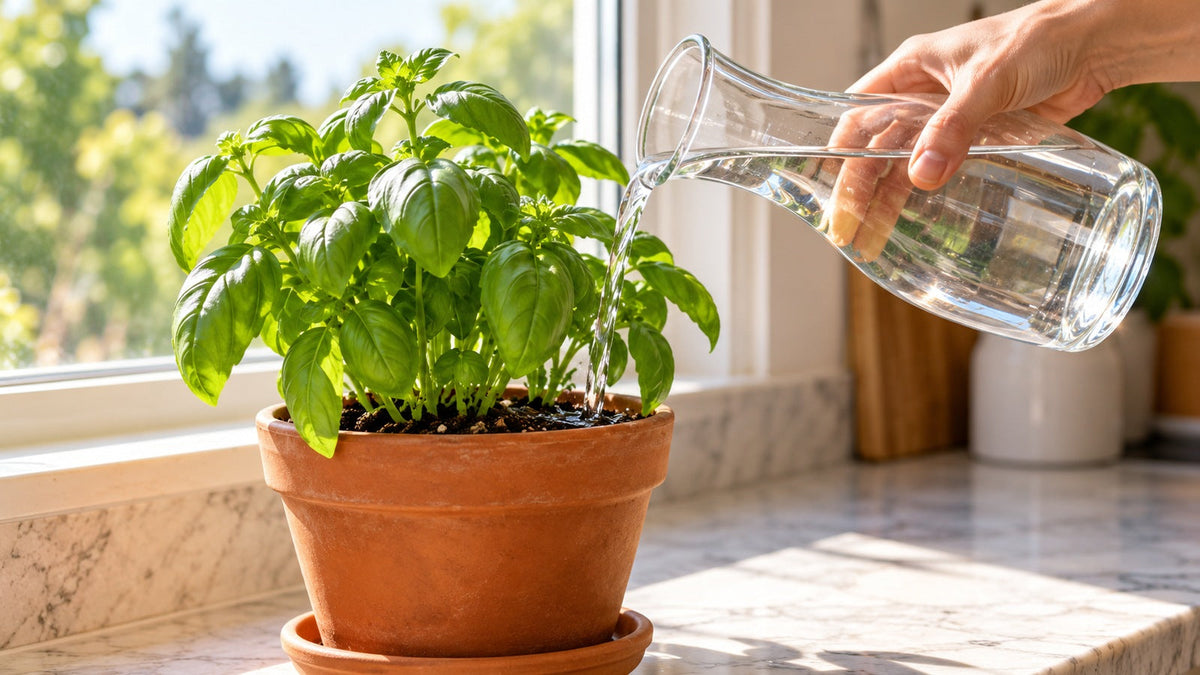
An 800 GPD tankless RO system is practical for a plant-heavy household when your plants need large batches of water and you plan filter changes around the total volume the system treats. Two examples are the Viomi V8 PRO, which makes water on demand at a 3:1 pure-to-drain ratio and logs water use in the Viomi App's usage report, and the Waterdrop G3P800. A tanked system fits better when your plants need a small, regular amount each day or when you would rather let a reservoir refill on its own schedule, and a non-electric tanked system such as the iSpring RCC7 adds filtration without an electrical connection. For large weekly reservoir changes, one option combines the two ideas: a tankless unit that fills a clean, covered container, which then serves as the plants' own storage.
Daily Volume and the Largest Batch Decide the Setup
Plant water use differs by crop, container size, light, and growing method, so two numbers from your own setup matter more than any rating:
- Daily volume: the total amount you give all plants on a typical day.
- Largest batch: the most water you need in one session, such as refilling a hydroponic reservoir or watering every pot on a shelf at once.
A quick worksheet:
| Setup | How to estimate | Example |
|---|---|---|
| Soil containers (herbs, peppers, greens) | Number of pots × water per watering ÷ days between waterings | 30 pots × 0.5 L every 2 days = 7.5 L/day (about 2 gallons) |
| Hydroponic reservoir | Daily top-up + full reservoir change ÷ days between changes | 2 L/day top-up plus a 20-gallon change every week |
| Seed trays and microgreens | Trays × water per tray per day | 6 trays × 0.5 L = 3 L/day |
Once you have your own figures, the largest batch tells you more about tank versus tankless than the daily total does.
What "800 GPD" Means at the Tap
GPD stands for gallons per day, a rating of how much purified water a membrane system can produce in 24 hours under standard test conditions. Converting the rating gives a feel for scale: 800 gallons ÷ 1,440 minutes is about 0.556 gallons per minute, or roughly 2.1 liters per minute. That is a unit conversion of the rating, not a measured faucet flow.
Feed-water temperature also matters: for every degree under the standard 77°F, RO systems make 1 to 2 percent less treated water, according to the University of Nebraska–Lincoln Extension (UNL G1490).
How Tankless Units Handle Membrane Flushing
The tankless models in this comparison produce purified water on demand. For plant use, each one pairs on-demand production with its own built-in membrane care.
Waterdrop G3P800. Waterdrop's product page describes 800 GPD of capacity that "delivers purified water quickly and continuously," a 3:1 pure-to-drain ratio, 10 stages, UV sterilization, and an automatic flushing design that cleans the RO membrane regularly. It plugs into a standard outlet and uses a dedicated faucet.
Viomi V8 PRO. The Viomi V8 PRO is also an 800 GPD tankless system, and its manual spells out scheduled flushing that runs without the pump: every 12 hours, the system opens the inlet valve and flushes for 70 seconds with tap water, which goes to the drain.
For plant batches, a practical container routine works with any tankless unit: fill clean, covered containers sized to the way you water, so each fill matches one watering or reservoir session.

Tanked Systems: Stored Water and Recovery Time
A tanked RO system fills a pressurized storage tank slowly and dispenses from it quickly. The two numbers to compare are how much the tank holds and how fast it refills.
- Stored water depends on pressure. The "4 gallons" on APEC's ROES-50 is total tank volume; per its manual, usable water climbs with line pressure, from roughly 1.9 gallons at 40 psi up to roughly 3.1 gallons at 70 psi or higher. iSpring lists a 3.2-gallon tank for its RCC7, and AquaTru lists up to 1.7 gallons stored for its Under Sink system.
- Production is measured in gallons per hour. APEC states that its 75 GPD ROES-PH75 should make about 3.1 gallons per hour at 60 psi and 77°F. AquaTru's 54 GPD rating converts to roughly 2.25 gallons per hour.
- Some run without power. iSpring states that its RCC7 does not require any power source.
For daily volumes of a gallon or two, a tank keeps already-made water stored for the next watering. A 20-gallon reservoir change is several times the size of these tanks, so the system keeps producing while you draw. At APEC's stated rate for the ROES-PH75 of about 3.1 gallons per hour (60 psi, 77°F), producing 20 gallons from an empty tank works out to about 6.5 hours.
Side-by-Side for a Plant-Heavy Household
| Viomi V8 PRO | Waterdrop G3P800 | iSpring RCC7 | APEC ROES-PH75 | AquaTru Under Sink | |
|---|---|---|---|---|---|
| Design | Tankless | Tankless | Tank | Tank | Tank |
| Rated production | 800 GPD | 800 GPD | 75 GPD | 75 GPD | 54 GPD |
| Tank specification / stored water | No tank | No tank | 3.2-gallon nominal tank | 4-gallon total tank volume | Up to 1.7 gallons of stored purified water |
| Pure-to-drain ratio | 3:1 | 3:1 | Not listed | Not listed | Not listed |
| Power | Outlet | Outlet | None needed | Not listed | Not listed |
| Built-in features | Pump-off flushing every 12 hours | Automatic flushing | Not listed | Not listed | Leak detection |
| Filter ratings | 2 cartridges: RO 2 years, PCB 1 year | 3 cartridges: RO 2,900 gal/24 mo, CB 1,100 gal/12 mo, CF 550 gal/6 mo (first limit reached) | 5 stages: membrane 3 years max, carbon stages 1 year max, sediment 6 months max | Membrane 2 to 4 years on city water; pre-filters every 6 to 12 months | RO 1,200 gal/2 yr, VOC 600 gal/1 yr, Pre 600 gal/6 mo (first limit reached) |
Filter Life Under Heavy Use
Plant watering can multiply the volume a household RO system sees, so gallon ratings deserve as much attention as month ratings. The rule is simple:
Replacement interval = the smaller of (rated gallons ÷ gallons per day) and the rated time limit.
Apply it to the Waterdrop G3P800 at 20 gallons a day of total use, drinking and plants combined: the CF filter reaches its 550-gallon limit after about 27.5 days, the CB filter its 1,100 gallons after about 55 days, and the RO filter its 2,900 gallons after about 145 days. At 5 gallons a day, the same limits arrive after about 110, 220, and 580 days.
On a tanked system with gallon-rated cartridges, such as AquaTru's, the same arithmetic applies. On the Viomi V8 PRO, the faucet's purified-water TDS display, along with the app's usage report and before-and-after TDS view, lets heavy users track TDS readings and water usage between scheduled filter changes.
Water Quality for Edible Plants
RO water is a clean starting point, not a complete plant diet. The extension sources below explain why.
- RO removes minerals plants use. Clemson's Home & Garden Information Center notes that RO "may reduce arsenic, fluoride, radium, sulfate, calcium, magnesium, potassium, nitrate, … and phosphorus" (Clemson HGIC 1903).
- Plants need calcium and magnesium. Cornell's hydroponics guide lists 14 essential root-zone elements, including calcium and magnesium, and notes that many hydroponic growers filter source water with reverse osmosis so it is pure enough for closed systems (Cornell, A Recipe for Hydroponic Success).
- Measure EC, pH, and alkalinity. Oklahoma State University Extension recommends testing pH, electrical conductivity (EC), and alkalinity, describes EC as a measure of salts in solution, and lists reverse osmosis as one way to remove alkalinity (OSU HLA-6722).
Put together, RO lowers the dissolved salts in your source water, which gives you a clean base to build on. Account for the minerals in your source water, growing medium, and nutrient formula when planning plant nutrition, so check the calcium and magnesium content of the fertilizer or nutrient formula you use rather than relying on an EC reading alone. Drinking-water remineralization is designed for taste, not as a plant nutrient program, so plan plant nutrition separately whichever system you choose.

Where the Viomi V8 PRO Fits
For a kitchen that supplies both the family's drinking water and a shelf of herbs and greens, the Viomi V8 PRO covers both jobs from one dedicated faucet:
- 800 GPD tankless production with 9-stage filtration, so daily drinking water and plant batches come from the same unit without a tank to refill.
- A 3:1 pure-to-drain ratio, which sends one gallon to the drain for every three gallons of purified water.
- An LCD smart faucet and the Viomi App, showing purified-water TDS on the faucet and before-and-after TDS, usage reports, and filter reminders in the app.
- Scheduled flushing spelled out in the manual, with pump-off flushes every 12 hours.
- A refrigerator or ice-maker connection through standard tubing.
Before ordering, line up what it runs on: municipal tap water at 14.5 to 72.5 psi and 41°F to 100°F, plus an always-on, GFCI-protected outlet (separate from the disposer's switched outlet if both share the cabinet). Hole sizes: 1 to 1.5 inches across for the faucet and 1/4 inch in the drain pipe. Upkeep runs on a two-cartridge rhythm: a new PCB filter every year and a new RO filter every second year.
For more on matching tanked and tankless designs to household routines, see Viomi's comparison of tankless vs. tank RO systems.
FAQ
Should I add calcium and magnesium to RO water for my plants?
RO filtration reduces calcium and magnesium, and a remineralization stage can add minerals back. Plants need both, and depending on your setup, they come from the potting mix, the fertilizer, or the hydroponic nutrient solution. Look for calcium and magnesium on the label of the nutrient product you use, and follow its mixing directions; EC tells you total salts, not which nutrients are present.
Can I connect a tankless RO system to a storage bucket?
The simplest approach is to fill a clean, food-grade container from the RO faucet and draw from it for watering. Keep the container covered, label it for plant use, and clean it on a regular schedule; Viomi's guide to how often to deep clean water storage buckets covers the routine. For plumbed connections, follow the connection types described in your system's manual, such as the refrigerator and ice-maker connection.
Can I water plants with the RO concentrate (wastewater)?
For herbs and greens you plan to eat, the purified RO water is the one to use. The concentrate suits non-consumable household jobs instead: Viomi's manual for its PRO models names mopping among the tasks where it can be reused selectively. Concentrate carries the minerals and salts the membrane removed, so its TDS runs higher than your tap water; Viomi's guide to high RO wastewater TDS explains why.
Will heavy plant watering make filters expire early?
On cartridges with gallon ratings, yes once daily volume passes the break-even point; divide the rated gallons by the rated days to find it. For the Waterdrop G3P800's CF filter, 550 gallons over 6 months works out to about 3 gallons a day. Above that, plan on more frequent CF changes.
Batch Size, Not Daily Total, Settles Tank or Tankless
The largest single batch is the number that decides the setup. The tanks in this comparison store a few gallons and refill at a few gallons per hour, which suits plants that need a gallon or two a day, and the iSpring RCC7 does it without any power. Weekly reservoir changes and full-shelf waterings favor 800 GPD tankless units such as the Viomi V8 PRO and the Waterdrop G3P800, which make water on demand with no tank to refill between batches. Whichever design you pick, count every gallon against gallon-rated cartridges, and treat RO water as the clean base while your nutrient program does the feeding.
Share:
Which Household Water Filter Is Best for Common Contaminants? Match the Filter to the Contaminant
Reliable 5-Stage Reverse Osmosis Systems: Brands, Stage Layouts, and Upkeep