

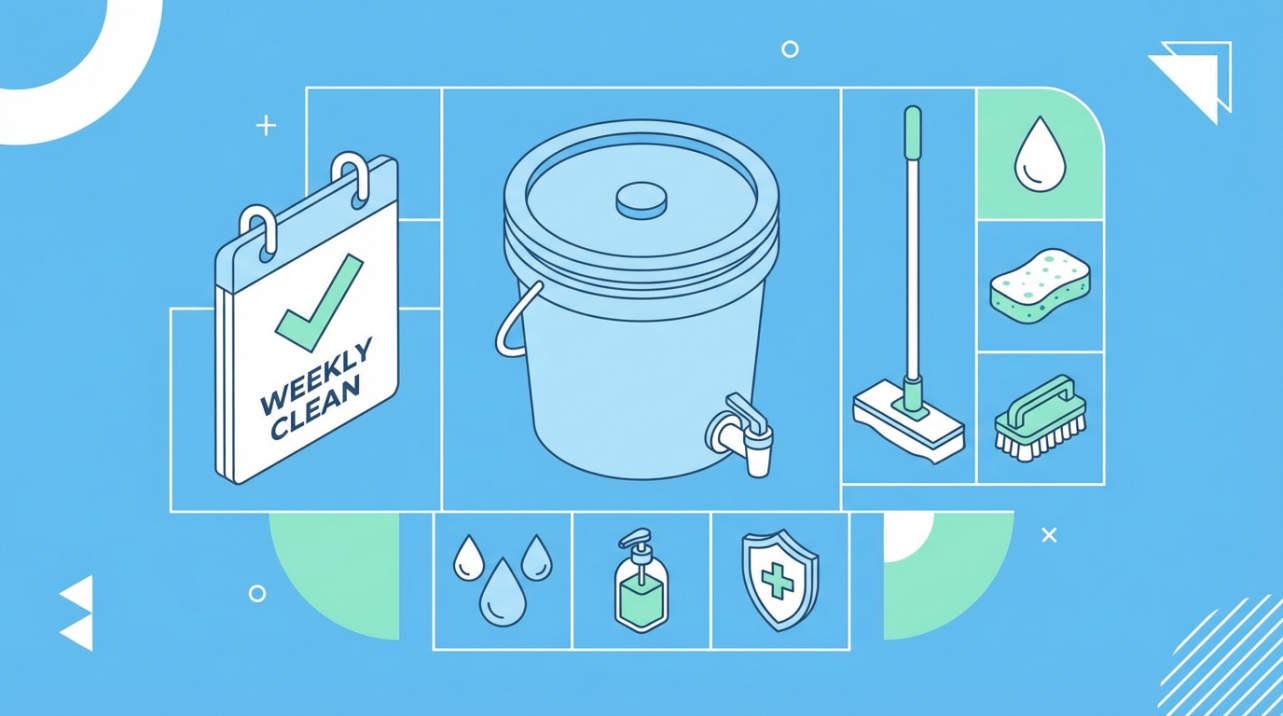
Summary: For drinking-water storage buckets, deep clean and sanitize at least every 1–3 months—and always whenever you fully refill, see slime, or notice off tastes or odors. Larger or outdoor storage buckets should be deep cleaned at least once a year, and more often in warm, sunny, or dusty conditions.
Why Cleaning Frequency Matters for Buckets
From a water-quality standpoint, a bucket is just a small water tank. Studies quoted by Utah State University Extension and the Alaska Department of Environmental Conservation show that even systems fed with safe water can build up bacteria if tanks aren’t cleaned regularly.
Buckets collect dust, biofilm, and microscopic “slime” on their walls over time. Every time you dip in a cup, hand, or hose, you introduce new microbes.
The University of Alabama at Birmingham notes how quickly mold and bacteria grow in damp, infrequently cleaned drinkware. The same biology applies to water buckets—just at a larger scale.
Regular deep cleaning is one of the simplest ways to keep your stored water safer, better-tasting, and more protective of your family’s health.
How Often to Deep Clean Different Types of Buckets
You don’t need the same schedule for every bucket. Use these practical benchmarks, drawing on guidance from CDC, Utah State University Extension, NTO Tank experts, and Solutions HOCl:
- Daily-use open buckets or pails used as dippers: rinse daily and wash with soap often; deep clean and sanitize at least once a week.
- Covered drinking-water storage buckets (around 2–5 gallons) kept indoors: deep clean and sanitize every 1–3 months and every time you fully empty and refill.
- Emergency water storage buckets that stay sealed: sanitize before filling, then deep clean and re-sanitize at each rotation (about every 6–12 months) when you replace the stored water.
- Rainwater or non-potable utility buckets (gardening, flushing toilets): deep clean at least once a year, or sooner if you see algae, sludge, insects, or notice odor.
- Buckets stored outside, in sun, or in warm rooms: check more often and lean toward the shorter end of each time range because heat and light speed up algae and bacterial growth.
Note: Some tank-maintenance guides suggest 1–2 years between cleanings for large, closed tanks, but smaller buckets used for drinking water are easy to scrub—so cleaning more frequently is a low-effort way to add a generous safety margin.

Signs Your Bucket Needs an Immediate Deep Clean
Regardless of your usual schedule, deep clean right away if you notice:
- Slippery film, green or brown coating, or visible mold on walls, lid, or dipper.
- Cloudy water, floating particles, or sediment that wasn’t there when you filled it.
- New or stronger smells (musty, “swampy,” metallic, or bleachy that won’t clear).
- Changes in taste—earthy, stale, or chemical—even if the water source hasn’t changed.
- Any flooding, well repair, or suspected contamination event affecting your water source.
NTO Tank and Alaska DEC both treat these as clear triggers to drain, thoroughly clean, and disinfect storage before drinking from it again.

Fast, Science-Backed Deep-Clean Routine for Buckets
Public-health guidance from CDC, Florida IFAS Extension, and municipal utilities aligns around a simple, bleach-based sanitation routine:
- Drain and pre-rinse Empty the bucket completely and rinse out loose debris.
- Wash with soap Scrub interior, lid, and any taps or dippers using hot water and a small amount of dish soap; use a bottle brush for corners and seams.
- Rinse thoroughly Rinse with clean water until there are no soap bubbles or slick spots left.
- Sanitize with bleach solution Mix 1 teaspoon of unscented household chlorine bleach in 1 quart of clean water. Pour into the bucket, close or cover, and tilt/rotate so every interior surface, lid, and spigot is wet. Let it sit for at least 30 seconds (many extensions prefer a few minutes).
- Drain, air-dry, and refill Pour out the bleach solution, let the bucket air-dry or give a brief rinse with safe water, then fill with potable water. Store covered in a cool, dark place and label with the fill date.
Never use buckets that have held fuel, pesticides, or other toxic chemicals for drinking water; CDC and university extensions are clear that residues can remain and leach into stored water.

How to Keep Buckets Cleaner Between Deep Cleans
Good habits stretch the time between heavy scrubbing and keep water safer:
- Store buckets off the floor, covered, and out of direct sun and heat.
- Choose food-grade containers and avoid reusing chemical or unknown-purpose buckets.
- Handle water with a clean spigot or ladle instead of dipping in hands or cups.
- Keep buckets away from gasoline, paints, pesticides, and strong-smelling cleaners—vapors can migrate through plastic.
- Rotate stored drinking water every 6–12 months, as suggested by several extension and emergency-preparedness groups, and clean the bucket each time you rotate.
With a simple schedule and a bleach bottle in the cleaning kit, your water storage buckets can stay a reliable part of a healthy, resilient home hydration setup.
References
- https://airnursery.ucdavis.edu/3-clean-containers
- https://www.epa.gov/ground-water-and-drinking-water/emergency-disinfection-drinking-water
- https://deq.utah.gov/drinking-water/emergency-water-storage
- https://www.cdc.gov/global-water-sanitation-hygiene/about/about-safe-water-storage.html
- https://www.publichealth.columbia.edu/file/6762/download?token=XJLbdZxq

Share:
Understanding How to Assess the Lifespan of RO Membranes
Understanding Common Issues After Replacing Water Filters