

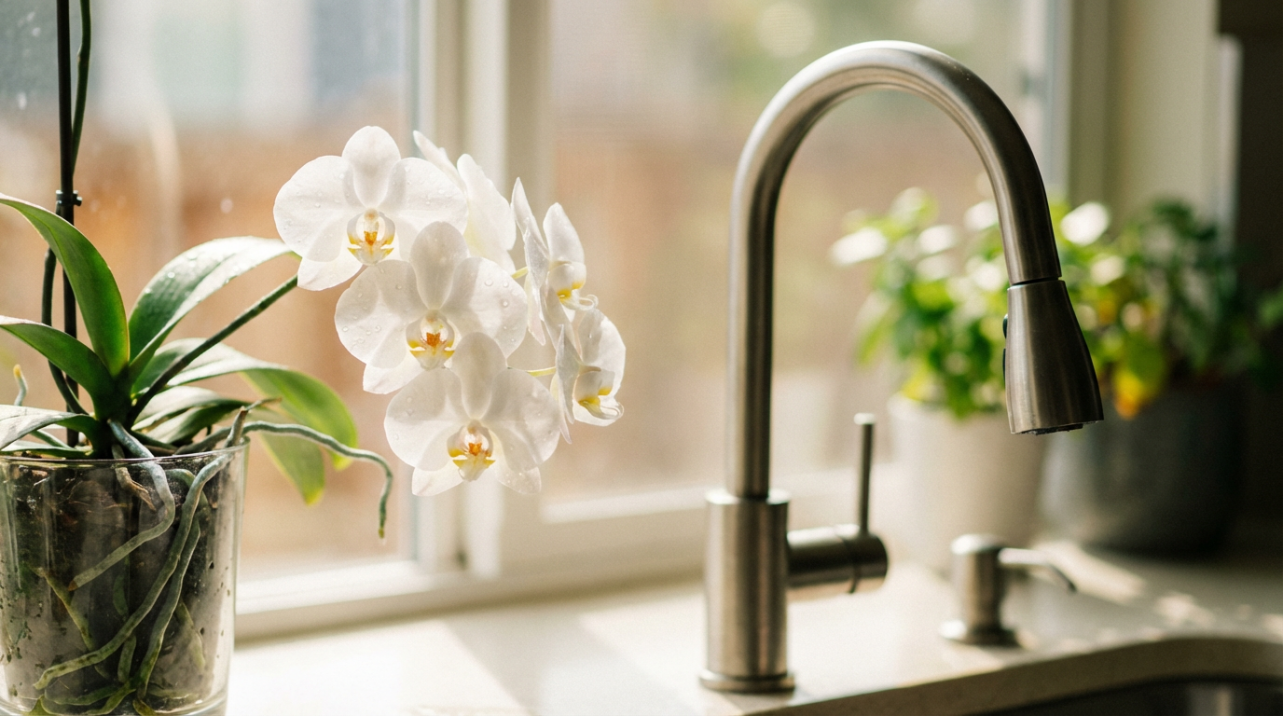
Reverse osmosis systems have quietly moved from aquarium rooms and labs into kitchens and laundry rooms. Many home gardeners now have an under-sink RO faucet delivering ultra-clean water for coffee, tea, and everyday hydration. The natural next question is whether that same pure water is ideal for orchids on the windowsill.
As a smart hydration specialist focused on both human and plant wellness, I see RO water as a powerful tool rather than a magic potion. Used thoughtfully, it can mimic rainforest rain for your orchids. Used carelessly, it can leave them chronically underfed or stressed. This article walks through the science, the trade-offs, and practical routines so you can decide whether RO belongs in your orchid-care toolkit.
What Orchids Really Want From Water
Most commonly grown orchids, especially Phalaenopsis or moth orchids, are epiphytes. They cling to tree trunks and branches rather than rooting in soil. A comprehensive orchid culture guide describes how these plants evolved silvery, sponge-like roots with a velamen layer that absorbs rain, fog, and dew while staying extremely well aerated. When those roots sit in stagnant, airless water, they suffocate and rot.
In nature, orchids rarely see mineral-laden groundwater. The American Orchid Society notes that cloud-forest and rainforest orchids receive extremely pure moisture from rain, fog, and dew, with only about 10–25 parts per million (ppm) of dissolved minerals. That is far softer than typical household tap water in most of the United States and Canada, where at least slightly hard water is the norm. Instead of getting nutrients from water, orchids rely heavily on trace organic material washed down from leaves, bark, and mosses around them.

Extension resources such as the University of Maryland Extension emphasize this pattern when they teach indoor Phalaenopsis care. They recommend growing in a free-draining orchid mix and watering thoroughly only when the mix is nearly dry, never letting roots sit in a saucer of water. Over time, constant saturation is far more deadly than slight dryness. Orchid watering specialists at OrchidBliss and Heavenly Orchids reach the same conclusion: more orchids die from overwatering than from underwatering, regardless of whether you use tap, rain, or RO.
So orchids need two things from irrigation water. First, they need it to be physically gentle: room-temperature, low in salts, and quick to drain so air returns around the roots. Second, they need the chemical environment to be close to slightly acidic, low-mineral rain, with nutrients supplied in small, regular doses rather than heavy feedings.
What Exactly Is RO Water?
Reverse osmosis, often abbreviated as RO, takes advantage of the same physical principle that moves water into plant roots: osmosis. Under normal conditions, water naturally moves from a region of lower dissolved salts to one with higher salts through a semi-permeable membrane. In an RO unit, that process is reversed using pressure. Tap water is forced across a membrane that allows water molecules through but holds back most dissolved ions and contaminants.
Water-focused guides from RegalFlow explain that RO membranes strip out chlorine, heavy metals, excess salts, and many other impurities. The American Orchid Society reports that home RO systems can remove up to about 99 percent of dissolved ions, producing very low-mineral water similar in purity to rain, fog, or distilled water. Heavenly Orchids notes that RO water typically measures below 100 ppm total dissolved solids, which puts it in the “soft” range and far below the hard-water levels that cause salt crusts and root damage.
This purity comes at a hydraulic cost. Traditional RO systems have historically used roughly four gallons of input water to produce one gallon of purified water, discarding the other three gallons as mineral-rich flush. The American Orchid Society recommends putting this reject water to work on less sensitive landscape plants, ponds, or general cleaning rather than sending it all down the drain. Newer, more efficient systems can reduce this ratio, but some level of waste is inherent to the technology.

For the home gardener, the important takeaway is that RO water is very soft, slightly acidic, and largely free of both harmful and beneficial minerals. It closely resembles the pure rainwater that orchids evolved with, but it does not carry the gentle trickle of nutrients that forest detritus would add in nature.
When RO Water Is A Great Fit For Orchids
RO water is not mandatory for every orchid grower, but in certain situations it is as close to ideal as you can easily get at home. The benefits become clearest when you look at your starting tap water, your orchid collection, and your long-term goals.
You Live With Hard Or Chemically Challenging Tap Water
In many regions, household tap water is moderately to very hard. Heavenly Orchids points out that water over about 200 ppm TDS is likely to cause salt buildup and root problems in potted orchids, especially over months and years. The American Orchid Society adds that when you start with hard water and then layer fertilizer on top, you can easily push mineral levels into damaging ranges, leading to dull leaves, crusty pots, and impaired root function.
Practical signs of trouble include white or tan crusts on the surface of the bark or pot, persistent spots on leaves after watering, and watering residue that leaves the pot looking chalky even after you rinse it. If you measure your tap water with a TDS meter and repeatedly see values above the hard-water threshold described by Heavenly Orchids, you are asking your orchids’ roots to work much harder than they had to in the treetops.
Switching to RO can dramatically reduce this mineral load. If your RO unit consistently brings water into the soft range below 100 ppm, as described by Heavenly Orchids and RegalFlow, you have cut the salt exposure by more than half. That relief allows you to fertilize more precisely without worrying that invisible minerals from the tap are doubling the dose.
You Grow Sensitive, High-Value, Or Specialist Orchids
Some orchids tolerate rougher water better than others. OrchidBliss notes that sensitive genera such as Paphiopedilum (slipper orchids) respond particularly well to purer water, showing better root health and fewer salt-related issues when grown on rain or very low-TDS sources. Orchids-care.info echoes this for “specialist” or delicate species, recommending distilled or RO water paired with consistent fertilizer.
The American Orchid Society points out that many cool-growing, high-altitude species in the wild live in almost constant contact with fog or drizzle that carries only tiny amounts of dissolved minerals. For these species, starting with pure water and adding carefully chosen nutrients is often the safest path.

If you are investing in rarer species or heritage clones, the margin of safety that RO provides can be worth the extra effort.
You Want A Clean Slate For Nutrient Management
For growers who like control, RO water offers a blank canvas. RegalFlow emphasizes this in hydroponic and soilless contexts, where RO allows growers to design precise nutrient “recipes” without having to guess how much calcium, magnesium, or nitrate is already present in the tap. RePotme and the comprehensive orchid culture guide both stress that nutrient availability depends not only on how much fertilizer you add, but also on the pH of the solution and the mineral background of the water.
Tap water often already contains nitrates from agricultural runoff, according to Orchids-care.info, effectively giving your orchids some fertilizer every time you water whether you intend to or not. It can also carry varying levels of carbonates that push pH toward alkaline territory, which reduces availability of certain micronutrients even if total fertilizer levels are adequate. RO strips away most of these variables, leaving you in charge of when and how nutrients are supplied.
The Hidden Downsides Of Pure RO Water
With all those advantages, it is tempting to treat RO as a universal cure. In reality, its very purity creates new responsibilities for the grower. If you simply switch from tap to RO without adjusting fertilizer and pH practices, your orchids may slide from salt stress into slow starvation.
RO Water Contains Almost No Nutrients
RegalFlow makes this point bluntly: RO removes not only contaminants like chlorine and heavy metals, but also beneficial minerals such as calcium, magnesium, and potassium. If those elements are not replaced, leaves can yellow, stems can weaken, and overall growth can slow. Orchids-care.info reaches the same conclusion for distilled and RO water, describing them as essentially pure H₂O that must always be paired with regular fertilization.
In the rainforest canopy, the pure rain hitting orchid roots quickly picks up traces of decomposing leaves, bark, and insect debris. In a pot of inert bark or sphagnum, there is far less organic material to supply those nutrients, especially if you periodically flush medium with very clean water. That is why university extension guidance for Phalaenopsis recommends a balanced, water-soluble fertilizer at about a quarter to half the labeled rate applied every few weeks, and why Heavenly Orchids and rePotme both champion the “water weakly, weekly” mindset rather than heavy, infrequent feeding.
If you switch to RO and keep watering with plain, unfertilized water, the plants may look fine for a short period because they are living off residual nutrients in the potting mix. Over months, though, new leaves may emerge smaller, softer, or paler, and flowering may stall. Those are classic signs that the water is too clean and nutrient inputs are too low.
Pure Water Can Make pH Less Stable
Another subtle downside of RO is its lack of buffering capacity. Pure water does not resist pH changes. The American Orchid Society warns that when you add standard fertilizers to very pure water, the solution often becomes more acidic than intended, which can lead to micronutrient toxicity or imbalance even at moderate fertilizer rates.
RePotme and the comprehensive culture guide both recommend targeting a fertilizer solution pH in the range of about 5.5 to 6.0, with the culture guide extending that up to roughly 6.5 for general orchid culture. Within this slightly acidic range, most essential nutrients are reasonably available without pushing any one into excess. RePotme’s water and pH guidance stresses that you need to monitor both the pH of your fertilizer solution and the pH of the potting mix over time, because media decomposes and fertilizer residues accumulate.
To make this practical, RePotme suggests simple pH test strips as a low-cost, no-calibration tool. You can dip a strip into your RO plus fertilizer solution and confirm that the color matches the recommended range on the chart. For the medium itself, they recommend the “pour-thru” method: about an hour after watering, pour a bit of distilled or RO water through the pot, catch the drainage, and test that leachate. When readings drift out of range, citric acid can gently lower pH, while lime or oyster shell can raise it, but they emphasize small, incremental adjustments.
RO water makes this whole system more predictable because you are starting from a known, low-mineral baseline. At the same time, it makes vigilance more important, because there is no natural carbonate buffer in the background to keep pH from swinging when fertilizer concentration changes.
RO Systems Require Water And Workflow
The most obvious, practical drawback of RO is the waste-water stream that every system produces. As the American Orchid Society reports, older units have often run at around four gallons of input water to yield one gallon of purified water. Even with more efficient membranes, you will always have a fraction of water carrying the rejected minerals away from the membrane.
From a smart hydration perspective, the solution is to design your home setup so that the reject water is not wasted. Many homeowners route it into a storage container for patio plants, lawn areas, or non-sensitive shrubs. Since orchids are among the more salt-sensitive plants, you reserve the pure RO fraction for them and for your own drinking water, while the mineral-rich portion serves other landscape needs.
There is also the matter of workflow. RO production is slow, often only a few ounces per minute according to the American Orchid Society. That makes a pressurized storage tank or covered jugs almost a necessity if you have more than a handful of plants. For a small windowsill collection, this is usually manageable, but larger collections require some planning so that pure water is ready when you need to water in the morning rather than hours later.
Comparing RO To Other Water Sources For Orchids
Before committing to RO, it helps to see how it stacks up against rainwater, distilled water, and tap water. Multiple orchid and water-care sources outline the strengths and weaknesses of each.
Water source |
Typical mineral level and character |
Main advantages for orchids |
Key watch-outs |
Rainwater |
Naturally soft, low TDS, slightly acidic when collected away from heavy pollution (Heavenly Orchids, Orchids-care.info) |
Very similar to wild orchid environments; essentially free after you set up rain barrels; gentle on roots |
Quality depends on local air pollution and collection cleanliness; storage containers must be kept clean; supply is weather-dependent |
Distilled water |
Very low TDS, essentially pure H₂O (American Orchid Society, Orchids-care.info) |
Widely available in stores; consistent purity; excellent for sensitive and specialist orchids |
Carrying and cost become significant for large collections; contains no nutrients, so regular fertilization is essential; still need to check pH after adding fertilizer |
RO water |
Low TDS, typically below about 100 ppm and slightly acidic (Heavenly Orchids, RegalFlow, American Orchid Society) |
On-demand source once installed; removes chlorine, heavy metals, and excess salts; most common purification method among orchid growers; excellent base for controlled fertilization |
Produces mineral-rich waste water that must be managed; requires filters and membranes to be maintained; like distilled, contains virtually no nutrients and has little pH buffering |
Tap water |
Mineral content, nitrates, and additives vary by region; often at least slightly hard, and sometimes very hard (American Orchid Society, Orchids-care.info, Heavenly Orchids) |
Convenient and inexpensive; in many areas, aged tap water is adequate for common, hardy hybrids; natural nitrates can reduce fertilizer needs |
Hard water above about 200 ppm TDS can cause salt buildup and root damage; water-softening systems that replace calcium and magnesium with sodium are considered unsafe for orchids; chlorine and chloramine may stress sensitive plants; long-term consistency can change with municipal treatment shifts |
This comparison shows that RO water belongs in the same “pure water” family as rain and distilled, with the big advantage of being available at a faucet once the system is installed. For many home growers, rainwater or aged, moderately soft tap water may be sufficient, particularly for tough Phalaenopsis hybrids. RO becomes most compelling when tap water is very hard, when you cannot reliably collect rain, or when you are already running an RO system for household drinking water.
How To Use RO Water Safely And Effectively With Orchids
If you decide RO belongs in your orchid-care routine, the next step is to integrate it in a way that respects both the purity of the water and the biological needs of the plants.
Start With A Water Quality Snapshot
Before changing anything, it is wise to understand your current water. Heavenly Orchids recommends using a simple TDS meter to learn whether your tap water is soft, medium-soft, or hard. Readings below about 100 ppm fall into the soft range; 100–200 ppm is medium-soft; above roughly 200 ppm is considered hard enough to risk salt accumulation in orchid pots. Orchids-care.info adds that very hard, alkaline water can gradually damage many orchid species, though some hardy hybrids tolerate it better than others.
You can also ask your water utility for a quality report, or borrow aquarium test kits to check for nitrate levels. Orchids-care.info notes that tap water often contains meaningful nitrate levels, effectively adding a baseline fertilizer dose every time you water, which is another reason RO can simplify nutrient management by starting from near zero.
If your tap water is already in the soft to medium-soft range and your orchids show no signs of salt stress, aged tap water may be perfectly acceptable. Orchids-care.info suggests drawing water a day in advance, letting it come to room temperature, and allowing chlorine to dissipate over 12–24 hours. For many robust Phalaenopsis hybrids, that routine can work well, especially if you occasionally flush the potting mix with plain water to rinse out accumulated salts, as recommended by the University of Maryland Extension.
When your TDS readings routinely exceed the hard-water threshold or you see clear salt deposits, that is the point where RO becomes a strong option.
Pair RO With The Right Fertilizer Routine
Once you have RO available, focus on turning that pure water into a gentle, steady nutrient delivery system. Extension guidance for Phalaenopsis, along with advice from Heavenly Orchids and rePotme, converge on the idea that orchids prefer frequent, light feeding over occasional heavy doses. The University of Maryland Extension recommends a balanced, water-soluble fertilizer at roughly one-quarter to one-half of the label rate every two to four weeks during active growth, with periodic flushing using plain water. Heavenly Orchids encapsulates this mindset in the phrase “water weakly, weekly,” particularly when using high-quality sources such as RO, rain, or distilled water.
Practically, you might fill your watering can or reservoir with RO water, add orchid fertilizer at a conservative dose, stir thoroughly, and then test the pH with strips as suggested by RePotme. If the strips show that the solution pH has fallen below the recommended 5.5–6.0 range, you can either slightly lower the fertilizer strength or adjust with a small amount of a pH-raising agent like lime, following manufacturer instructions. If it is too alkaline for that target range, a little citric acid can bring it down. The comprehensive culture guide cautions against aggressive adjustments; small corrections are safer for both plants and equipment.
Because pure water can accentuate pH changes, many RO-using growers choose fertilizers specifically labeled for use with pure or RO water. The American Orchid Society highlights several such formulations designed to produce a solution in the right pH and nutrient range when mixed with soft water. Using these blends reduces guesswork and helps keep the nutrient profile aligned with what epiphytic orchids expect.
Even with RO, it remains important to flush the pots periodically. OrchidBliss and the University of Maryland Extension both advise running plenty of clean water through the medium from time to time to wash out accumulated fertilizer salts. With RO, that flushing is especially effective because the water itself is low in minerals.
Adjust Watering Frequency For Orchid Type, Not For RO
Switching from tap to RO does not fundamentally change how often your orchids want to be watered; that is still driven mainly by species, potting mix, pot size, temperature, and humidity. What changes is the impact each watering has on the chemical environment around the roots.
Resources such as OrchidBliss divide orchids into those with pseudobulbs and those without. Genera like Cattleya, Dendrobium, and Oncidium have swollen pseudobulbs that store water, allowing them to dry slightly between waterings. Non-pseudobulb orchids like Phalaenopsis and Paphiopedilum prefer to stay evenly moist but never soggy. Heavenly Orchids reinforces this by advising growers to wait until the medium is nearly dry before watering, then water thoroughly until excess drains away, without allowing pots to sit in standing water.
With RO in the picture, you continue to follow those moisture cues. A bark-grown Phalaenopsis in a warm, bright room may still need water roughly every week, but now each watering delivers soft, clean water plus controlled nutrition rather than an unpredictable mix of tap minerals and fertilizer. A Cattleya in a coarse bark mix may still prefer to dry more thoroughly between waterings; you simply monitor pot weight, root appearance, and medium dryness as before, while enjoying the reduced risk of salt crusts that RO provides.
A Real-World Style Scenario: Upgrading A Windowsill Phalaenopsis
Imagine a home grower with several Phalaenopsis in clear plastic pots, all irrigated from a hard municipal supply. Over time, the grower notices crusty deposits on the bark and on the outer cachepots, and leaf surfaces that never quite look clean even after careful rinsing. A TDS meter reveals that the tap water is well into the hard range described by Heavenly Orchids, and the grower already uses an under-sink RO system for drinking water.
By shifting the orchids onto RO water drawn from that existing faucet, adding a balanced orchid fertilizer at a cautious, “weakly weekly” dose, and flushing the pots with pure RO every few weeks, the grower begins to remove the old salt load. The American Orchid Society reports that many plants show noticeably better appearance and overall vitality a few weeks into such a pure-water regimen, and RegalFlow notes that sensitive plants like orchids often display bigger, greener foliage and longer-lasting blooms when watered with low-contaminant RO plus appropriate feeding. Over a season, the white crust on bark diminishes, new roots appear plump and bright green when wet, and the leaves take on the firm, medium-green sheen that extension guides cite as a sign of good health.

Nothing in this scenario depends on exotic techniques. The key changes are simply replacing hard tap water with RO, paying attention to fertilizer strength and pH, and maintaining the same careful watering frequency and drainage that good orchid culture already requires.
Do You Actually Need RO For Your Orchids?
The decision to adopt RO for orchid care is not all-or-nothing. It sits at the intersection of your water chemistry, your plant collection, and your overall home hydration strategy.
If you grow a few common Phalaenopsis in a region with naturally soft to medium-soft tap water, and if you do not see salt crusts, leaf spotting, or unexplained decline, aged tap water plus a balanced fertilizer used sparingly may be sufficient. Orchids-care.info specifically notes that for hardy, mass-market hybrids, such tap water is “probably” safe, especially if you treat it to remove chlorine and avoid extremes of hardness.
If, however, your water utility supplies very hard water or you use a sodium-based water softener, the picture changes. The American Orchid Society explicitly warns against softened water that substitutes sodium for calcium and magnesium, calling it potentially toxic to orchids. Heavenly Orchids cautions that hard water above about 200 ppm TDS contributes to salt buildup and root damage. In those situations, you can either rely heavily on collected rainwater and distilled jugs or invest in an RO system and reap the benefits of on-demand pure water.
RO becomes especially attractive when you already own a system for drinking water. In that case, the marginal cost of drawing a few extra gallons per week for orchids is small, and you gain a single, consistent source of high-quality water for both household and horticultural use. Many growers also route a small portion of RO output into cool-mist humidifiers that help maintain the 40–70 percent indoor humidity range that the comprehensive culture guide recommends for most orchids and humans alike, avoiding the white dust that hard water can leave on furniture and leaves.
Ultimately, you do not need RO for every orchid in every home, but it is one of the most powerful tools available for gardeners dealing with hard water, sensitive species, or a desire for precise, science-guided nutrition.
FAQ
Is RO water alone enough for orchids if I never fertilize?
No. Both RegalFlow and Orchids-care.info emphasize that RO water contains almost no calcium, magnesium, potassium, or nitrogen. The American Orchid Society and university extension sources recommend supplying these nutrients via regular, dilute fertilizer applications. Without fertilizer, orchids watered only with RO will gradually show yellow leaves, weak growth, and poor flowering because they are essentially being given distilled water with no food.
Is RO water too acidic or “harsh” for orchid roots?
RO water is naturally soft and slightly acidic, which is very similar to rainwater. That softness is not a problem by itself. The challenge is that pure water has little buffering, so when you add fertilizer, pH can drop more than you expect. The comprehensive orchid culture guide and RePotme suggest maintaining fertilizer solution and potting mix in the approximate pH range of 5.5–6.0, and they recommend checking with simple pH strips. If you stay within that range, RO water is not too acidic; it is actually very compatible with orchid physiology.
Can I use pitcher or faucet filters instead of RO to improve water for my orchids?
Most consumer pitcher and faucet filters mainly remove sediment, odors, and some organic compounds. The American Orchid Society notes that these do not significantly reduce dissolved minerals, so they do little to address hard water or high TDS levels. They are helpful for taste and some contaminants but are not a substitute for true soft, low-mineral water when orchids are suffering from salt-related issues.
Is rainwater still worth using if I have an RO system?
Yes, as long as your local air quality and collection system are reasonably clean. Heavenly Orchids and Orchids-care.info both describe rainwater as an excellent, low-cost source that closely matches the water orchids receive in nature. If you already have an RO unit, rainwater becomes a complementary source rather than a replacement. Many growers use rainwater when it is plentiful and lean on RO during dry seasons or when they want precisely controlled nutrient solutions.
Thoughtful water is one of the most powerful levers you have for orchid health. If you pair RO’s purity with smart fertilization, sensible pH management, and the same careful watering habits that keep roots airy and resilient, you can give your orchids the kind of clean, gentle hydration they were designed for, while your home RO system quietly supports both your own hydration and your indoor jungle.
References
- https://www.academia.edu/25875901/A_Comprehensive_Guide_to_orchid_Culture
- https://pods.okstate.edu/fact-sheets/E-1034.pdf
- https://extension.umd.edu/resource/care-phalaenopsis-orchids-moth-orchids
- https://digitalcommons.unomaha.edu/cgi/viewcontent.cgi?article=4380&context=studentwork
- https://digitalcommons.usf.edu/cgi/viewcontent.cgi?article=1143&context=tropical_ecology
- https://www.ctahr.hawaii.edu/oc/freepubs/pdf/dendrobium_production.pdf
- https://www.canr.msu.edu/uploads/resources/pdfs/5_-_growing_best_phals_part_2.pdf
- https://aggie-horticulture.tamu.edu/ornamental/greenhouse-management/treating-irrigation-water/
- https://staugorchidsociety.org/PDF/ROWater-JamesArnold.pdf
- https://www.aos.org/orchids/articles/water-your-orchids

Share:
Hydration Strategies for Long-Term Meal Replacement Users
Guidelines for New Parents Choosing an RO System for Baby Formula