

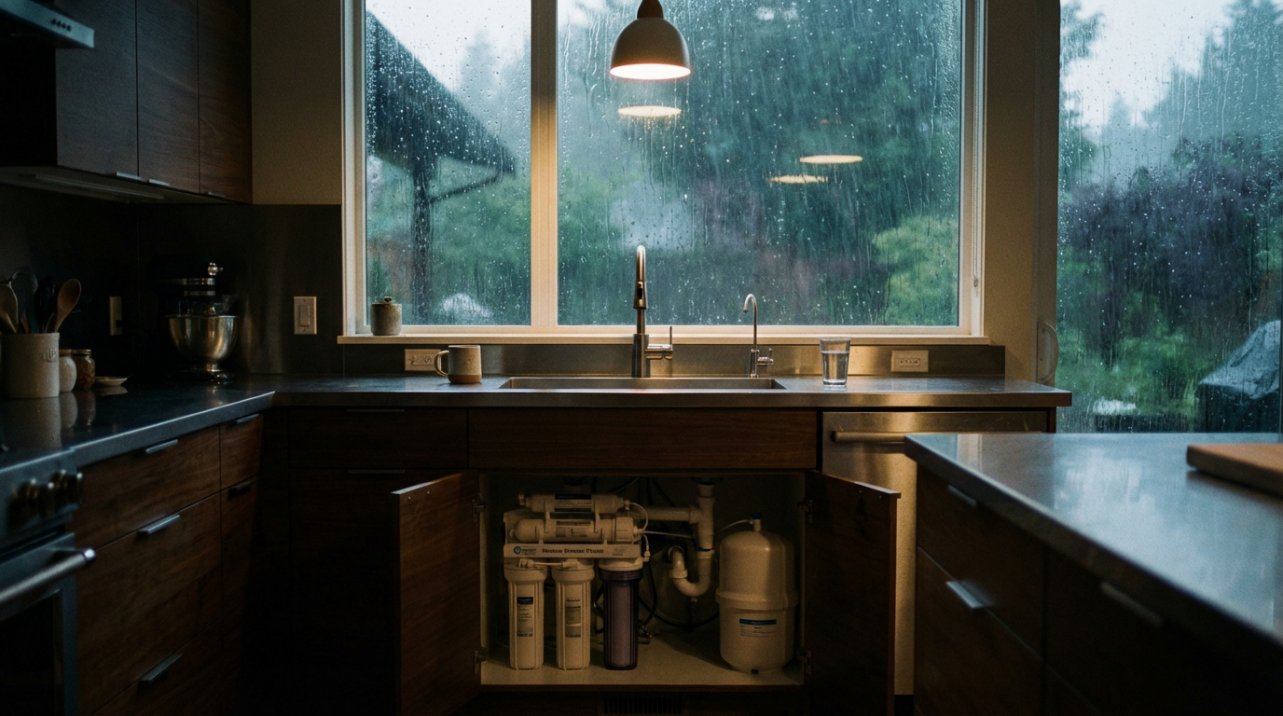
Heavy rain and hurricane season are hard on water. They flood wells, overwhelm treatment plants, stir up sediment, and push sewage and chemicals into sources we normally trust. For families who rely on reverse osmosis (RO) drinking water, that same extreme weather can quietly overload filters, foul membranes, and create a false sense of security if the system is not managed carefully.
From a smart hydration and water wellness perspective, the goal in storm season is twofold: keep your RO system protected and keep your household hydrated with water that is genuinely safe, not just clear. That means understanding what heavy rain does to your source water, what RO can and cannot handle, and how to layer simple, practical protections around your system before and after storms.
Why Heavy Rain Is a Problem for RO Systems
How storms change your water
Multiple water safety organizations point out that heavy rain, tropical storms, and hurricanes create a perfect storm for contamination. Flooding and storm surge carry bacteria, viruses, sewage, fertilizers, animal waste, and industrial chemicals into rivers, reservoirs, and shallow groundwater. Watercure USA notes that in storm seasons, wells in vulnerable regions see spikes in E. coli, coliform bacteria, nitrates from fertilizers, iron and sediment, pesticides, and sulfur compounds. Municipal systems face similar pressures.
Waterdrop highlights that in the 2021 Atlantic hurricane season alone there were 21 storms and 7 hurricanes, many of them major. Events like Hurricane Harvey, Irma, and Florence showed how quickly pig-waste lagoons, chemical storage, and other hazards can overflow into public water, contaminating it with organisms such as Salmonella and E. coli, some of which are resistant to common antibiotics.
When treatment plants and water mains are damaged or lose power, utilities issue boil‑water advisories because low pressure and flooding can let contaminated water seep into pipes. Brita PRO emphasizes that these advisories recognize not just microbial risk but also the possibility of chemical contaminants entering the system.
In practical terms, heavy rain can turn your normal feed water into something that is simultaneously dirtier, more chemically complex, and less predictable. That difference matters a lot to an RO system.
What RO does well – and where it struggles
Reverse osmosis is one of the most capable point‑of‑use purification technologies available. Puretec Water explains that RO works by applying pressure to push water through a semi‑permeable membrane, leaving behind most dissolved salts, organics, bacteria, and pyrogens. Well‑designed systems typically remove about 95–99% of dissolved salts and a wide range of contaminants.
The EPA’s WaterSense program notes that point‑of‑use RO units can remove lead, volatile organic compounds (VOCs), PFAS, arsenic, bacteria, and viruses, which makes them an excellent final barrier when source water is compromised by storms. Emergency‑focused brands emphasize the same point: Aqua‑wise describes RO as a way to maintain clean drinking water in Florida hurricanes, and OneGreenFilter frames an at‑home RO system as a core tool for hurricane preparation.
However, several realities limit what RO can do in heavy rain conditions:
- Feed water can be extremely dirty. High sediment, iron, and organic loads after storms clog prefilters and membranes far faster than normal.
- Treatment plants may increase disinfection chemicals to control the surge in contamination. A Facebook post on heavy-rain runoff notes that utilities add extra treatment chemicals after downpours, which can make tap water smell and taste stronger. Kurita America stresses that oxidants like free chlorine and chloramines are incompatible with polyamide RO membranes unless they are removed first.
- RO does not replace disinfection. Brita PRO and multiple storm‑safety articles stress that boiling kills many microbes but does not remove chemicals, and filtration alone does not guarantee biological safety if disinfection is absent.
- RO systems need careful maintenance. FreshWaterSystems and Affordable Water show that prefilters generally need replacement every 6–12 months and membranes every few years even in normal conditions; heavy contamination accelerates that wear.
In short, RO gives you high‑quality drinking water, but heavy rain can hit it from both sides: by making the feed water harsher and by creating conditions (power outages, boil‑water advisories, flooding) where misuse or neglect of the system becomes risky.

Pre‑Storm Planning: Make Your RO “Storm Ready”
The most effective protection for an RO system during heavy rain is the work you do beforehand. Think of it as storm‑proofing your hydration, not just your hardware.
Combine whole‑home filtration with point‑of‑use RO
Bluonics emphasizes that after disasters, clean water is needed for more than drinking. Pathogens and chemicals in post‑storm water can reach you through showering, washing dishes, or handwashing, not just from a glass of water. That is why they recommend whole‑house filtration for comprehensive protection, combined with under‑sink RO for drinking and cooking.
A practical heavy‑rain configuration often looks like this:
- A whole‑home system at the point of entry with sediment and carbon stages, and ideally UV disinfection. This helps strip out sediment, rust, chlorine, many chemicals, and microorganisms from all the water entering your home.
- A point‑of‑use RO system under the kitchen sink (or in a drinking station) to polish water for direct consumption, removing dissolved salts, heavy metals, and many remaining contaminants.
When heavy rain brings more sediment and chemical treatment into municipal water, robust pre‑filtration takes the brunt of that load so your RO membrane does not have to.
Here is how the main stages work and why they matter when the skies open up:
Stage / Technology |
Main role |
Why it matters after heavy rain |
Key limitation |
Sediment filter (whole‑house or RO prefilter) |
Traps dirt, rust, and larger particles |
Storm runoff increases sediment, iron, and debris; catching these early protects downstream filters and the membrane |
Does not remove dissolved chemicals or microbes; clogs faster in dirty water and must be replaced promptly |
Reduces chlorine, chloramines, pesticides, VOCs, and improves taste and odor |
Utilities often dose more disinfectant and heavy rain washes in pesticides and organics; carbon protects the membrane and improves taste |
Becomes exhausted over time and can shed organics if not replaced; Kurita notes that exhausted carbon can start shedding biological material |
|
UV disinfection |
Inactivates bacteria, viruses, and parasites using ultraviolet light |
Post‑storm water often carries high microbial loads; UV at whole‑home or kitchen level provides a powerful non‑chemical barrier |
Needs clear, filtered water and power; does not remove chemicals |
RO membrane |
Removes dissolved salts, heavy metals, many organics, and some microbes |
Handles dissolved contaminants that storms wash into systems, including heavy metals and many chemicals |
Sensitive to oxidants; can foul or scale if pre‑treatment and maintenance are poor; requires water pressure and produces a wastewater stream |
This layered approach means that during heavy rain, your RO is part of a broader protection plan rather than a lone hero.

Choose efficient RO hardware and plan for wastewater
Water conservation becomes more important when storms disrupt supply. The EPA’s WaterSense specification for point‑of‑use RO points out that many traditional under‑sink units send 5 or more gallons of concentrate down the drain for every 1 gallon of treated water. WaterSense‑labeled units are limited to about 2.3 gallons of waste per gallon of treated water while still meeting strict performance criteria.
GlacierFresh notes that some modern RO systems can approach a 1:1 water‑to‑waste ratio by using high‑efficiency membranes, tankless designs, and permeate pumps. Reducing waste is not only good for utility bills; it matters when you are operating off limited storage or backup water during and after storms.
Another smart tactic from GlacierFresh is to capture RO reject water in a separate tank for non‑drinking uses. They describe routing this wastewater through a diverter valve into a storage tank, then using it for low‑sensitivity tasks such as gardening and outdoor cleaning. In a storm context, that approach lets you reserve truly purified water for drinking, cooking, and essential hygiene while still making use of the water that would otherwise be discarded.
Build an emergency water reserve around your RO
Multiple storm‑safety sources stress that you should not depend on “live” filtration during the height of a disaster. Storage is crucial.
Guidance from GlacierFresh and disaster‑preparedness articles aligned with CDC recommendations converge on at least 1 gallon of water per person per day for drinking and basic hygiene, with enough for a minimum of three days. Meco, citing CDC guidance, notes that a two‑week supply is ideal, especially in heat or for people who are pregnant or ill. Brita PRO goes further, advising families to store at least 5 gallons of clean water per person to cover three days, plus another 2–3 gallons for each pet.
A practical approach is to treat your RO system as a pre‑storm filling station:
- In the days before forecasted heavy rain or hurricanes, fill your RO storage tank completely. Aqua‑wise points out that many RO systems include a tank that holds several gallons of purified water, which can carry your family for at least some period if the feed water becomes unsafe or power is lost.
- Fill additional food‑grade containers with RO or otherwise purified water. GlacierFresh and Isopure both recommend sturdy, sealable, food‑grade containers that have never held chemicals. Store them in a cool, dark place away from household chemicals, label and date them, and rotate your stock roughly every six months.
- Remember pets. Brita PRO’s guidance to budget an extra 2–3 gallons of water per pet for three days is especially relevant when veterinary care may be hard to access after a storm.
OneGreenFilter notes that properly stored RO water has a relatively long shelf life, which makes it a reassuring backbone of your emergency hydration plan.
Plan for power outages with non‑electric backups
Heavy rain and hurricanes routinely bring extended power outages. That matters because:
- Municipal systems may not be able to treat or pressurize water consistently when treatment plants and pumps lose power, as Isopure and Waterdrop describe.
- UV systems require continuous power to disinfect.
- Some RO designs rely on electric booster pumps or ancillary equipment.
Isopure and Bluonics both highlight the value of non‑electric or low‑power filtration in these conditions. Gravity‑fed countertop filters, portable pump filters, and compact manual or battery‑powered RO units can all produce safe water without grid electricity. GlacierFresh similarly recommends gravity systems, portable filters, and even DIY filters using activated charcoal, sand, and gravel as non‑electric options.
For households that already use UV disinfection, Isopure recommends connecting the UV unit to an uninterruptible power source or generator so it continues working when the lights go out. Aqua‑wise suggests considering a backup generator if you want to keep a powered RO system running consistently through Florida‑style hurricane outages.
From a smart hydration standpoint, think in layers: pre‑filled RO storage for the first days, non‑electric gravity or straw filters for backup, and, where possible, UV and RO systems connected to backup power so you can safely transition back to filtered tap water as infrastructure recovers.

Operating Your RO Safely During Heavy Rain and Flooding
Follow advisories; do not assume “filtered” equals “safe”
Brita PRO emphasizes that storms can lower system pressure and damage infrastructure in ways that allow outside contaminants into water lines, which is why local authorities issue boil‑water alerts. GlacierFresh and Waterdrop both stress waiting for officials to declare tap water safe and treating all drinking, cooking, and tooth brushing water until that happens.
Several key points emerge from these storm‑safety sources:
- A boil‑water advisory means the utility is not confident in microbiological safety, but chemical contamination may also be present.
- Boiling can inactivate many biological contaminants (such as E. coli and many bacteria and viruses), but Brita PRO and Waterdrop are clear that boiling does not remove chemical contaminants. Water that is chemically contaminated is unsafe even after boiling.
- Disinfection and filtration should be used together when contamination is suspected. WaterFilterGuru explains that safe drinking water requires both physical filtration to remove particles and many dissolved contaminants and disinfection to kill or inactivate microorganisms.
In this context, do not assume that an RO faucet makes storm‑damaged tap water safe on its own. RO does remove a wide range of contaminants, but the unit was sized and certified for a particular quality of feed water. Extreme post‑storm conditions can exceed that design envelope.
A cautious operating strategy is:
- During active boil‑water advisories, rely primarily on stored water, bottled water, or water that has been both filtered and appropriately disinfected (by boiling, UV, or chemical means recommended by manufacturers and local health authorities).
- Once the advisory is lifted and safe water service is restored, follow Brita PRO’s recommendation to fully sanitize any home filtration system that was in use and replace all filters and RO membranes.
That second step protects you from biofilms and captured contaminants that may have accumulated inside the system while it was dealing with compromised water.
Know when to shut off or bypass the RO system
Facility‑level guidance from IWC Innovations after storms translates well to a home RO context. They advise that at any sign or suspicion of contamination, facilities should immediately restrict non‑essential water use, shutting off or limiting taps, fountains, and water‑fed equipment until the situation is assessed.
Applied at the kitchen sink, this means:
- If your cold water turns cloudy or discolored, develops metallic, earthy, or sulfur odors, or shows unusual changes in taste, treat that as a warning sign rather than trusting the RO faucet to “fix” it.
- If your home has been flooded and the RO system, tubing, or faucet base has been submerged, treat it as contaminated equipment. Brita PRO recommends discarding items such as baby bottle nipples and pacifiers that contacted floodwater because they are almost impossible to sanitize reliably. A complex RO system is in the same category: it should be professionally evaluated, sanitized, and in many cases have internal components replaced.
In practice, turning off the feed valve to the RO system when obvious contamination or physical damage is present, and relying on stored or portable water instead, protects both your health and your RO components.
Protect the membrane from chlorine, fouling, and scale after storms
Heavy rain does not just carry contaminants into source water; it also prompts utilities and facility managers to change treatments. Kurita America notes that polyamide thin‑film membranes used in RO are very sensitive to oxidants such as free chlorine and chloramines. At the same time, a Facebook post about heavy‑rain runoff highlights that water authorities often add extra treatment chemicals after storms to cope with higher contaminant levels, which can increase the chlorine or chloramine dose.
To bridge that gap, systems use upstream dechlorination:
- Larger or more advanced RO setups often inject sodium bisulfite or related chemicals to neutralize chlorine. Kurita stresses that these systems need careful design and monitoring. Overdosing sulfite can strip dissolved oxygen and actually promote heavy growth of slime‑forming bacteria on RO membranes, while underdosing leaves residual chlorine that damages the membrane.
- Activated carbon filtration is another common method. Kurita explains that carbon reacts with chlorine and also adsorbs organics and heavy metals, but it eventually exhausts its capacity and can start shedding biological material if not replaced.
For households, the practical takeaway is to treat carbon prefilters as critical storm‑season components. Affordable Water and FreshWaterSystems both recommend replacing sediment and carbon prefilters roughly every 6–12 months, and sooner if you see reduced water flow or changes in taste or odor. After an intense heavy‑rain or hurricane period when utilities have likely increased disinfectant doses, it is wise to err on the early side of that replacement window.
Storm‑driven contaminants also increase fouling and scaling risk:
- Puretec notes that RO performance depends heavily on controlling fouling (deposits of particles and biofilms) and scaling (precipitation of hardness and other salts) through pre‑treatment measures such as multi‑media filtration, microfiltration, antiscalant dosing, softening, and proper recovery settings.
- Kurita explains that acids, softeners, and chemical scale inhibitors all play roles in controlling scale, and that systems should be rinsed at shutdown to prevent concentrated salts from forming scale while the membrane is idle.
In storm‑prone areas, that translates into paying close attention to pre‑treatment health and not pushing RO systems to extreme recoveries when feed water is unstable. For home systems, simple habits such as changing prefilters on time, draining the RO tank every couple of weeks (as FreshWaterSystems recommends) to maintain turnover, and following manufacturer flushing procedures all help membranes survive the harsher post‑rain chemistry.
Rainwater and RO: Backup Strategy or Overkill?
Many households in storm belts collect rainwater as a backup source when city supplies are compromised. The role of RO in that setup is debated, and it is helpful to understand both sides.
WaterFilterGuru explains that rainwater, while relatively pure in the atmosphere, becomes non‑potable as it falls through polluted air and flows over roofs and gutters, picking up dust, bird droppings, insects, leaves, chemicals, metals, and PFAS. They recommend two stages for making rainwater safe: filtration to remove physical and dissolved contaminants, and disinfection to kill microorganisms. In their view, RO is the best all‑in‑one filtration method for rainwater, especially countertop units that combine sediment, carbon, a very tight membrane, and a polishing stage, removing more than 99.99% of total dissolved solids and many microbes.
My Water Filter presents a different perspective for many rainwater scenarios. They argue that rainwater stored in concrete tanks is often already close to neutral pH and relatively clean, mainly carrying sediment plus possible herbicides, pesticides, and heavy metals from roofs and gutters. In their experience, using full RO on such rainwater is unnecessary and wasteful because the RO step typically discards about half the input water and strips beneficial minerals. Instead, they recommend mechanical filtration plus pH adjustment, often with a triple‑stage setup that includes sediment filtration, an “Ultrapure” cartridge for bacteria and chemicals, and an alkalizing cartridge.
Here is how these approaches compare in a heavy‑rain context:
Approach |
Description |
Pros in heavy rain |
Cons in heavy rain |
Rainwater plus RO (WaterFilterGuru) |
Collects rainwater and sends it through multi‑stage RO, often with a countertop batch unit, then disinfects (or disinfects first and then RO) |
Very high contaminant removal, including many chemicals and microbes; useful when airborne pollution, roof materials, or local contamination are uncertain; provides a robust backup when municipal water is unsafe |
RO wastes a portion of collected rainwater, which can be significant during long outages; requires appropriate pre‑filtration and maintenance; may need power depending on the unit |
Rainwater with mechanical filtration and pH adjustment (My Water Filter) |
Uses sediment and high‑performance mechanical cartridges plus alkalizing media, without RO |
Conserves rainwater volume, avoids RO wastewater; maintains minerals; sufficient when rainwater contamination is modest (mostly sediment plus some pesticides and metals) |
Does not provide the extreme contaminant reduction of RO; may be less appropriate if rooftops or local air contribute significant industrial or urban pollutants |
From a smart hydration standpoint, your choice should be driven by how contaminated the rainwater is likely to be in your area and what you are using it for. In storm‑response planning, it is reasonable to treat rooftop rain as potentially dirty and rely on a conservative combination of filtration and disinfection, whether or not you add RO.
WaterFilterGuru specifically suggests boiling or UV‑treating rain‑barrel water first, then running it through a countertop RO system, which gives both microbial safety and high contaminant reduction. That layered strategy helps protect your RO membrane from the worst of the biological load while still giving you very high‑quality drinking water.
Post‑Storm Recovery: Cleaning Up Your RO System
Inspect water quality and plumbing before resuming normal use
After heavy rain or flooding, resist the urge to “just get back to normal” with your RO faucet. Watercure USA recommends professional testing of well water after any major weather event or flooding rather than trusting clear appearance alone. They also list warning signs such as cloudy or discolored water, metallic or sulfur odors, sudden taste changes, extra sediment, and unexplained stomach issues after drinking tap water.
IWC Innovations advises facilities to inspect for visible and sensory changes, and to use official advisories as a guide. The same logic applies at home: if water looks, smells, or tastes off, or if officials have not explicitly declared it safe, treat it as unsafe regardless of how many filters it passes through.
Also examine your RO system’s surroundings. If there has been interior flooding under the sink, or if you see evidence of leaks or water damage near tubing and housings, plan for a deeper cleaning and possibly component replacement rather than simply turning things back on.
Sanitize and replace components after contamination events
Brita PRO is very clear that when a home filtration system has been in use during a boil‑water alert, the entire system should be fully sanitized and all filters and membranes replaced once safe water service is restored. Affordable Water and FreshWaterSystems provide context for what thorough maintenance looks like even in normal times:
- Sediment and carbon prefilters generally need replacement every 6–12 months, with high‑chlorine city water pushing you toward the 6‑month side.
- Post‑filters (polishing carbon) are typically changed annually.
- RO membranes last around 2–3 years in many home systems, with FreshWaterSystems noting that they may last up to 5–7 years with soft water and good prefilter maintenance.
Storms that drive highly contaminated, chlorinated, or sediment‑rich water into your system effectively compress those timelines. After a significant heavy‑rain event that triggered advisories or caused visible changes in your water, it is prudent to:
- Replace prefilters even if they are not yet at their scheduled change date.
- Evaluate the RO membrane using a TDS meter if you have one; a significant decline in rejection performance suggests it may need replacement.
- Sanitize housings, tubing, and the storage tank following manufacturer instructions. FreshWaterSystems recommends at least annual sanitization in normal conditions and describes using an EPA‑registered and NSF‑approved sanitizer such as Sani‑System, with appropriate contact time and thorough flushing.
These steps not only restore performance but also clear out any bacteria or chemicals that may have been captured during the storm.
Re‑test and adjust your plan
Once your RO system is cleaned and reassembled, revisit the bigger picture of your water resilience.
For private wells, Watercure USA strongly recommends scheduling a comprehensive water test after storms, checking for bacteria, nitrates, iron, sediment, pesticides, and other regionally relevant contaminants. For facilities and high‑risk environments like hospitals and schools, IWC Innovations advises working with certified professionals to test both bacteriological and chemical parameters before resuming full operation.
If testing shows recurring problems after heavy rain events, consider:
- Upgrading or adding whole‑home filtration stages (for example, additional sediment or iron reduction) upstream of your RO system.
- Adding or enhancing UV disinfection if microbial contamination is frequent.
- Re‑evaluating drainage, well construction, or storage tanks to reduce future contamination.
On the municipal side, Meco encourages communities to plan for on‑site purification capacity, including larger‑scale RO, rather than relying solely on bottled water deliveries. The same principle scales down to households: the better prepared your system is before the next storm, the less disruptive heavy rain will be to your daily hydration.
FAQ: RO Systems and Heavy Rain
Is my under‑sink RO enough protection during a boil‑water advisory?
Not by itself. RO membranes remove a wide range of contaminants, but boil‑water advisories are issued because utilities are not confident in microbiological safety, and storm events can introduce both microbes and chemicals. Guidance from Brita PRO and GlacierFresh, along with CDC‑aligned recommendations, is to treat drinking, cooking, and tooth brushing water during advisories using boiling, appropriate disinfection tablets, or filtration specifically recommended for emergency use. Once the advisory is lifted and safe water service is restored, fully sanitize your RO system and replace all filters and membranes.
Should I keep using my RO when the tap water is brown or smells strange after heavy rain?
Discoloration, unusual odors, and sudden taste changes are classic warning signs of contamination, as Watercure USA and IWC Innovations emphasize. In those situations, it is safest to shut off non‑essential water use, including your RO feed, and switch to stored or emergency water until you understand the issue and local authorities or tests confirm safety. Using a small RO system as a band‑aid for obviously compromised water risks overloading and fouling the system and may not fully address all contaminants.
Can I feed rainwater directly into my existing RO system?
Both My Water Filter and WaterFilterGuru agree that untreated rainwater is not automatically safe. It can carry pollutants from air and rooftop surfaces, including dust, animal droppings, pesticides, and metals. If you intend to feed rainwater into an RO system, pre‑filtration and disinfection are essential to protect the membrane and ensure safety. WaterFilterGuru suggests treating rain‑barrel water with boiling or UV first, then applying RO for high‑level filtration. My Water Filter argues that for relatively clean rainwater, well‑designed mechanical filtration plus pH adjustment may be enough, with RO reserved for more contaminated sources like city or bore water.
Protecting your RO system from heavy rain is really about protecting the entire hydration ecosystem in your home. When you layer robust pre‑filtration, efficient and well‑maintained RO, smart storage, and sensible disinfection together, heavy rain becomes a challenge you are prepared for rather than a crisis. As a smart hydration specialist, my focus is always the same: keep the water you rely on both safe and sustainable, so that even when the storm outside is intense, what comes out of your glass is something you never have to worry about.
References
- https://www.epa.gov/watersense/point-use-reverse-osmosis-systems
- https://www.affordablewaterinc.com/reverse-osmosis-maintenance-tips-for-first-time-owners
- https://www.aqua-wise.com/post/how-an-ro-system-can-save-your-family-when-a-hurricane-hits-the-florida-coast-say-goodbye-to-bottle
- https://espwaterproducts.com/pages/rainwater-filter-systems?srsltid=AfmBOor4lO4Ikx4C4hmBtlwomVcENwJvXxygUqcIDBp0jVmOF75v_l70
- https://www.finehomebuilding.com/forum/capturing-reverse-osmosis-waste-water
- https://www.kuritaamerica.com/the-splash/design-and-care-of-reverse-osmosis-systems-part-2-upstream-equipment
- https://www.meco.com/water-purification-disaster-preparedness/
- https://onegreenfilter.com/hurricane-preparation-with-reverse-osmosis/
- https://waterfilterguru.com/how-to-filter-rain-water/
- https://www.bluonics.com/blogs/water-quality-education/using-water-filtration-systems-after-a-natural-disaster-a-vital-step-for-clean-and-safe-water?srsltid=AfmBOopFGw1k2F0B6SqJP2gaBEw2ezT8u96vDwhhctTdUmy5GD8AJgID

Share:
Maintenance Frequency for RO Systems in Dust Storm Areas
Wastewater Reduction Techniques Using Concentrated Water Circulation Technology