

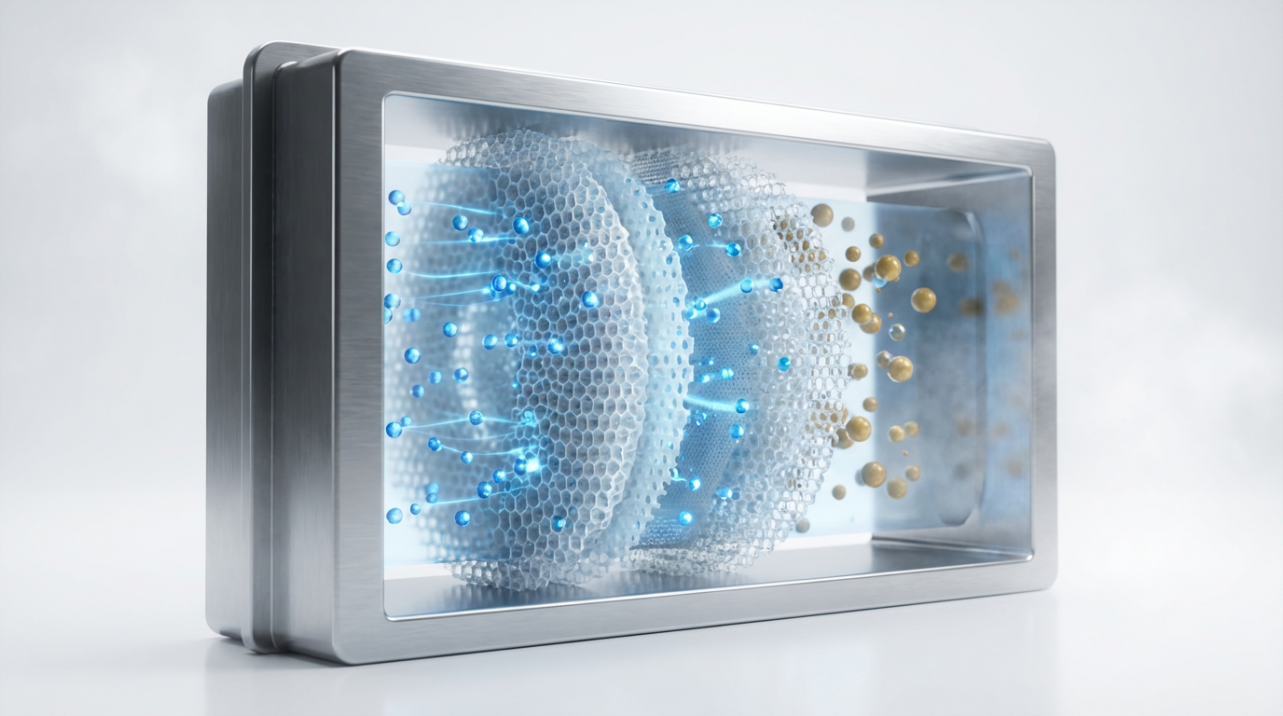
Summary: You can’t judge an RO membrane by years alone—its true lifespan is about how well it still removes dissolved solids and delivers steady flow, which you can track with a simple TDS meter, a watchful eye on faucet flow, and a few key maintenance habits.
What “Lifespan” Really Means
When homeowners ask how long an RO membrane lasts, answers range from 1 to 5 years. Residential and light commercial experts such as SoftPro, Membrane Solutions, and US Water Systems generally see 2–5 years as realistic, with 2–3 years common in average homes and closer to 4–5 years in well-protected systems.
But “lifespan” is not a magic date on the calendar. It’s the point where the membrane can no longer deliver clean, low‑TDS water at a reasonable flow without over‑pressurizing or constant cleaning.
In practice, membranes slowly foul and scale. Performance drifts gradually, then more sharply once a tipping point is reached, as noted by J.Mark Systems and the journal Desalination. That’s why you assess lifespan by performance metrics, not just by age.
Core Indicators Your Membrane Is Still Healthy
The most useful health check is salt rejection, which you can estimate with a handheld TDS meter. US Water Systems and Dultmeier both recommend measuring TDS at the cold tap and at the RO faucet, then calculating rejection. As a rule of thumb, a healthy drinking‑water membrane usually delivers about 90–97% rejection.
If your tap water is 300 ppm and your RO water is 15 ppm, rejection is about 95%—excellent. If RO water climbs to 50–60 ppm on the same tap water, rejection falls toward 80% and most experts consider that membrane near end‑of‑life, especially for health‑focused use.
Flow rate is your second key indicator. If it suddenly takes twice as long to fill a glass, or the system runs almost constantly to fill the tank, fouling is likely. Industrial guides from Complete Water, ChemTreat, and Kurita suggest action when normalized permeate flow drops around 10–15%; in a home, you can treat a sustained 20–30% drop—after you’ve changed prefilters—as a strong sign the membrane is aging.
A rising pressure drop across the membrane (if your system has gauges), worsening taste or odor, or cloudy water are additional red flags. If these persist after fresh prefilters and a good flush, it’s time to plan cleaning or replacement.
Conditions That Stretch (or Shrink) Membrane Life
Water quality is the single biggest driver of lifespan. Hard water, high TDS, iron, manganese, and hydrogen sulfide all accelerate fouling and scaling, according to SoftPro and the Water Quality Association. Studies cited by SoftPro show hard‑water conditions can shorten membrane life by roughly 30%.
If your incoming TDS is above about 500 ppm, expect closer to 2–3 years of service, even with good care. With softer water below about 100 ppm and solid pretreatment, many homes comfortably reach 4–5+ years.

Operating conditions matter too. Residential RO typically runs around 40–80 psi. Too little pressure gives poor rejection; too much strains the membrane and housings. Temperature also plays a role: University of Nebraska–Lincoln Extension notes that output can drop roughly 1–2% for every degree Fahrenheit below about 77°F, so a winter well supply near 45°F may produce roughly half the water you see at 77°F.
In higher‑recovery systems, Bestamembrane and Puretec point out that pushing recovery above about 75% concentrates salts at the membrane surface and rapidly increases fouling risk. Most residential units sit closer to 20–30% recovery for this reason.
Cleaning vs. Replacing the RO Membrane
For larger or commercial systems, experts such as Complete Water, Kurita, and J.Mark Systems recommend cleaning when normalized flow falls about 10% below baseline or pressure drop rises 15%. Crystal Quest brings similar thinking into the residential space, suggesting cleaning when you see reduced faucet output, rising TDS, or off tastes—especially if the membrane is under about 3 years old.
High‑pH cleaners target organic fouling and biofilm, while low‑pH cleaners dissolve mineral scale. Industrial setups often use clean‑in‑place (CIP) skids; at home you’re more likely to remove the membrane, soak it 30–60 minutes in the proper cleaner, rinse with chlorine‑free water, and then flush the system, as Crystal Quest outlines.
However, several sources—including Crystal Quest and J.Mark Systems—agree on one key point: membranes older than about 3–4 years, or those that stay under‑performing after a proper cleaning, are usually better replaced than “rescued.” From a health perspective, chasing the last few months out of a tired membrane is rarely worth the risk.

Nuance: research from the University of Arizona shows advanced operators can sometimes restore end‑of‑life membranes with carefully controlled chlorination, but that’s a specialized, engineered approach—not a DIY method for home RO units.
A Simple At‑Home Checkup Routine
Use this quick routine to track your membrane’s real lifespan.
- Monthly: Record tap and RO TDS, and confirm rejection stays at or above roughly 90%.
- Monthly: Notice flow, taste, and odor; investigate any consistent change that lasts more than a day or two.
- Every 6–12 months: Replace sediment and carbon prefilters on schedule to keep chlorine and grit off the membrane.
- At 2–3 years: Recheck rejection, flow, and how hard your water is; if rejection drops below about 85% or flow is poor despite new prefilters, budget for a new membrane.
- Any time cleaning fails to restore performance or the membrane is 3–4+ years old: prioritize replacement to protect water quality and your family’s health.
References
- https://www.academia.edu/40484599/Comparative_life_cycle_assessment_of_end_of_life_options_for_reverse_osmosis_membranes
- https://experts.arizona.edu/en/publications/extending-the-life-of-water-reuse-reverse-osmosis-membranes-using
- https://www.energy.gov/femp/articles/reverse-osmosis-optimization
- https://ui.adsabs.harvard.edu/abs/2024E%26ES.1401a2012A/abstract
- https://wqa.org/wp-content/uploads/2022/09/2019_RO.pdf

Share:
How Often Should Water Storage Buckets Be Deep Cleaned?
Understanding Common Issues After Replacing Water Filters