

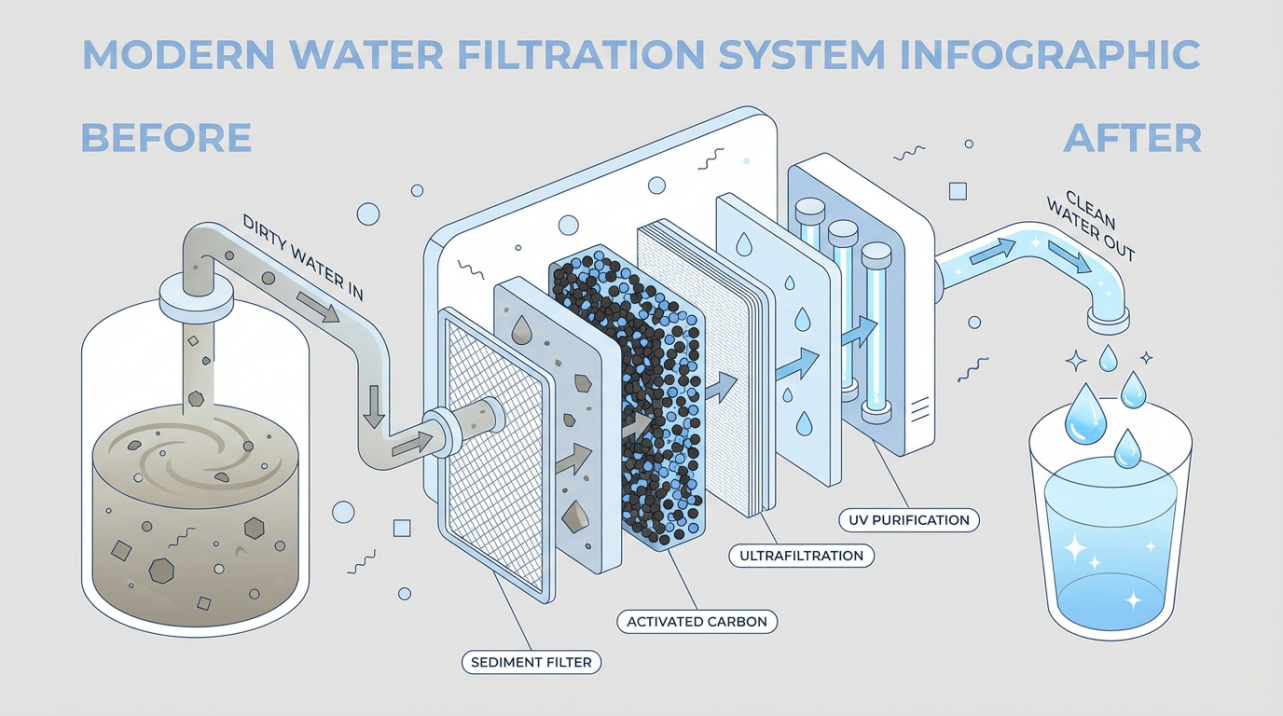
When you invest in a new water filter, you expect instant, crisp, clean-tasting water. Yet many people are surprised to find that right after a filter change, their water tastes off, smells strange, or even seems worse than before. As a Smart Hydration Specialist and Water Wellness Advocate, I see this pattern all the time in homes, offices, and small businesses that genuinely care about hydration but feel frustrated after doing “the right thing” and maintaining their filters.
The good news is that most post-replacement issues are understandable, often temporary, and very fixable when you know what is normal, what is a warning sign, and how different systems behave. Drawing on guidance from the CDC, university and extension research, and multiple filtration manufacturers and labs, this article will walk you through the most common problems you may notice after replacing a water filter and what to do about them in a practical, science-backed way.
Why Your Water Tastes or Smells Different Right After a Filter Change
The first sip after a filter change can be surprising. Sometimes the water tastes dusty, slightly bitter, or unusually flat. Other times the chlorine “pool” smell disappears overnight. All of these changes are linked to what the new filter is actually doing to your water.
New Filter “Break-In”: Carbon Dust, Protection Liquids, and Trapped Air
Many home filters, from pitchers to refrigerator cartridges and under-sink units, rely on activated carbon. According to multiple filtration providers, including Brio and Culligan, carbon is excellent at capturing chlorine, hydrogen sulfide, rust, and many odor-causing organics, which is why it so often makes water taste and smell better.
However, brand-new carbon cartridges do not behave like “seasoned” ones. Filterway notes that new filters can release fine carbon dust and trap air pockets, which often creates temporary off-tastes or mild cloudiness right after installation. That is why manufacturers typically recommend flushing the system with running water for at least several minutes, often in the range of 5–10 minutes, to clear dust and air from the media.
For reverse osmosis (RO) systems, there is an additional element. A Membrane Solutions article on bad-tasting RO water explains that some new RO membranes ship with a protection liquid to keep the membrane stable during storage. If you do not flush long enough after installation, that liquid can cause noticeable odor or bitterness. Their recommendation is to open the waste line and faucet and let the system flush for roughly 15 minutes to remove the protection liquid and restore normal taste.
In real homes, what this means is simple: if you have just replaced a carbon or RO element and notice a faintly dusty or chemical note that gets weaker during the first several minutes of flushing, you are probably experiencing normal break-in behavior.

You should see gradual improvement rather than a worsening trend.
A Different Taste Is Not Automatically a Problem
Even when the water looks perfectly clear, you may find that it tastes very different from what you are used to. That difference is not necessarily a sign that the filter is failing; it often reflects what the filter is intended to remove.
Brio’s research on tap water taste emphasizes that chlorine is a major driver of sharp, “pool-like” flavor in municipal water. Activated carbon filters are explicitly designed to remove chlorine and hydrogen sulfide, while ultrafiltration and RO systems can strip out particles, microorganisms, and dissolved salts. As a result, water from a new carbon or RO system commonly tastes:
- Less chlorinated or chemical, because chlorine is being removed.
- Less mineral-forward and almost “neutral,” especially with RO, because many dissolved minerals are stripped along with contaminants.
- Cleaner and crisper in the case of ultrafiltration, which keeps healthy minerals while removing microbes and fine particulates.
Waterdrop and Culligan both highlight that reverse osmosis produces extremely pure water that many people describe as very neutral or even slightly flat compared with mineral-rich tap or spring water. A study summarized by the Water Interface Group at Virginia Tech found that minerals such as calcium, magnesium, sodium, and iron actively shape how sweet or metallic a beverage tastes, even when those minerals are present at low levels. When your new filter removes a significant portion of those minerals, your palate notices, even if the water is technically “better.”
This explains why some families feel their new filtered water tastes softer and more pleasant, while others miss the mineral snap of unfiltered tap.

As Brio and the Albemarle County Service Authority both suggest, taste preferences are subjective; a change in taste alone does not equal unsafe water, especially if your municipal supply already meets quality standards.
When Bad Taste After a Filter Change Signals a Real Issue
While many taste shifts are simply the result of effective filtration, there are certain patterns that should prompt you to dig deeper. The key is to distinguish short-lived break-in effects from persistent or worsening flavors that point to underlying problems with the water, the filter, or the plumbing.
Chemical or “Pool-Like” Taste That Gets Worse Instead of Better
Municipal systems rely heavily on disinfectants such as chlorine and chloramine. TapScore, Culligan, Brio, and SpringWell all note that these chemicals protect against pathogens but frequently cause noticeable chemical or bleach-like taste and odor. A properly installed carbon filter should reduce that profile, not intensify it.
Filterway points out that when water still tastes strongly of chlorine or develops an even harsher “chemical” character after a filter change, several issues are possible. The filter media might not be the right type for your water chemistry. The filter stages might be in the wrong order, leaving carbon overwhelmed by sediment or iron. Or, in some unfortunate cases highlighted by Membrane Solutions, the device itself may be low-quality or even counterfeit, offering little actual filtration.
There is also the water supply to consider. Filterway, Oklahoma State University Extension, and SpringWell all describe how seasonal changes, infrastructure work, and stormwater runoff can dramatically change raw water quality and disinfectant levels. This means your water can start tasting harsher even if you install a high-quality filter correctly.
Taken together, a chemical or “pool” taste that gets weaker during the recommended flush and then stays mild is probably normal. A strong chemical taste that persists or intensifies after a full flush and several glasses often signals a mismatch between the filter and your water, a poor-quality cartridge, or a significant change in the supply. In those cases, the guidance from TapScore, Filterway, and the CDC is to test rather than guess, using home test strips as a first check and a certified lab when taste changes are sudden or severe.
Bitter, Metallic, or Rusty Notes After Replacement
Bitter and metallic tastes are among the most common complaints after a filter swap. TapScore explains that metallic flavors are usually associated with iron, manganese, zinc, or copper, and that low pH water can corrode pipes and leach metals, including tasteless but toxic ones such as lead. SpringWell adds that metallic and sour-tangy water often signals metals leaching from older plumbing, especially when the water is acidic. Fresh Water Systems also ties metallic and bitter tastes to high total dissolved solids, hard water minerals, and corroded copper piping.
So why would this show up right after a filter change? Filterway notes that new filtration can change the flow pattern and chemistry of water moving through your lines, disturbing accumulated scale or changing how corrosive the water is to metals in pipes and fixtures. They also point out that residual water in older plumbing can take days of regular use to be fully replaced by newly filtered water.
In practice, a homeowner might replace an undersink carbon cartridge and immediately notice a slightly metallic note that gradually fades over a few days as old water is flushed from the lines. If staining, discoloration, or rust particles accompany the taste, or if the taste is strong and persistent, TapScore, SpringWell, and Fresh Water Systems all recommend investigation. That should include testing for metals rather than assuming the filter is handling them, especially in homes with older plumbing.
Rotten-Egg, Earthy, or Moldy Smells That Persist
Rotten-egg odor is usually linked to hydrogen sulfide gas or sulfur bacteria rather than the filter itself. Brio’s taste research and SpringWell’s guide both associate sulfur’s “rotten egg” smell with hydrogen sulfide stemming from geology, decaying organic matter, or sulfur-using bacteria, particularly in well systems. Fresh Water Systems also mentions dirty, moldy, or musty tastes arising from algae, harmless bacteria, and sediment, especially in private wells.
Filters can help, but they can also become part of the problem. Aquaox warns that a malfunctioning or poorly maintained filter can become a source of contamination, introducing new pollutants or allowing bacteria and other pathogens to pass through. Artesian and Southern Living both emphasize that old or clogged filters can become breeding grounds for bacteria and mold, turning into a source of bad taste and potential illness. Filterway notes that housings and fittings themselves can accumulate algae, scale, or biofilm, especially with inconsistent use or warm conditions, and recommends periodic sanitization of those components.
A very common pattern is the refrigerator dispenser that still smells musty or earthy even after a new filter is installed. The All Filters troubleshooting summary indicates that in these cases, the problem may reside in the internal reservoir, lines, or dispenser area, which need to be cleaned and sometimes sanitized, not just filtered. Similarly, a reverse osmosis system with a storage tank can develop off odors when water stagnates; the personal account from a user comparing RO and ionizing systems points out that large storage tanks and long internal runs provide plenty of surface area for biofilms when water sits unused.
If you experience persistent rotten-egg or musty smells that do not change after proper flushing, it is wise to treat that as more than aesthetic. SpringWell advises stopping use and contacting your utility if a public supply smells like gasoline or strong sulfur in cold water. Aquaox recommends stopping use and seeking medical advice if you feel sick after drinking filtered water. In well systems, consulting a local water expert to address hydrogen sulfide or bacterial contamination is appropriate.
Plastic, Rubber, or “Storage Tank” Tastes
Plastic or “rubbery” tastes are often linked to the plumbing rather than the filter cartridge. TapScore explains that plastic pipes such as PEX, PVC, and CPVC can leach a range of compounds into drinking water, creating plastic-like tastes. They also note that more than one hundred compounds associated with plastic piping have been detected in drinking water, though the long-term health impacts remain uncertain.
Waterdrop points out that filtered water taste is influenced not only by what is removed but also by how the water is stored. Storing filtered water in clean, sealed glass or stainless steel away from sunlight helps prevent stale or off flavors. When water sits in plastic tanks, tubing, or refrigerator reservoirs for long periods, it can gradually pick up flavors from those materials or, as the anecdotal RO user story suggests, from microbial growth on the internal surfaces.
Membrane Solutions describes another cause of “storage tank” taste in RO systems: stagnation. If the purifier sits unused and water remains held in the membranes and filters, that trapped water can deteriorate and develop bad taste and odor. Their recommendation is to remove the filter elements and clean out the stagnant water before resuming use when an RO system has been idle.
If plastic-like tastes show up right after a filter change, especially after work on plumbing or installation of new tubing, they can sometimes fade as the system is flushed and used regularly. If the taste is strong, persistent, and clearly linked to specific plastic components, TapScore and Fresh Water Systems both recommend investigating plumbing materials and considering flushing or replacement.
Taste and Safety: When to Take Immediate Action
One of the most important principles from the CDC’s guidance on home water filters is that taste, smell, and appearance are unreliable indicators of safety. Harmful germs and chemicals often do not change how water looks or tastes, while many harmless substances can produce strong odors. That means that “good-tasting” water is not automatically safe, and bad-tasting water is not automatically dangerous.
However, certain taste profiles are widely treated as red flags. SpringWell and Fresh Water Systems both caution that gasoline, diesel, or solvent-like tastes can indicate petroleum or chemical contamination from leaking fuel tanks, spills, or industrial discharges. Their recommendation is to stop using the water immediately, have it tested, and involve local utilities or health authorities where appropriate. SpringWell also notes that persistent rotten-egg odor in city-supplied cold water should trigger a call to the utility.
Aquaox and Artesian both warn that if you feel sick after drinking filtered water, especially when you know your filter is overdue for replacement, you should stop using that water and seek medical advice. Old filters can re-release bacteria and chemicals they previously removed, sometimes making filtered water more contaminated than the tap, according to Artesian’s discussion of aged filters. For people with weakened immune systems, the CDC recommends consulting healthcare providers and using filtration systems certified to remove specific germs, rather than relying on standard taste-and-odor filters.
In short, sudden and severe gasoline-like, chemical, or rotten-egg tastes, especially when accompanied by physical symptoms, are a reason to stop drinking the water and seek testing and professional help rather than simply swapping cartridges again.

How Different Systems Behave After a Filter Change
Not all filters are built the same, so their post-replacement quirks are different as well. Understanding how your specific system is meant to work helps you interpret what you taste and see.
Pitcher and Countertop Filters
Pour-through filters, such as pitcher systems, rely mainly on granular activated carbon and sometimes ion-exchange resins. A study at Southern Illinois University Edwardsville evaluated several such filters under realistic household conditions and found that certified units could reduce metals and adjust pH and mineral content over many gallons of use, often bringing tap water’s inorganic profile close to that of common bottled waters. At the same time, the study showed that performance changes over time and differs by brand; some filters began releasing certain ions after their capacity was approached.
In everyday use, the first fills after inserting a new pitcher cartridge often show fine particles or a slightly gray tint, which align with Filterway’s description of carbon dust and the All Filters guidance about flushing new carbon filters. The SIUE study operated filters up to more than forty gallons of throughput; Membrane Solutions notes that long-term economics depend heavily on filter lifespan and replacement frequency. Artesian, discussing common pitcher and tap-mounted filters, describes typical lifespans in the range of a few months and stresses that using filters far beyond their rated capacity can result in water that is no cleaner—and sometimes more contaminated—than the original tap.
If your freshly changed pitcher filter produces water that tastes a bit dusty during the first few fills and then quickly clears, that is consistent with normal carbon break-in. If the taste becomes increasingly bitter, metallic, or musty as days go on, Aquaox and Artesian would consider that a strong signal that the filter is either overloaded or compromised and should be replaced or upgraded.
Undersink and Reverse Osmosis Systems
Undersink systems range from simple two-stage arrangements to multi-stage RO units. Filterway describes common configurations where a sediment pre-filter protects a carbon block, and in three-stage systems, an additional specialty filter handles iron, lead, or other contaminants. Correct filter type and order are critical; placing carbon ahead of sediment or omitting necessary specialty stages can leave significant taste and odor problems unresolved.
Reverse osmosis systems go further. Oklahoma State University Extension notes that RO is widely used in bottled water production and food processing because it removes a very broad spectrum of dissolved contaminants and about 99.9% of viruses and bacteria, but also strips beneficial minerals, operates relatively slowly, and wastes approximately two to three volumes of water for every volume purified. Culligan describes household RO systems similarly: they pair carbon pre-filtration with a semipermeable membrane and optional specialty cartridges and often add a mineral-boosting stage to restore pleasant taste.
Right after a filter change in an RO system, you may notice a few distinct issues. The RO water can taste noticeably more neutral or even flat; Brio, Waterdrop, and Culligan all emphasize that RO’s mineral removal is the reason. If you use an RO system with a remineralization stage, you may notice taste improve further once that stage is fully flushed and active. Membrane Solutions cautions that new RO elements may carry protection liquids that create temporary off-tastes until the system is flushed thoroughly.
In RO systems with storage tanks, changes in usage patterns around the time of a filter swap can also matter. Membrane Solutions points out that water left sitting in filters can stagnate, and a forum user’s experience highlights how large, rarely emptied tanks and long plastic lines provide ample surface for microbial colonization. If water has sat unused for a long period, it is prudent to empty the tank, flush the system as recommended by the manufacturer, and, if needed, clean or sanitize storage components rather than assuming the new membrane alone will correct a stale or unpleasant taste.
Refrigerator Filters and Dispensers
Refrigerator water filters, as Southern Living explains, are primarily designed to improve taste and odor and reduce some contaminants such as chlorine, sediment, and certain metals like lead and mercury. They are usually carbon-based and not full-scale germ-removal devices. Whirlpool’s guidance, cited in that article, recommends replacing fridge filters about every six months.
After installing a new refrigerator filter, manufacturers and retailers commonly recommend dispensing and discarding several glasses or even a few gallons of water to clear carbon fines and air, consistent with the All Filters troubleshooting summary. During that initial flush, slight cloudiness or tiny dark specks can appear; these usually diminish quickly.
If your water still tastes bad after flushing a new fridge filter, several possibilities emerge from the combined guidance of Southern Living, Filterway, All Filters, and Artesian. The filter could be the wrong model or of poor quality. The internal reservoir, lines, or dispenser could harbor biofilm or scale that a simple cartridge swap cannot fix. Or there may be underlying issues with the home’s water supply, such as changing chlorine levels or upstream contamination.
Southern Living and Artesian both warn that old fridge filters can become bacterial reservoirs, contributing to bad taste, odor, and potentially illness. If you are replacing a filter after a long overdue interval and the water still tastes off, consider both the new cartridge’s quality and the hygiene of the internal water pathway. In some cases, using the manufacturer’s bypass mode temporarily and relying on another safe source while you clean and troubleshoot is the safest route.
Whole-House Filters and Softeners
Whole-house systems, also called point-of-entry filters, treat all water entering your home. OneCall Plumbing describes how these systems typically combine sediment filters, activated carbon, and sometimes specialty media such as KDF, UV disinfection, or even whole-house RO to reduce chlorine, sediments, certain chemicals, and sometimes microbes. They can improve taste at every tap, protect plumbing and appliances, and often complement water softeners that address hard water scale.
Right after replacing cartridges or media in a whole-house filter, you may notice the chlorine smell disappearing in showers and sinks or a change in how soaps and shampoos lather. Oklahoma State University Extension explains that hard water reduces soap foaming and rinsing effectiveness, and that removing minerals improves cleaning performance. A fresh softener or hardness-reducing filter can therefore make water feel “slippery” or change how easily you rinse products from your skin and hair.
When whole-house filters remove chlorine or other disinfectants, the CDC notes that germ growth in plumbing can actually increase if there is no alternative disinfection step. That makes maintenance especially important. OneCall Plumbing emphasizes regular cartridge replacement, often in the range of every several months to a few years depending on usage and water quality, and warns that neglect can lead to low pressure, poor taste, and system damage. Cost estimates in their discussion place typical whole-house equipment in the approximate 3,000 range, with additional professional installation and ongoing maintenance costs.
If taste improves initially but gradually worsens long before the rated service interval, that pattern often points to unexpectedly high contaminant loads or a mismatch between system design and your actual water conditions. In those cases, testing and consultation with a qualified water professional are usually more effective than simply swapping cartridges more often.
Quick Reference: Common Symptoms After a Filter Change
The research and field experience from multiple sources can be distilled into a brief comparison to help you interpret what you notice right after replacing a filter.
Symptom right after replacement |
Likely short-term cause |
When to investigate further |
Mild off-taste or slight cloudiness that improves as you let water run |
Carbon dust, trapped air, or RO protection liquid flushing out, as described by Filterway, All Filters, and Membrane Solutions |
Off-taste remains strong after the recommended flush time or gets worse with more use |
Chlorine or “pool” smell suddenly much weaker or gone |
Activated carbon removing chlorine and chloramine, as noted by Brio, Culligan, and Waterdrop |
Chemical or bleach-like odor becomes stronger after replacement or water tastes sharply chemical despite a full flush |
Water tastes noticeably flatter or more neutral than before |
Reduction of minerals and dissolved solids by RO or mixed-bed filters, consistent with Brio, Waterdrop, and Oklahoma State University Extension |
Taste is bitter, metallic, or otherwise unpleasant rather than simply neutral, or family members report stomach upset after drinking |
Rotten-egg or musty smell that does not change after flushing |
Hydrogen sulfide or sulfur bacteria in source water, or biofilm in housings and reservoirs, as described by Brio, SpringWell, Aquaox, and Artesian |
Odor is strong in cold water from a public supply, or you feel ill after drinking; stop use and contact your utility or a water expert |
New metallic taste appears after filter change |
Disturbed pipe scale or altered corrosion behavior releasing metals, consistent with TapScore, SpringWell, and Fresh Water Systems |
Metallic taste remains or intensifies, stains appear, or tests show elevated metals, especially in homes with older plumbing |
Plastic or “tank” taste shows up with a new system |
New plastic components or stagnant water in tanks and lines, reflecting TapScore, Waterdrop, and the RO user anecdote |
Taste is strong and persistent, or there is visible slime or residue in tubing or tanks; consider flushing, cleaning, or upgrading materials |
This table is not a substitute for testing, but it gives you a science-informed starting point to decide whether you are seeing a normal transition or a potential problem.
How Maintenance Habits Shape Post-Replacement Problems
A new filter cannot compensate for chronic neglect. Many of the taste complaints that appear “right after replacement” actually began months earlier as filters aged, housings accumulated biofilm, and water quality shifted.
Respecting Filter Lifespans and Capacities
Artesian explains that typical household filters, such as pitcher and tap-mounted units, have finite lifespans on the order of a few months, measured in both gallons and time. Once they reach capacity, their ability to trap contaminants declines sharply, and they can even become breeding grounds for bacteria. Their discussion describes how old filters may release trapped bacteria and minerals back into the water, sometimes visible as particles, making old filtered water less safe than the original tap.
Filterway provides more granular guidance, noting that sediment filters often need replacement every three to six months, carbon filters around every six months, and specialty cartridges such as KDF, iron, or lead reduction elements on six to twelve month cycles, depending on contaminant load. Southern Living reports similar timing for refrigerator filters, citing Whirlpool’s six-month recommendation.
Membrane Solutions adds a long-term cost perspective. Their ten-year comparison for an eight-person family estimates that bottled water could cost around $8,500, ordinary filters about $3,000, and RO systems roughly $1,500, with the key driver being how often filters must be replaced and at what price. SIUE’s study on pitcher filters reinforces that certified filters can provide bottled-water-quality inorganic profiles at a fraction of the environmental and financial cost of bottled water, as long as capacity limits are respected.
The pattern is clear: running filters far beyond their design life not only worsens taste but undermines the very safety and cost benefits that led you to filtration in the first place.

Cleaning Housings, Reservoirs, and Plumbing
Replacing cartridges without addressing the rest of the system is a bit like changing only the air freshener in a car with a dirty cabin filter. Filterway highlights that housings and fittings can accumulate algae, mineral scale, and biofilms, particularly in warm or intermittently used systems. Aquaox emphasizes that neglected filters and housings can become contamination sources. The All Filters troubleshooting summary and Southern Living’s refrigerator guidance both point toward cleaning dispenser areas, drip trays, and accessible internal parts to prevent musty or moldy tastes.
In RO systems with storage tanks and refrigerators with built-in reservoirs, a combined approach is often necessary. Membrane Solutions advises removing filters and clearing stagnant water before resuming use in idle RO systems. The RO user anecdote underscores that replacing or regularly cleaning susceptible plastic tubing can reduce biofilm-related taste issues. For refrigerators, cleaning the dispenser, drain tray, and any accessible hoses according to the manufacturer’s instructions helps ensure that a new filter does not simply push water through old contamination.
Testing, Certifications, and Smarter System Choices
The CDC advises starting with knowledge. If you use a private well, they recommend testing at least annually and whenever color, taste, or smell changes. If you have public water, your utility’s water quality report is the baseline; home or lab testing adds detail when you notice new issues after a filter change. TapScore and Fresh Water Systems both emphasize that guesswork is a poor strategy; taste gives clues, but you need actual data to select the right filter media.
Certifications matter as well. The CDC and Membrane Solutions both reference NSF/ANSI standards as a way to match filter performance to your needs. NSF 42 focuses on aesthetic effects like taste and odor. NSF 53 addresses health-related contaminants such as many heavy metals. NSF 58 applies to RO systems. Membrane Solutions also notes that pitcher and filter products with those certifications are more likely to deliver the advertised reductions in chlorine, metals, and other contaminants.
When you select a filter, thinking about your water’s specific issues, as Brio, Culligan, and the Albemarle County Service Authority all recommend, leads to better outcomes than buying generic “purifiers” that may have little verified performance. In areas where tap water is already well filtered and treated, as the Service Authority points out, additional filtration is often about taste, odor, and personal comfort, not basic safety. In those settings, carbon-based systems focusing on chlorine and aesthetic issues may be more than adequate.
What To Do When Your New Filter “Isn’t Working”
If you have just replaced a water filter and the results are disappointing or alarming, a practical, stepwise approach can help you respond calmly and effectively.
First, confirm that you have installed the correct filter in the correct orientation and flushed it for the amount of time recommended by the manufacturer. Filterway, All Filters, and Membrane Solutions all stress that incomplete flushing is a leading cause of temporary off-tastes, especially with carbon and RO elements.
Second, pay attention to the direction and persistence of the taste change. If a dusty or slightly chemical flavor gets weaker with each glass and disappears after a day of normal use, that pattern aligns with normal break-in behavior described by Filterway and Membrane Solutions. If a chemical, metallic, or rotten-egg taste is strong, does not change after a full flush, or appears suddenly in cold water from a city supply, it is more consistent with the red-flag situations described by TapScore, SpringWell, Aquaox, and the CDC.
Third, consider how long the previous filter was in service and whether you have cleaned supporting components. Old filters, as Artesian and Southern Living warn, can harbor bacteria and accumulated contaminants. If you are replacing a very overdue filter and still have bad taste, the problem may reside in housings, tubing, tanks, or the source water itself rather than in the brand-new cartridge. Cleaning and, where appropriate, sanitizing those components according to manufacturer guidance can be as important as the filter change.
Finally, bring data into the conversation. If taste changes are pronounced or you have any concerns about health, testing your water is the most direct way to clarify what is happening. Filterway recommends at least annual testing for municipal users and every six to twelve months for well owners, with additional tests after major events such as flooding. TapScore, Fresh Water Systems, and Culligan all suggest that lab testing can pinpoint metals, chlorine, total dissolved solids, and other constituents that affect taste and safety, allowing you to match filters precisely to the contaminants actually present.
Short FAQ on Post-Replacement Filter Issues
How long should a “new filter taste” last? Filterway and Membrane Solutions describe new-filter tastes related to carbon dust, trapped air, or RO protection liquids that usually clear after following the manufacturer’s flushing instructions, typically in the range of several minutes up to around fifteen minutes of running water. If an unusual taste remains strong after a full flush and a day of normal use, especially if it is chemical, metallic, or rotten-egg in character, it is wise to treat that as more than a simple break-in effect and investigate further.
Is very flat-tasting water after an RO filter change safe to drink? RO systems are specifically designed to strip dissolved minerals and other dissolved solids, producing very neutral or almost “flavorless” water, as highlighted by Brio, Culligan, and Oklahoma State University Extension. That flat taste alone is not a sign of danger; it is the expected result of high removal efficiency. If you prefer more flavor, many RO systems, including those described by Culligan and Artesian, offer remineralization stages that add small amounts of minerals back to the water to improve taste while preserving high filtration performance.
If my city says my tap water is safe, do I really need a filter at all? The Albemarle County Service Authority and the CDC both point out that in many U.S. communities, tap water already meets or exceeds safety standards, thanks to multi-stage municipal treatment and monitoring. In those settings, home filters are often optional from a safety standpoint and are chosen to improve taste, odor, or color, or to address particular concerns like lead or specific chemicals. If you dislike the chlorine taste or want extra peace of mind about certain contaminants, a certified filter targeted to your local water conditions can make sense. If you are satisfied with the taste and have no special risk factors, you may reasonably choose to drink tap water directly and focus on regular review of your utility’s water quality report.
Staying well hydrated should feel simple and reassuring, not confusing or worrisome. When you understand how new filters behave, what different tastes are telling you, and how to align maintenance, testing, and technology with your actual water, you put yourself back in control of your home hydration. That is the heart of smart water wellness: not chasing fads or fear, but making clear, informed decisions that keep every glass of water in your home both enjoyable and trustworthy.
References
- https://extension.okstate.edu/fact-sheets/water-use-in-the-food-industry.html
- https://waterinterface.graduateschool.vt.edu/blog_archive/effect-of-water-minerals-on-taste-perception-and-emotional-respo.html
- https://www.cdc.gov/drinking-water/prevention/about-choosing-home-water-filters.html
- https://www.isws.illinois.edu/pubdoc/C/ISWSC-127.pdf
- https://www.siue.edu/~enavarr/projects/WaterFilterSIUE.html
- https://cse.umn.edu/college/feature-stories/finding-ways-make-your-water-taste-better
- https://scholarworks.indianapolis.iu.edu/server/api/core/bitstreams/97f7c5d5-4c65-42f5-9100-c067c0641825/content
- https://openaccess.uoc.edu/server/api/core/bitstreams/1f8e971c-9c13-4d51-9adf-707b2a1847b6/content
- https://serviceauthority.org/should-i-filter-my-tap-water/
- https://www.southernliving.com/what-happens-if-you-dont-replace-fridge-water-filter-11851147?srsltid=AfmBOop53agS9akZJLwJ-E8QvdSpKcDRWswtaDF1f-zXtO3uNCPxxmGF

Share:
Understanding How to Assess the Lifespan of RO Membranes
Optimizing RO Membrane Cleaning Frequency for Maximum Efficiency