

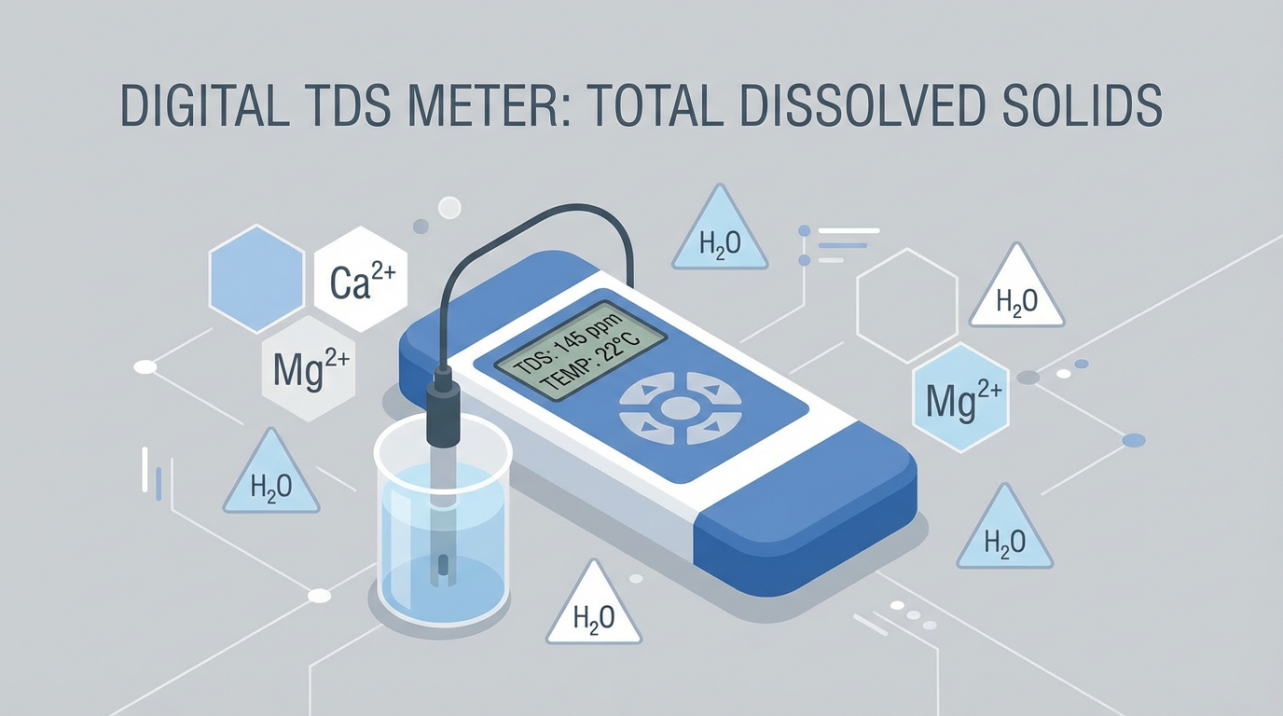
As a smart hydration specialist, I see the same question over and over when someone buys a TDS meter for the first time: “My water is 42 ppm… is that good or bad?” or “My tap is 420 ppm. Should I panic?”
Total Dissolved Solids, or TDS, is one of the simplest numbers you can get from a water test, yet it is also one of the most misunderstood. When you understand what different TDS levels mean, you can use that number as a powerful tool to tune taste, protect your plumbing and filtration system, and decide when you really need more detailed testing.
This guide walks through what TDS measures, how the meters work, how to interpret different TDS ranges, and how to act on the results without overreacting.
What TDS Really Measures
Total Dissolved Solids is the total concentration of everything dissolved in your water that is not H₂O. Across the research from Fresh Water Systems, Crystal Quest, Waterdrop, and others, that “everything” usually includes:
Dissolved minerals such as calcium, magnesium, sodium, and potassium. Common anions such as bicarbonates, chlorides, sulfates, and nitrates. Metals such as iron, copper, zinc, lead, aluminum, and arsenic. Other dissolved substances, including fluoride, pesticides, herbicides, and organic matter.
TDS is usually expressed in parts per million (ppm) or milligrams per liter (mg/L). For typical drinking water, these units are essentially equivalent: 300 ppm means about 300 milligrams of dissolved material in one liter of water.
It is important to understand that TDS is a sum. It does not tell you how much of each substance is present. Five hundred ppm that is mostly calcium and magnesium has a very different health profile from five hundred ppm that includes elevated lead or arsenic. That is why multiple sources, including the CDC and Culligan, describe TDS mainly as a general indicator of water quality rather than a direct safety rating.

TDS vs. Hardness, pH, Salinity, and Conductivity
Another source of confusion is how TDS relates to other water measurements. Several sources clarify the relationships this way:
Hardness is mainly about calcium and magnesium. Doctor Fresh and Racoman emphasize that hardness is a subset of TDS that focuses on scale-forming minerals. Hard water is usually higher in TDS, but not all high TDS water is hard, and hardness is typically treated with a water softener rather than a TDS-only solution.
pH measures acidity or alkalinity. It is not a measure of how much is dissolved in the water. The CDC notes that water that is too acidic or too basic can corrode pipes and leach metals, which can show up as part of TDS, but the two numbers describe different aspects of water chemistry.
Electrical conductivity (EC) measures how well water conducts electricity. Reagecon and NDSU explain that dissolved ions carry current, so higher TDS generally means higher conductivity. Most handheld TDS meters simply measure conductivity and convert it to a TDS estimate using a factor, rather than measuring solids directly.
Salinity is often used for natural waters like rivers, estuaries, and seawater. The U.S. Geological Survey points out that salinity and TDS are related but not identical. Salinity focuses on dissolved salts, while TDS includes a broader set of dissolved materials and is usually defined by the residue left after evaporation.
The key takeaway is that TDS gives you a “big picture” of how loaded your water is with dissolved material, while pH, hardness, and specific contaminant tests fill in the details that matter for health and system design.
How TDS Is Measured
Gravimetric (Laboratory) Method
In formal water analysis, TDS is measured directly. According to Reagecon and NDSU, the gravimetric method works like this. A precise volume of water is filtered to remove suspended particles, then the clear sample is evaporated and dried in an oven at about 356°F. The dish is weighed before and after drying, and the increase in weight is the mass of dissolved solids that were in the original sample.
This approach is slow and requires lab equipment, but it is the reference method. It is especially valuable in research settings, such as the U.S. Geological Survey’s large study of salinity and TDS in natural waters, where TDS is defined by that dried residue.
Electronic TDS Meters
For everyday use, almost everyone relies on electronic TDS meters. Multiple sources, including Mayu Water, AMPAC, Gaimc, and Doctor Fresh, describe the same basic design.
The meter has a probe with metal electrodes that sense the water’s electrical conductivity. Many models also include a temperature sensor to adjust readings to a standard temperature, typically around 77°F. Inside, the device multiplies the conductivity by an empirical factor to estimate TDS and shows the result in ppm on a digital display.
Because TDS meters infer TDS from conductivity, they are approximate. The conversion factor changes with water composition; NDSU shows that typical factors range from about 0.5 at low conductivity to around 0.8 at higher conductivity. That is why you can see slightly different readings between meters in the same glass of water.
Accuracy, Calibration, and Care
The research is very consistent on one point: a TDS meter is only as good as its calibration and maintenance. Mayu Water and Reagecon recommend:
Calibrating regularly, often about once a month or after ten to fifteen uses, using a standard solution such as 342 ppm sodium chloride at room temperature. Immersing the probe to the marked depth and avoiding air bubbles, which can distort the electrical path. Rinsing the probe with distilled or low-TDS water after use, storing it with the protective cap on, and never immersing the device beyond the probe area. Watching battery health, because weak batteries can cause drifting or unstable readings.
Good handheld meters typically advertise accuracy around plus or minus two percent and resolution down to one ppm or even 0.1 ppm.

That level of precision is more than enough for home hydration decisions, provided you use the meter consistently.
How Different TDS Levels Are Classified
There is no single global chart that everyone uses, but multiple reputable sources converge on similar patterns. The World Health Organization and the U.S. Environmental Protection Agency both recommend an upper guideline of about 500 ppm for drinking water TDS, mainly for taste and scaling reasons rather than direct toxicity. Fresh Water Systems notes that readings above 1,000 ppm are considered unsafe to drink, and water over 2,000 ppm may be difficult for typical filtration systems to handle.
Several hydration and filtration companies, including Crystal Quest, AMPAC, Racoman, Waterdrop, Gaimc, and Doctor Fresh, offer taste-based and quality-based bands. When you line these up side by side, the picture looks roughly like this.
TDS range (ppm) |
General description (across sources) |
Typical notes from cited sources |
0–50 |
Ultra low or “pure” |
Often reverse osmosis or distilled water; very flat taste; more aggressive toward plumbing; used for baby formula or lab use. |
50–150 |
Excellent, “sweet spot” for drinking |
Crisp, refreshing taste; good balance of purity and minerals; favored range for everyday drinking and specialty coffee. |
150–300 |
Good to typical |
Normal tap water range in many areas; noticeable mineral taste but still pleasant for most people. |
300–500 |
Acceptable to high |
Still within WHO and EPA guidance; more pronounced salty or mineral notes; more scale and spotting on fixtures. |
500–900 |
Poor to potentially unsafe |
Exceeds EPA secondary standard; taste and scaling problems; may signal elevated sodium, nitrates, or heavy metals. |
Above 900–1000 |
Unsafe for drinking in most guidance |
Strong off tastes; high likelihood of problematic contaminants; typically calls for treatment and deeper testing. |
Crystal Quest and AMPAC emphasize that 50–150 ppm is an optimal target for most households.

Waterdrop and Racoman use slightly different thresholds but still classify anything under about 300 ppm as excellent or good, and anything over about 900 ppm as poor or unacceptable.
One more nuance matters. Waterdrop highlights that the United States, Canada, and international bodies such as the World Health Organization do not set a minimum TDS level. The main regulatory focus is the upper bound of about 500 ppm for taste and maintenance reasons. As a result, you should think of low TDS water as a taste and plumbing conversation, not a violation of a regulation.
Taste, Health, and Plumbing: What Different Levels Really Mean
Low TDS: Very Pure, Not Always Ideal
Water in the zero to about fifty ppm range is usually produced by reverse osmosis, distillation, or deionization. Crystal Quest notes that ultra-pure water in this range is very flat. Mayu Water and Fresh Water Systems both point out that reverse osmosis often drives TDS down to about five to fifty ppm, and that many people choose to remineralize this water to improve flavor and restore some beneficial minerals.
KnowYourH2O adds an important plumbing and health perspective. Extremely low TDS water, such as deionized water, tends to be more corrosive, often has a lower pH around 5.5, and can leach metals from pipes. Over the very long term, exclusive consumption of such aggressive water may contribute to acidosis, although major agencies have not adopted a specific minimum TDS limit.

This is why systems like the Mayu Full Cycle and many reverse osmosis units include remineralization cartridges or blending valves. They intentionally raise very low TDS water into that 50–150 ppm “sweet spot” so you get clean water with a more natural mineral feel.
Moderate TDS: The Everyday Sweet Spot
In the roughly 50–300 ppm window, multiple sources agree that water is generally excellent to good for everyday drinking. Crystal Quest calls 50–150 ppm the optimal range, describing it as crisp, refreshing, and gentle on appliances. AMPAC and Gaimc classify 50–150 ppm as ideal and 150–300 ppm as moderate but acceptable.
From a health standpoint, this range often reflects a mix of magnesium, calcium, and sodium that can support taste and provide small mineral contributions. Shell Water Systems notes that some of these TDS components are beneficial, and sometimes they are even added back after treatment.
Appliance-wise, you may see light spotting and scale in the upper part of this range, but routine maintenance usually keeps things in check. Coffee and tea enthusiasts often prefer to dial in their brewing water to about 75–150 ppm, a range Crystal Quest highlights as optimal for extraction and flavor clarity.

High TDS: Taste, Scale, and Possible Contaminants
Between roughly 300 and 500 ppm, your water still falls within WHO and EPA guidance, but several sources warn about aesthetic and maintenance issues. Fresh Water Systems notes that taste often becomes bitter or noticeably mineral at higher TDS levels, and scale buildup in kettles, humidifiers, and plumbing becomes more pronounced.
Once TDS rises above about 500 ppm, multiple sources begin to use terms such as poor, unacceptable, or potentially unsafe. Waterdrop and Culligan both emphasize that TDS at or above this level frequently brings hard water, corrosion, salty or metallic flavors, and reduced effectiveness of soaps and detergents. The U.S. EPA’s secondary standard of 500 mg/L is designed specifically to catch these taste and scaling problems.
The real red flag appears as TDS crosses about 900–1,000 ppm. Doctor Fresh and Fresh Water Systems both describe water above about 900 mg/L as poor or unsafe for drinking. Fresh Water Systems classifies anything over 1,000 ppm as unsafe, and notes that water above 2,000 ppm can be difficult for many filtration systems to handle effectively. At this point, more thorough testing is strongly recommended to identify specific contaminants such as sodium, nitrates, or heavy metals.

Very High TDS in Special Contexts
There are situations where very high TDS is intentional or necessary. For example, Fresh Water Systems notes that hydroponic flowers may thrive at around 1,000–1,100 ppm and vegetables around 900–1,000 ppm, because those readings largely reflect nutrient salts such as potassium and nitrate. Crystal Quest highlights that reef aquariums are typically filled with water that starts at near-zero TDS, with carefully controlled salt and mineral additions to reach the right marine chemistry.
In swimming pools, Orenda Tech explains that total dissolved solids can climb into the thousands of ppm, especially in saltwater pools. Their field experience suggests that even extremely high TDS levels do not automatically ruin chlorine effectiveness; most problems blamed on TDS turn out to be related to other chemistry factors. In that world, TDS is more of an “age of water” indicator that helps pool professionals decide when to drain or dilute.
The common thread across all of these examples is context. A TDS reading only makes sense when you know what the dissolved solids are and what you are trying to achieve.
Why TDS Alone Cannot Tell You If Water Is Safe
One of the most important messages in the research is that low TDS does not guarantee safe water, and high TDS does not guarantee danger.
Mayu Water, Gaimc, AMPAC, Culligan, and Waterdrop all stress that TDS meters have a fundamental limitation. They mainly detect ionic compounds that conduct electricity. They cannot detect many non-ionic pollutants, including pesticides, oils, and a wide range of organic chemicals, and they cannot distinguish between beneficial minerals and harmful metals such as lead or arsenic.

They also cannot tell you anything about bacteria, viruses, or parasites.
The CDC treats TDS as a water quality indicator. In its well water guidance, the agency recommends testing private wells at least once a year for total coliform bacteria, nitrates, TDS, and pH. TDS, in that framework, is a signal that something may have changed in your water source or plumbing, not a direct health verdict. High TDS can hint at saltwater intrusion, farm runoff, or corroding pipes, but it cannot specify which of those is happening.
KnowYourH2O echoes this. Elevated TDS itself is not regulated as a primary health contaminant in the United States. It is a secondary, aesthetic standard. The real concern is that when TDS climbs above a few hundred ppm, there is a higher chance that regulated contaminants like nitrate, arsenic, aluminum, copper, or lead may also be elevated.
The practical implication is straightforward. Use TDS as a compass, not a diagnosis. When TDS is unusually high or changes suddenly, that is your cue to run more detailed tests or contact your local health or environmental department, especially if you are on a private well.
Interpreting Your Own TDS Reading
When you hold a TDS meter in your hand, knowing how to interpret the number can turn anxiety into action. Drawing on the ranges and recommendations from Crystal Quest, Racoman, Waterdrop, Fresh Water Systems, Doctor Fresh, and others, here is how to think about common scenarios.
If your drinking water TDS is below about 50 ppm and it comes from reverse osmosis, distillation, or deionization, your water is very pure. That is a great starting point for removing contaminants, but you may find the taste flat. Long term, ultra-low TDS water can also be more corrosive to metal plumbing. In these situations, it often makes sense to add a remineralization cartridge or blending valve, so that some healthy mineral content is restored and the final TDS lands closer to the 50–150 ppm sweet spot.
If your TDS is between roughly 50 and 150 ppm, you are in the range many experts call ideal. Taste is usually crisp and refreshing, and scaling is limited. For most municipal supplies and well-managed home filtration systems, this is a comfortable place to be. A periodic TDS check every six to twelve months, as Crystal Quest suggests for city water, is usually enough to verify that nothing major has changed.
If your TDS is between about 150 and 300 ppm, you are still in a range that multiple sources classify as good or typical. You may notice a slightly stronger mineral flavor, especially in tea and coffee, and you may see light spotting on fixtures, but this alone is not a reason to panic. It can be a reason to fine-tune your filtration or consider targeted treatment if you want to reduce hardness or improve taste for brewing.
When TDS rises into the 300–500 ppm band, taste issues and maintenance concerns become more prominent. This is often where people start to notice bitter, salty, or metallic notes, more soap scum in the shower, and faster scale buildup in kettles and humidifiers. The EPA’s secondary standard of 500 ppm sits near the upper edge of this band. At this point, it is wise to look at your local water quality report if you are on municipal water, or to consider lab testing or a comprehensive home test kit if you use a private well, so you can see exactly which dissolved solids are driving that number.
If your TDS reading is above about 500 ppm and especially if it approaches or exceeds 900–1,000 ppm, the guidance from Doctor Fresh, Racoman, Fresh Water Systems, Waterdrop, and others converges: treatment and deeper testing are recommended. Water at these levels is more likely to contain excessive sodium, nitrates, or metals, and it will cause more severe taste, scaling, and appliance wear. High-TDS groundwater often calls for a reverse osmosis system, sometimes followed by remineralization to maintain pleasant taste. In very high TDS cases, distillation or deionization can be employed, especially where almost mineral-free water is needed.
If you already have a reverse osmosis system, Fresh Water Systems recommends using TDS to track performance by measuring both feed water and RO water and calculating the rejection percentage. For example, if your tap water is 260 ppm and your RO faucet reads 20 ppm, the rejection is about 92 percent.

A significant rise in the RO TDS reading over time can tell you that filters or the membrane are nearing the end of their useful life.
Across all these scenarios, remember that TDS is a trend tool. Monitor changes over time, and pair TDS checks with periodic broader testing for specific contaminants.
Getting the Most from Your TDS Meter
From a practical hydration standpoint, a TDS meter earns its keep when you use it intentionally. Based on the combined recommendations from Mayu Water, AMPAC, Gaimc, NDSU, and others, an effective routine looks like this in everyday language.
Use a clean glass or beaker so you are measuring your water, not residue from dish soap or previous samples. Let cold water run briefly to flush the line before collecting your sample.
Turn on the meter and, if the manufacturer recommends it, verify calibration with a standard solution at room temperature. For many home meters, that standard solution is around 342 ppm sodium chloride at roughly 77°F.
Immerse the probe to the indicated depth, gently stir to release air bubbles, and give the reading ten to fifteen seconds to stabilize. Read the ppm value from the display.
Rinse the probe with low-TDS or distilled water, tap off any droplets, and replace the protective cap. Store the meter dry, and avoid leaving it in direct sunlight or extreme heat.
If you use an RO or other filtration system, test both the feed water and the treated water periodically. Watch for creeping increases in the treated water TDS, which often signal that filters or membranes are due for replacement.
Finally, respect the meter’s limitations. When the number surprises you, treat it as a prompt to investigate, not as a final verdict on safety.
FAQ: Common Questions About TDS Levels
Is low TDS water bad for you?
Research and guidance from Waterdrop indicate that there is no established minimum TDS level in major regulations, and low TDS water is not considered harmful by itself. However, extremely low TDS water can taste flat, and sources such as KnowYourH2O point out that deionized or very low TDS water can be more corrosive, potentially leaching metals from plumbing and contributing to acid-base imbalance if consumed exclusively for long periods. In practice, bringing RO or distilled water up into the 50–150 ppm range with remineralization gives you a good balance of purity, taste, and system friendliness.
Can I rely on a TDS meter to decide if my water is safe?
No. TDS meters are excellent screening tools but poor safety devices. As Mayu Water, Culligan, Gaimc, and the CDC all emphasize in different ways, a TDS reading cannot tell you if bacteria, viruses, pesticides, or low-level heavy metals are present. It cannot distinguish between harmless and harmful dissolved solids. Use TDS to track changes and to verify filter performance, but rely on targeted tests or laboratory analysis when you need to assess health risks.
How often should I test my TDS?
Crystal Quest recommends testing municipal drinking water about every six to twelve months and private wells more frequently, such as quarterly. The CDC suggests that well owners test their water at least once a year for TDS, nitrates, pH, and total coliform bacteria, and more often after flooding, system repairs, or noticeable changes in taste, color, or smell. If you rely on filtration systems like RO or softeners, adding quick TDS checks whenever you change filters or notice taste changes is a practical habit.
The goal of smart hydration is not to chase the lowest possible TDS number, but to understand what your number means in your specific context, then tune your water so it is clean, safe, and genuinely enjoyable to drink. When you pair an informed reading of TDS levels with sensible testing and the right filtration and remineralization tools, you move from guessing about your water to confidently managing it for your health, your home, and your everyday comfort.
References
- https://www.usgs.gov/publications/salinity-and-total-dissolved-solids-measurements-natural-waters-overview-and-a-new
- https://www.cdc.gov/drinking-water/safety/guidelines-for-testing-well-water.html
- https://www.ndsu.edu/agriculture/extension/publications/using-electrical-conductivity-and-total-dissolved-solids-meters-field-test
- http://honeforest.net/wp-content/uploads/2019/11/TDS-Testing-Guide-Green.pdf
- https://blog.orendatech.com/understanding-total-dissolved-solids-tds
- https://www.wikihow.com/Calculate-Total-Dissolved-Solids
- https://www.culligan.com/blog/tds-tester-tips-and-why-a-water-test-is-better
- https://www.ecosoft.com/post/tds-tester-tips-and-why-a-water-test-is-better
- https://www.erunwas.com/news-detail/id-107.html
- https://www.gaimc.com/Newsinfo/How-TDS-Water-Test-Meters-Work

Share:
Understanding the Impact of Alkaline Water on Blood pH Levels
Understanding Why Bartenders Prioritize Water Quality Over Alcohol