

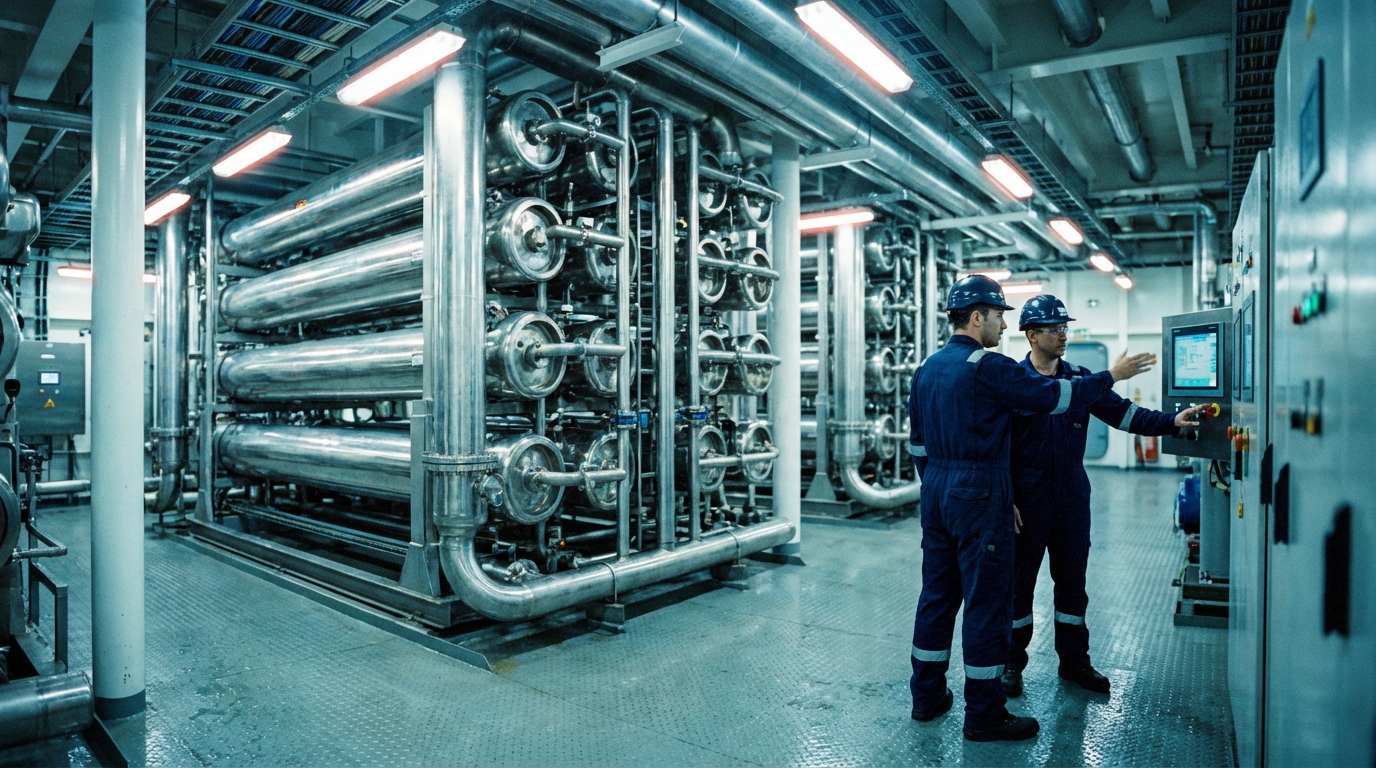
Cruise ships today are essentially floating cities. A single large vessel can carry several thousand guests and crew, each expecting hotel-level showers, sparkling pools, safe ice, and flawless drinking water from every tap. You simply cannot deliver that level of comfort and safety at sea without highly reliable reverse osmosis (RO) desalination.
As a smart hydration specialist who spends a lot of time looking at how large ships make and safeguard their water, I see the same pattern repeatedly. The difference between “barely coping” and “quietly reliable” RO plants is not exotic technology. It is disciplined maintenance, intelligent monitoring, and a health-first mindset that treats every gallon as both a technical and a public-health responsibility.
This article focuses on how to maintain large RO systems on cruise ships efficiently, drawing on marine engineering practice, industrial RO guidance, public-health standards, and real-world cruise operations.
Why Cruise Ships Depend On Big RO Plants
On a modern cruise vessel, relying on stored shore water alone is not practical. For example, one well-known mega-ship carries around 6,600 passengers and, according to marine engineering briefings, uses roughly 200 to 250 liters of water per person each day. That is about 50 to 65 gallons per person. At full load, total use approaches 1.5 million liters per day, close to 400,000 gallons.
Storing that volume for a week-long itinerary would require enormous tank space, hurt fuel efficiency because of extra weight, and still leave the ship vulnerable to variable port-water quality. This is why large vessels produce fresh water continuously at sea, primarily by desalinating seawater through RO, sometimes supplemented by thermal evaporators.
RO is a pressure-driven process. High-pressure pumps push seawater, typically at 800 to around 1,000 psi, against semi-permeable membranes. Water molecules pass through as low-salt permeate, and most salts, organics, and microorganisms stay behind in the concentrate or brine stream. Well-designed systems remove about 95 to 99 percent of dissolved salts and many other contaminants, according to industrial RO guides and a comprehensive review of desalination technology published in a membrane-science journal.
For cruise lines, RO offers several advantages over thermal distillation. It usually uses less energy per gallon, fits into modular skids that can be tucked into machinery spaces, and does not depend on large amounts of waste heat. The main tradeoff is that RO is more sensitive to feedwater quality and fouling, which makes maintenance and operation discipline absolutely critical.
What “Healthy” RO Performance Looks Like At Sea
To maintain a large RO plant efficiently, you need a clear mental picture of what “good” looks like in terms of performance. Across industrial and marine references, four parameters appear again and again: recovery, salt rejection, differential pressure, and permeate flow.
Recovery is the percentage of feedwater that becomes product water. On seawater RO, shipboard recovery commonly lands in the 30 to 50 percent range. If you feed 100,000 gallons of seawater per day and produce 40,000 gallons of permeate, you are operating at 40 percent recovery, and the remaining 60,000 gallons leave as brine. Pushing recovery higher can save energy and reduce intake volumes but also drives up scaling risk in the brine.
Salt rejection describes how effectively the membrane is removing dissolved ions. It is often expressed as a percentage based on conductivity. If feedwater is at 35,000 parts per million total dissolved solids (TDS) and permeate is at 350 ppm, overall salt rejection is about 99 percent. Industrial sources define high-quality RO as typically achieving 95 to 99 percent rejection. A slow upward creep in permeate conductivity at constant operating conditions is one of the earliest warning signs of membrane fouling or damage.
Differential pressure is simply the pressure drop across the membrane array or individual pressure vessels. As suspended solids, biofilm, or scale accumulate on the membrane surface, feed-to-concentrate differential pressure rises. Multiple industrial guides recommend scheduling cleaning when normalized permeate flow has dropped by around 10 percent from baseline or when overall pressure drop has increased by roughly 15 to 20 percent. Applying those same thresholds onboard helps crews intervene early without wasting cleaning chemicals.

Permeate flow is the volume of product water produced per hour. Designers often think in terms of membrane flux, measured as gallons per square foot per day. For seawater, typical design ranges are around 8 to 12 gallons per square foot per day, according to RO design references. In practice, ship crews will monitor actual permeate gallons per hour and compare them to a temperature-corrected baseline. Significant deviations that cannot be explained by feed temperature or salinity changes usually point to a problem.
Consider a simplified example. A vessel has a RO train that, when new, produced 20,000 gallons per day of permeate at 800 psi feed pressure and 30 psi pressure drop across the membranes. After a few months, operators notice that permeate has dropped to 18,000 gallons per day while pressure drop has climbed to 36 psi. That represents a 10 percent drop in flow and a 20 percent increase in differential pressure.

According to industrial maintenance guidance, this is exactly when to schedule a clean-in-place (CIP) before fouling becomes much harder to remove.
Fouling, Scaling, And Biofilm: The Main Enemies Of Cruise-Ship RO
In every major technical review of desalination, membrane fouling is identified as the dominant operational challenge. Multiple sources categorize foulants into inorganic scaling, organic fouling, biofouling, and colloidal fouling. Marine RO practitioners see all of them because seawater is a complex mixture of minerals, organics, and microorganisms, and ship operations add further risks from oil, chemicals, and intermittent operation.
Suspended solids and colloids from sand, silt, and rust will plug the feed channels and increase pressure drop if pretreatment is weak. Hardness minerals such as calcium carbonate and calcium sulfate precipitate as scale when concentration in the brine stream exceeds solubility, especially at higher recoveries. Dissolved metals like iron and manganese can oxidize and form sticky deposits on the membrane surface. Biofouling arises when bacteria grow on membrane and spacer surfaces, producing slimy films that dramatically increase pressure and reduce flow. Organic contaminants from spills or port water can be particularly troublesome.
A variety of industrial sources describe the operational symptoms of these problems in very similar ways. A gradual increase in pressure drop, accompanied by a slow decrease in permeate flow, often points to particulate or colloidal fouling. A sharp increase tied to higher recovery or warmer feedwater may indicate mineral scaling. A musty smell and rapid re-fouling after cleaning often mean biofilm is present.
On cruise ships, where water demand is relatively constant but operating environments change, real-time monitoring is the only way to catch these shifts early. According to industrial RO maintenance guides, operators should continuously track feed, permeate, and concentrate pressures and flows, along with temperature and conductivity, and then normalize trends to a reference condition. That might sound like a lot of work, but modern data loggers and control systems can automate most of the calculations while crew focus on clear alarms and dashboards.
To translate these concepts into daily practice, it helps to link symptoms, likely causes, and response strategies. The following table synthesizes recommendations from industrial maintenance guides, marine RO discussions, and RO chemistry references.
Symptom at RO train |
Likely dominant cause |
Immediate operational response |
Gradual increase in feed-to-concentrate pressure drop by about 15 to 20 percent with modest loss of permeate flow |
Particulate or colloidal fouling from undersized or overloaded pretreatment filters |
Check and replace cartridge filters, verify multimedia filter backwash performance, schedule low-pH cleaning if deposits are inorganic, and consider feedwater clarification improvements |
Pressure drop and permeate TDS both increasing, especially at higher recovery setpoints |
Mineral scaling (often calcium carbonate or sulfate) in later stages |
Reduce recovery setpoint temporarily, confirm antiscalant dosing and pH control, plan low-pH cleaning targeted to scale, and review antiscalant selection using feedwater analysis |
Permeate flow decreasing with stable or slightly improved TDS, and deposits that feel slimy or gelatinous |
Biofouling from bacteria and organics |
Confirm disinfection of pretreatment, schedule high-pH or biocidal cleaning, inspect for dead legs and stagnant piping, and review preservation practices during layup |
Sudden loss of salt rejection with an apparent increase in permeate flow at constant pressure |
Mechanical damage or oxidant attack on membranes |
Check for residual chlorine or oxidants, inspect for pressure shocks or improper start-up, isolate affected elements if possible, and consult membrane supplier before cleaning |
This kind of symptom-to-action mapping is the backbone of efficient maintenance.

It avoids both extremes of over-cleaning and neglect, two patterns that shorten membrane life and increase total operating cost.
Choosing The Right Cleaning Chemistry
Several detailed RO care guides emphasize that using the wrong cleaning chemistry can be as bad as not cleaning at all. Once membranes are significantly fouled, chemical cleaning is typically the only way to recover capacity. The challenge lies in matching cleaners to foulants while respecting the pH, temperature, and material limits set by the membrane manufacturer.
Low-pH cleans, usually in the acidic range, are recommended for inorganic colloidal fouling and many mineral scales, such as carbonates and some metal oxides. High-pH cleans, often alkaline, are used for organics and biofouling. When both scale and organics are present, multiple sources recommend starting with a low-pH step to strip mineral deposits and then following with a high-pH step to remove organic and biological residues. Specific biocides can also be used to address bacterial contamination, assuming compatibility with the membrane polymer.
On board a cruise ship, feedwater chemistry changes with region, season, and local events like algal blooms. Industrial experts advise operators to review antiscalant projections and mineral analyses of feed and concentrate streams to determine whether carbonate or sulfate scales dominate. That information guides whether to favor a particular acidic cleaner or a chelating alkaline cleaner. Marine engineering references on RO maintenance during lay-up further stress the importance of preserving membranes with appropriate biocidal solutions if the plant is idle for long periods, rather than allowing stagnant seawater or brackish water to sit in the system.
Before any cleaning, operators should confirm that chemical choices, concentrations, and temperatures are within the limits recommended by the membrane manufacturer. This is especially important because many large marine RO plants use thin-film composite membranes that are vulnerable to strong oxidants and extreme pH.
CIP On A Large Vessel: What Efficient Practice Looks Like
A typical clean-in-place cycle for industrial RO, adapted to shipboard constraints, follows a structured sequence. First, operators flush the membranes with permeate water while opening the concentrate valve fully. This step removes bulk salt and prepares the system for contact with cleaning solution rather than raw seawater.
Next, a dedicated CIP pump and tank are connected so that cleaning solution is circulated from the tank through the membrane feed inlet. Permeate and concentrate outlets are usually routed back to the same tank, creating a recirculating loop. Industrial guidance often recommends recirculation for about an hour at a controlled temperature and pH, with occasional soak periods to enhance penetration into foulant layers.
Throughout the cleaning, crew should monitor the pH and, if necessary, adjust it with small chemical additions to keep it in the target range. After recirculation, the system is flushed thoroughly with permeate to remove residual chemicals before normal operation resumes. If both acid and alkaline steps are needed, the entire cycle is repeated with the second solution.
On large cruise ships, the practical challenge is scheduling CIP so that it aligns with routine maintenance windows and does not disrupt passenger services. Many operators choose to perform CIP while in port with reliable shore power, or immediately before scheduled shutdowns, as suggested by industrial RO maintenance sources. This timing not only restores performance but also prevents deposits from hardening during idle periods.
A simple calculation highlights the benefit of timely cleaning. Suppose a RO train is rated for 25,000 gallons per day but has declined to 22,000 gallons per day due to fouling. If cruise operations require 50,000 gallons per day from two trains, the ship must now run both trains harder and longer, consuming more energy per gallon. Restoring each train to near its design flow can free enough capacity to handle peak demand with lower pressure or fewer operating hours, directly saving energy and runtime on high-pressure pumps.

Building A Preventive Maintenance Program That Works At Sea
Reactive maintenance is the enemy of efficient RO operation. According to a detailed guide on membrane pressure vessels, a robust preventive maintenance program should specify regular tasks such as cleaning, lubrication, inspections, testing, and replacement, all scheduled based on equipment age, operating conditions, and manufacturer guidance. For critical assets like cruise-ship RO plants, inspections should occur much more frequently than the bare minimum of once a year.
Pretreatment is the first line of defense. Marine watermaker maintenance articles emphasize that clogged sea strainers and prefilters quickly starve the high-pressure pump and membranes of adequate flow. On many marine systems, seawater passes through a coarse strainer, then through a set of cartridge filters, often in the 20 to 30 micron range followed by about 5 micron. These filters capture particles large enough to cause plugging and protect the membrane from abrasion and oil. In practice, crews monitor the low-pressure supply gauge and replace prefilters whenever supply pressure drops below a defined threshold or when differential pressure across the filters approaches about 10 psi.
For large cruise-ship RO plants, the same logic applies at scale. Multimedia filters, cartridge filters, and sometimes ultrafiltration units provide staged removal of solids. Regular backwashing of media filters, timely cartridge changes, and attention to oil contamination are non-negotiable. Several marine and industrial sources warn that even small amounts of oil or hydrocarbons can permanently damage RO membranes, making an oil separation step in the intake line valuable for ships that may occasionally operate near spills or busy ports.
High-pressure and low-pressure pumps need scheduled attention as well. Marine RO maintenance references suggest that, depending on pump design, oil changes, seal replacements, and bearing inspections may be due anywhere between a few hundred and several thousand operating hours. Each vessel’s planned maintenance system should translate these generic intervals into calendar reminders, aligned with actual running hours recorded by the automation system.
Membrane pressure vessels themselves, often made of glass-reinforced plastic or high-grade stainless steel, also benefit from routine external inspections for corrosion, mechanical damage, and leaks. Vessel manufacturers recommend ensuring that operating pressure, temperature, and chemical exposure stay within design limits to prevent premature failure and safety hazards. On a ship, where vibration and hull flexing add extra mechanical stress, regular visual inspections and careful torque control on end closures are essential.
To keep such a maintenance program organized, many operators rely on computerized maintenance management systems. These systems log every task, date, and responsible technician. They support internal audits, regulatory inspections, and trend analysis and help set realistic service intervals. Knowing not just that a CIP occurred, but what the before-and-after permeate flow, pressure drop, and salt rejection looked like, is invaluable for refining future maintenance.
Monitoring, KPIs, And Condition-Based Maintenance
Efficient maintenance is increasingly driven by data instead of fixed time intervals. A membrane-vessel maintenance guide emphasizes three key performance indicators: equipment uptime, total maintenance cost, and mean time between failures. In RO terms, that translates into how many hours the plant is available, how much is being spent on labor and spare parts to keep it running, and how long components such as pumps and membranes last before replacement.
Water-treatment experts recommend turning the RO skid into a small laboratory. Alongside flow and pressure, crews should track normalized permeate flow, normalized salt rejection, and normalized pressure drop. Normalization accounts for changes in feed temperature and salinity so that operators are comparing like with like over time. Software tools and spreadsheets can automate these corrections, making it realistic to trend performance on a daily or weekly basis even with limited crew time.
More advanced condition monitoring is also becoming common in industrial membrane systems. Tools such as vibration analysis for pumps, acoustic monitoring for bearings and valves, and infrared thermography for motors and electrical connections can identify mechanical issues before they cause failures. These techniques, originally developed for power plants and oil and gas facilities, are well-suited to large cruise ships where downtime of a major RO train can have immediate operational consequences.
By combining these measurements with maintenance logs, ship operators can adopt true condition-based maintenance. For example, instead of cleaning membranes every three months by default, they can clean each train when normalized flow has dropped by a defined percentage or when salt passage reaches a particular threshold. This approach avoids unnecessary chemical use, reduces labor, and extends membrane life, all while protecting water quality.
From RO Skid To Cabin Tap: Protecting Passenger Health
From a health standpoint, producing low-salt water is only half the story. The greatest passenger risks are usually microbial, not mineral. Cruise ships have experienced outbreaks of gastrointestinal illness and Legionnaires’ disease that were traced back to water and distribution systems. According to public-health reports, norovirus outbreaks have forced ships to end voyages early, and investigations by regulators have detected Legionella bacteria in potable water on some vessels.
International health authorities such as the World Health Organization, along with the United States Centers for Disease Control and Prevention through its Vessel Sanitation Program, recommend a multi-barrier approach to ship water safety. That means combining robust source protection, effective treatment, safe storage, reliable disinfection, and vigilant monitoring, rather than relying on any single barrier.
RO contributes a strong barrier to many pathogens by physically rejecting bacteria and protozoa along with salts. However, viruses and very small organisms may pass in small numbers, and membranes do nothing to control regrowth in storage tanks and distribution piping. This is where residual disinfectants, temperature management, and system design become crucial.
An expert guide on Legionella control in maritime settings highlights that a significant fraction of tested ferries and cruise ships showed the presence of Legionella pneumophila, including the most concerning serogroup. It stresses the need for vessel-specific water safety plans, covering not only RO plants but also hot and cold distribution systems, showers, spa pools, and decorative water features. Each ship, like each building on land, has its own hydraulic quirks, dead legs, and temperature gradients that must be understood and managed.
Guidance on recreational water environments, such as pools and spas, reinforces the same message. Designers and operators are advised to treat pools with a multi-barrier approach involving circulation, filtration, disinfection, and dilution. On cruise ships, those pools and spas are fed by RO or evaporator water, but the primary safety control is still adequate disinfection and turnover, not the desalination method.
Bringing these threads together, an efficient cruise-ship water program integrates RO maintenance with the broader water-safety plan. That means:
Maintaining continuous disinfection with carefully controlled free chlorine or equivalent residual at the point of distribution, while protecting RO membranes upstream from oxidant damage using carbon filters or reducing agents.
Keeping hot-water systems in temperature ranges that discourage Legionella growth, balanced with scald protection.
Flushing low-use branches and fixtures to prevent stagnation.
Performing routine microbiological testing for indicators like E. coli and Legionella, even though sampling logistics at sea are challenging.
Newer sensor technologies for real-time microbial and chemical monitoring, promoted by some water-analytics companies, are beginning to offer cruise operators an additional layer of situational awareness. By detecting early shifts in bacterial load or disinfectant residual, these systems can help bridge the gap between periodic lab samples and continuous water use.
Efficiency, Energy, And Environmental Footprint
From a sustainability perspective, the way a cruise ship runs its RO plant matters both for fuel consumption and for the surrounding marine environment. Seawater reverse osmosis typically requires about 3 to 6 kilowatt-hours of electricity per cubic meter of product water, according to industry reviews and desalination companies. That translates to roughly 11 to 23 kilowatt-hours per 1,000 gallons.
Returning to the earlier example of a ship producing about 400,000 gallons of water per day, the RO plant might consume in the neighborhood of 4,500 to 9,000 kilowatt-hours daily. That energy load ultimately comes from the ship’s engines, meaning more fuel burned and more emissions. Energy recovery devices that capture pressure from the brine stream and feed it back into the system can significantly reduce this burden, although they themselves require maintenance and eventual replacement.
Environmental scientists and desalination technology companies also highlight the impact of brine discharge. For every liter of freshwater produced, seawater RO plants typically generate more than a liter of concentrated brine. Globally, desalination plants are estimated to discharge over 100 million cubic meters of brine each day, enough to cover large land areas in a shallow layer of saline water. In semi-enclosed seas with many desalination plants, such as the Arabian Gulf, this has been associated with rising ambient salinity and reduced biodiversity.
Cruise ships add a more mobile, diffuse contribution. Their RO brine is usually discharged overboard, and if not carefully managed it can create localized plumes of high salinity, sometimes warmer than ambient water. The environmental impact depends on discharge depth, local currents, and mixing. Water agencies and industry reports stress that brine and associated cleaning and antiscalant chemicals must be handled responsibly to protect marine ecosystems.
Several practical steps can help large cruise-ship RO systems operate more efficiently and cleanly:
Operate RO primarily in open, cleaner waters rather than near ports and harbors where feedwater may carry more pollutants and suspended solids, which increase fouling and chemical use.
Optimize recovery and pressure based on real-time performance data rather than aiming for maximum instantaneous output. Running slightly below the theoretical maximum recovery can cut fouling and cleaning frequency.
Select antiscalants and cleaners with lower environmental persistence when possible and follow manufacturer instructions for dilution and neutralization before discharge, in line with international regulations.
Coordinate RO production with other water-use systems onboard. For example, if advanced wastewater treatment plants can reclaim some greywater for non-potable uses under certain regulations, that can reduce the freshwater burden.
Advanced monitoring and predictive analytics, discussed in a number of industry and academic reviews, are beginning to help operators strike a better balance between water security, fuel use, and brine impact.
A Daily Operating Rhythm For Efficient Cruise-Ship RO
Bringing all of this down to the deck-plate level, what does an efficient daily routine around a large cruise-ship RO plant actually look like?
At the start of the day, engineering watchkeepers review trends from the previous twenty-four hours. They look at normalized permeate flow for each train, salt rejection, differential pressure, and any alarms. If one train shows a steady decline toward that 10 percent flow drop or 15 to 20 percent pressure increase threshold, they flag it for cleaning in the next available window.
Throughout the day, operators patrol the RO space. They listen for unusual pump noise that might indicate cavitation or bearing issues, feel for hot motor housings, and check that feed strainers are clean and that backwash cycles on multimedia filters are running as intended. They verify that chlorine residual upstream is low enough not to harm membranes but that downstream, in the potable-water distribution, disinfectant levels are within the range recommended by health authorities.
Once per watch or on a defined schedule, they record key readings manually and compare them against expected values. Automated systems make the data available, but manual notes still help catch anomalies and satisfy inspection requirements.
When ship operations allow, perhaps during a port stay or night-time period with lower passenger demand, the team may take one train out of service for CIP. They follow a documented procedure based on industrial RO best practices, carefully controlling chemical dosing, temperature, and contact time. Afterward they log before-and-after performance and update the maintenance system.
Meanwhile, hotel and deck departments coordinate with engineering on pool and spa operation, ensuring that halogenation, filtration, and turnover meet guidance from pool-safety and ship-sanitization manuals. Hotel and public-health officers review microbiological sampling results and adjust flushing or shock-disinfection plans as needed.
On a weekly or voyage-by-voyage basis, senior engineers and environmental officers review cumulative RO energy use, chemical consumption, and membrane performance. They use these metrics to refine operating setpoints and maintenance intervals, always with two goals in mind: delivering safe, pleasant water to every tap and minimizing the plant’s footprint on fuel and the ocean.
Short FAQ
How often should a large cruise-ship RO membrane be cleaned?
Industrial guidance suggests cleaning when normalized permeate flow drops by about 10 percent from the original baseline, when differential pressure rises about 15 to 20 percent, or when salt passage increases beyond acceptable limits. On many ships that works out to every few months, but true frequency depends on feedwater quality, recovery rate, and pretreatment performance. Using performance-based triggers rather than rigid calendar intervals generally leads to fewer cleans and longer membrane life.
Is it safe to rely on RO alone for potable water safety?
No single barrier is enough. RO does an excellent job of removing salts, many organics, and most microorganisms, but health authorities such as the World Health Organization and the CDC’s Vessel Sanitation Program recommend a multi-barrier approach. That means pairing RO with robust disinfection, secure storage, well-designed distribution, temperature control in hot-water systems, and routine microbiological testing, all embedded in a shipwide water safety plan.
What is the most important parameter to watch daily on a cruise-ship RO plant?
If forced to pick one, differential pressure across the membranes is often the earliest and most sensitive indicator that something is changing. When tracked alongside normalized permeate flow and conductivity, it gives a quick picture of whether fouling, scaling, or mechanical issues are starting to compromise the system. Catching those trends early allows crews to act before performance and water quality are significantly affected.
Maintaining large RO systems on cruise ships efficiently is about more than keeping gauges in the green. It is about delivering consistently safe, pleasant water to thousands of people in a confined environment, day after day, while respecting the ocean that supplies it. When engineering teams treat RO maintenance as a core health and wellness function rather than a background utility, the entire vessel becomes a safer, more sustainable place to sail.
References
- https://www.epa.gov/vessels-marinas-and-ports/cruise-ship-discharges-and-studies
- https://www.ncbi.nlm.nih.gov/books/NBK310818/
- https://www.cdc.gov/vessel-sanitation/media/pdfs/2025/06/2025_VSP_Environmental_Public_Health_Standards-508.pdf
- https://your.kingcounty.gov/dnrp/library/wastewater/csi/0708-CruiseShipWMreport.pdf
- https://cruising.org/wastewater
- https://complete-water.com/resources/how-to-maintain-industrial-reverse-osmosis-systems
- http://www.desolenator.com/blog-post/why-desalination-is-unsustainable-the-challenges-pitfalls-of-reverse-osmosis
- https://krakensense.com/blog/ensuring-safe-water-on-cruise-ships
- https://stark-water.com/analysis-of-common-faults-in-reverse-osmosis-system-operation/
- https://www.theshipyardblog.com/how-cruise-ships-work-part-1-water-and-waste-management/

Share:
Can Reverse Osmosis Make Volcanic‑Ash–Polluted Water Safe to Drink?
Special Treatments for Well Water Contaminated by Agricultural Fertilizers