

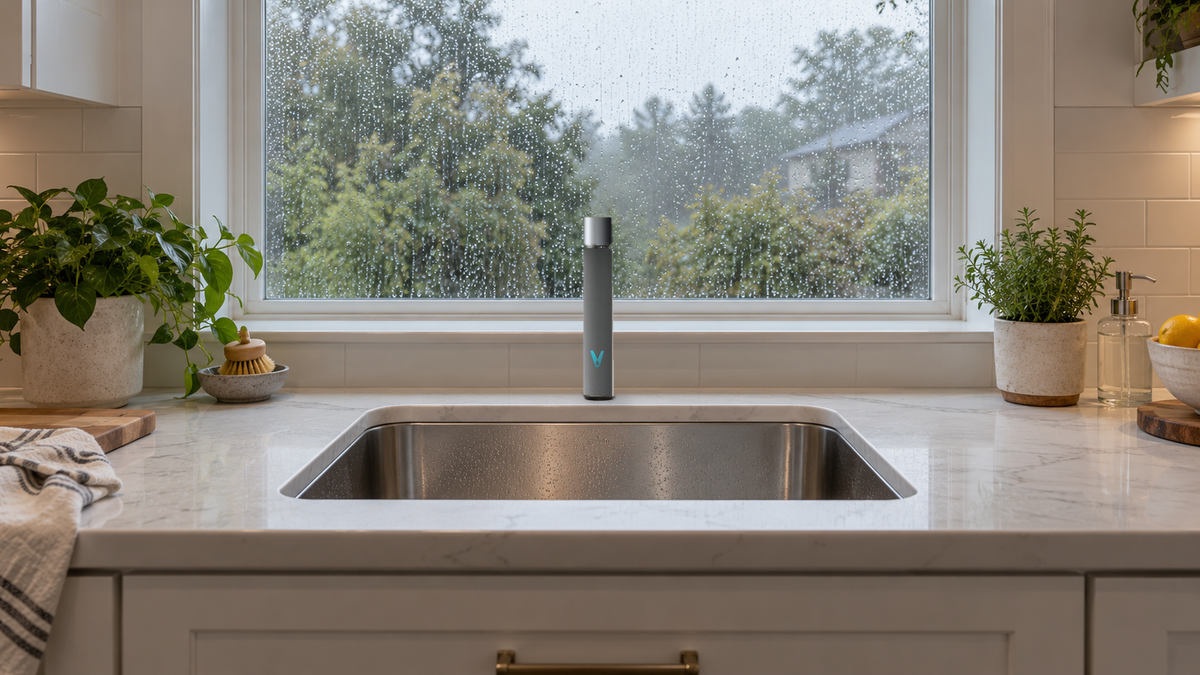
Reverse osmosis pushes water through a membrane with pores the CDC puts at about 0.0001 micron, the finest barrier among the home filters used for microplastics. For drinking and cooking water at the kitchen sink, the Viomi M1 puts that membrane in a tankless under-sink system with its own faucet.
Carbon block, pitcher and faucet cartridges are compared differently, through NSF/ANSI 401 microplastics listings, a test run on particles of 0.5 to 1 micrometer.
How Filters Hold Back Plastic Particles
Home filters stop particles in two broad ways. The first is membrane separation: a membrane is a thin barrier with pores of a defined size, so water passes through while particles larger than the pores stay behind on the feed side. The finest membrane used in home drinking water systems is the RO membrane, and in the EPA's description, reverse osmosis is a process that "forces water through an extremely thin barrier that separates chemicals from the water." (EPA). Ultrafiltration separates particles the same way, with larger pores that the CDC puts at about 0.01 micron. On that scale, an RO pore is about a hundred times finer than an ultrafiltration pore and about a thousand times finer than a microfiltration pore.
A carbon block takes the second route, depth filtration and adsorption. The block is a thick, porous bed: particles are caught as water winds through the material, and carbon also binds many dissolved chemicals on its surface. Performance depends on the whole bed, which is why cartridge filters are judged by test results at a given particle size. That difference decides how to read each product's evidence: a membrane is described by the size of its pores, a carbon cartridge by what it removed in a test.
Size Scales From Microplastics Down to RO Membranes
At the large end of the scale, microplastics are pieces "typically considered less than five millimeters" in size, and nanoplastics are those "typically considered to be less than one µm," according to the FDA (FDA). The NSF/ANSI 401 microplastics test works within that range, using particles of 0.5 to 1 µm at a challenge of at least 10,000 particles per milliliter, with at least 85% reduction required, as listed on Brita's and PUR's performance data sheets.
Filter pores go far smaller. In the CDC's guide to household drinking water treatment technologies, pore sizes run from "about 0.1 micron" for microfiltration to "about 0.01 micron" for ultrafiltration, "about 0.001 micron" for nanofiltration and "about 0.0001 micron" for reverse osmosis. Expressed in nanometers, the 401 test particles start at 500 nanometers, an ultrafiltration pore is about 10, a nanofiltration pore about 1, and an RO pore about 0.1.
Those figures measure different things: the FDA figures describe particles, the 401 band describes a test, and the CDC figures describe filter pores.
Brands and Models Compared by Mechanism
| Model | Format | Mechanism | Where it sits on the size scale |
|---|---|---|---|
| Viomi M1 | Under-sink RO, tankless | 9-stage filtration around an RO membrane, then remineralization | 0.0001-micron RO membrane |
| AquaTru Classic and Carafe | Countertop RO, hand-filled tank | Multi-stage filtration with an RO membrane | RO membrane (CDC: about 0.0001 micron for RO) |
| Culligan Aquasential RO | Under-sink RO, with tank | RO membrane with pre- and post-filters | RO membrane (CDC: about 0.0001 micron for RO) |
| Aquasana SmartFlow RO (AQ-SFRO2) | Under-sink RO, with tank | Carbon block, RO membrane, Claryum block, remineralizer | RO membrane (CDC: about 0.0001 micron for RO) |
| Aquasana Claryum Direct Connect (AQ-MF-1) | Under-sink, existing faucet | Activated and catalytic carbon, ion exchange, sub-micron filtration | Sub-micron filtration within the Claryum cartridge |
| Brita Elite filter (OB06) | Pitcher | Pitcher cartridge | Listed under the 401 test at 0.5 to 1 µm |
| PUR PLUS faucet filter (RF-9999) and pitcher filter (PPF951K) | Faucet mount; pitcher | Faucet and pitcher cartridges | Listed under the 401 test at 0.5 to 1 µm |
| ZeroWater ExtremeLife (ZFM-400CR / ZFM-400WH) | Faucet mount | Faucet cartridge | Listed under the 401 test at 0.5 to 1 µm |
The four RO rows are placed by their membrane, the Claryum row by its sub-micron filtration, and the last three by the particle size of the test they are listed under.
Reverse Osmosis Systems: The Membrane at the Center

RO systems from Viomi, AquaTru, Culligan and Aquasana put a membrane in the path of every drop that reaches the glass, which is why they sit at the fine end of the comparison. The same purified water serves drinking, coffee and cooking from one faucet. They differ in how they deliver the water and in what surrounds the membrane.
In the Viomi M1, a 0.0001-micron RO membrane sits at the core of 9-stage filtration. Microplastics are among the contaminants it targets, along with lead, PFOS, PFOA and chlorine, and its microplastic particle removal has been tested by SGS. After the membrane, a remineralization stage adds selected minerals back for a cleaner, smoother taste.

Past the membrane, the RO systems here part ways on delivery, and tankless and tanked designs differ mainly in where the purified water waits. The Viomi M1 is tankless, so water is filtered as it is poured. Rated at 1000 GPD, it returns three cups of purified water for every cup sent to the drain (3:1). The Culligan Aquasential RO and the Aquasana SmartFlow RO keep a reserve of purified water in a tank under the sink instead, and AquaTru's Classic and Carafe purifiers collect it in a clean-water tank on the counter after the RO membrane. At the faucet, that difference is the source of each glass: water filtered as it is drawn, or water poured from what the tank already holds.
At the M1's own faucet, the touchscreen shows tap and purified TDS, and the same screen starts preset pours. When a cartridge is due, the Viomi app sends a filter reminder, and it keeps track of usage in between.
The system installs in a standard kitchen, with installation parts in the box and a step-by-step video.
Models Listed Under NSF/ANSI 401 for Microplastics
Listed models are compared on what the 401 test measures: particles of 0.5 to 1 µm, with at least 85% removed. Each model on the list, in other words, cleared that bar in that size band. The cartridge filters among them treat water at the point of use: a pitcher holds a filtered batch in the fridge, a faucet mount filters while the tap is switched to filtered, and an under-sink cartridge filters the cold line feeding the existing faucet.
Most of the listings here sit on small cartridges: the faucet-mount and pitcher filters from Brita, PUR and ZeroWater in the table above. The faucet listings come from IAPMO R&T or WQA, and the pitcher listings from WQA and IAPMO R&T. The one under-sink carbon option, the Aquasana Claryum Direct Connect (AQ-MF-1), sends filtered water to the existing faucet, and its Claryum technology is IAPMO certified for "99% of lead and microplastics" according to Aquasana.
The pitcher, faucet and carbon cartridges are rated in gallons and months, from 40 gallons or 2 months for the PUR PLUS pitcher filter to 784 gallons or 6 months for the Aquasana Claryum, while the Viomi M1's cartridges are measured in years, up to 2 for the PCB filter and up to 4 for the RO filter. For a broader look at how these claims line up across formats, see water filter brands designed for microplastics, and for filters chosen for both PFAS and microplastics, affordable filters for PFAS and microplastics.
FAQ
How small a particle can a 0.5-micron carbon block hold back?
A 0.5-micron rating puts the block's nominal scale at 500 nanometers, the lower edge of the 0.5 to 1 µm band used in the NSF/ANSI 401 microplastics test. The rating describes how the carbon block is built, and a 401 listing reports what a specific filter removed: at least 85% of the challenge particles in that band. Among the carbon filters here, Aquasana describes its Claryum cartridge as combining carbon with "sub-micron filtration" and states 99% reduction of microplastics under its IAPMO certification. Particles below 0.5 µm sit outside that test band, so the rating and the listing are best read as two separate pieces of information.
Is reverse osmosis always ahead of a carbon block for microplastics?
On physical scale, the RO membrane is the finest barrier in this comparison; the CDC puts RO pore size at about 0.0001 micron. Both groups have models with documented microplastics evidence, though, and both come in more than one format: RO as countertop and under-sink systems, and the 401-listed cartridges here as pitchers, faucet mounts and an under-sink carbon block on the existing tap.
Do the other stages in an RO system change where it sits on the size scale?
The membrane sets that position, so a 9-stage system and a 4-stage system both reach the RO scale, which the CDC puts at about 0.0001 micron. The stages around the membrane carry other jobs. In the Viomi M1, the PCB filter removes sediment, rust, chlorine and organic contaminants, protecting the RO membrane and extending its life. Chlorine, taste and odor are handled by a carbon block at the start of the Aquasana SmartFlow RO, before the water reaches its membrane, while AquaTru pairs its RO filter with a Pre/Carbon filter and a VOC Carbon filter.
How small is the 0.5 to 1 µm test band next to a human hair?
The EPA puts the average human hair at about 70 micrometers in diameter (EPA). A 1-µm particle from the NSF/ANSI 401 microplastics test is one-seventieth of that width, and a 0.5-µm particle one-140th. The CDC's pore figures go much further: about 7,000 ultrafiltration pores of 0.01 micron would fit across a single hair, and an RO pore of about 0.0001 micron is roughly 700,000 times narrower than the hair itself.
Putting the Microplastic Comparison to Work at Home
- Settle on a location for filtered water first, since a dedicated drinking-water faucet, the existing kitchen tap, a countertop unit or the fridge each narrow the field to a few formats.
- On particle size, membranes sit at the finest end of the scale, and the carbon, pitcher and faucet models here with 401 listings were tested against particles of 0.5 to 1 µm.
- A pitcher suits a few glasses a day, and a plumbed system suits a full day of drinking and cooking water, so daily volume narrows the format further.
- Cartridge schedules differ as well: pitcher and faucet cartridges are rated in gallons and a few months, while many under-sink systems rate each cartridge separately, from months to several years. A household that drinks and cooks from one faucet uses far more water than a few glasses a day, so the gallon rating is worth weighing alongside the months.
Share:
Under-Sink Water Filter Brands With Easy-to-Find Replacement Filters
Reverse Osmosis Water Purifier Brands to Consider, Matched to Your Household