

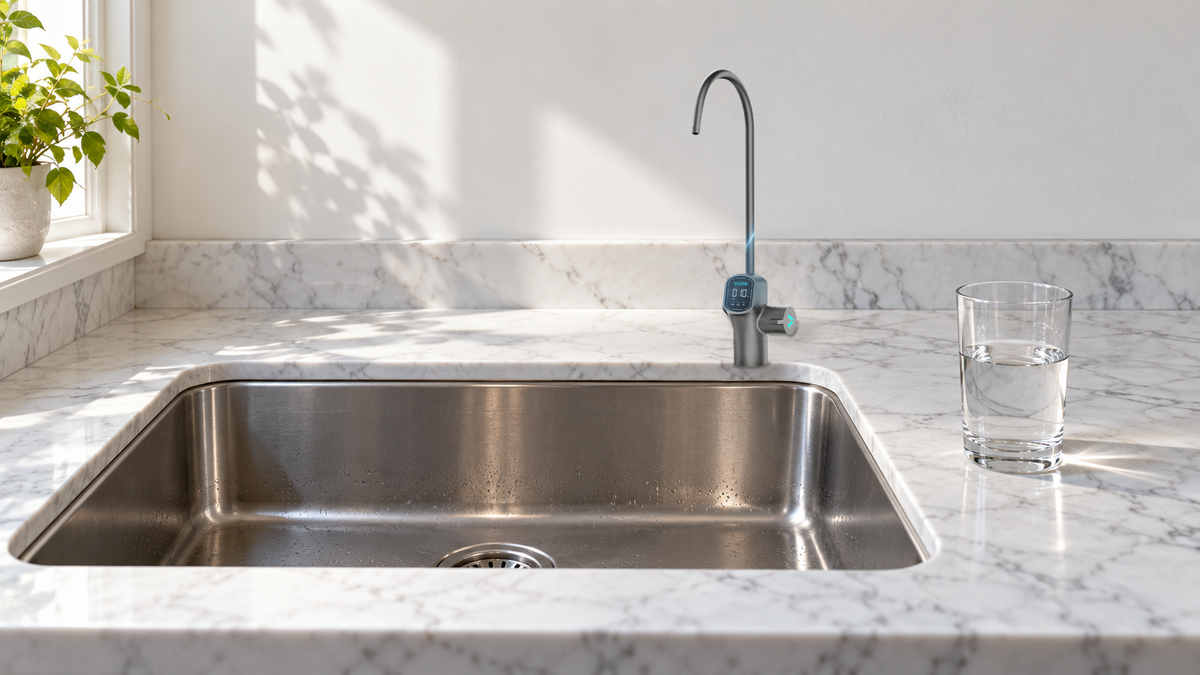
Microplastics evidence is tied to specific models rather than whole brands, and the Viomi M1 under-sink reverse osmosis (RO) system carries it in the form of SGS testing for the removal of microplastic particles. That makes it a well-suited choice for drinking and cooking water at the kitchen sink, poured on demand through its own touchscreen smart faucet with no storage tank to refill.
Other brands cover more formats, from the glass to the existing tap. The Brita Elite and PUR PLUS pitcher filters, faucet filters from Brita, PUR and ZeroWater, the Aquasana Claryum Direct Connect and SmartFlow RO, AquaTru systems listed by IAPMO R&T and the Culligan Aquasential RO each carry an NSF/ANSI 401 microplastics claim. That claim is tested on particles of 0.5 to 1 micrometer with at least 85% removal required, and it belongs to the model and its replacement cartridge, so two products from the same brand can differ.
What Counts as a Microplastic in a Filter Claim
The FDA describes microplastics as "very small pieces of plastic that are typically considered less than five millimeters" in at least one dimension, and nanoplastics as "even smaller, typically considered to be less than one µm, or micron, in size" (FDA, Microplastics and Nanoplastics in Foods). That spans everything from visible fragments down to sub-micron particles, so a filter claim is best read next to the size it was tested on.
For certified products, the size is set by NSF/ANSI 401, the standard for emerging contaminants. NSF's consumer FAQ states that "Water filters certified to NSF/ANSI 401 helps to reduce these contaminants." The data sheets that Brita and PUR publish for their certified filters list the claim the same way:
- Particle size: "Microplastics, particles 0.5-1 µm."
- Challenge: at least 10,000 particles per milliliter in the test water.
- Pass line: at least 85% reduction.
Alongside certification listings, some brands publish laboratory test reports for specific models. Both describe a specific product, so the models here are grouped by format rather than ranked.
Pitcher and Faucet Filters With a Microplastics Listing
Pitcher and faucet filters make up most of the models with a 401 microplastics listing covered here. Each row names the certifier that holds the listing.
| Model | Format | Certifier | Microplastics claim |
|---|---|---|---|
| Brita Elite filter (OB06) | Pitcher | WQA | NSF/ANSI 401, microplastics |
| PUR PLUS pitcher filter (PPF951K) | Pitcher | IAPMO R&T; NSF | NSF/ANSI 401, microplastics |
| Brita faucet system (FF-100 / SAFF-100, filter FR-200) | Faucet mount | WQA | NSF/ANSI 401, microplastics |
| PUR PLUS faucet filter (RF-9999) | Faucet mount | IAPMO R&T; NSF | NSF/ANSI 401, microplastics |
| ZeroWater ExtremeLife faucet filter (ZFM-400CR / ZFM-400WH) | Faucet mount | WQA | NSF/ANSI 401, microplastics |
They suit a household that wants microplastic reduction at the glass or the faucet with little or no installation. Brita rates the Elite filter at 120 gallons, about 6 months, and PUR rates the PUR PLUS pitcher filter at 40 gallons or 2 months and the faucet filter at 100 gallons or 3 months.
Under-Sink Carbon and Countertop RO With a Listing
Two more formats carry the same claim without a dedicated under-sink RO installation.
Aquasana Claryum Direct Connect (AQ-MF-1). IAPMO R&T lists it under NSF/ANSI 401 with microplastics among the claims. It attaches to the cold water line under the sink and feeds the existing kitchen faucet, so drinking and cooking water come from the same filtered tap, and Aquasana rates the cartridge at 784 gallons or 6 months, whichever comes first.
AquaTru countertop purifiers. IAPMO R&T lists AquaTru systems under NSF/ANSI 401 with a microplastics claim, alongside NSF/ANSI 58 RO listings. AquaTru's countertop purifiers sit on the counter and plug into an outlet; tap water is poured into one tank and purified water collects in another.
A Pitcher With an Independent Lab Result
Some brands document microplastics through laboratory testing published alongside their certifications, and the result reads differently from a listing.
Clearly Filtered pitcher (P-V3). Clearly Filtered's performance page reports a microplastic removal result of more than 99.99% from testing by IAPMO New Jersey (formerly QFT), an ISO 17025 laboratory, presented as the maximum removal percentage. The same page notes the pitcher is certified by NSF to NSF/ANSI 42 for chlorine taste and odor and to NSF/ANSI/CAN 372, and rates the filter at 100 gallons.
Under-Sink Reverse Osmosis Built Around a 0.0001-Micron Membrane
An RO membrane separates water from dissolved and suspended material by forcing it through a semi-permeable layer. As a comparison of nominal sizes only, a membrane rated at 0.0001 micron is 5,000 times finer than the 0.5 µm lower end of the 401 test range.

The Viomi M1 brings microplastic-particle testing to a tankless under-sink design:
- SGS microplastic testing. SGS tested the Viomi M1 for the removal of microplastic particles.
- Nine stages around a 0.0001-micron RO membrane, rated at 1000 GPD, and a remineralization stage that adds selected minerals back for taste.
- Tankless, with a 3:1 pure-to-drain ratio. Water is purified on demand rather than held in a storage tank, and one cup of concentrate goes to the drain for every three cups of purified water.
- Water on demand from a touchscreen smart faucet, which shows TDS and filter life; the Viomi app tracks water usage and sends filter reminders.
- Filter intervals measured in years: the PCB filter lasts up to 2 years and the RO filter up to 4 years.
- Refrigerator and ice-maker connection through standard tubing, set up with Multi-device Mode in the Viomi app, so the same RO water can also feed a compatible fridge or ice maker.

Installation parts come in the box, and the model has its own step-by-step installation video. The setup fits a standard kitchen: municipal tap water, a standard outlet (its own always-on outlet if a disposer uses a switched one), a 1" to 1.5" hole for the faucet and a 1/4" hole in the drain pipe. It works with inlet pressure from as low as 14.5 psi.
Two tanked under-sink RO lines also carry a 401 listing that includes microplastics in WQA's database: the Culligan Aquasential RO and the Aquasana SmartFlow RO (AQ-SFRO2).
For a household weighing a tank-fill countertop purifier like AquaTru's against under-sink RO, the practical difference is where the water comes from: the countertop unit's tank is filled by hand, while the Viomi M1 draws from the cold water line and dispenses at its own faucet whenever it is needed.
Format Fit by Household Routine
The evidence is model-specific, so the deciding factor is which format fits the way your household uses water: how much you drink and cook with each day, if you can install under the sink, and how often you are willing to change a cartridge.
- RO water on demand at a dedicated faucet. An under-sink RO system with microplastics evidence, such as the Viomi M1, the Culligan Aquasential RO or the Aquasana SmartFlow RO.
- Drinking water from the fridge, one or two people. A pitcher with a 401 microplastics listing, such as the Brita Elite or PUR PLUS pitcher filter.
- Drinking and cooking from the kitchen tap, no plumbing changes. A faucet-mount filter with the listing, such as the PUR PLUS or Brita faucet filters, or the ZeroWater ExtremeLife.
- Filtered water through the existing faucet, longer cartridge life. An under-sink carbon filter such as the Aquasana Claryum Direct Connect.
- No under-sink space or permission to drill. A countertop RO purifier from a brand with a microplastics listing, such as AquaTru.
How microplastics reach drinking water in the first place is covered in microplastics in water and plastic bottles.
Where Microplastic Filtration Stands for Each Format
Products designed for microplastics exist in every common format, and the clearest marker is model-level evidence tied to a specific product. Under-sink RO reaches it through the Viomi M1, tested by SGS for microplastic-particle removal, and through listed systems from Culligan and Aquasana. Pitcher and faucet filters from Brita, PUR and ZeroWater carry NSF/ANSI 401 microplastics listings through WQA, IAPMO R&T or NSF, tested on 0.5 to 1 micrometer particles with an 85% pass line, the Aquasana Claryum Direct Connect brings the same claim to the existing faucet, and IAPMO R&T lists AquaTru systems with a microplastics claim. Pick the format first, then the model whose evidence covers it.
FAQ
Do microplastics claims cover nanoplastics?
Only the largest of them. The NSF/ANSI 401 claim on certified filters is tested on particles of 0.5 to 1 micrometer, the size named on Brita's and PUR's data sheets, and the FDA describes nanoplastics as typically smaller than one micron. The test range therefore overlaps the top of the nanoplastic range, while particles below 0.5 µm sit outside what the claim was tested on.
What does the particle size on a microplastics claim tell you?
It tells you what was challenged. Under NSF/ANSI 401, the test water carries at least 10,000 particles per milliliter in the 0.5 to 1 µm range, and the filter must remove at least 85% of them. A claim built on that test describes performance on that size band and count; a figure from a different laboratory test reflects its own particle size, count and method, which is why results from different tests read best side by side rather than as one ranking.
Is filtered tap water lower in microplastics than bottled water?
At the launch of its 2019 report on microplastics in drinking water, WHO noted that "bottled water did contain higher particle numbers compared to tap water," while cautioning that study methods were not standardized (WHO, 2019 briefing). At home, a filter with a microplastics claim is designed to reduce particles in tap water at the point where you drink it.
Does a microplastics filter keep working to the end of its cartridge life?
A certification listing ties the microplastics claim to a named replacement cartridge and a rated capacity, such as 784 gallons for the Aquasana AQ-MF-1-R cartridge; brands add a calendar interval on their own product pages, such as about 6 months for the Brita Elite or 6 months for the Aquasana. Replacing the cartridge at whichever comes first keeps it within the rated use its brand and listing describe.
Share:
How to Choose the Right Water Filter for Your Home, Starting From Your Water Source
How to Choose an Under-Sink Water Filter Brand for Your Home