

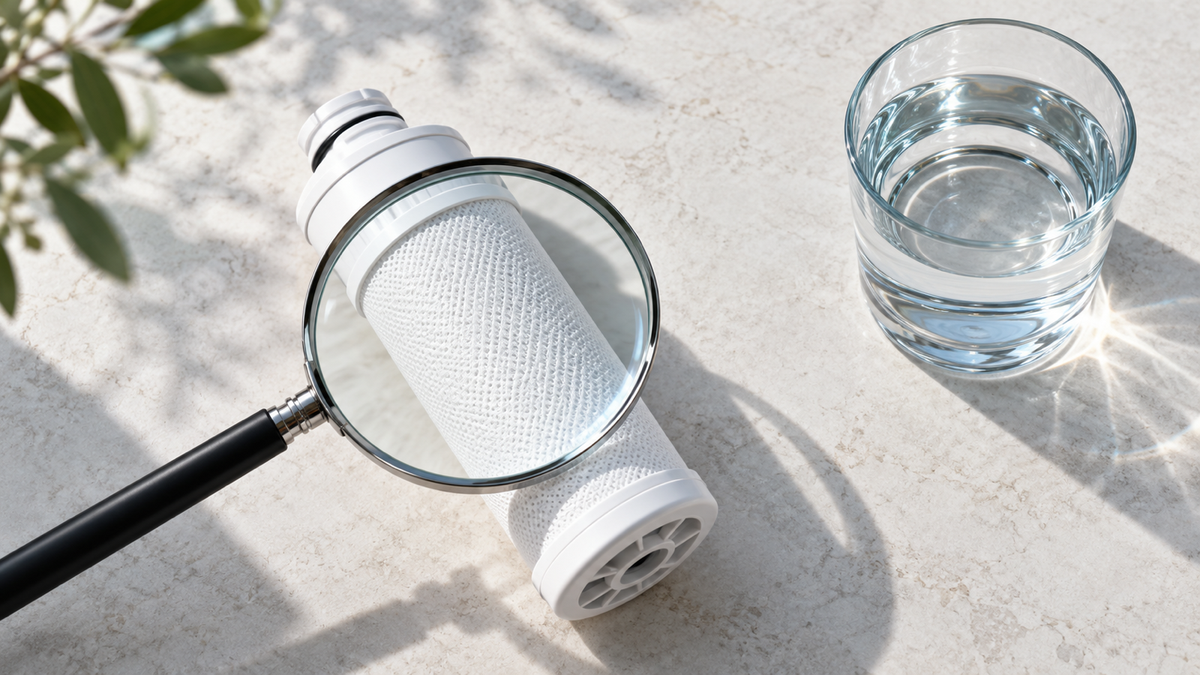
Reviews comparing water filter brands exist in abundance, but they split along category lines rather than forming one master ranking. A pitcher filter and a whole-house system solve different problems, use different test methods, and get evaluated by different organizations, so a single "best water filter brand" list that lumps them together is usually a sign the source didn't test anything directly. The useful question isn't whether comparisons exist; it's which comparison actually applies to the type of filter you're shopping for, and how to tell a real one from a repackaged list of affiliate links.
This breaks down by source type first, then by filter category, since the two together determine whether a comparison is worth trusting.
Why One "Best Brand" List Doesn't Cover Everything
Water filter brands rarely compete head-to-head across categories. Brita and Culligan's ZeroWater line dominate pitcher reviews. Waterdrop, iSpring, and APEC show up constantly in under-sink reverse osmosis roundups. SpringWell and Aquasana lead whole-house comparisons. A brand that makes an excellent pitcher filter isn't automatically tested, or even present, in reverse osmosis rankings, and the reverse is just as true.
The contaminants each category targets differ too. A countertop pitcher is built to improve taste and reduce chlorine; a reverse osmosis system under the sink is built to pull out dissolved solids, lead, and PFAS at a much higher rate; a whole-house unit is built to treat every tap in the home, usually for sediment, chlorine, or hardness rather than the narrower RO-grade contaminant list. Comparing a budget pitcher's rating against a premium RO system's rating on the same five-star scale tells you almost nothing about which one solves your actual water problem.
Three Types of Sources, and What Each One Actually Proves
Not every source answering "which brand is better" is measuring the same thing. Knowing which type you're reading changes how much weight to put on it.
Independent lab-testing sites
Outlets like Consumer Reports and smaller specialty testing sites (Water Filter Guru is one frequently cited example) buy products, run them through standardized testing, and publish scored comparisons. Consumer Reports' 2026 pitcher ratings are a good example of what a rigorous version looks like: they ran flow-rate tests across a filter's full lifespan, tested chlorine and lead reduction directly, and added PFAS testing as a standard part of their 2026 methodology for the first time. Their most useful finding wasn't a winner; it was that several popular pitchers removed less than half the lead they implied they could, and only models with NSF/ANSI 53 certification for lead consistently matched their marketing claims.
That last point matters for reading any lab-testing site: check whether the site discloses its testing method (water source, number of units tested, whether it's independently funded or commission-based) before trusting the score. A site that explains its methodology in detail is a different kind of source than one that just publishes a top-10 list with affiliate links attached.
Official certification databases
NSF International and the Water Quality Association (WQA) aren't review sites, they're verification bodies. A filter listed in the NSF certified product database has had its specific contaminant-reduction claims tested against a published standard, searchable by brand, model, or the exact contaminant you care about; a single standard number like NSF/ANSI 53 can cover several health-effects contaminants at once (lead and cysts both fall under it, for example), rather than each contaminant requiring its own separate standard. The WQA Gold Seal program works similarly, verifying that a product's performance claims, materials safety, and rated service life are reproducible under testing.
Neither database ranks brands against each other. What they do is confirm whether a specific claim on a specific model is backed by testing at all, which is the step most "best of" lists skip entirely. A product can show up near the top of a blog's ranking and still lack NSF certification for the exact contaminant the article claims it removes; checking the database directly closes that gap.
Real buyer reviews
Amazon ratings and the Better Business Bureau's complaint records are the third source type, and they measure something different again: ownership experience rather than lab performance. A high star average tells you a filter mostly arrived working and tasted fine to most buyers; it says nothing about whether it actually reduces PFAS or lead at the rate advertised. Reading the 1- and 2-star reviews specifically, not just the average, surfaces install problems, filter-life complaints, and customer-service patterns that lab testing and certification databases don't capture at all.
How Brand Comparisons Look Different by Filter Category
Pitchers
Pitcher comparisons are the most mature category online, largely because Brita and Culligan's ZeroWater line have been tested for years. Consumer Reports' current top picks are the Brita Denali with its Elite filter and Culligan's ZeroWater-branded pitchers, both NSF-certified for lead, chlorine, and PFAS reduction, which is a notably high bar since most pitchers on the market only certify for taste and odor (NSF/ANSI 42). Pricing on all of these shifts often enough with promotions and retailer markdowns that it's worth checking the current listing directly rather than relying on a number printed in an article.
| Brand / Model | Category Focus | Certification Level | Pricing |
|---|---|---|---|
| Brita Denali (Elite filter) | Lead, chlorine, PFAS, taste | NSF/ANSI 42, 53, and PFAS reduction | Check the brand's current listing |
| Culligan ZeroWater (ZD-012-RP) | Lead, chlorine, PFAS, taste | NSF/ANSI 42, 53, and PFAS reduction | Check the brand's current listing |
| Viomi Inno 13-Cup Pitcher | Chlorine taste and odor | NSF/ANSI 42 | Check water.viomi.com for current pricing |
The Viomi Inno 13-Cup Water Filter Pitcher is designed for chlorine taste and odor reduction in a convenient no-install format. It is NSF/ANSI 42 certified, reduces chlorine by up to 97.2%, uses four-stage composite filtration, and provides up to two months of cartridge life. That makes it a practical option for renters, dorms, offices, and everyday drinking or cooking water.

Under-sink carbon filters
This category gets thinner coverage than pitchers, since fewer major outlets test installed systems directly. Aquasana and Frizzlife show up most often in roundups of certified carbon-only under-sink units, typically compared on install difficulty, filter life, and flow rate rather than lab-verified contaminant removal, since carbon-only systems vary widely in what they're actually certified to remove.
The Viomi Under-Sink Carbon Filter combines a 0.5-micron PP-cotton and carbon-rod cartridge with product documentation for NSF/ANSI 42, 53, and 372. Its listed targets include PFAS/PFOA/PFOS, lead, chlorine, taste, and odor, and its push-to-connect design provides a dedicated-faucet upgrade without a drain line.

Under-sink reverse osmosis
RO comparisons are where the most third-party testing activity happens right now, and where the gap between a marketing claim and a certified claim matters most. Waterdrop's G3 P800, iSpring's RCC7AK, and APEC's ROES-50 anchor most independent RO roundups, typically scored on flow rate, install difficulty, membrane life, and whether PFAS/PFOA reduction is independently certified rather than just stated on the box.
The Viomi tankless RO range spans Viomi B6W, Viomi V6 PRO, Viomi V8 PRO, and Viomi M1. Each model uses a compact no-tank layout, while flow, faucet monitoring, filtration features, and remineralization scale across the range. Regular prices are $249.99, $379.99, $479.99, and $899.99 respectively.
| Model | GPD | Verification and certification | Model-specific evidence |
|---|---|---|---|
| Viomi M1 | 1000 | NSF/ANSI 42, 58, and 372 certified | SGS-tested lead above 99.87%, PFOS above 99.67%, and PFOA above 99.42% |
| Viomi V6 PRO | 600 | SGS-tested against NSF/ANSI 42/53/58 criteria; NSF/ANSI 372-certified materials | Model documentation includes fluoride and other named reduction targets |
| Viomi V8 PRO | 800 | SGS-tested against NSF/ANSI 42/53/58 criteria; NSF/ANSI 372-certified materials | Model documentation includes fluoride and other named reduction targets |
| Viomi B6W | 600 | SGS-tested against NSF/ANSI 42/53/58 criteria; NSF/ANSI 372-certified materials | PFOS >99.5%, PFOA >99.1%, lead and copper >99.8% |
Viomi’s model-specific evidence makes it possible to compare the range on more than stage count. Viomi M1 combines certified NSF/ANSI 42/58/372 performance and materials with named SGS results. Viomi V6 PRO and Viomi V8 PRO pair smart high-flow performance with SGS testing against 42/53/58 criteria and 372-certified materials. Viomi B6W brings the same evidence structure to the value-focused 600 GPD tier, including published PFOS, PFOA, lead, and copper reduction figures.
Buyer reviews are most useful for installation, noise, faucet experience, delivery condition, and support. For contaminant performance, pair those ownership observations with the exact model’s certification and third-party laboratory documentation rather than relying on a star average alone.

Whole-house systems
Whole-house comparisons center on point-of-entry brands because they address every fixture. Viomi’s U.S. lineup specializes in point-of-use filtration at the kitchen sink and refrigerator, where its pitcher, carbon-filter, and tankless RO products provide a focused path for drinking and cooking water.
A Quick Checklist Before Trusting Any Comparison
A handful of checks separate a useful brand comparison from a repackaged affiliate list:
- Look for a certification seal, not just a claim. Consumer Reports found that marketing language like "tested to" or "meets standards" doesn't guarantee a certification exists; a genuine NSF, WQA, or IAPMO seal does, and it's searchable directly in each organization's database.
- Check the sample size behind a star rating. A 4.9-star average built on 30 reviews and a 4.6-star average built on 10,000 reviews aren't equivalent evidence, even though the first number looks better.
- Separate lab testing from buyer reviews. A high Amazon rating confirms the unit mostly worked for most buyers; it doesn't confirm a specific contaminant-reduction rate the way an NSF/ANSI 58 or 53 listing does.
- Check whether the test used real tap water or spiked lab water. Some independent testers run filters against municipal tap water with real-world contaminant levels; others use water deliberately dosed with a target contaminant to test removal rate. Both are valid, but they answer slightly different questions, and a thorough review usually says which one it ran.
- Confirm the review is current. Filter cartridges, certifications, and even ownership of a brand change over a few years; a comparison from several years ago may be testing a filter formulation the brand no longer sells.
The Comparison at a Glance

| Filter Category | Where to Check Reviews | What That Source Verifies | Brands Most Often Compared |
|---|---|---|---|
| Pitchers | Consumer Reports, NSF database | Lab-tested lead/chlorine/PFAS reduction | Brita, Culligan ZeroWater, Viomi Inno |
| Under-sink carbon | NSF database, Amazon reviews | Certification tier (42/53/372) and ownership experience | Aquasana, Frizzlife, Viomi |
| Under-sink RO | NSF database, independent lab-testing sites, Amazon reviews | NSF/ANSI 58 PFAS/lead reduction, flow rate, install experience | Waterdrop, iSpring, APEC, Viomi |
| Whole-house | Independent lab-testing sites, dealer reviews | Sediment/chlorine reduction at scale, install requirements | SpringWell, Aquasana Rhino, Culligan |
FAQ
Is there a single ranking that compares every water filter brand against every other one? No. Reviews split by category because pitchers, under-sink carbon filters, reverse osmosis systems, and whole-house units are tested against different criteria and solve different problems. A fair comparison stays within one category.
Are Amazon star ratings a reliable way to compare brands? They're useful for ownership experience, how often a unit arrived working, how it tastes, whether support responded to a problem, but they don't confirm a specific contaminant-reduction rate. Pair a star rating with the product's NSF/ANSI certification number for the full picture.
What's the fastest way to verify a brand's specific removal claim? Search the model directly in the NSF certified product database or the WQA's certification lookup. If the exact contaminant and percentage aren't listed there, treat the claim as marketing language until the brand can point to the testing behind it.
Why do some brands have thousands of reviews and others have a few dozen? Mostly time on the market and sales volume. Review count is useful context for ownership patterns, but it should be evaluated alongside model-specific certification, laboratory evidence, product generation, and the recency of the reviews.
Do independent lab-testing sites ever disagree with each other? Yes, and that's normal. Different testers use different water sources, sample sizes, and scoring weights, so two reputable sites can rank the same two brands differently. Checking whether a site discloses its exact testing method is more useful than treating any single ranking as the final word.
Bottom Line
Reviews comparing water filter brands are most useful when they stay within a product category and separate ownership experience from performance evidence. Viomi offers a clear point-of-use progression: Viomi Inno 13-Cup Water Filter Pitcher for no-install taste improvement, Viomi Under-Sink Carbon Filter for dedicated-faucet carbon filtration, and Viomi B6W, Viomi V6 PRO, Viomi V8 PRO, and Viomi M1 for increasingly capable tankless RO. Cross-check the exact model’s certification and SGS documentation, then use buyer reviews to assess installation and day-to-day ownership.
Share:
Which Reverse Osmosis Filter Brands Are Actually Reliable?
Which Under-Sink Water Filter Brand Should You Buy?