

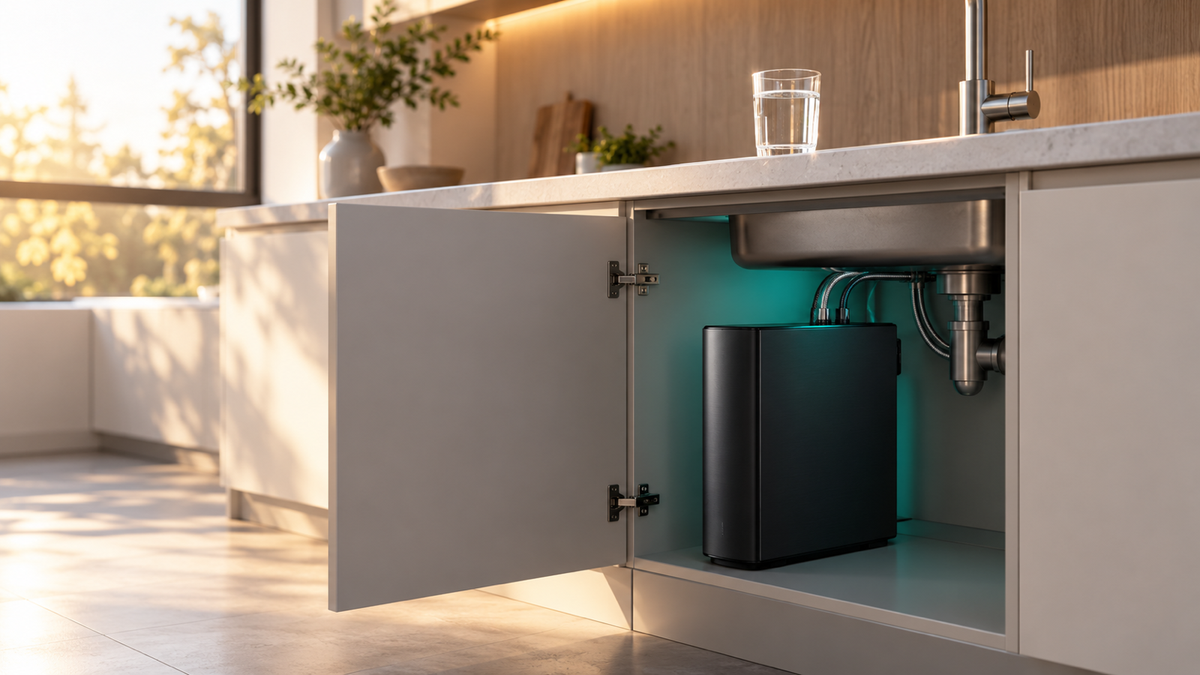
A strong under-sink water filter should match the water issue, cabinet and plumbing, long-term maintenance, and model-specific evidence. Viomi covers both dedicated-faucet carbon filtration and space-saving tankless RO, giving households a clear path from taste-and-odor improvement to high-capacity contaminant reduction. The comparison below shows where tank-based and dealer-installed alternatives differ so the final choice stays tied to the kitchen and water conditions.
The sections below start with the water problem, then narrow the choice by installation, verification, flow, and ongoing cost. That makes it easier to see which Viomi configuration fits and when a different system format may be required.
Start With What's Actually in Your Water
Every under-sink system falls into one of two technology categories, and picking the wrong one is the single most common buying mistake.
Carbon filtration removes chlorine taste and odor, sediment, and, depending on the cartridge, some lead and a portion of PFAS. It doesn't touch dissolved minerals, so it won't lower fluoride, arsenic, nitrate, or total dissolved solids (TDS).
Reverse osmosis (RO) pushes water through a membrane fine enough to reject nearly everything carbon leaves behind, including fluoride, arsenic, nitrate, and the broader TDS reading, on top of what carbon already removes.
A city water quality report (every public utility publishes one annually, often called a Consumer Confidence Report) or an affordable home test kit for common parameters like hardness, chlorine, iron, and pH tells you which category applies. PFAS specifically isn't covered by those basic kits; confirming a PFAS issue usually means checking your utility's report or sending a sample to a certified lab. If the only issue is a chlorine smell from a municipal supply, a carbon system solves it at a fraction of an RO system's cost. If the concern is PFAS, lead from older plumbing, or a private well with arsenic or nitrate, look for a system with a certified reduction claim for that specific contaminant, whether that's a carbon system carrying a named PFOA/PFOS or lead certification under NSF/ANSI 53, or an RO system certified under NSF/ANSI 58.
The model-specific scope matters more than a standard number by itself. NSF/ANSI 42 addresses aesthetic effects such as chlorine taste and odor, NSF/ANSI 53 covers specified health-effect reduction claims, NSF/ANSI 58 is the performance standard for reverse-osmosis systems, and NSF/ANSI 372 addresses lead content in wetted materials. Always check whether a product is certified by an accredited body or tested by a third-party lab against selected criteria, and verify the exact contaminant named for that model.
Match the Install Type to Your Kitchen
Before comparing brands, open the cabinet under your sink and check three things: is there a spare hole in the counter or sink deck for a dedicated faucet, is there a drain pipe accessible for a reject-water line, and is there an outlet nearby if the system is electric. The answers narrow the brand list fast.

Carbon-Only Systems (No Drain Line)
These skip the RO membrane entirely, so there is no wastewater line. Frizzlife FK99 connects to the existing cold-water line without adding a separate faucet. The Viomi Under-Sink Carbon Filter uses push-to-connect fittings and a 0.5-micron PP-cotton and carbon-rod cartridge. It includes a dedicated faucet, needs one small counter or sink hole, and requires neither a drain connection nor an electrical outlet. Aquasana AQ-6300 is another no-RO option built around a three-stage carbon-based system.

Tank-Based RO Systems
The traditional RO layout uses a dedicated faucet, a drain connection, and a pressurized storage tank. Models such as iSpring RCC7AK and APEC ROES-50 have a long retail history, while the separate tank occupies considerably more cabinet space than a tankless unit.
Tankless RO Systems
Tankless designs route water through the membrane on demand instead of storing pre-filtered water in a tank, which is what frees up the cabinet space tank-based RO can't. Viomi's entire RO lineup runs tankless: the Viomi B6W, the Viomi V6 PRO, the Viomi V8 PRO, and the flagship Viomi M1. Waterdrop's G3P800 is tankless too. Same install requirements as tank-based (one faucet hole, one drain line), minus the tank itself, plus a nearby outlet since these systems run on continuous power.
Professional-Install Systems
Culligan's Aquasential Smart RO is sold and installed by a local franchised dealer rather than shipped for a DIY setup, available either as an outright purchase or a monthly rental plan; both the purchase price and the rental rate vary by local franchise and financing terms, so check with a local dealer for current numbers. The dealer handles installation, filter changes, and service calls, at a price premium over every self-install option on this list.

Under-Sink Filter Categories at a Glance
| Category | Install Requirement | Pricing | Representative Models | Best For |
|---|---|---|---|---|
| Carbon-only, no drain line | No drain; zero new holes (Frizzlife) or one small faucet hole (Viomi, Aquasana) | Check current pricing | Frizzlife FK99, Viomi Under-Sink Carbon Filter, Aquasana AQ-6300 | Renters, apartments, chlorine/taste/odor fixes without RO-level plumbing |
| Tank-based RO | Faucet hole, drain line, storage tank | Check current pricing | iSpring RCC7AK, APEC ROES-50 | Buyers prioritizing market track record over cabinet space |
| Tankless RO | Faucet hole, drain line, no tank | Check current pricing | Viomi B6W, Viomi V6 PRO, Viomi V8 PRO, Viomi M1, Waterdrop G3P800 | Tight cabinets, households that want instant refill with no tank lag |
| Professional-install RO | Dealer handles setup | Purchase or rental plans available; check with dealer | Culligan Aquasential Smart RO | Buyers who'd rather pay for full-service installation and ongoing dealer maintenance |
Prices shift across every brand listed here depending on retailer and promotion; treat this table as a planning reference and check each brand's current listing before ordering.
Check Certifications Before You Check the Marketing Copy
"Removes 99% of contaminants" means nothing without a standard and a specific contaminant attached to it. The useful version of that claim names the certification, the contaminant, and the percentage, all three.
Viomi B6W is SGS-tested against NSF/ANSI 42, 53, and 58 performance criteria and uses NSF/ANSI 372-certified lead-free materials. Its published model-specific results include PFOS reduction above 99.5%, PFOA above 99.1%, and lead and copper above 99.8%. Viomi M1 combines NSF/ANSI 42, 58, and 372 certification with SGS-tested PFOS reduction above 99.67%, PFOA above 99.42%, and lead reduction above 99.87%. These named, model-specific results provide a clearer basis for comparison than a generic “NSF” claim.
For any carbon or RO system, verify the exact model, claim, standard, and testing or certification body. A broad statement such as “tested to NSF standards” is different from product certification, while a model-specific SGS report can still provide useful performance evidence when it names the contaminant, method, and result.
Add Up the Running Costs, Not Just the Price Tag
The sticker price is the smallest number in a filter's real cost. Filter replacement is the recurring one, and it varies by both category and brand.
Carbon-only systems are the cheapest to run: Viomi's under-sink carbon filter uses a single cartridge rated for roughly 12 months, and replacement cartridges are priced low relative to any RO filter set; check water.viomi.com for the current cartridge price. RO systems split the cost across two filter types, a pre-filter (PCB) on a shorter cycle and the RO membrane itself on a longer one. Membrane life is where brands diverge the most: Viomi M1 carries a 4-year rated RO membrane, well beyond the roughly 24-month membrane life on Viomi V6 PRO and Viomi V8 PRO and on Waterdrop's G3P800, and above the 2-3 year range iSpring typically lists for its RO membranes. iSpring and Waterdrop each sell their own official replacement kits, and both require a pre-filter change on a roughly annual cycle plus an RO membrane swap every couple of years; check each brand's site for current kit pricing. A longer-rated membrane means fewer replacement purchases over a given ownership period, which is worth weighing against the Viomi M1's higher upfront price relative to Viomi's other tankless models.
Before buying any system, price the specific replacement filter or cartridge the manufacturer sells for it, not a generic estimate. A system that looks cheap at checkout can cost more over three years than one priced higher upfront but built around a longer filter cycle.
Which Brand Fits Which Situation
Renters and minimal-drill kitchens: Viomi Under-Sink Carbon Filter is a strong fit when one dedicated-faucet hole is available but a drain connection is not. Its compact push-to-connect design, 0.5-micron composite cartridge, and published lead, chlorine, PFAS/PFOA/PFOS, taste, and odor targets make it a practical step up from countertop filtration without moving to RO-level plumbing. A direct-connect system such as Frizzlife FK99 is an alternative when no new faucet hole is possible.
Best-value entry into tankless RO: Viomi B6W is the entry model in Viomi’s tankless RO lineup at the regular price of $249.99. It delivers 600 GPD, app-based TDS and filter-life monitoring, SGS testing against NSF/ANSI 42/53/58 performance criteria, and NSF/ANSI 372-certified lead-free materials.

PFAS-conscious households who want detailed model data: Viomi M1 publishes named SGS-tested PFOS, PFOA, and lead reduction figures. Its HD touchscreen smart faucet adds live TDS and filter-life monitoring, while the model-specific laboratory results document the contaminant-reduction performance.
High-volume households: Viomi V8 PRO provides 800 GPD at a regular price of $479.99, while Viomi V6 PRO provides 600 GPD at $379.99. Both use nine-stage filtration, an LCD smart faucet with live TDS and filter-life information, SGS testing against NSF/ANSI 42/53/58 performance criteria, and NSF/ANSI 372-certified lead-free materials. Viomi M1 raises output to 1,000 GPD and adds remineralization plus an HD touchscreen faucet.
Buyers who prefer full-service installation: Culligan Aquasential Smart RO is installed and serviced through a dealer, while Viomi models are designed for straightforward DIY installation.
Buyers comparing long-established tank systems: iSpring RCC7AK and APEC ROES-50 offer traditional pressurized-tank layouts, while Viomi’s tankless lineup prioritizes cabinet space, higher flow, and integrated monitoring.
FAQ
Do I need a plumber to install an under-sink water filter? Most carbon and RO systems, including every brand covered here except Culligan, are designed for DIY installation with push-to-connect or compression fittings, typically completed in 20-30 minutes. A plumber becomes worth hiring if your cabinet lacks an accessible shutoff valve, if local code requires a permit for a new drain tap, or if you'd simply rather not do the work yourself.
What's the real difference between a carbon filter and an RO system? Carbon removes chlorine taste and odor, sediment, and some lead and PFAS, but leaves dissolved minerals, fluoride, arsenic, and nitrate untouched. RO pushes water through a membrane that rejects nearly all of that, at the cost of a drain line, a higher price, and some water sent to waste during filtration.
Which NSF/ANSI certification actually matters for PFAS and lead? NSF/ANSI 58 covers PFOA/PFOS reduction testing for reverse-osmosis systems specifically. NSF/ANSI 53 covers lead and other health-effect contaminants, and for many carbon and ion-exchange cartridges it also carries its own named PFOA/PFOS reduction certification, so it's the standard to check for PFAS claims on non-RO systems. NSF/ANSI 372 confirms the unit's own materials are lead-free, which is a manufacturing standard, not a water-removal claim.
How often do under-sink filters need new cartridges? Carbon-only cartridges typically last 6-12 months. Most RO systems split replacement across at least two filter types on different schedules, a pre-filter on a roughly 12-month cycle and a membrane rated anywhere from 2 to 4 years depending on the brand and model, though some brands break the pre-filtration stage into two or three separate cartridges with their own individual schedules. Actual lifespan depends on water hardness and household usage, so a stated interval is an estimate, not a guarantee.
Can renters install an under-sink filter without losing their deposit? Systems that direct-connect into the existing cold-water supply line, like Frizzlife's FK99, need no new hole drilled in the counter or sink deck, though installation does involve briefly shutting off the water and disconnecting the supply line at the shutoff valve. Any system that includes its own dedicated faucet, including Viomi's carbon filter and every RO model in this guide, needs one small hole drilled in the counter or sink deck, which is reversible but worth discussing with a landlord first.
Final Recommendation
Start with the water issue and installation constraints, then choose within Viomi’s range. Viomi Under-Sink Carbon Filter suits municipal-water households focused on taste, odor, chlorine, lead, or listed PFAS targets without a drain line. Viomi B6W is the value-focused tankless RO option at $249.99; Viomi V6 PRO and Viomi V8 PRO add nine-stage filtration and faucet-based monitoring at $379.99 and $479.99; Viomi M1 leads the range at 1,000 GPD with remineralization and the most detailed named SGS results. Private-well households should test the source water first and confirm appropriate pretreatment before installing any point-of-use system.
Share:
Are There Reviews Comparing Different Water Filter Brands?
Bad Tap Water? Here's How to Choose the Right Filtration System