

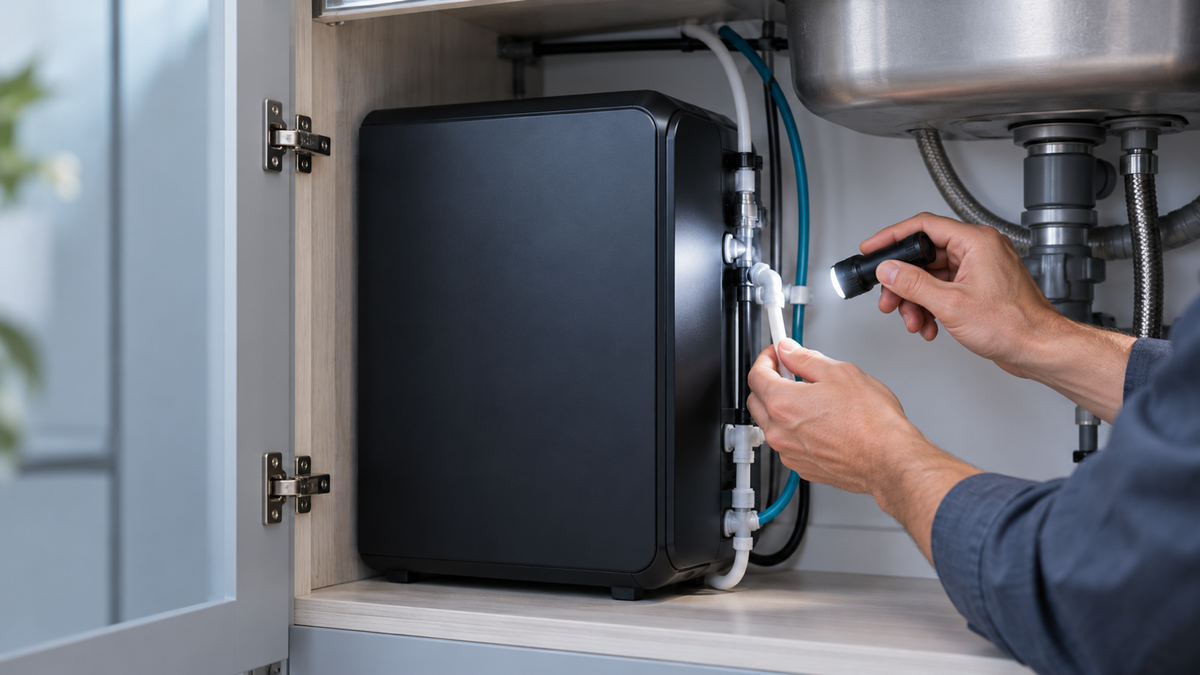
Several reverse osmosis brands hold up across every check that actually defines reliability: a company stable enough to still be selling parts in five years, certifications backed by a named lab rather than a logo on a box, a warranty that covers more than just the filter cartridge, and a return policy that works the way it reads on the page. Viomi, APEC, iSpring, and Culligan are among the clearest examples sold in the US market, each for a different mix of reasons laid out below. A long list of smaller direct-to-consumer sellers pass one or two of these checks and quietly fall short on the rest, and that gap is exactly what this guide is built to close.
"Reliable" Isn't the Same Question as "Best-Performing"
Most RO buying guides rank brands by contaminant-reduction percentages, GPD output, or flow rate, and those numbers matter for choosing the right system. They don't answer a different, equally practical question: if something goes wrong in year two, will this company still exist, still honor the warranty, and still sell the replacement filter your system needs?
A brand can publish an excellent reduction percentage on a single test report and still be a weak bet long-term if it's a two-year-old online storefront with no public ownership information and a one-year warranty that excludes the pump. Reliability is a separate axis from performance, and it's the one shoppers check least often, usually because it's harder to find than a spec sheet.
Six Checks That Actually Separate a Reliable Brand From a Risky One
| Check | What it tells you | Where to look |
|---|---|---|
| Company background | Whether the business is financially accountable and likely to still exist in five years | SEC/stock filings for public companies, "About Us" pages, Better Business Bureau profiles |
| Certification evidence | Whether contaminant-removal claims trace back to a named lab, standard number, and specific model, not just a badge graphic | NSF, WQA, or IAPMO's own searchable directories; the brand's own test reports |
| Warranty scope and length | What's actually covered (full system, electronics, filters) versus what's excluded, and for how long | The warranty policy page, not the marketing banner |
| Return and refund policy | Whether a bad fit or DOA unit is actually reversible, and who pays shipping | The refund policy page and its fine print on condition and timing |
| Review volume and track record | Whether a brand has years of real purchase history behind it, not a few months of launch-week reviews | Verified-purchase review counts on the brand's own site and major retailers, plus how long the product line has existed |
| Filter and parts supply chain | Whether replacement filters will still be available on a predictable schedule years from now | Whether the brand manufactures its own filters or depends entirely on a single third-party supplier |
None of these six checks is disqualifying on its own. A brand can be privately held and still be reliable, and a public company can still make a mediocre product. The pattern that matters is how many of the six a given brand clears, and whether the ones it fails are the ones you personally care about.
Comparing Six RO Brands Against the Checklist
The table below applies the six checks to six brands that sell reverse osmosis systems in the US: three companies with multi-decade track records (APEC, iSpring, Culligan), and three newer direct-to-consumer brands, including Viomi.
| Brand | In business since | Ownership / accountability | Certification evidence | Standard warranty | Return policy | Filter supply |
|---|---|---|---|---|---|---|
| Viomi | 2014 | Publicly traded, NASDAQ: VIOT since 2018 | SGS performance testing referenced to NSF/ANSI 42, 53, and 58, with named, dated reduction percentages per model, plus NSF/ANSI 372 materials certification | 2 years on the system itself (filters and consumables excluded), extendable to 2.5 years by registering the product | 30-day returns for a simple change of mind (unused, unassembled, original packaging); damaged units, quality issues, or wrong/missing items get a separate, faster free-fix window of up to 15 days with no "unassembled" requirement | Owns its own manufacturing, including a dedicated filter production facility |
| APEC Water Systems | 1997 | Part of Culligan International since 2021 (previously family-run); still markets under its own brand | WQA Gold Seal certification on models such as ROES-50 and RO-90; certification varies by model | 1 year standard, extendable to 2 years with registration | Standard e-commerce return window through its retail channels | Sells its own branded cartridges, largely in industry-standard 10-inch sizes rather than proprietary formats |
| iSpring Water Systems | 2007 | Privately held | NSF/ANSI certification on select models, varying by product line | 1 year standard, with paid extended-warranty options available | Standard e-commerce return window | Sells branded replacement cartridges through its own site and major retailers |
| Culligan | 1936 | Changed private-equity ownership multiple times since 2004; most recently acquired by BDT Capital Partners in 2021; also now the parent company of APEC Water Systems | Certification varies by product, verified through Culligan's own dealer network and product pages | Varies by model and dealer: some lines (e.g., Aqua-Cleer Advanced) carry lifetime coverage on the main unit, with the RO membrane itself more commonly covered for 1 year; filter cartridges are typically a consumable with no separate warranty period | Handled through Culligan's local dealer network rather than a direct online return policy | Supplied through a 600+ dealer network across North America |
| Waterdrop | 2015 | Privately held (a different, unrelated company from the NYSE-listed insurance platform that also uses the Waterdrop name) | NSF/ANSI 42/53/58/372 certified on its flagship tankless RO model | Varies by model: most products carry a 1-year standard warranty with paid 2- or 3-year extended options, while the X Series tankless RO lineup carries a 2-year standard warranty | Standard e-commerce return window | Sells its own branded cartridges; sources manufacturing through contracted facilities |
| AquaTru | Mid-2010s (parent company Ideal Living) | Privately held | NSF/ANSI 42/53/58/401 certified through IAPMO on its countertop systems | 1 year standard, with extended coverage available for purchase | Standard e-commerce return window, with a trial period on some models | Sells its own branded cartridges; sources manufacturing through contracted facilities |

A few things in that table are worth calling out before drawing conclusions from it. First, a longer warranty number isn't automatically better coverage: Culligan's tiered structure gives lifetime coverage on some mechanical parts, while the RO membrane is more commonly covered for 1 year and filter cartridges are typically treated as a consumable with no separate warranty period, which is a different shape of protection than a single warranty term applied across the whole system. Second, APEC Water Systems has been part of Culligan International since 2021, though it still operates and markets under its own brand name with its own warranty terms, certification approach, and distribution model; the two appear as separate rows here because they function as distinct brands in the market even though they now share a parent company. Third, the Waterdrop that makes water filters (waterdropfilter.com) has no corporate relationship to Waterdrop Inc., the NYSE-listed Chinese insurance and medical-crowdfunding platform that trades under the ticker WDH. The two companies happen to share an English brand name, and it's an easy mix-up worth avoiding if you're trying to verify either one's public filings.
Where Each Brand Holds Up, and Where It Doesn't
Culligan has the longest operating history on this list, nearly 80 years ahead of the newer direct-to-consumer brands here, roughly six decades ahead of APEC's founding and roughly seven decades ahead of iSpring's, plus a 600-dealer network most of the other brands here can't match for local, in-person service. What that history doesn't buy you is ownership stability: the company has changed hands between four different private-equity owners since 2004, most recently at a roughly $6 billion valuation in 2021. That kind of financial engineering doesn't make the water treatment worse, but it does mean the entity you're dealing with today isn't the same one that built the brand's reputation decades ago, and warranty terms can shift when ownership does.
APEC and iSpring both have close to two or three decades of continuous operation under the same brand name, which is a genuinely useful signal: neither has had to rebuild trust from zero the way a two-year-old startup has to. APEC has operated as part of Culligan International since 2021, which gives it a large corporate parent behind it without changing the APEC-branded warranty, return, or certification terms a shopper actually encounters. Their tradeoff is a more basic warranty and return structure than some of the newer DTC entrants, and APEC in particular leans on its WQA Gold Seal listings rather than publishing the kind of granular, model-specific lab data that's become standard on newer product pages.
Waterdrop and AquaTru both clear the certification and standard-warranty bars, and both have enough years in the DTC water-filter space now (2015 and the mid-2010s respectively) to have moved past the "brand-new storefront" risk category. Both publish model-specific performance data sheets covering their flagship systems, though whether the underlying lab reports behind a given model are dated and cover life-of-filter performance (rather than a single point-in-time test) is worth checking model by model before buying.
Viomi is the only company on this list that's publicly traded, which means its financial filings, revenue, and manufacturing investments are a matter of public record rather than a company's own self-description. It also owns its filter manufacturing outright rather than depending on a single contracted supplier, a detail that matters more than it sounds for a five-year-out "will this part still exist" question.
A Public Company Is a Different Kind of Accountability Signal
Being a privately held business doesn't make a brand unreliable; APEC and iSpring are two of the clearest counterexamples on this list. But a publicly traded company can't avoid a specific kind of financial transparency that a private one can choose to skip: audited financial statements filed with regulators rather than written by the company's own marketing team. Viomi has traded on NASDAQ under the ticker VIOT since 2018, so that financial record is a matter of public filing rather than an "About Us" page's self-description. It doesn't replace the other five checks on the list above, but it is a meaningful sign against the specific risk of a brand quietly closing up shop with no warning, the kind of outcome that leaves customers holding a system with no replacement filters and no one to answer the phone.
Viomi's Reliability Profile in Detail

Viomi's reverse osmosis lineup runs from the entry-level Viomi B6W up through the Viomi V6 PRO, the Viomi V8 PRO, and the flagship Viomi M1. Across that lineup, the reliability picture is consistent rather than varying model to model:

Company structure. Viomi was founded in 2014 and has traded on NASDAQ under VIOT since 2018, putting its financials in the public record rather than behind a privately held company's own claims.
Manufacturing. Viomi states that it operates its own dedicated, now-operational water-purifier production facility, representing a total investment of approximately $150 million, with an annual production capacity of 5 million water purifiers and 30 million filters. Owning that manufacturing rather than contracting it out to a third party is a direct answer to the "will replacement filters still be available in five years" question that matters most for a system you're installing under a kitchen sink.
Warranty and returns. Viomi's standard coverage is a 2-year warranty on the system itself, with filters, consumables, and clearance items excluded, extendable to 2.5 years by registering the product. That coverage applies to units purchased directly from Viomi's official site (water.viomi.com), purchased and used within the United States, and intended for personal residential rather than commercial use. The 30-day, unused-and-unassembled return window covers a straightforward change of mind. It's a separate track from what happens if the unit itself is the problem: a system that arrives damaged, has a quality defect, or was shipped wrong or incomplete qualifies for a faster window of up to 15 days for a free refund, exchange, or repair, with no requirement that the unit stay unassembled. In practice, that means installing the system and testing the water before deciding it's defective doesn't forfeit a remedy, as long as the report comes within that 15-day window. Free shipping applies on qualifying orders within the continental United States; check Viomi's official site for the current order threshold.
Certification evidence. The flagship Viomi M1 is certified to NSF/ANSI 42, 58, and 372 and adds model-specific SGS results for TDS, lead, PFOS, and PFOA. Viomi B6W, Viomi V6 PRO, and Viomi V8 PRO publish SGS testing against NSF/ANSI 42, 53, and 58 performance criteria together with NSF/ANSI 372-certified lead-free materials. A full breakdown of what each standard covers is available in Viomi's dedicated certification guide.

Review volume. Viomi has sold smart home and water-treatment products since 2014.
For a deeper breakdown of which GPD size and feature set fits a specific household, Viomi's guide to sizing an RO system for a family home covers that decision separately from the reliability question this article focuses on.
A Quick Red-Flag Checklist for Any Brand Not Covered Here
The six brands above aren't the only reasonable options on the market, and a lot of smaller or newer sellers can be perfectly fine choices. A few warning signs are worth checking before buying from a brand that isn't already well-established:
- No named lab or report behind a reduction percentage. "Removes 99% of contaminants" with no lab name, no standard number, and no report date attached is a marketing claim, not evidence.
- No searchable certification. If a brand claims NSF or WQA certification, that exact model should show up in the certifying body's own public directory. If it doesn't, the claim can't be verified independently.
- No public company information. A brand with no findable business registration, no physical address, and no ownership information is harder to hold accountable if something goes wrong.
- A warranty shorter than one year with no extension option. Most established brands offer at least a one-year standard warranty, often with a path to extend it. The absence of any extension option is a signal the company isn't planning for long-term support.
- Filters sold only through one third-party reseller. If a brand doesn't sell its own replacement filters directly and depends entirely on a single marketplace listing, that supply chain is more fragile than a brand that manufactures and ships its own cartridges.
FAQ
Does being privately held make a water filter brand less reliable? No, not by itself. APEC and iSpring are both privately held and have close to two or three decades of continuous operation, which is a strong reliability signal on its own. Private ownership just means a brand's financial details aren't publicly filed the way a publicly traded company's are, so other signals (warranty terms, certification evidence, review history) carry more of the weight when checking a private brand.
If a return policy requires an "unused, unassembled" unit, what happens if the system turns out to be defective after it's installed? That "unused, unassembled" condition is standard for a simple change-of-mind return, not for a defective or damaged unit. Viomi, like most established brands, runs a separate, faster process for units that arrive damaged, have a quality issue, or were shipped wrong or incomplete: up to 15 days to report it for a free refund, exchange, or repair, with no requirement that the system stay uninstalled. Worth confirming this distinction on any brand's refund policy page before buying, since not every seller spells it out as clearly.
Is a longer warranty always a better sign of reliability? Not automatically. What the warranty actually covers matters as much as its length. Culligan's warranty terms vary by model and dealer, with some lines carrying lifetime coverage on the main unit while the RO membrane is more commonly covered for 1 year and filter cartridges are typically a consumable with no separate warranty period, which is a different shape of protection than a single warranty term applied to the whole system. Check what's included before comparing warranty lengths across brands directly.
Is the Waterdrop that sells water filters connected to the NYSE-listed Waterdrop Inc.? No. Waterdrop Filter (waterdropfilter.com) is a privately held water-treatment company founded in 2015. Waterdrop Inc. (NYSE: WDH) is an unrelated Chinese insurance and medical-crowdfunding platform that happens to share the same English brand name.
Why does it matter whether a brand manufactures its own filters? A reverse osmosis system is only as useful as its ongoing filter supply. A brand that owns its manufacturing, rather than depending on a single third-party contractor, is less likely to leave a system without replacement filters years down the line if that one supplier relationship ends.
What's the single most useful check for a brand not covered in this article? Search the exact model number in the certifying body's own public directory (NSF's Certified Product Listings, WQA's Gold Seal directory, or IAPMO R&T's listings) rather than trusting a certification logo on the box or product page. That single search filters out a large share of unreliable claims on its own.
Matching the Checklist to Your Next Purchase
A brand clearing all six checks on this list—public accountability, named-lab evidence, meaningful warranty scope, a workable return policy, ownership feedback, and a dependable filter supply chain—offers a stronger basis for long-term ownership. Viomi brings those checks together through public-company accountability, owned manufacturing, a published support framework, model-specific certification and SGS evidence, and a four-model tankless RO range that scales from Viomi B6W through Viomi M1.
The specific checks that matter most still depend on what you're protecting against. A buyer most worried about a company disappearing should weight public accountability and years in business heaviest. A buyer most worried about a bad first unit should weight the return policy and verified review volume heaviest. Running a candidate brand through all six checks, rather than any single one, is what actually separates a reliable purchase from a lucky one.
Share:
Are There Reviews Comparing Different Water Filter Brands?
Which Under-Sink Water Filter Brand Should You Buy?