

Readings on the faucet and the higher output rating make the Viomi V8 PRO the better choice for a family that drinks its RO water plain and wants to see TDS and filter life every time it pours. Minerals added back after purification are the reason to choose the Frizzlife PD600-TAM3.
Both are tankless under-sink RO systems that connect to the kitchen's cold-water line and sink drain. The Frizzlife model in this comparison is the PD600-TAM3 package, which pairs the PD600 main unit with the TAM3 alkaline remineralization cartridge that comes with it. The Viomi V8 PRO's membrane is rated at 800 GPD, against 600 GPD for the PD600, and the system connects to the Viomi app. The TAM3, for its part, adds minerals back and brings the water's pH above 7.5, on the slightly alkaline side of neutral.
What Each Package Includes
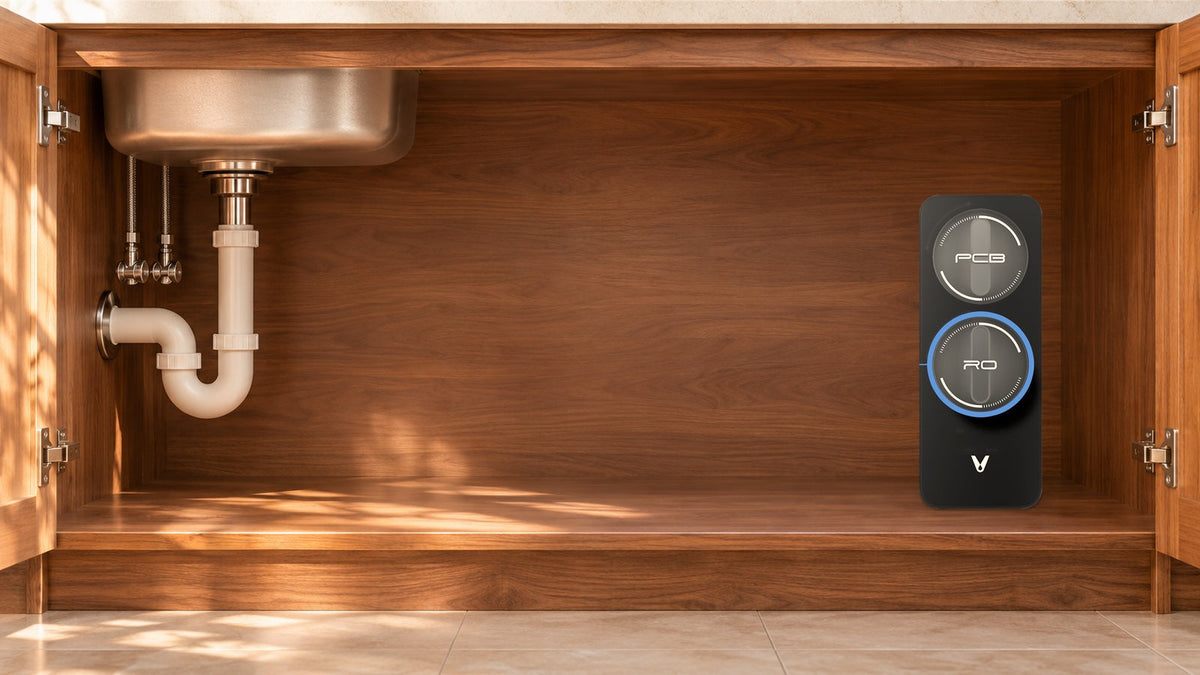
The Viomi V8 PRO arrives as a single main unit with two filter cartridges, a smart faucet with a TDS and filter-life display that puts the readings where the water comes out, and the fittings for a standard cold-water line, including a tee for connecting a compatible refrigerator or ice maker over standard tubing. The RO filter comes installed, and a spare PCB filter sits in the box beside the installed one, so the first pre-filter change is covered from the start.

The PD600-TAM3 has two pieces under the sink, and its box adds the TAM3 canister with its FZ-4 core to the main unit and faucet. The PD600 main unit holds a 2-in-1 sediment and carbon block pre-filter and the RO membrane. A length of tubing runs from the "Filtered" port on its back to the TAM3, a separate canister that holds the mineral cartridge. Frizzlife describes the whole package as eight-stage filtration. Water reaches the counter through a dedicated stainless steel faucet with a brushed nickel finish, and the TDS reading and filter-life lights sit on the front of the main unit.
Side-by-Side Specs for Each Priority
| What the household is weighing | Viomi V8 PRO | Frizzlife PD600-TAM3 |
|---|---|---|
| Rated output | 800 GPD membrane rating | 600 GPD; 0.41 GPM stated flow |
| Pure-to-drain ratio | 3:1 | 2:1 |
| Where TDS and filter life are shown | On the smart faucet | On the main unit's screen, with filter-life indicator lights |
| Filters and lifespans | PCB composite, 12 months; RO, 24 months | ASR211 pre-filter, 12 months; ASR212-600G RO membrane, 24 months; FZ-4 mineral cartridge, 12 months |
| Filtration stages | 9 | 8 |
| Size under the sink | One unit, 16.3 x 5 x 12.8 in | PD600, 5.3 x 14.7 x 15.5 in, plus TAM3 cartridge, 5 x 5 x 13.5 in |
The Viomi V8 PRO keeps its nine stages in two cartridges inside one housing, while the PD600-TAM3 spreads its eight stages across three cartridges, one of them in the separate TAM3 canister, which is where its mineral stage sits.
When Minerals After RO Are the Priority
In the PD600-TAM3's water path, the TAM3 sits after the RO membrane, so it treats water that has already been purified, and its canister stands beside the PD600 main unit in the cabinet, connected by a short run of tubing. Frizzlife says the cartridge adds minerals back for a fresh taste and a balanced pH above 7.5, and because it ships in the PD600-TAM3 box, a household gets that mineral stage from the first day of use.
The canister design gives owners some flexibility. The FZ-4 core runs on the same 12-month interval as the ASR211 pre-filter, so both come up at the same change. At that point only the core needs replacing, which makes the yearly mineral change a cartridge swap inside the existing canister, and Frizzlife also sells a TAM3-HF kit that includes a new housing. If a household later decides it would rather drink plain RO water, Frizzlife notes that the TAM3 filter can simply be unscrewed and water will still pass through.
For a family that wants minerals together with readings on the faucet, the Viomi M1 is Viomi's tankless RO model that adds minerals back after purification. The differences between a mineral stage built into the system and one added as a separate cartridge are explained in built-in versus add-on RO remineralization.
When Output and Faucet Readings Are the Priority
Converted to a per-minute figure, the Viomi V8 PRO's 800 GPD membrane rating comes to about 0.56 gallon a minute, and the PD600's 600 GPD converts to about 0.42, close to the 0.41 GPM Frizzlife lists for it.
On the Viomi V8 PRO, the faucet itself shows a real-time TDS reading for the purified water and the remaining life of both filters, so the numbers are in view of whoever is filling a glass. Each filter's remaining life is shown separately, so the PCB and RO changes appear on the faucet as each one approaches. The Viomi app adds TDS before and after filtration, a water-usage report and filter-life tracking with replacement reminders. Seeing the incoming and purified TDS side by side on the phone shows how much the system is lowering the reading from the tap water it starts with. Over the weeks, the usage report shows how much purified water the household actually draws. On the PD600-TAM3, the TDS reading and filter-life lights are on the main unit under the sink, and Frizzlife's system takes its TDS reading after a minute of continuous production. A wider look at how RO brands handle TDS monitoring is in RO brands that include TDS monitoring.
The pure-to-drain ratio is 3:1 on the Viomi V8 PRO and 2:1 on the PD600-TAM3. At 3:1, three parts of purified water are made for each part sent to the drain.
Filter Changes and Fitting Under the Sink
The RO membrane runs 24 months on each system, and the differences show up in the shorter cycles. On the Viomi V8 PRO, the PCB filter comes due at about 12 months, and the spare in the box covers that first change. A change takes no tools, since each cartridge twists to unlock and pulls out, and after the new one goes in, a filter-life reset restarts the countdown on the faucet and in the app. On the PD600-TAM3, the ASR211 pre-filter and the FZ-4 mineral cartridge both come due at about 12 months, and the main unit signals the timing with its indicator lights, flashing red when about 5 percent of a filter's life remains and staying solid red once it has expired. Its front panel also carries a filter-life reset and a manual flush button, so the owner restarts the count there after a change.
Going by the published lifespans, under normal household use the Viomi V8 PRO's first two years bring a PCB change at about 12 months, using the spare from the box, and a change of both cartridges together at about 24 months. The PD600-TAM3 changes its pre-filter and mineral core at about 12 months, and all three of its cartridges come due together at about 24 months.
For installation, the fittings for a standard cold-water line and the sink drain come in the Viomi V8 PRO box, and the installation video follows each step of the setup. Frizzlife's manual recommends a 1/2 inch hole for the PD600-TAM3 faucet, and the main unit connects to power through its adapter. In the cabinet, the Viomi V8 PRO is one 5-inch-wide unit, and the PD600-TAM3 places its main unit with the TAM3 canister standing right beside it in the cabinet.
FAQ
What does the gap between 600 and 800 GPD mean for a family?
GPD stands for gallons per day, the volume of purified water a system is rated to produce over 24 hours. The Viomi V8 PRO's rating is 200 GPD higher than the PD600's, so it carries more rated daily capacity, and the Viomi app's usage report shows how much purified water a household actually draws for drinking and cooking.
What do the 3:1 and 2:1 ratios mean at the sink?
A pure-to-drain ratio describes how much purified water a system produces for each unit of water it sends to the drain. At 3:1, that is three parts purified water to one part drain water, and at 2:1 it is two parts to one. Put another way, for every 3 gallons of purified water, a 3:1 system sends about 1 gallon to the drain and a 2:1 system about 1.5 gallons.
How far ahead does the Viomi V8 PRO flag a filter change?
Orange lights on the Viomi V8 PRO's control panel come on 10 to 15 days before a change is due. The remaining life of both filters also shows on the smart faucet, and the Viomi app sends replacement reminders, so the household hears about a change in more than one place before it comes up.
Can the Viomi V8 PRO supply a refrigerator or ice maker?
It can. The Viomi V8 PRO connects to a compatible refrigerator or ice maker over standard tubing, using the tee fitting that comes in the box, so chilled water and ice come from the same filtered supply as the faucet. The fittings for the main drinking-water connection are in the same box, and the installation video covers the setup.
What does the PD600-TAM3's screen show, and where is it?
The screen is on the front of the PD600 main unit. According to Frizzlife's manual, it shows the TDS of the RO water, which the system tests automatically once it has been producing water for one minute, along with filter-life indicator lights. A white or blue light means a filter is in normal use, a flashing red light means its life is close to expiring, and a solid red light means it has expired, with a beep each time water is dispensed after that point.
Why does TDS read higher after the TAM3 cartridge?
Frizzlife explains that the TAM3, as the post filter, adds minerals to the water and normally raises TDS by 10 to 30 ppm. A higher reading after the mineral stage is therefore expected, and it reflects the minerals the cartridge puts back into the purified water.
Two Priorities, Two Systems
- If the family drinks its RO water plain and wants the readings right at the faucet and on a phone, the Viomi V8 PRO covers that.
- When minerals added back from the first day matter most, the PD600-TAM3's included TAM3 cartridge is built for it.
- With room under the sink for only one unit, a single housing takes up one spot instead of two.
Share:
Viomi V6 PRO vs iSpring RCC7AK: Two Cartridges With Advance Alerts or Six Stages on Their Own Schedules