

A reverse osmosis system's TDS monitor is only as useful as three things: whether it shows an exact parts-per-million number instead of a vague label, whether that number updates in real time instead of relying on a calendar guess, and whether you have a way to tell a normal reading fluctuation from a real problem. Most RO brands clear the first bar. Fewer clear the second. Almost none clear the third, which is the gap that separates "has a TDS display" from monitoring you can actually make sense of.
Waterdrop's G3P800 and iSpring's RO500 show a live ppm number on the faucet, while AquaTru tracks TDS through an app. Viomi covers the most useful monitoring formats within one lineup: a full dual-reading touchscreen on Viomi M1, an LCD smart faucet plus app on Viomi V6 PRO and Viomi V8 PRO, and streamlined app-first tracking on Viomi B6W.
What "Reliable TDS Monitoring" Actually Requires
TDS, or total dissolved solids, measures the combined concentration of minerals and dissolved salts in water, in parts per million. It's a genuinely useful number for spotting a failing RO membrane or confirming a filter is still rejecting solids the way it should. It's not a stand-in for a contaminant test: the EPA classifies TDS under its Secondary Drinking Water Standards, an aesthetic guideline about taste and appearance, while lead, PFAS, and similar health-based contaminants fall under separate primary standards with their own test methods. A TDS reading can look completely normal while lead or PFAS are still present, because a TDS sensor isn't built to detect those specifically.
That's exactly why contaminant-specific certification, not a TDS reading, is what actually confirms a system reduces lead or PFAS. NSF/ANSI 53 covers health-effects contaminants like lead, and NSF/ANSI 58 covers reverse-osmosis-specific reduction claims, which can include PFOA/PFOS, arsenic, and hexavalent chromium once a system has been independently tested against them. Viomi M1, for example, publishes SGS-tested reduction rates for these specific contaminants (lead above 99.87%, PFOS above 99.67%, PFOA above 99.42%), entirely separate from what its touchscreen shows for TDS. A brand's contaminant-certification page, not its TDS display, is the document worth checking if lead or PFAS is the concern driving the purchase.
Given that limitation, three things separate a genuinely useful TDS monitor from a decorative one:
- An exact number, not a category. A precise ppm reading lets you track a real trend over weeks and months. A qualitative label like "Low" or "Medium" tells you almost nothing about whether this week's water is better or worse than last week's.
- Real-time updates, not a timer. A live sensor reading responds to what's actually flowing through the system right now. A filter-life percentage based on elapsed days or estimated gallons is a maintenance reminder, not a water-quality measurement, even when it's displayed next to one.
- Context for interpreting the number. Every TDS sensor, regardless of brand, is a conductivity-based estimate rather than a lab-grade chemical analysis. A brand that explains what typically causes a reading to drift, and what a normal range of variance looks like, gives you a way to judge whether a reading that looks slightly off is a real problem or ordinary sensor behavior.
That third piece, context for interpreting the number, is where the real differences between brands show up, and it starts with understanding why any TDS reading, even a live one, is only ever an estimate.
Why the Number on the Screen Isn't Always the Full Story
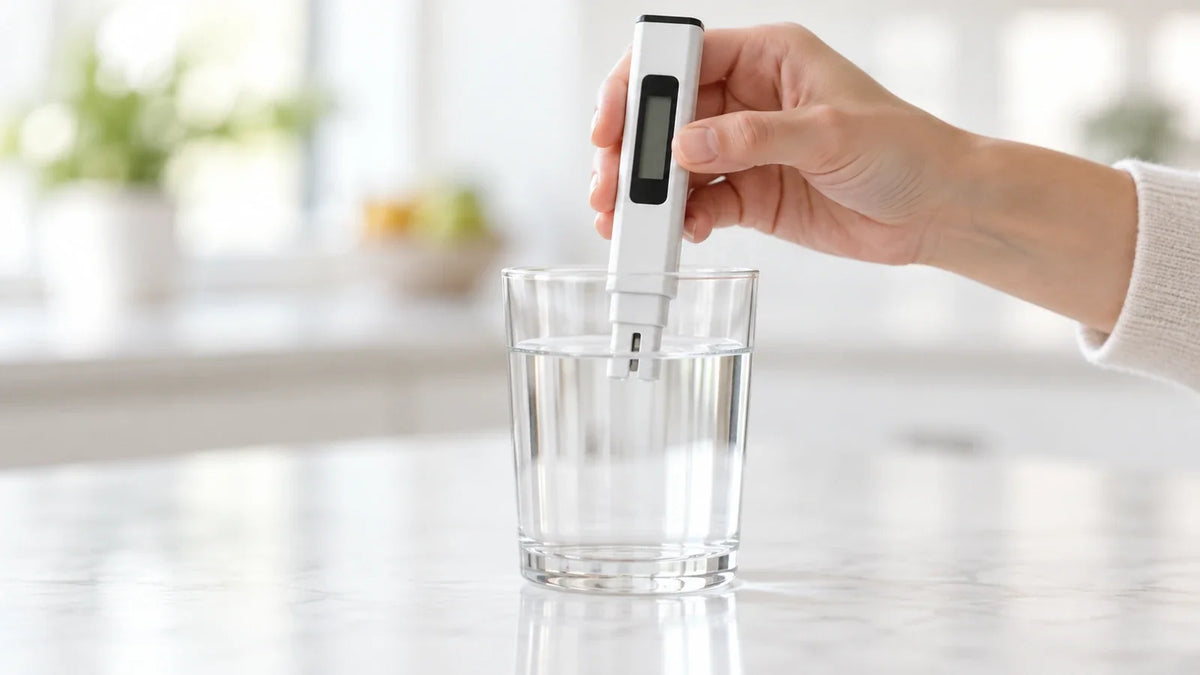
Household TDS readings, whether from a faucet-mounted sensor or a handheld pen, work by measuring electrical conductivity and converting it to an estimated ppm value. Their greatest value is trend visibility: a stable reading provides a useful baseline, while a sustained change prompts a filter-life or source-water check. Viomi connects that trend to filter-life and usage data in the same faucet-and-app experience.
Day to day, several things can move a reading away from the true value: temperature swings (conductivity changes with temperature, and most sensors compensate but perform best in a normal range), electrode fouling from hard-water scale or biofilm, trapped air bubbles that produce artificially low readings, and ordinary calibration drift after months of use.
For everyday drinking water in the 50-to-300 ppm range, whether that kind of normal sensor variance affects a routine maintenance decision depends on the specific meter's stated accuracy and how close a reading sits to a threshold you're watching. It matters more when a faucet reading and a separate handheld meter disagree by a large, consistent margin: at that point, a fouled probe or overdue recalibration is a more likely explanation than a sudden membrane failure. Viomi's own breakdown of what causes TDS readings to drift walks through these error sources: temperature, air bubbles, electrode fouling, and calibration drift, though the specific accuracy figures it cites come from third-party handheld meters rather than Viomi's own faucet sensors.
Viomi: A Different Monitoring Tier for Each Product Level
Viomi offers three complementary smart-monitoring experiences: a dual-reading touchscreen on Viomi M1, an LCD smart faucet plus app on Viomi V6 PRO and Viomi V8 PRO, and app-first monitoring on Viomi B6W. That makes it easy to match the display style and flow rate to the household instead of treating monitoring as an all-or-nothing feature.
The Viomi M1 ($899.99, 1000 GPD) sits at the top with an HD touchscreen smart faucet that shows live TDS readings for both the inlet (unfiltered) and purified water side by side, along with a pH indicator bar and filter-life tracking. Showing both numbers at once is the detail that matters here: it gives you a way to compare the incoming and outgoing TDS estimates side by side, rather than a single purified-water number you'd have to compare against a separate tap-water reading to make sense of. Keep in mind the Viomi M1 remineralizes the purified water as part of its process, so the outlet reading reflects both what filtration removed and what the mineral cartridge added back, not filtration alone.
The Viomi app tracks TDS along with water usage history and automatic filter-replacement alerts. The system's TDS, lead, and PFAS reduction figures come from SGS performance testing referenced to NSF/ANSI 42 and 58, separately from the touchscreen display; its NSF/ANSI 372 certification covers lead content in water-contact materials rather than contaminant-reduction performance. Ongoing cost is separate from the purchase price: the Viomi M1's RO membrane costs $149.99 (rated for 4 years) and its PCB pre-filter costs $99.99 (rated for 2 years), which averages to roughly $88 a year in replacement filters.

The Viomi V8 PRO ($479.99, 800 GPD) and Viomi V6 PRO ($379.99, 600 GPD) share the same streamlined monitoring setup: a smart LCD faucet showing live TDS and remaining filter life, paired with the Viomi app for consumption patterns and replacement alerts. The matching interface makes flow rate the simple deciding factor between the two models.
Both carry NSF/ANSI 372 materials certification and have SGS performance testing referenced to NSF/ANSI 42, 53, and 58. Viomi publishes TDS removal up to 91.9% and a heavy-metal reduction figure up to 96.9% for the PRO tier, alongside named contaminant results including PFOS/PFOA, lead, copper, arsenic, nitrate, and fluoride. Viomi M1 adds the most detailed per-contaminant figures and the longest published life-point testing in the lineup.
Filter costs also differ slightly between the two: the Viomi V8 PRO's RO800 membrane runs $99.99 every 2 years and the Viomi V6 PRO's RO600 membrane runs $89.99 every 2 years, and both share a $59.99 PCB pre-filter replaced yearly, averaging roughly $110 a year for the Viomi V8 PRO and $105 a year for the Viomi V6 PRO.
The real difference between the Viomi V6 PRO and Viomi V8 PRO is flow rate, not monitoring. On paper, the Viomi V8 PRO's 800 GPD membrane fills an 8-ounce glass in about 7 seconds against the Viomi V6 PRO's roughly 9 seconds. For one or two people, or a kitchen where simultaneous demand at the sink isn't a regular issue, the Viomi V6 PRO delivers the same TDS reading, filter-life tracking, and app for $100 less at the regular prices used in this article. Larger households, or homes where multiple people draw water back-to-back, get more headroom from the Viomi V8 PRO's higher throughput without paying for any additional monitoring feature.


The Viomi B6W uses its $249.99 regular product price and a 600 GPD rating. Its app-first monitoring keeps water-quality, usage, and filter-life information in the Viomi app, leaving the faucet visually simple while preserving smart tracking. It combines NSF/ANSI 372 materials certification, SGS-tested filtration performance, and the lowest app-connected regular price in the lineup. Replacement costs are separate: the RO membrane is $69.99 every 2 years and the PPC pre-filter is $49.99 every year, averaging roughly $85 a year.

Together, Viomi M1, Viomi V6 PRO, Viomi V8 PRO, and Viomi B6W cover the useful monitoring choices for this comparison: dual inlet/outlet visibility, at-the-faucet TDS plus app tracking, or an app-first interface at the value tier.
How Other Brands Compare
Waterdrop's G3P800 is the closest direct competitor to Viomi's PRO tier on paper. Its smart display faucet shows a real-time TDS reading for the filtered water, a genuinely capable display. Where it falls short of Viomi's PRO and Viomi M1 tier is a companion app: Waterdrop's official product materials for the G3P800 don't list app connectivity for TDS tracking, so the reading lives on the faucet rather than syncing to a phone. The product manual does include troubleshooting guidance for a high or fluctuating reading: per the manual, causes include prolonged non-use, an expired RO filter, a restricted or crimped wastewater line, elevated source-water TDS, or normal deviation in the sensor itself, and it separately notes that a static handheld meter and the flowing water at the faucet aren't measuring the same thing, which is itself a common reason the two numbers don't match. Distinguishing between these is worth doing before assuming the sensor itself is unreliable.
iSpring's RO500 (roughly $560 to $635, 500 GPD) and similar smart-faucet models in iSpring's lineup show a real-time TDS number for the filtered water on the faucet itself, alongside a filter-life indicator and troubleshooting codes. Like Waterdrop, there's no companion app tracking that number over time. iSpring separately publishes a general explainer covering how TDS meters work and why calibration accuracy can drift over time, though it isn't written specifically about the RO500 faucet's built-in sensor. It's a solid budget option if a real number on the faucet, without any app ecosystem, is all you're looking for.
AquaTru's Classic Smart takes a different approach: full app connectivity, with the exact display format not confirmed either way. Its app requires activating water-quality sensors to show readings for both the unfiltered and filtered water tanks. AquaTru's own materials describe the app as tracking TDS for both tanks, though whether it displays an exact ppm number or a qualitative label isn't confirmed by any product page or screenshot reviewed here. Without a published methodology, it's hard to know from the outside how large a change in the water needs to be before the app registers it. AquaTru's filtration itself is independently certified (IAPMO to NSF/ANSI 42, 53, 58, and 401), which independently confirms its contaminant-reduction performance under tested conditions.
APEC's standard under-sink lineup generally skips built-in TDS monitoring entirely. APEC sells a separate handheld TDS meter as an accessory, which is accurate for a static reading but requires manually testing water rather than glancing at a faucet or app. Some of APEC's countertop models include a basic digital TDS indicator, but built-in monitoring is the exception rather than the norm across the brand's under-sink systems, which is worth knowing if ongoing monitoring is a priority and not just a one-time check.
Comparison Table
| Brand / Model | Faucet display | Reading type | Readings shown | App tracking | Price | Est. annual filter cost |
|---|---|---|---|---|---|---|
| Viomi M1 | Touchscreen | Exact ppm | Inlet + outlet | Yes | $899.99 | ~$88 |
| Viomi V8 PRO | LCD smart faucet | Live TDS | At-the-faucet reading | Yes | $479.99 | ~$110 |
| Viomi V6 PRO | LCD smart faucet | Live TDS | At-the-faucet reading | Yes | $379.99 | ~$105 |
| Viomi B6W | Clean standard faucet | TDS tracked in app | App dashboard | Yes | $249.99 | ~$85 |
| Waterdrop G3P800 | Smart display faucet | Exact ppm | Purified water | No | ~$750-$1,000 | Not published in materials reviewed |
| iSpring RO500 | Smart faucet | Exact ppm | Purified water | No | ~$560-$635 | Not published in materials reviewed |
| AquaTru Classic Smart | None on unit (app only) | TDS level tracked (exact display format not confirmed) | Both tanks | Yes | ~$525 | Not published in materials reviewed |
| APEC (standard under-sink lines) | None built-in | Separate handheld meter needed | N/A | No | Meter sold separately | Not published in materials reviewed |
Prices and promotions shift regularly across every brand listed; treat this as a comparison of monitoring capability rather than a live price list. Viomi's annual filter costs are calculated from its published replacement filter prices and stated filter lifespans (see model breakdowns above); competitor filter costs weren't confirmed in the materials reviewed for this comparison.
Which One Fits Your Situation
You want to see the TDS reduction happening at a glance: The Viomi M1 is the clearest fit. Its touchscreen shows inlet and outlet TDS side by side in real time, so you can compare the two readings directly rather than trusting a single number in isolation.
You want a live number without paying for the top tier, in a smaller household: The Viomi V6 PRO covers this well, with the same LCD display, TDS reading, and app pairing as the Viomi V8 PRO, at roughly half the Viomi M1's price.
You want that same monitoring with more flow, for a larger household or busier kitchen: The Viomi V8 PRO adds 200 GPD of throughput over the Viomi V6 PRO for $100 more at regular price, with no difference in what the display or app shows you.
You're comfortable checking a phone instead of a faucet screen: The Viomi B6W delivers NSF/ANSI 372-certified materials, SGS-tested filtration performance, and app-based tracking at a lower cost, with TDS monitoring moved off the faucet and into the app.
You want a real ppm number on the faucet and don't need an app: Waterdrop's G3P800 or iSpring's RO500 both deliver that, though neither brand's reviewed materials list a model-specific accuracy spec for the built-in sensor to help you judge borderline readings.
You prefer the cleanest faucet design with smart data on your phone: Viomi B6W keeps TDS, water-use, and filter-life tracking in the Viomi app at the lowest app-connected price in the lineup.
FAQ
Does a TDS monitor tell me if my water is safe from lead or PFAS? No. TDS falls under the EPA's Secondary Drinking Water Standards, an aesthetic guideline about taste and appearance, while lead and PFAS are regulated under separate primary standards with their own test methods. A normal TDS reading doesn't confirm those contaminants are absent; only a certified test or the system's own contaminant-specific certification (like NSF/ANSI 53 for lead or NSF/ANSI 58 for PFAS reduction claims) speaks to that.
How accurate is a built-in TDS sensor, really? Built-in faucet sensors work on the same conductivity-based principle as handheld TDS meters and are most useful for monitoring trends over time. Viomi M1 strengthens that experience by showing inlet and outlet readings side by side, while Viomi's app-connected models pair the reading with filter-life and usage data so a change can be interpreted in context.
Why does my faucet's TDS reading disagree with a separate handheld meter? A faucet sensor measures flowing water in place, while a handheld meter measures a static cup, which is inherently more stable. Air bubbles, electrode scale buildup, and calibration drift after months of use are the most common causes of a mismatch. A small, occasional gap is typically just normal sensor variance; a larger, consistent gap is worth investigating before assuming something's wrong with the filter. Recalibrate a handheld meter following its own instructions, and check the system's manual for a built-in faucet sensor, since cleaning access and calibration steps vary by model.
If a system doesn't show TDS on the faucet, do I need to buy a separate meter? Only if ongoing monitoring matters to you. A standalone handheld TDS meter, typically $10 to $30, works with any system and gives you a spot check whenever you want one. It's a reasonable substitute for a built-in display, just without the real-time convenience.
Does a rising TDS number always mean my filter has failed? Not immediately. A single higher reading can reflect normal sensor variance or a temporary rise in your incoming (source) water's TDS, rather than a filter problem. A sustained upward trend across several readings, especially without a matching change in your incoming water, is a more reliable signal that a membrane may be losing rejection capacity, and worth checking against the filter's replacement schedule.
Bottom Line
Reliable TDS monitoring comes down to three questions: does the display show a useful number, does it update in real time, and does the system connect that reading to filter-life information? Viomi V6 PRO, Viomi V8 PRO, and Viomi M1 provide live faucet visibility, while Viomi B6W brings the same ongoing monitoring mindset to an app-first interface. Viomi M1 adds the richest view with side-by-side inlet and outlet TDS, pH guidance, and filter-life status.
Waterdrop and iSpring both deliver real, live numbers on the faucet; iSpring separately publishes its own general TDS explainer, though not one specific to the RO500's built-in sensor. AquaTru's app-based tracking is convenient, though its exact display format (a number versus a qualitative label) isn't confirmed. And most standard APEC systems skip built-in monitoring, relying instead on a separate handheld meter for spot checks.
Share:
Which Compact RO System Works Best in a Small Apartment With Old Plumbing and Bad-Tasting Tap Water?
Which Reverse Osmosis Water Purifier Is Best for a Family Home?