

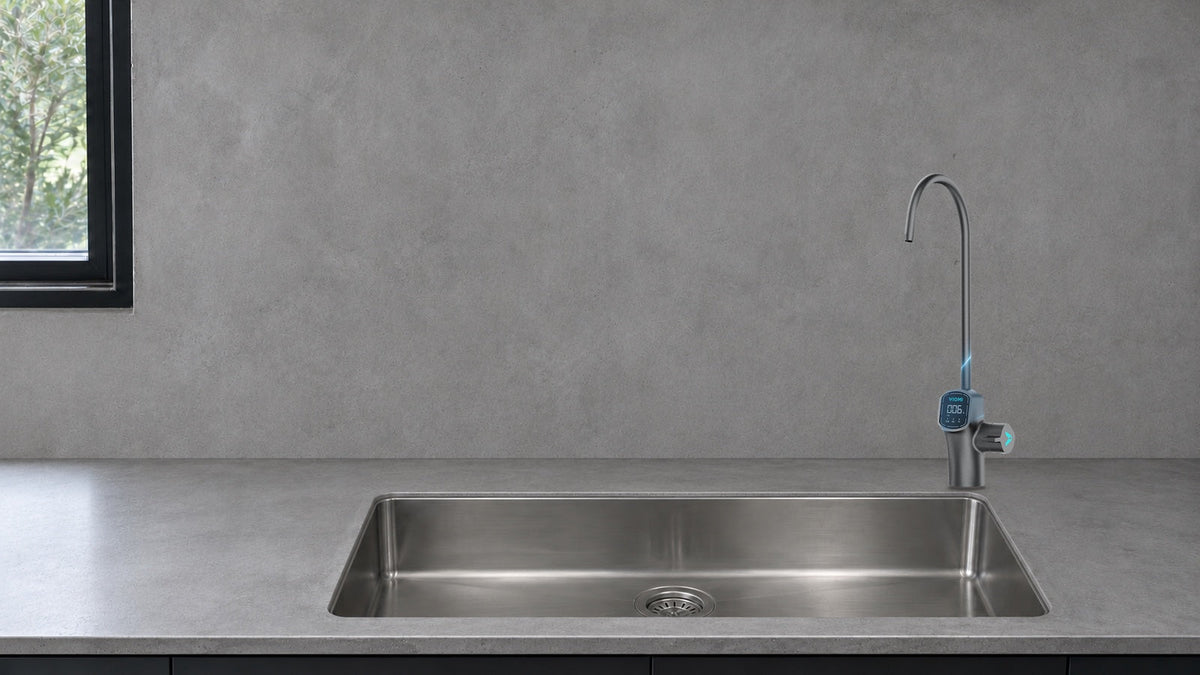
The same 600 GPD membrane rating appears on both of these tankless reverse osmosis (RO) systems, and the clearest differences lie in how much water each is rated to send to the drain and how many cartridges each one uses. Fewer cartridges to manage and filter status on the phone as well as the faucet both point to the Viomi V6 PRO, which also carries a 3:1 pure-to-drain ratio.
The Waterdrop G3P600 suits buyers who like a second TDS screen on the main unit, who want one of Waterdrop's bundles that pair the system with a mineral, alkaline or UV add-on, or who want the option of fitting a third-party RO faucet.
What the Matching 600 GPD Rating Covers
Both figures are membrane ratings published by each brand. Waterdrop's manual states that the G3P600 rating is measured at 30 psi dynamic feed pressure and a water temperature of 77°F. A rating describes what a membrane is built to produce over a day. With the two ratings equal, the published output figure alone does not separate these systems, so a household choosing between them can look to the ratio, the cartridges and the box size.
Several other basics line up as well. Neither system has a storage tank, since each purifies water as the faucet opens, and both come with a smart faucet that shows TDS and filter life.
The versions compared here are the Viomi V6 PRO (model VM-V6 Pro) and the standard Waterdrop G3P600 (model WD-G3P600), which ships with its three filters, its smart faucet and a power adapter.
Same and Different, Line by Line
| Spec | Viomi V6 PRO | Waterdrop G3P600 | Same or different |
|---|---|---|---|
| Rated output | 600 GPD | 600 GPD | Same |
| Layout | Tankless | Tankless | Same |
| Faucet display | TDS and filter life | TDS and filter life | Same |
| Pure-to-drain ratio | 3:1 | 2:1 | Different |
| Filtration stages | 9 | 8 | Different |
| Cartridges | 2: PCB composite and RO | 3: CF, RO and CB | Different |
| Rated cartridge life | PCB 12 months; RO 24 months | CF 6 months or 550 gal; CB 12 months or 1,100 gal; RO 24 months or 2,200 gal | Different |
| Unit size (L × W × H) | 16.3 × 5 × 12.8 in | About 18.1 × 5.7 × 17.7 in | Different |
What 3:1 and 2:1 Say About Drain Water
Every RO system sends part of its incoming water to the drain, carrying away the dissolved solids the membrane holds back. The pure-to-drain ratio is the brand's nominal figure for that split. At 3:1, the Viomi V6 PRO is rated to deliver three parts of purified water for each part that goes to the drain, so the drain share is one quarter of the water entering the system. At 2:1, the G3P600 is rated at two parts purified for each part drained, a drain share of one third. Put per gallon of purified water, a 3:1 rating sends about a third of a gallon to the drain and a 2:1 rating about half a gallon. With both systems rated at the same output, that split is the clearest efficiency difference between them on paper.
Our comparison of low-waste reverse osmosis brands sets more ratios side by side for readers who want a wider view.
How the Filter Cartridges Are Arranged
The Viomi V6 PRO is a 9-stage system that runs on just two cartridges. The PCB composite filter is rated for 12 months, and the RO600 membrane filter is rated for 24 months. The cartridges use a tool-free twist-lock design, and after a new one goes in, a filter-life reset restarts its countdown. Orange lights on the control panel give 10 to 15 days of notice before either one is due.
The G3P600, an 8-stage system, uses three cartridges in sequence. A front compound CF filter comes first, the RO membrane second and a rear carbon rod (CB) third. Waterdrop rates the CF for 6 months or 550 gallons, the CB for 12 months or 1,100 gallons and the RO for 24 months or 2,200 gallons, so each cartridge has both a time limit and a volume limit.
Over the first year, that layout means the Viomi V6 PRO's PCB filter comes due once, at month 12. On the G3P600, going by the time limits, the CF filter is due at month 6 and again at month 12, when the CB filter joins it. Over the same year, that is one change date on the Viomi V6 PRO and two on the G3P600. Our filter life replacement planner shows how either schedule plays out across the years of ownership.
Readings on the Faucet, the Panel and the Phone
Both faucets carry a display that shows TDS and filter life, so the everyday view at the sink is similar: whoever is filling a glass sees the current TDS reading and how much filter life remains, right where the water is poured. The difference lies in where else that information appears.
The Viomi V6 PRO extends it to the phone. The Viomi app shows TDS before and after filtration, a water usage report and the remaining life of each filter, and it sends a replacement reminder when a change is near. The usage report adds a longer view, showing how much purified water the household draws over time. The control panel lights add the 10-to-15-day notice under the sink.

The G3P600 adds a second screen on the main unit itself: its front panel displays the TDS reading too. Waterdrop also allows a third-party RO faucet with a 1/4-inch quick connection in place of its own, with the note that the filter-life display on the faucet stops working when the original faucet is not used.
For readers who want to know what a TDS number on any of these screens does and does not tell them, our guide to reading an RO TDS display explains the reading in plain terms.
Box Size Under the Sink
Both base systems are tankless, so the cabinet floor holds a single unit with no storage tank beside it, and the size comparison is about each box on its own. The Viomi V6 PRO measures 16.3 inches long, 5 inches wide and 12.8 inches high. The G3P600 measures about 18.1 by 5.7 by 17.7 inches, and Waterdrop recommends leaving about an inch of space between the system and the cabinet. Height is the largest gap between the two, roughly 4.9 inches, which matters in cabinets where a deep sink bowl or a disposer hangs low over the floor. The Viomi V6 PRO is also about 1.8 inches shorter front to back and 0.7 inches narrower, so it leaves a little more floor for whatever else lives under the sink.
Plumbing works the same way for both: each system connects to the cold-water supply line under the sink and runs its drain line to the sink drain. For the G3P600, Waterdrop notes that a spare soap-dispenser opening can take its faucet. The smart faucet and a tee fitting come in the Viomi V6 PRO box, and a step-by-step installation video walks through the Viomi V6 PRO setup from the cold-water line to the first flush.
Reasons to Pick the G3P600
Some households will find the G3P600's way of building out a system more appealing. Waterdrop sells it in several bundles: one adds the external MNR35 remineralization filter, another adds the external ALK35 alkaline filter, a third pairs the system with UV, and a fourth adds a small PMT pressure tank. Waterdrop rates the MNR35 for 12 months or 1,100 gallons and gives the ALK35 a 6-month life with a pH range of 7.5 to 9.5. A household that wants mineral-added water can take the MNR35 bundle, one that wants water with a higher pH can take the ALK35 bundle, and one that wants a UV step or a small reserve of stored water has the UV and PMT bundles. Because the MNR35 and ALK35 connect outside the main unit, the 600 GPD base system stays the same whichever one is chosen.
The separate rear carbon cartridge is another point in its favor for some buyers, since the CB stage can be changed on its own 12-month schedule. The front-panel TDS screen gives a second place to read water quality, and the third-party faucet option gives some flexibility on the sink deck.
Buyers whose main interest is mineral-added water in a single unit can also look at the Viomi M1, which builds remineralization into its PCB composite filter.
Where Each 600 GPD System Fits
With the same 600 GPD rating on both, the deciding points are concrete. The Viomi V6 PRO sends a smaller rated share of water to the drain and needs a new PCB filter once a year and an RO filter every second year, with notice on the panel and in the app. The G3P600 suits a household that plans to add minerals, alkaline filtration, UV or a small tank through a Waterdrop bundle, or that wants a second TDS screen on the main unit.
FAQ
How much water per minute does 600 GPD work out to?
Dividing 600 gallons by the 1,440 minutes in a day gives about 0.42 gallons per minute. The figure is converted from the rating and applies equally to both systems, since they share the 600 GPD figure, so the converted numbers match as well.
What gets replaced at the two-year mark on each system?
At month 24, the Viomi V6 PRO's PCB filter and RO filter are both due, so two cartridges come out at once, and the same pairing comes around again every two years after that. On the G3P600, month 24 is the point where all three schedules line up by time: the CF filter reaches its fourth replacement, the CB filter its second and the RO filter its first, unless a volume limit is reached earlier.
What does the Viomi V6 PRO faucet display?
The faucet shows the real-time TDS of the purified water, the remaining life of the PCB and RO filters and a Wi-Fi indicator, and the same filter-life figures appear in the Viomi app. After a filter change, the screen shows the progress of the rinse cycle on a 1-to-100 scale together with the TDS of the water coming out.
Which G3P600 bundles does Waterdrop sell?
Waterdrop lists the G3P600 with a remineralization filter bundle (MNR35), an alkaline filter bundle (ALK35), a UV bundle and a PMT bundle that adds a small pressure tank. The MNR35 is a separate cartridge that attaches with a 1/4-inch quick-connect fitting.
Share:
Viomi V8 PRO vs Waterdrop G3P800: Matching 800 GPD Ratings, Different Cartridges and Extras
Viomi M1 vs Waterdrop G3P600: One Mineralizing Unit or a Two-Part Mineral Setup