

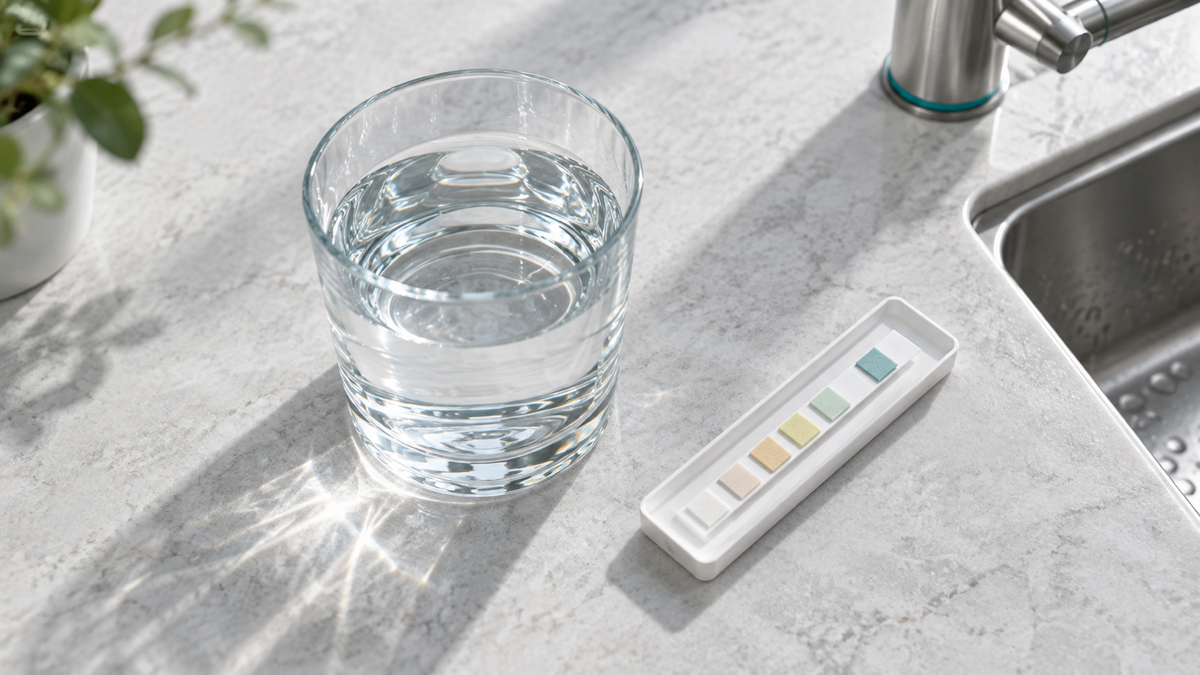
Start by figuring out what's actually wrong with your water, not by buying a filter and hoping it works. A carbon pitcher won't touch arsenic, and a full reverse osmosis system is overkill for a chlorine smell that fades after the tap runs for a few seconds. The fix only makes sense once you know the problem, and that starts with reading the signals your water is already giving you.
What Your Water Is Telling You
Taste, smell, color, and staining each point toward a different cause. None of these symptoms confirm a diagnosis on their own, but they narrow down what to test for and which filters are even worth considering.
| What you notice | Likely cause | What to check next |
|---|---|---|
| Chlorine or "pool" smell/taste | Residual chlorine or chloramine from municipal treatment | Your utility's annual water quality report (see below) |
| Rotten-egg smell | Hydrogen sulfide, usually from well water or an aging water heater | Isolate whether it's every faucet or just hot water |
| Metallic taste | Iron, copper, zinc, or corroding household pipes | Check if the taste shows up right after the tap sits unused |
| Orange, red, or brown staining on fixtures | Iron | A private lab test for iron and manganese |
| Blue-green staining | Copper, often from acidic water corroding pipes | A pH and copper test |
| Cloudy or white water that clears from the bottom up | Trapped air, usually harmless | Let a glass sit for a minute before assuming a filter problem |
| Persistent cloudiness, sand, or grit | Sediment, more common with well water or aging municipal pipes | A sediment pre-filter upstream of any other treatment |
| Soap that won't lather, white scale on fixtures | Hardness (calcium and magnesium) | A hardness test, reported in grains per gallon or mg/L |
| Earthy or musty taste | Algae or organic matter, common seasonally in surface-water systems | Check if your utility's report mentions seasonal taste-and-odor events |
A few of these symptoms call for more than a filter decision. If your water suddenly changes color, smells strongly of sewage, or anyone in the household develops gastrointestinal symptoms shortly after drinking it, stop drinking the tap water and contact your water utility or local health department before troubleshooting with a filter.
Municipal Water and Well Water Start From Different Places
The type of filter that makes sense depends partly on where your water comes from, because municipal and well water carry different baseline risks.
If you're on municipal (city) water, it's already been treated and tested. Every community water system in the US is required to publish an annual Consumer Confidence Report (CCR) listing which contaminants were detected and at what levels. That report, usually available on your utility's website, is the fastest and cheapest way to find out what's actually in your water before you buy anything. Municipal water can still carry residual chlorine or chloramine (added for disinfection), trace lead picked up from old service lines or household plumbing, and in some regions, PFAS, the "forever chemicals" now tracked under the EPA's UCMR 5 monitoring program.
If you're on a private well, no agency tests it for you. The CDC and EPA recommend testing private wells at least once a year for total coliform bacteria, nitrates, total dissolved solids (TDS), and pH level, and sooner after flooding, nearby construction, a new pregnancy in the household, or any noticeable change in taste, color, or smell. Wells are also more likely to carry iron, manganese, hardness, sulfur, and in some regions, arsenic or radon, none of which a municipal CCR will tell you about.
When to Test Instead of Guess
A filter bought on a hunch is a coin flip. Three levels of testing cover most situations:
- Read your CCR first if you're on municipal water. It's free and already paid for by your water bill.
- Use an at-home test strip for a quick screen of chlorine, hardness, or pH. These are fine for a rough read but aren't precise enough to confirm low-level contaminants like lead or PFAS.
- Send a sample to a certified lab when you need an actual number, for well water annually, or any time you're specifically concerned about lead, bacteria, nitrate, arsenic, or PFAS. Many state health departments maintain lists of certified labs, and some offer low-cost well testing programs directly.
Match the Problem to the Right Filtration Technology
Once you know what you're dealing with, the filtration technology choice gets a lot simpler. Each type solves a specific set of problems and leaves others untouched.

Activated Carbon
Carbon filtration is the workhorse for taste and odor. It adsorbs chlorine, chloramine (less effectively than chlorine), many organic compounds responsible for musty or earthy tastes, and, depending on the specific filter's certification, can reduce lead and some PFAS compounds. Carbon comes in pitchers, faucet-mounted units, and under-sink systems with their own dedicated spout.
What it doesn't do: carbon doesn't meaningfully reduce hardness, dissolved salts, nitrate, arsenic, or fluoride, and it doesn't disinfect bacteria or viruses. It's also only as good as its NSF/ANSI certification. A filter certified to NSF/ANSI 42 is rated for taste and odor, not the same thing as NSF/ANSI 53, which covers specific health-related contaminants like lead.
For households on municipal water whose main complaint is chlorine taste, odor, or a documented lead concern, the Viomi Under-Sink Carbon Filter is built for that use case. Its 0.5-micron 2-in-1 PP-cotton and carbon-rod cartridge targets lead, chlorine, PFAS/PFOA/PFOS, bad taste, and odor. Push-to-connect fittings simplify installation, and the system needs no drain line. Its product documentation lists NSF/ANSI 42, 53, and 372 verification for the applicable aesthetic, health-effect, and lead-free-material claims, with a cartridge rated for up to 12 months or 8,000 gallons under normal municipal-water use.

For the simplest possible starting point, a filtered pitcher solves chlorine taste with no installation at all. The Viomi Inno 13-Cup Water Filter Pitcher is NSF/ANSI 42 certified and reduces chlorine by up to 97.2%, with a filter life of up to two months per cartridge. It's a reasonable fit for renters, dorms, or anyone who just wants better-tasting drinking and cooking water without touching any plumbing, though it's not built to address lead, hardness, or dissolved contaminants the way an under-sink or RO system is.

Reverse Osmosis (RO)
RO is the broadest-spectrum option available at the point of use. Water is forced through a semipermeable membrane fine enough to block dissolved contaminants that carbon alone can't touch: lead, arsenic, nitrate, fluoride, most PFAS compounds, and a large share of total dissolved solids. Multi-stage RO systems typically pair the membrane with carbon pre- and post-filters, so you get carbon's taste-and-odor benefits plus the membrane's broader removal range in one system.

The tradeoffs: RO systems need a drain connection (for the wastewater the membrane produces), typically a drilled hole for a dedicated faucet, and a membrane that needs periodic replacement. Output is also slower than a straight tap, since water has to pass through the membrane rather than flow freely.
For households that want the highest-capacity RO system in Viomi's own lineup, along with mineralized output and confirmed reduction of TDS, lead, PFOS, and PFOA, the Viomi M1 is built around exactly that case. It's a tankless, 9-stage RO system rated at 1000 GPD with a 0.0001-micron membrane, certified to NSF/ANSI 42, 58, and 372, and it runs a 3:1 pure-to-drain ratio, meaning it wastes less water than many older or entry-level RO designs that discharge 3 or more gallons for every gallon purified. After purification, it reintroduces minerals (including magnesium, calcium, and sodium) to produce alkaline, remineralized water rather than the flat-tasting output some RO systems are known for. A touch-screen smart faucet shows live TDS readings and filter life, and the companion app tracks usage and sends replacement reminders.

Viomi also offers two high-flow tankless RO systems below Viomi M1’s 1,000 GPD capacity. Viomi V8 PRO provides 800 GPD, and Viomi V6 PRO provides 600 GPD. Both use nine-stage filtration, are SGS-tested against NSF/ANSI 42, 53, and 58 performance criteria, and use NSF/ANSI 372-certified lead-free materials. Their documentation lists reduction targets including PFAS, lead, copper, arsenic, nitrate, and fluoride.
The two share the same 16.3 x 5 x 12.8-inch footprint and the same two-year RO filter replacement schedule, so the decision between them comes down almost entirely to output rather than price (check water.viomi.com for current pricing on both). The Viomi V8 PRO's maximum flow rate is 71 oz/min versus 53 oz/min for the Viomi V6 PRO, which matters most when more than one tap or appliance draws water at the same time, filling a pot while the ice maker runs, for example. A single person or couple with modest daily use is well served by the Viomi V6 PRO; larger households, or anyone who wants more headroom for simultaneous demand, get more practical value out of the Viomi V8 PRO.
| Model | Regular price | Nominal production capacity | Filtration | Verification and certification | Best fit |
|---|---|---|---|---|---|
| Viomi M1 | $899.99 | 1000 GPD | 9-stage RO + remineralization | NSF/ANSI 42, 58, and 372 certified; model-specific SGS results | Households wanting Viomi’s highest-capacity RO system and mineralized output |
| Viomi V8 PRO | $479.99 | 800 GPD | 9-stage RO | SGS-tested against NSF/ANSI 42/53/58 criteria; NSF/ANSI 372-certified materials | Larger households or faster refill needs (71 oz/min) |
| Viomi V6 PRO | $379.99 | 600 GPD | 9-stage RO | SGS-tested against NSF/ANSI 42/53/58 criteria; NSF/ANSI 372-certified materials | Smaller households where 53 oz/min is sufficient |
| Viomi Under-Sink Carbon Filter | Check water.viomi.com | N/A | 0.5-micron carbon/PP composite | Product documentation lists NSF/ANSI 42, 53, and 372 | Chlorine taste/odor and documented lead concerns, no drain hookup |
| Viomi Inno 13-Cup Pitcher | Check water.viomi.com | Not rated (gravity-fed pitcher) | 4-stage composite filtration | NSF/ANSI 42 | Renters and no-plumbing situations, chlorine taste only |
Pricing on all five products changes with promotions and inventory, so the table above points you to the current listing on water.viomi.com rather than a fixed number that could be out of date by the time you read this.
Water Softening
If your main complaint is scale buildup, soap that won't lather, or filmy residue on dishes and skin, that's hardness, not something carbon or RO alone is built to solve at the whole-house level. Whole-house softeners use ion exchange to swap calcium and magnesium ions for sodium or potassium, treating every tap in the house rather than just the kitchen.
Viomi’s U.S. lineup specializes in point-of-use drinking-water systems. In hard-water areas, a non-salt scale inhibitor or conditioner upstream can protect the RO membrane, while a dedicated whole-house softener remains the right tool when hardness affects every fixture.
Viomi M1, Viomi V8 PRO, and Viomi V6 PRO are engineered for treated municipal incoming water. Private-well installations should begin with a certified water test and suitable pretreatment for sediment, iron, manganese, microorganisms, and pressure stability, followed by compatibility confirmation with Viomi support.
UV Disinfection
UV treatment uses ultraviolet light to inactivate bacteria, viruses, and other microorganisms without adding chemicals. It's most relevant for private wells where a test has confirmed microbial contamination, since municipal water is already disinfected before it reaches your tap. UV doesn't remove chemical contaminants, hardness, or dissolved solids, so it's typically installed alongside, not instead of, a carbon or RO system.
For confirmed microbial contamination in private-well water, an NSF/ANSI 55 Class A UV stage can complement point-of-use filtration. Carbon and RO then handle their specified chemical and dissolved-contaminant targets while UV addresses microorganisms.
Sediment Pre-Filters
Sediment filters trap sand, rust flakes, and other particles before they reach more sensitive downstream equipment. They're common as a first stage ahead of carbon or RO systems, especially on well water or in older homes with aging pipes, and they extend the life of the finer filters that follow.
Point-of-Use vs. Whole-House: Where the Filter Lives
Point-of-use (POU) systems treat water at one location, typically the kitchen sink, and cover pitchers, faucet filters, under-sink carbon units, and under-sink RO systems. They're the right fit when your main concern is drinking and cooking water specifically. The Viomi products covered in this guide, Viomi Inno 13-Cup Water Filter Pitcher, Viomi Under-Sink Carbon Filter, Viomi M1, Viomi V8 PRO, and Viomi V6 PRO, all fall into this category.
Whole-house, or point-of-entry (POE), systems treat water as it enters the home, so every faucet, shower, and appliance gets treated water. They matter when the problem affects more than the kitchen tap: whole-house hardness, a strong sulfur smell in every shower, or sediment clogging fixtures throughout the house. POE systems are typically larger installations handled by a licensed plumber.
Putting the Diagnosis Into a Decision
A simple way to walk through this: start with what you noticed (taste, smell, staining, or a test result), find it in the symptom table above, then match the likely cause to the filtration type built for that specific problem. A household dealing with chlorine taste and nothing else doesn't need a 9-stage RO system any more than a household with confirmed PFAS and lead needs to stop at a pitcher.
Municipal households with straightforward taste-and-odor complaints can start with Viomi Inno 13-Cup Water Filter Pitcher or Viomi Under-Sink Carbon Filter. For broader dissolved-contaminant reduction, Viomi V6 PRO and Viomi V8 PRO combine nine-stage filtration with SGS testing against NSF/ANSI 42/53/58 performance criteria and NSF/ANSI 372-certified materials. Viomi M1 leads capacity at 1,000 GPD and combines NSF/ANSI 42, 58, and 372 certification with model-specific SGS results for TDS, lead, PFOS, and PFOA plus remineralization. Whole-house hardness or confirmed well-water bacteria still requires suitable upstream treatment alongside the drinking-water system.
Frequently Asked Questions
How do I know if I have hard water or just bad-tasting water? Hardness shows up as physical signs, white scale on faucets and showerheads, soap that won't lather, and filmy residue on dishes, rather than purely as taste. A hardness test (reported in grains per gallon or mg/L) confirms it. Bad taste alone, without those physical signs, more often points to chlorine, chloramine, or organic matter rather than hardness.
Do I need a water test before buying a filter, or can I just go by taste and smell? Taste and smell can steer you wrong in both directions, since lead, arsenic, nitrate, and PFAS don't reliably change how water tastes, so a filter picked on smell alone can miss the contaminant that actually matters. A CCR review is free and a certified lab test typically costs far less than the filter you'd otherwise buy on a guess, so it's cheap insurance against solving the wrong problem.
Can one system handle both chlorine taste and something like lead or PFAS? A multi-stage RO system combines carbon pre-filtration for taste and odor with a membrane stage for broader dissolved-contaminant reduction. Viomi Under-Sink Carbon Filter is optimized for its listed carbon-filtration targets, while Viomi’s RO lineup adds membrane-based reduction of TDS and other dissolved contaminants.
What's the actual difference between a carbon filter and reverse osmosis? The sections above cover how each technology works; the practical shortcut is to check your CCR or test results. If the only items flagged are chlorine, chloramine, or a general taste-and-odor complaint, carbon resolves it without a drain line or membrane to maintain. If the report shows a measurable level of something actually dissolved in the water, lead, arsenic, nitrate, fluoride, or PFAS, carbon alone won't remove it and RO is the one built to reach it.
My water comes from a well. Is the process different? The biggest practical difference is source-water variability. Viomi point-of-use systems are engineered for municipal-quality incoming water, so a private-well installation should begin with annual testing and suitable pretreatment, followed by compatibility confirmation with Viomi support.
What if my water quality changes suddenly, like going cloudy or smelling different overnight? A sudden change is different from a gradual issue you've lived with for years. Stop drinking the water, check whether your utility has issued a boil-water advisory or service notice, and contact your water provider or local health department before assuming a new filter will fix it. Sudden changes can signal a main break, treatment issue, or contamination event that a home filter isn't designed to handle on its own.
Share:
Are There Reviews Comparing Different Water Filter Brands?
Which Under-Sink Water Filter Brand Should You Buy?