

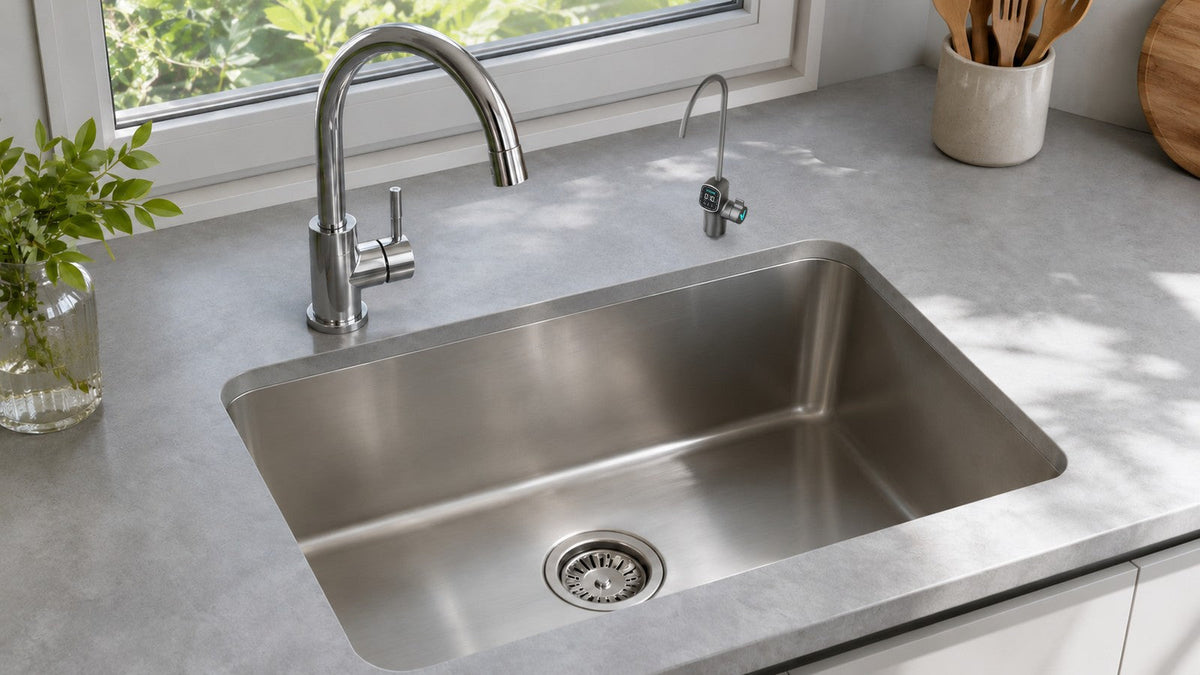
Where filtered water comes out of your sink decides the plumbing underneath it. If you want filtered cold water from the faucet you already use, an inline filter goes on the cold supply hose and nothing changes above the counter, which is the layout the Viomi Under-Sink Water Filtration System (VM-IUO1PCW-L-US) is built for. If you would like a separate tap for drinking and cooking water, a dedicated faucet sits beside the main one, fed either by a carbon filter or by a tankless reverse osmosis unit such as the Viomi V6 PRO, which also shows the purified-water TDS reading and filter life on the faucet itself.
Brand-by-brand picks are collected in a separate comparison of under-sink water filter brands.
Water Paths From the Cold Valve to the Glass
Every layout starts at the same place: the cold shutoff valve under the sink. What happens after that valve is where the three common setups part ways.
Keeping the existing faucet means the filter sits inline on its cold supply:
- The filter's inlet hose connects to the cold shutoff valve. Standard 3/8-inch valves under most U.S. kitchen sinks take the hose directly, and a 3/8-inch to 1/2-inch adapter in the box covers a 1/2-inch cold line.
- Water passes through the filter, which hangs from a bracket on the side or back wall of the cabinet.
- The outlet hose joins the faucet's own cold supply hose. A hose end with a 9/16 UNEF thread connects straight to the braided tube, and a 1/2-inch hose end uses the outlet adapter supplied with the system.
- Filtered water leaves the existing faucet on the cold side.
A carbon filter with its own drinking faucet branches off the same valve instead, and the Viomi Under-Sink Carbon Filter follows this path:
- A three-way ball valve sits on the cold shutoff valve, and the main faucet's cold hose reconnects to it, so the kitchen faucet works as before.
- A 3/8-inch tube runs from the ball valve to the filter on the cabinet wall.
- From the filter, a tube rises to the drinking faucet that ships with the system.
Reverse osmosis splits incoming water into a purified stream for the drinking faucet and a concentrate stream for the drain. On the Viomi V6 PRO and Viomi V8 PRO, the tubes are color coded:
- A feed water adapter goes on the cold shutoff valve. The kitchen faucet's supply hose and the RO unit's blue inlet tube both attach to it.
- The blue tube enters the main unit's inlet port.
- A white purified-water tube runs from the unit up to the dedicated faucet. On the Viomi V6 PRO, Viomi V8 PRO and Viomi M1, a signal wire runs alongside it and plugs into the unit, which is how the faucet shows the purified-water TDS reading and filter life.
- A gray concentrate tube carries the concentrate stream to the drain saddle on the sink drain pipe.

Holes, Hoses and Power for Each Layout
The three paths differ most in what they connect to above and below the counter.
| Layout | Example system | Countertop or sink deck | Water supply | Connection at the cold valve | Power | Drain |
|---|---|---|---|---|---|---|
| Inline, existing faucet | Viomi Under-Sink Water Filtration System (VM-IUO1PCW-L-US) | No change | Cold | 3/8" hose on the valve; 3/8" to 1/2" adapter included | None | None |
| Dedicated faucet, carbon | Viomi Under-Sink Carbon Filter | One faucet hole | Cold | Three-way ball valve | None | None |
| Dedicated faucet, tankless RO | Viomi V6 PRO, Viomi V8 PRO, Viomi M1 with display faucets; Viomi B6W with a standard faucet or your own compatible faucet | One 1"–1.5" faucet hole | Cold | Feed water adapter | Standard outlet with constant power on a GFCI-protected circuit; its own outlet where a garbage disposer uses a switched one | Drain saddle over a 1/4" hole in the drain pipe |
The carbon filters run on line pressure alone and have no concentrate stream, so their rows stop at the cold valve and the faucet. The RO unit runs a pump and sends its concentrate stream to the drain, which is where the outlet and the drain saddle come in.
On the carbon side, both Viomi systems use the same 0.5-micron cartridge built from PP cotton and a carbon rod, so the choice between them turns on where the filtered water comes out. At the faucet, the RO models fall into two groups: a display faucet wired to the unit on the Viomi V6 PRO, Viomi V8 PRO and Viomi M1, and a standard faucet on the Viomi B6W, which also accepts a compatible faucet of your own with a 3/8-inch connection on the filter side.
Reading the Sink Deck You Already Have
The countertop around the sink usually points to one layout before anything else is measured. Look at how many holes are already there and what each one is doing.
| What you find on the sink deck | Layout that fits with the fewest changes |
|---|---|
| An existing drinking faucet left from an older filter | An RO system that accepts a compatible faucet, such as the Viomi B6W |
| One faucet, no spare holes | Inline filter on the existing faucet |
| A spare hole from a soap dispenser, side sprayer or earlier filter | A dedicated drinking faucet in that hole, when it measures within the faucet-hole range above |
| Stone or solid-surface countertop with no spare hole | Inline filter on the existing faucet |
A soap dispenser or side sprayer that the household no longer uses leaves an opening that can become the spot for a drinking faucet once the old fitting comes out. Measure its diameter with a tape or ruler and compare it with the faucet hole size in the table above.
Where the drinking faucet lands on the deck also shapes daily use. A spot beside the main faucet, with its spout reaching over the sink bowl, lets a tall pot or a pitcher sit in the bowl while it fills, and keeps drips in the sink. On a double-bowl sink, the side used for rinsing produce can be the handier one, since filtered water and the main faucet then serve the same bowl.
The inline layout leaves the top of the counter exactly as it is, which suits a single-hole pull-down faucet set into a stone countertop.
Pull-Down Faucets, Sprayers and the Hot Side
A pull-down or pull-out faucet has a spray hose that hangs in a loop under the sink, separate from the cold and hot supply hoses. The inline filter connects between the cold valve and the faucet's cold supply hose, so the spray hose and its counterweight keep their own route through the faucet body.
With a single-handle faucet, the handle blends the hot and cold lines. The filter sits on the cold line, so filtered drinking and cooking water comes from the cold side, and the hot line feeds the faucet as it always did for dishwashing and other warm-water tasks.
The dedicated-faucet layouts give each job its own tap. The main faucet keeps both hot and cold supplies for washing, and the small faucet delivers filtered cold water for glasses, kettles and pots.
Cartridge Changes in Each Layout
The two carbon systems hang from a wall bracket near the cold valve, with at least 60 mm, about 2.4 inches, of open space beneath the cartridge, which comes off downward with a twist and no tools. For the RO units, 2.0 to 3.9 inches behind the Viomi M1 is set aside for its tubing connections and about 1 to 1.5 inches above the Viomi B6W for its connectors. A single replacement cartridge fits both the inline and the dedicated-faucet system.
On the display-faucet RO models, the faucet itself does the reminding. The faucet on the Viomi V6 PRO, Viomi V8 PRO and Viomi M1 shows filter life next to the TDS reading, and on the Viomi M1 the PCB cartridge changes with a twist and pull, without tools. The complete installation sequence, from the feed adapter to the first flush, is covered in a setup and care guide for under-sink RO.

FAQ
Does an inline filter on the cold line change the hot water?
The hot supply line is not connected to the filter at all, so hot water reaches the faucet exactly as before. Only water drawn from the cold side passes through the cartridge.
Will a pull-down faucet's sprayer still work after an inline filter goes in?
The sprayer hose is part of the faucet body and hangs separately from the supply hoses. An inline filter connects to the cold supply hose, upstream of the faucet, so the spray head, the hose loop and the counterweight are not part of the filter connection.
Can an old soap-dispenser hole take a drinking faucet?
Often it can. Measure the hole after removing the dispenser; an opening in the faucet-hole range shown in the layout table can take the RO drinking faucet.
Does the RO drinking faucet need its own power supply?
Only the main unit plugs into an outlet. On display-faucet models, the faucet connects to the unit through a signal wire that runs up with the purified-water tube, and the unit supplies what the faucet needs to show readings.
Can the main faucet still deliver unfiltered water once a dedicated faucet is installed?
The main faucet's cold hose reconnects to the ball valve or feed adapter on the cold valve, so it keeps its normal supply. Washing, rinsing and hot-water tasks stay at the main faucet, while filtered water comes from the dedicated tap.
Settling the Layout at Your Sink
Once the faucet arrangement is fixed, the remaining choice is which treatment sits behind it, carbon for the inline and small-tap layouts or reverse osmosis for a dedicated tap. That part of the decision rests on the water itself, and the guide to choosing an under-sink filter brand works through which lines of a water report point to carbon and which point to RO.
Share:
New York Apartment Water Filters: A Permission-First Checklist
Reading Austin's Water Reports Before Choosing a Filter