

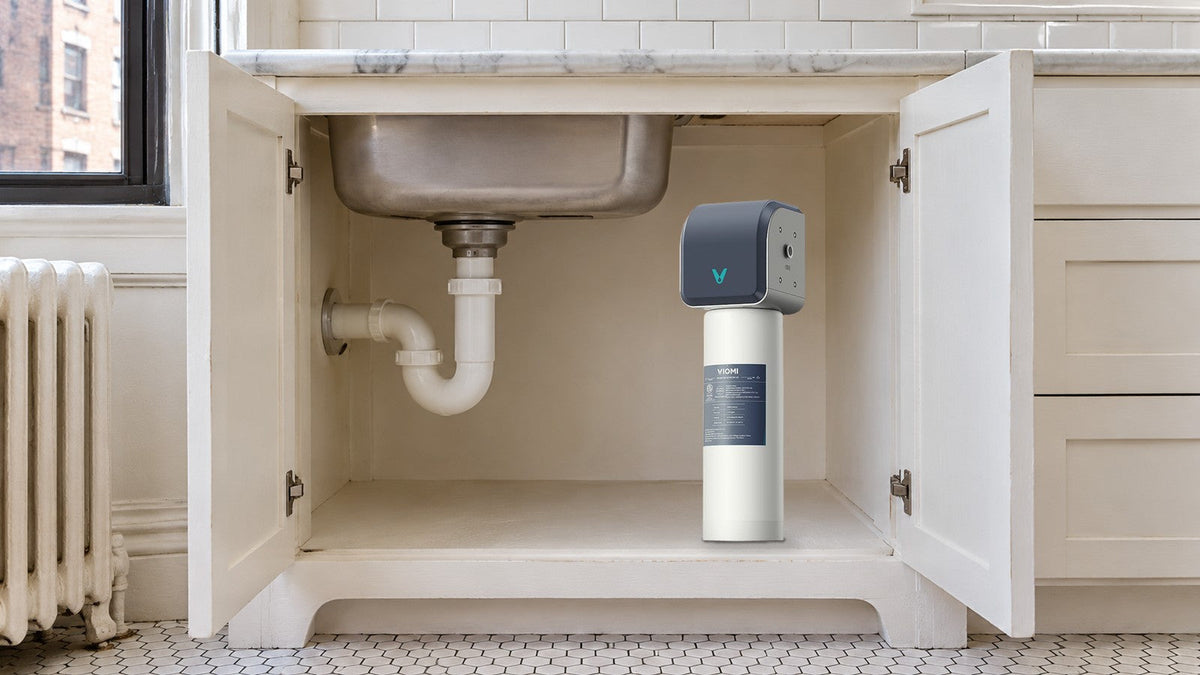
Permission in a New York apartment is given for specific work, so a filter request is clearer when it names every change the setup makes under the sink and on the counter, and how each change will be undone at move-out. For a tenant whose landlord will allow a connection under the sink but not a new hole in the counter, the Viomi Under-Sink Water Filtration System (VM-IUO1PCW-L-US) fits that boundary well, since it sits between the existing cold-water valve and the faucet the apartment already has. Setups that add their own faucet, a drain connection or an outlet call for a broader approval, and knowing which side of that line a product falls on shapes the whole conversation with the building.
What Each Filter Setup Changes in the Kitchen
A landlord or board reads a filter request in terms of parts: which connection gets opened, what gets attached, and whether anything is cut. Sorting the common setups that way gives the request a clear scope.
| Setup | What it attaches to | Counter hole, drain line or outlet | What goes back at move-out |
|---|---|---|---|
| Inline filter on the existing faucet, such as the Viomi Under-Sink Water Filtration System (VM-IUO1PCW-L-US) | The cold-water valve under the sink and the existing faucet's cold supply hose | None; filtered water comes out of the faucet already installed | The faucet's cold hose goes back onto the valve |
| Faucet-mount filter | The threaded tip of the spout, in place of the aerator | None | The original aerator screws back on |
| Pitcher or non-electric dispenser | Nothing; it is filled by hand | None | Nothing to restore |
| Countertop unit filled by hand | A wall outlet, for units that run on power | An outlet only | Unplugged and taken along |
| Countertop unit on a faucet diverter | The spout tip, through a diverter fitting | None at the sink; an outlet for powered units | Diverter off, original aerator back on |
| Under-sink RO with its own faucet | The cold-water valve, the sink drain and a separate faucet | A faucet opening (unless the sink already has a spare one), a drain connection, and an outlet for powered models | The separate faucet and drain fitting come out, and the opening is finished the way the approval specified |
The rows differ in how far the work reaches. A pitcher touches nothing, a faucet mount swaps the aerator, the direct-connect filter opens the cold-water connection under the sink without a new hole in the counter or sink, and RO with its own faucet adds a fixture and a drain connection. Each of those belongs in the request by name, since lease clauses on alterations are written around exactly this kind of detail. New York City's Rent Guidelines Board, in its repairs FAQ (accessed November 2026), puts it plainly: "Most leases prohibit alterations to the apartment without the landlord's permission" (NYC Rent Guidelines Board).
A faucet-mount filter also depends on the spout. PUR states that pull-out and handheld faucets are not compatible with its faucet systems and a Brita faucet system user guide says that system cannot be attached to faucets with a built-in spray feature at the end, so a tenant with that style of faucet looks at the other rows of the table instead.
Who Signs Off in a Rental, a Co-op and a Condo
In a rental, the approval comes from the landlord, or from the agent the lease or the building names to act for the landlord. The building's super often knows exactly where the shutoff is and how old the valves are, which is useful when planning the job, but a passing "that's fine" in the hallway leaves nothing on paper.
A co-op shareholder works under a proprietary lease and house rules, and those documents name who receives a request for plumbing work and when it goes to the board. Whatever conditions the building attaches to plumbing work, such as who may do it, belong in the request too, so the approval and the job match.
A condo owner owns the unit, yet the condominium's bylaws and rules can still cover work that touches the building's water lines. Tenants renting a condo or co-op unit from its owner have two things to look at: the owner's consent under their lease, and whatever the building's rules say about the same work.
For the wider range of products New York renters tend to compare, the overview of water filter brands for New York City apartments covers each category.
Putting the Request in Writing
A complete request describes the job the way a property manager would need to picture it, and it leaves both sides with the same record of what was agreed. These are the points worth covering, in plain language:
- Name the product and describe the setup in one line, for example "an inline filter on the cold-water line that feeds the existing kitchen faucet."
- List each physical change: which connection will be opened, what will be attached, where and how any housing will be fixed inside the cabinet, and whether anything will be drilled or plugged in.
- Say who will do the work, the tenant or a plumber, and include the plumber's name if one is booked.
- Photos of the cabinet, the valve and the faucet taken before any work give both sides a shared starting point.
- A short move-out plan sets out, change by change, whether it will be reversed, repaired or left in place with approval, and where the original parts will be kept.
- Ask for the answer by email or letter, and file it with the lease.
Plain descriptions of the work serve better than product marketing here. A line such as "the faucet stays, the counter is not drilled, and the faucet's hose goes back on the valve when I leave" tells the manager exactly what is being approved.
A Connection Under the Sink Without a Counter Hole
The Viomi Under-Sink Water Filtration System (VM-IUO1PCW-L-US) is built for the kitchen where the faucet has to stay as it is. Its hoses and the adapter in the box join the existing cold-water line and the under-sink faucet. The filter goes on the cold side, and the faucet's hot side stays exactly as the landlord installed it.

Day-to-day upkeep stays inside the cabinet too. The cartridge twists in and out by hand, so a cartridge change, rated at up to 12 months on municipal water such as New York City's, does not reopen the connections the landlord approved.
In the written request, the connection itself is simple to describe: a cold-water line between the valve and the faucet, reversed at move-out, alongside the housing's spot in the cabinet and how it is held there, as covered in the request list above.
When the Approval Covers a Dedicated Faucet
Owners, co-op shareholders with board sign-off, and tenants whose landlord agrees to a faucet opening and a drain connection can look at under-sink reverse osmosis (RO). The request then names where the faucet and the drain connection will go, and the restoration plan gives each its own line.
Where the sink cabinet is narrow, a tankless design helps. The Viomi V6 PRO is about 5 inches wide, and its LED faucet shows the remaining filter life at a glance. For a closer look at fitting RO into a small kitchen, the guide to a compact RO system for a small apartment walks through the cabinet side of the job.

Restoring the Kitchen at Move-Out
A few notes and photos taken before the first connection is opened let the tenant put each part back in the order it came off.
| Part of the kitchen | Note on installation day | Where the original part waits | At move-out |
|---|---|---|---|
| Cold-water valve | Photo of the valve, its handle position and the hose connection | Stays in place | Valve closed, filter hoses off, faucet's cold hose back on the valve |
| Faucet cold supply hose | Photo of where it meets the valve | Stays on the faucet | Reconnected and checked for drips with the valve open |
| Faucet aerator (faucet-mount setups) | Photo of the spout tip | Labeled bag in a kitchen drawer | Screwed back on by hand |
| Faucet opening (dedicated-faucet setups) | Photo and measurement of the sink deck or counter | Any cap or soap dispenser removed for the faucet, bagged | Faucet out, opening finished as the written approval specified |
| Drain connection (RO setups) | Photo of the drain pipe and any existing fittings | Original fittings, if any were replaced, bagged | Drain fitting removed and the pipe returned to the state the approval specified |
| Spot where any housing sits in the cabinet | Photo of the spot and a note of how the housing is held in place | Not applicable | Housing and any fixings removed, and the spot left as the approval specified |
| Cabinet floor and walls | Wide photo of the empty cabinet | Not applicable | Photographed again so the end state sits next to the start |
| Written approval | Date and sender | Filed with the lease | Available if questions come up at inspection |
New York's General Obligations Law sets two protections around move-out, in section 7-108 for most rental units and in section 7-107 for rent-stabilized units (both accessed November 2026). A tenant can ask for an inspection before moving out, generally held no earlier than two weeks and no later than one week before the tenancy ends, with at least 48 hours' written notice from the landlord of the time, and then has the chance to fix what the landlord lists. Within 14 days after move-out, the landlord must give an itemized statement of anything kept from the deposit and return the rest; among the costs the law allows a landlord to keep is damage caused by the tenant beyond normal wear and tear. Rent-controlled apartments follow separate rules. In every case, the approval, the before photos and the restoration record let the tenant show what was agreed and what was put back.
FAQ
Does a verbal OK from the super count as permission?
A super can tell a tenant where the shutoff is and whether the valve turns freely, but the super is usually not the party to the lease. A written reply from the landlord or managing agent, in whatever form the lease and the building already use for approvals, is the record to keep with the lease.
Should a co-op shareholder start with the board or the managing agent?
Whichever the proprietary lease and house rules name; where they point to the managing agent, the agent can say whether the request goes on to the board and which forms come with it. Including the full description of the work, the installer's details and the photos in that first message gives the agent everything the request is about.
Can a subtenant or roommate make the request?
The request should come from, or go through, the person named on the lease, because that is who the landlord's approval binds. A roommate who is not on the lease can draft the description and take the photos, and the leaseholder sends it.
What if the setup changes after the approval?
A switch from a faucet mount to an under-sink connection, or from a direct-connect filter to RO with its own faucet, changes the work, so it calls for a fresh request describing the new parts. Keeping each approval with its own photos makes it clear later which change was agreed when.
Who keeps the restoration record after move-out?
The tenant keeps the original, with the approval and the photos, until the deposit is settled. Sending the landlord a copy of the finished record at the pre-move-out inspection, where the tenant has asked for one, puts both sides on the same page about what was restored.
Leaving the Kitchen the Way the Lease Found It
In a New York rental, the practical sequence is a written request that lists each change, an approval kept with the lease, photos taken before the first connection is opened, and a move-out that follows the restoration table. A connection between the valve and the faucet already in place keeps that list short, and a dedicated faucet works for owners and long-term tenants who have the wider approval in hand.
Share:
Connecting a Refrigerator to an RO Line: Branch, Route and Filter Checks
Under-Sink Filter Plumbing and Faucet Configuration: Matching the Layout to Your Sink