

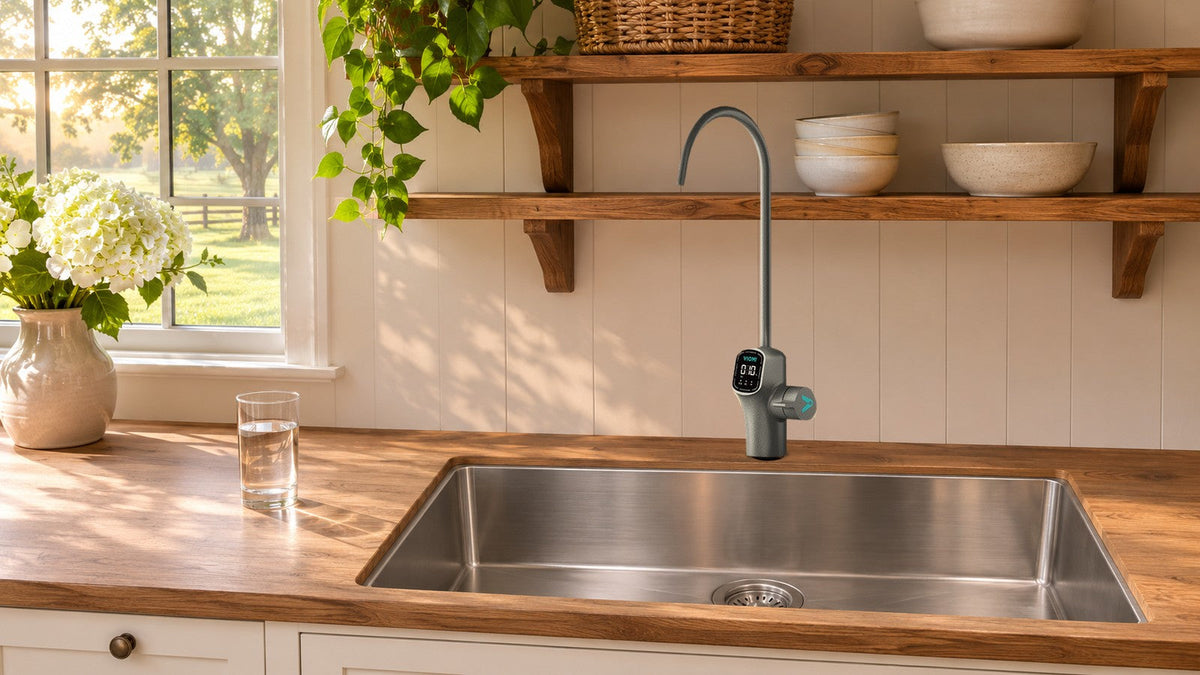
Writing down when an off taste shows up and which taps share it turns bad-tasting tap water into a question with a place to start: the water supply, the plumbing shared by the whole house, the water heater, or a single fixture. A short note taken each time the water seems wrong, kept for a week to begin with, records when the change started and how far it reaches. With those two facts on paper, the filter question becomes specific, such as a carbon filter for a steady chlorine taste at the kitchen tap, or a call about the water heater before any filter is bought. When the notes do land on a steady chlorine taste at the kitchen tap, the Viomi Under-Sink Water Filtration System (VM-IUO1PCW-L-US) is a practical pick, because it fits the faucet already on the sink.
The companion piece on choosing a filtration system for bad tap water explains what each filter technology handles. The step before that is turning a vague sense that the water is "not great" into a problem with a known location.
What to Record Each Time the Water Seems Off
A useful note takes less than a minute. The aim is to capture the same few details every time, so that patterns show up after several entries instead of relying on memory.
| Field | What to write down | Example entry (hypothetical) |
|---|---|---|
| Date and time | When the water was drawn | Tuesday, 6:40 a.m. |
| Tap | Which faucet, and whether it was kitchen, bathroom or outdoor | Kitchen sink |
| Hot or cold | Which side of the faucet was running | Cold only |
| First draw or after running | Whether the water had been sitting in the pipes, or ran for a minute first | First glass of the morning |
| What you noticed | Taste, smell, color, cloudiness or particles, in your own words | Faint metallic taste, clear color |
| After standing in a glass | Whether the water changed after a few minutes, such as cloudiness clearing or particles settling | No change |
| Anything unusual nearby | Plumbing work, a new water heater, a street repair, a utility notice, a change of season | Street crew working on the main this week |
Two habits make the log more reliable. Draw the sample into a clear glass held against a white background, which makes faint color easier to judge. And note when the water seemed fine, too, because a tap that tastes normal on most days is as informative as one that never does.
Sudden Changes and Long-Standing Ones
Timing is the first way to sort the notes. A change that appeared on a particular day, after months of water that tasted fine, tends to have a cause that also started on a particular day: a main repair on the street, a change in the utility's treatment or source, a new water heater, or plumbing work in the house. A long-standing taste that has been there since moving in tends to come from the water as it is delivered, or from fixtures and pipes that have been in place for years.
The two call for different first moves. On public water, when the change is sudden and every tap in the house shares it, the water utility is the first call, and the log is what makes that call useful. Utilities expect these calls; Dallas Water Utilities, for one, lists a phone line for taste, odor and color questions in its annual water quality report. The date the change began, the taps affected and whether hot and cold both changed are the details that let a utility connect a household's complaint to work on a nearby main or a treatment adjustment. Neighbors on the same street noticing the same thing points the same way.
A long-standing pattern can be investigated at the household's own pace. Here the log is building a case for what to test and, later, what to treat.
Every Tap, One Tap, or Hot Water Only
Reach is the second way to sort the notes. Comparing the kitchen with a bathroom sink and an outdoor spigot, cold side and hot side, usually takes one morning.
When every cold tap in the house shares the same taste or smell, the search covers everything those taps have in common: the water arriving from the supply and the main pipes inside the house that feed every fixture. A chlorine or "pool" note on public water comes from the disinfectant the utility adds, and an earthy note in lake-fed systems can follow the seasons; Dallas Water Utilities, for example, notes that algae in area lakes occasionally give its water an earthy taste and odor in summer and early fall.
A rotten-egg smell that appears only in hot water points to the water heater. DuPage County's health department, in its guide to water quality problems, lists a rotten-egg odor in hot water only as its own condition tied to the anode rods inside water heaters, and its first advice is to make sure the problem is in the hot water heater only. A drinking-water filter on the cold line would not change that. Other odors that show up only on the hot side go into the log the same way, with the water heater added to the list of places to look.
When a single faucet is the odd one out, the fixture, its aerator or the short run of pipe feeding it becomes the focus. And when the log shows an off taste only in the first glass of the morning, which then fades after the tap runs, the water that sat in the household's own pipes overnight is part of the picture. For an everyday log, comparing the first glass with a glass drawn after the cold water has run is enough to note whether the taste changes.
Turning the Notes Into a Lab Request
A long-standing pattern eventually needs numbers. The log helps in two ways: it suggests which tests to ask a laboratory for, and it shows which lines of the utility's report to read first. The EPA's table of secondary drinking water standards links common complaints to the measurements behind them, and those standards exist for aesthetic reasons such as taste, color and odor. Read against a log, the table turns a description into a short list of tests.
Metallic notes cover the most ground. The EPA attaches a metallic or bitter metallic taste to iron, copper, manganese and zinc, and to water with a low pH, so a log that mentions metal leads to all five. Stains narrow things further: reddish or orange marks match iron, which the EPA links to rusty color and staining above 0.3 mg/L, dark brown or black marks match manganese above 0.05 mg/L, and blue-green marks around fixtures match copper. A salty taste sends the request in another direction, toward chloride, sulfate and total dissolved solids, which share that description in the same table.
The log captures how the water looks, tastes and smells, while the identity and level of any substance come from a test result, so the log suggests where to start and the test settles what is there. On public water, the related results that the annual water quality report lists can be read beside the log. On a private well, the panel is set with a certified laboratory, using the log as one input.
Reading the Notes Against Timing and Reach
Putting the two sorting questions together gives four common patterns, each with a narrower area to compare and a next step.
| Pattern in the log | What to compare next | Next step |
|---|---|---|
| Sudden change, every tap | The supply, work on nearby mains, and any recent work on the home's main line | On public water, call the utility with the dates and taps from the log; on a well, test a sample |
| Sudden change, one tap or hot water only | A fixture, recent plumbing work, or the water heater | Compare with other taps, then look at what changed at that point |
| Long-standing, every tap | The water as delivered and the plumbing shared by every fixture | Read the utility's annual water quality report, or test a private well |
| Long-standing, one tap or first draw only | The branch line and fixture at that tap | Compare the first glass with a glass drawn after running the water |
Rusty or reddish water deserves one extra note. Wisconsin's Department of Natural Resources advises households on public water who see red water to contact a utility official to determine whether it comes from the public system or the home's own plumbing, which is the same supply-or-house question the log is built to answer.
When the Notes Point to the Kitchen Tap
Some logs end with a clear goal at the kitchen sink: a steady chlorine taste in the cold drinking water on a public supply, or a mineral or salty taste the household would like gone from the water it drinks and cooks with. Once the notes have pointed there, the choice is about drinking and cooking water at that tap.
A chlorine taste is a classic job for carbon filtration. The Viomi Under-Sink Water Filtration System connects to the existing cold line and faucet, so the sink stays as it is; its carbon cartridge is built to reduce chlorine and unpleasant tastes and odors, and it twists out without tools when a change is due. It is one of several ways to remove chlorine taste from tap water.
Salty or mineral notes point somewhere else. The EPA associates a salty taste with chloride, sulfate and total dissolved solids, and reverse osmosis is the kitchen technology that reduces dissolved solids. A household keeping a log may also like to see a number at the tap, and the LED smart faucet on the tankless Viomi V8 PRO shows the water's TDS each time it runs, with remaining filter life on the same display. Anyone curious how RO water tastes once minerals are lower can read about water taste and RO purifiers at home.

What a Week of Notes Settles
A log kept for a week, and longer when a taste comes and goes, puts three answers on paper: whether the change started on a known day, whether it reaches every tap, and whether the hot water is involved. Those answers help decide whether the next call goes to the utility, a plumber, someone who services the water heater, a laboratory or a filter retailer.
FAQ
How long should the log run?
A week makes a practical first stretch, since it includes both weekday and weekend routines and several mornings when water has sat overnight. A taste that comes and goes with the seasons, such as an earthy note in late summer, may need entries spread over a few weeks or months before a pattern shows.
Is it worth photographing the water?
A photo of a glass against a white background, taken alongside the written entry, helps when describing faint color to a utility or a plumber. Photos of stains on fixtures over time also show whether the problem is getting stronger or staying the same.
What does it mean if neighbors notice the same taste?
Shared complaints on the same street point toward the supply or the mains serving that street, since the water reaching several homes is the common factor. Comparing dates with neighbors also helps establish when the change began.
Why does the water taste odd after coming home from a trip?
Water that sat in the household's pipes for days has been in contact with the plumbing the whole time. Vermont's health department, in its lead and copper sampling instructions, notes that in most cases letting the cold tap run until the water is as cold as it will get draws water from farther upstream. For a taste log, an entry before and after running the tap shows whether the taste clears.
Can renters do this kind of investigation?
Keeping the log needs nothing more than a glass and a notebook, so it works in any home. For renters, the notes are also a clear way to report a problem to the property manager, with dates and taps already listed.
Share:
Los Angeles Water Reports and Home Plumbing: What Each One Can Tell You
After a Coliform-Positive Water Test: What to Verify