

The annual water quality report from the Los Angeles Department of Water and Power (LADWP) describes the city's water system as a whole, including the service lines it has inventoried and a targeted round of home tap samples, and it is the right record for questions about the supply. The pipes, solder and faucets inside one particular building are a separate matter, because they sit on the property side of the service line and no citywide report measures them house by house. For that last stretch, a first-draw sample from the household's own tap, collected under the State Water Board's procedure and tested by an accredited lab, adds a lead result for that tap, which the report cannot supply.
The earlier overview of water filter brands for Los Angeles tap water matches filter types to specific concerns, from taste to individual contaminants.
Which Report Applies to Your Address
LADWP is the water provider for the City of Los Angeles, serving roughly 4 million residents and businesses according to its 2025 Drinking Water Quality Report. Los Angeles County is a different matter. The county's Water for LA site counts more than 200 water agencies managing drinking water, wastewater and stormwater across the region, so a Los Angeles mailing address outside the city limits is often served by another agency with its own annual report.
Within the city, the report is divided further. LADWP lists five water quality service areas (San Fernando Valley, Western, Eastern, Central and Harbor communities), and each draws on its own combination of Los Angeles Aqueduct water, State Water Project and Colorado River supplies from the Metropolitan Water District, and local groundwater. The column for your community is the one that describes your supply, and the report notes that sources "may fluctuate in these communities depending on operational needs and source water availability".
What LADWP's 2025 Report Settles
LADWP describes the annual publication as "a report card on the quality of the drinking water LADWP provides to its customers", and the current edition covers January 1 through December 31, 2025. During that year LADWP tested for 240 constituents and performed more than 100,500 tests on samples drawn across its system, and it states that it "met and complied with all the primary drinking water standards in 2025".
Two findings speak directly to the plumbing question. LADWP completed its lead service line inventory in October 2024 and, on its water quality page, reports no lead service lines in its distribution system, a finding that covers privately owned and customer-owned service lines as well, with 41,813 customer-side service lines inspected and verified as non-lead. The State Water Board has also evaluated LADWP's corrosion control program and deemed the system optimized.
Those findings settle the service lines. The plumbing beyond them sits outside this kind of inventory, and California's statewide inventory announcement from February 2026 says so for every system in the state: the service line inventory "does not reflect piping, solder and fixtures inside a building".
From the Meter to the Faucet, Section by Section
LADWP draws the same boundary in its report. Lead in drinking water "is primarily from materials and components associated with service lines and home plumbing", and while LADWP removes lead pipe from its own system, it "cannot control the materials used in premise plumbing or fixtures", so the report asks customers and property owners to identify their plumbing materials.
| Section of pipe | Who identifies its materials | Records that cover it | What a household can look at |
|---|---|---|---|
| Water mains and the utility side of the connection | LADWP | Annual report results, corrosion control status | The community column in the annual report |
| Customer-side service line (meter to building) | Property owner, per the State Water Board FAQ; LADWP's inventory has covered it | LADWP's 2024 inventory, which verified customer-side lines as non-lead | Pipe material at the meter box and at the shutoff valve outside the home |
| Interior pipes and solder | Customers and property owners | Not covered by the service line inventory | Building age and any repiping work on record |
| Faucets and fixtures | Customers and property owners | Not covered by the service line inventory | Faucet age and any recent replacement |
The State Water Board's 2019 customer FAQ makes the second row concrete: homeowners are "responsible for the pipes from the water meter to the home", and the pipe can be inspected at the meter and at the shutoff valve outside the house. LADWP's inventory has already covered that section across its system, which leaves the last two rows as the parts where one building can differ from another.
Arranging a Household Tap Sample
A tap sample measures the water after it has traveled from the main, through the service line and the building's pipes, to the faucet. The State Water Board's homeowner sampling procedure for voluntary lead testing sets out each step, and most of the planning happens the day before.
| Step | What the procedure says | How it plays out at home |
|---|---|---|
| Arrange the test | Contact a local testing laboratory and tell it you want to test for lead | Use the State Water Board's ELAP laboratory map to find an accredited lab, and collect its sample bottle |
| Choose the tap | A regularly used kitchen or bathroom cold-water tap | The kitchen cold tap is the one that supplies drinking and cooking water |
| Let water stand | At least 6 hours and no more than 12, with no water used anywhere in the house | Plan for overnight: no toilet flushing, showers or dishwasher until the bottle is filled |
| Fill the bottle | One liter, containing the first water drawn from the faucet | Open the cold tap and fill straight into the lab's bottle |
| Note treatment | If the tap has a treatment device, sample it the way water is normally drawn for drinking or cooking | A faucet with a filter is sampled through the filter if that is how the household drinks from it |
| Note recent work | Record any recent plumbing repairs or replacement on the custody form | Mention a new faucet, repiping or other work on the form |
The state's 2019 customer FAQ also encourages testing through a certified lab rather than a home kit for lead, since lead in drinking water is measured at the parts-per-billion level, and it suggests asking the community water system for a lab referral. For LADWP customers, the utility's Water Quality Hotline at (213) 367-3182 is another route to arranging a test, as its report notes. The guide to lead in tap water testing and removal covers how to read the numbers once they come back.
A Kitchen Filter on the Cold Line
With the report and a tap sample in hand, treatment at the kitchen sink becomes a choice about how the household wants its drinking water to taste and how much it wants to manage. LADWP's report advises cold water for drinking, and an under-sink system on the kitchen cold line serves exactly that water.
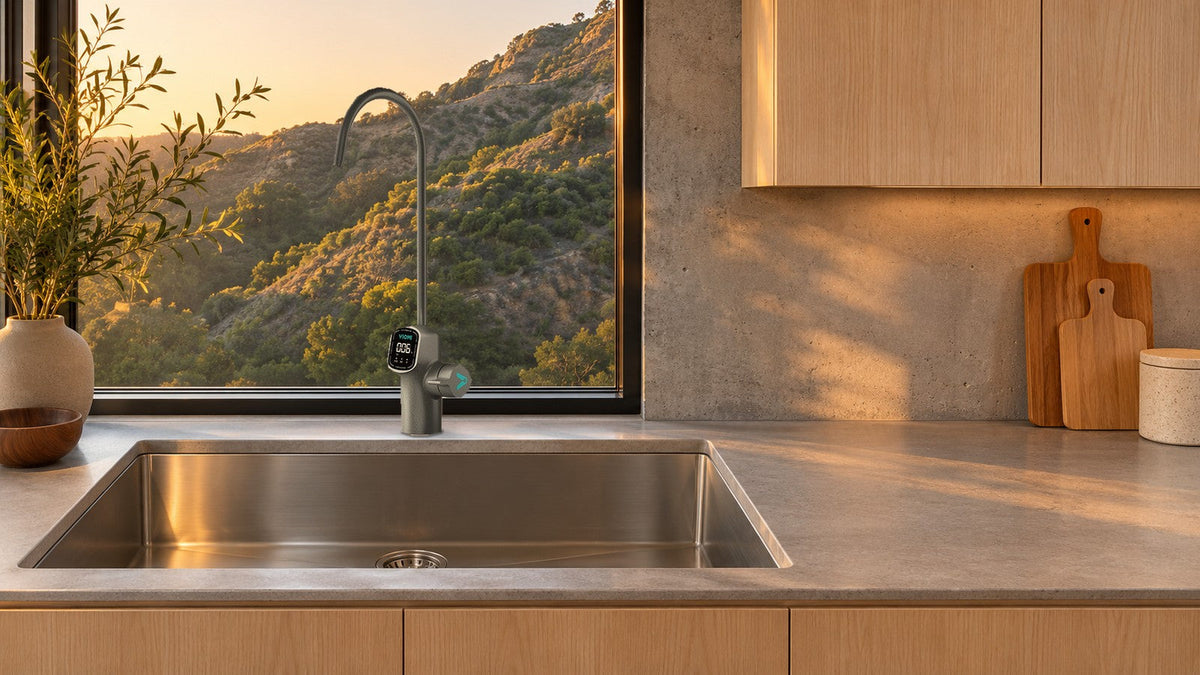
Both Viomi tankless reverse osmosis (RO) systems put filtered drinking and cooking water at a dedicated faucet beside the sink, while the regular faucet keeps handling dishes and cleaning. Independent SGS testing of the Viomi M1 shows lead reduction above 99.87%, and its mineral stage adds selected naturally sourced minerals back after the RO stage, which gives the glass a softer, rounded taste. Its tankless design also fills a stock pot without waiting for a storage tank to refill. Households that would like to watch the TDS reading on an LED faucet as they pour can choose the Viomi V6 PRO, which is also SGS-tested with lead among its targets.

Report, Pipes and Faucet in One View
The LADWP report comes out once a year and the service line inventory was completed in 2024, while the plumbing inside a building can change with any repair. That is why the state's procedure asks for recent plumbing work to be noted on the custody form, and why a fresh first-draw sample after repiping or a new faucet gives the household an up-to-date result for its own tap that can be set beside any earlier one.
FAQ
My address says Los Angeles, but my bill isn't from LADWP. Which report do I read?
The report published by the agency that sends the water bill. LADWP serves the City of Los Angeles, and the county's Water for LA site offers a Find My Water Provider tool for addresses elsewhere in the region, where another agency's annual report describes the supply.
Does LADWP's citywide sampling include my home?
Generally not. LADWP's lead and copper program samples a targeted group of homes: single-family residences built between 1982 and 1987 with original plumbing. Its 2023 round collected 105 first-draw samples, with a 90th percentile lead result of 3.9 ppb against the 15 ppb action level. Those results describe the system, so a household outside that group answers the question for its own tap with its own sample.
Why does the sample need 6 to 12 hours of standing time?
The State Water Board's procedure requires at least 6 hours of standing time and no more than 12 before a first-draw sample is collected. In practice, an overnight stretch fits that window for most households, as long as nobody uses water in the house before the bottle is filled.
Should drinking and cooking water come from the hot or the cold tap?
The cold tap. LADWP's report advises cold water for drinking, and heating cold tap water on the stove or in a kettle covers cooking and hot drinks. The same report suggests running the tap for 1 to 2 minutes before drinking from it, and points out that this can be done in a water-efficient way by taking a shower, doing laundry or running a load of dishes first.
Where can I see the service line inventory for my water system?
The State Water Board publishes a California Service Line Inventory Summary with an interactive map and dashboard on its service line data page. Across nearly 10 million service lines reported statewide, no lead lines have been reported, and each system's own inventory sits behind that total.
Who is responsible for the pipe between the meter and the home?
Homeowners, according to the State Water Board's FAQ, which also suggests inspecting that pipe at the meter and at the shutoff valve outside the home. A tenant in an apartment or condominium can share sample results with the owner or building management.
Share:
How Much Work Does Water Filter Maintenance Really Take?
Bad-Tasting Tap Water? A Step-by-Step Investigation Checklist