

A reverse osmosis system's long-term dependability is easiest to judge at the level of the exact model: replacement cartridges sold for it by name, a short upkeep routine with few parts to service, support documents for the owner, and a way of showing what condition it is in. The Viomi V8 PRO fits those points well: its two cartridges are sold under its own model name on water.viomi.com, and its faucet shows filter life at a glance.
Each of these points belongs to one specific system, which makes them more useful for a single kitchen than a brand's general reputation.
Reliability Starts With the Exact Model
A brand's reputation is an average across everything it sells, while a kitchen runs one system. The same company can make a two-cartridge tankless unit and a five-stage tank system, and the two will differ in parts, tools and upkeep for as long as they are installed. Judging reliability therefore means looking past the logo to the model and its cartridges.
Company-level signals such as track record, ownership and published policies are compared in Which Reverse Osmosis Filter Brands Are Actually Reliable?.
Cartridges Sold Under the System's Own Name
Replacement cartridges are the part of an RO system an owner buys again and again, so a cartridge sold under the name of the system it fits makes the right part easier to pick when a change comes due.
Replacement cartridges for each current Viomi RO model are sold separately on water.viomi.com, each named for the system it fits. On the Viomi V8 PRO, for instance, the RO cartridge is made for that model alone, while its pre-filter also fits the Viomi V6 PRO and carries both model names. The Viomi M1 and Viomi B6W have their own named pairs as well.
Model-specific naming matters because similar-looking cartridges are common across product generations. Waterdrop takes the same approach with its G3P600 RO cartridge, which it describes as made for the G3P600 and not recommended for the G3P800, even though the two systems share their pre-filters. APEC takes a different route and sells its tank-system filters as sets grouped by product series, with the stage numbers each set covers printed in the name, such as a complete set for stages 1 to 5 of one Essence model.
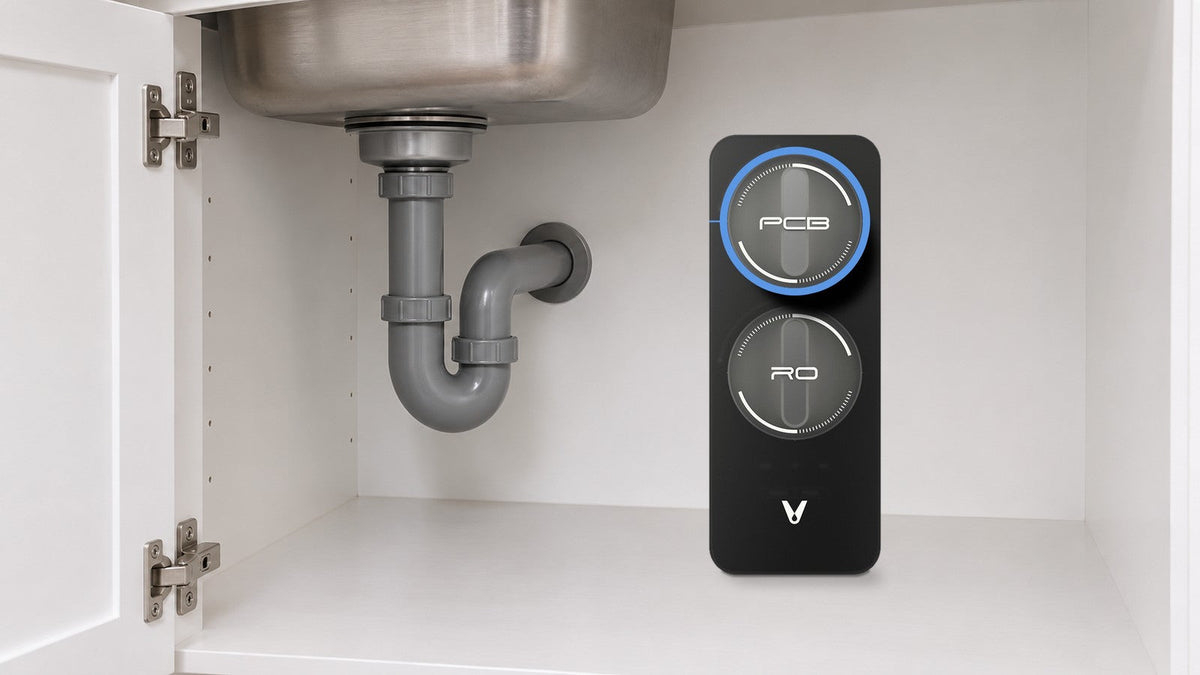
When every cartridge a model uses is already sold under that model's name, the parts for its upcoming changes are identified before the system is installed. The naming also lines up with the reminder itself. On the Viomi V6 PRO and Viomi V8 PRO, the indicator lights on the unit are labeled PCB and RO, so the light that comes on shows which type of cartridge is due. The PCB fits both models, and the RO cartridge to order is the one named for the model in the cabinet.
What Comes in the Box and Who Answers the Phone
What ships in the box shows how much of the installation has been planned for. The Viomi V6 PRO and Viomi V8 PRO arrive with both cartridges already in place and the smart faucet in the box. The hookup itself is covered by ten kinds of accessories, including the power adapter, the feed water adapter and the drain saddle. Each one has a job in the hookup: the feed water adapter joins the system to the cold-water line, the drain saddle clamps the drain tubing to the sink drain, and the tubing and fittings link the unit to its faucet. The Viomi V8 PRO adds a second PCB cartridge as a spare.
Installation help comes as a quick installation guide and a full user manual in the box, plus a step-by-step installation video to watch before starting, and Viomi's U.S. customer-service phone line and email address are there from day one.
Support carries on after installation. A fault-indicator light reference, a faucet-display error-code reference and a troubleshooting list match each indicator or code on the system to a next step, and the same U.S. support line and email address are on hand for anything the list does not settle.
Fewer Parts That Need Regular Attention
Every part with its own service schedule is one more thing to keep in stock and one more chance for a step to be missed. Counting those parts is a practical way to compare how much a design asks of its owner over the years.
On the Viomi V6 PRO, Viomi V8 PRO and Viomi M1, routine upkeep is two cartridges that twist out and lock back in without tools. The filter media and its shell are one piece, so there is no separate housing to open, clean or seal.
Systems built on 10-inch filter housings carry a longer list. The owner's manual for the APEC ROES-50, a five-stage tank system, recommends replacing the filter housing O-rings every year or whenever the three pre-filters are changed, and replacing the stage 1 to 3 housings themselves every five years. The housings open with a plastic wrench, and the system ships with two of them (APEC ROES-50 manual). Each of those items is reasonable on its own; together they add parts to the long-term list that an integrated cartridge design simply does not have. On an integrated two-cartridge design, the filter media and its shell are replaced together at each change, so there are no separate housings or housing O-rings on the routine list.
A System That Reports Its Own Condition
A system that shows its own status keeps the owner informed without opening the cabinet. On the Viomi V6 PRO, Viomi V8 PRO and Viomi M1, a glance at the faucet shows the purified-water TDS reading and how much life each cartridge has left. Both readings update on their own, so nothing has to be noted down between changes. Opening the app adds the household's consumption patterns and the system's own status for anyone who wants more detail.
Advance notice of the next change comes in two styles. On the Viomi V6 PRO and Viomi V8 PRO, an orange control-panel light gives 10 to 15 days of warning, and the app carries a replacement reminder as well. The Viomi M1 app keeps a running count of the days left for each cartridge, weeks or months ahead.

More on how RO brands handle on-board TDS readings is in this comparison of RO brands with TDS monitoring.
Cartridges, Tools and Alerts Compared Across RO Designs
Details for the Waterdrop and APEC systems come from each brand's product pages, replacement-filter listings and manual.
| Check | Viomi V8 PRO | Waterdrop G3P600 | APEC ROES-50 |
|---|---|---|---|
| Cartridges in the system | 2 (PCB and RO) | 3 (CF, CB and RO) | 5 (three pre-filters, membrane and post-carbon) |
| How replacement cartridges are named | Each listing names the Viomi V8 PRO; the PCB listing also names the Viomi V6 PRO | RO listing names the G3P600; CF and CB listings name the G3 series | Pre-filter set, membrane and post-carbon identified by part number in the manual |
| Tools for a routine cartridge change | None; twist and pull | None for the CF pre-filter, according to its listing | Housing wrench, two supplied |
| How a due change is signaled | Orange control-panel light 10 to 15 days ahead; filter life on the faucet and in the app | Faucet display alerts when a filter is due | Replacement schedule printed in the manual |
The cartridge row carries the most weight over the years, because every cartridge in it is a part to reorder on its own schedule.
FAQ
Why does the number of cartridges matter more than the number of stages?
Stages describe filtration layers, while cartridges are the parts an owner buys and changes. The Viomi V8 PRO packs nine stages into two cartridges, while the APEC ROES-50 spreads five stages across five cartridges, so the shorter cartridge list is the one that sets the long-term upkeep.
What does "exclusively compatible" on a cartridge listing tell a buyer?
It tells the buyer which system the cartridge was made for, which makes a similar-looking part from another product generation easier to rule out. When every cartridge for a model is listed that way, the model's replacement parts are identified before purchase.
Is a two-cartridge RO easier to keep running than a five-stage system?
It has fewer parts with their own schedules. A two-cartridge integrated design replaces the filter media and its shell together, while a five-stage housing system adds pre-filter changes in separate housings, plus seals and housings that come due on their own timetable.
Does a pre-filter shared by two models make a difference?
The Viomi V6 PRO and Viomi V8 PRO use the same PCB pre-filter, so one cartridge type covers both systems. A household running one of each, or moving from one model to the other, keeps a single pre-filter on its reorder list.
What a Dependable System Looks Like on Paper
A dependable RO system, seen before purchase, is one whose upkeep is already mapped out in plain terms: the cartridges it will need are sold under its own name, the parts that need regular attention are few, help comes in the box and over the phone, and the faucet keeps the household informed. Over years of use, that adds up to fewer surprises at the kitchen sink, which is what reliability feels like from the owner's side.
Share:
Iron in Household Water: What to Test Before Choosing Treatment
Arsenic and RO: Matching Your Water Test to the Performance Claim