

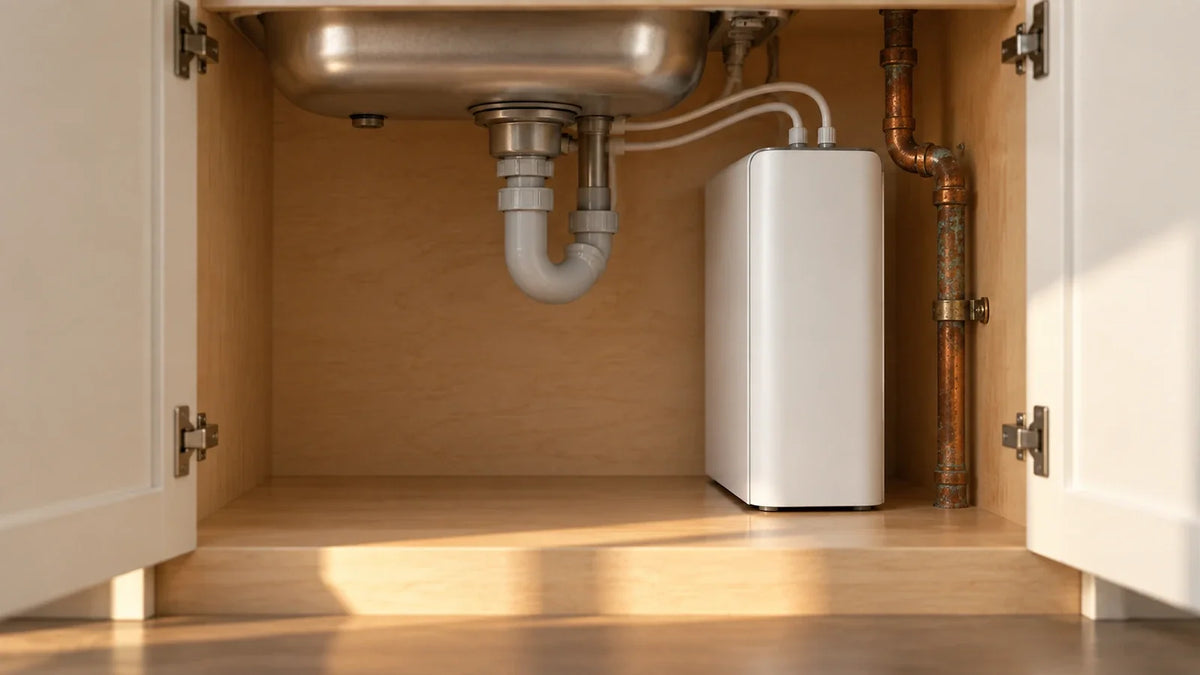
Old plumbing, a tight cabinet, and bad-tasting tap water point to one answer: a tankless under-sink RO system, built around push-to-connect fittings instead of soldered pipe, with no bulky storage tank competing for cabinet space. Within that category, cabinet width, not overall footprint, is usually what decides whether a specific unit clears a crowded under-sink cabinet in a small apartment. Before any specific model matters, though, the apartment's plumbing has to be checked, because that's what actually determines whether this install goes smoothly or stalls halfway through.
What "Compact" Means Once You Look Under the Sink
Traditional RO systems use a pressurized storage tank, usually a 9 to 11-inch-diameter cylinder standing over a foot tall, sitting next to the filter housings. In a small apartment cabinet that also has to hold a trash bin, cleaning supplies, and sometimes a garbage disposal, that tank alone can eat half the usable space.
Tankless RO systems remove that tank and filter water on demand instead, which is why they're the category worth focusing on for a tight cabinet. Overall footprint matters less here than width: a system that's short but wide still won't slide past a disposal unit or a P-trap.
Viomi V6 PRO and Viomi V8 PRO share the same case, 16.3 inches long, 5 inches wide, and 12.8 inches tall, and that 5-inch width is the number that decides whether it clears a crowded cabinet. Viomi B6W trades some of that width for a shorter case: at 5.91 inches wide and 12.64 inches long, it's about an inch wider than the Pro models but nearly 4 inches shorter front-to-back, with a taller 16.22-inch height that matters more in a shallow cabinet than a narrow one.
Waterdrop's current tankless lineup, like the G3P600, targets the same narrow-footprint category, though Waterdrop's site doesn't publish case dimensions for it. Countertop units like AquaTru's Classic skip the cabinet question entirely by sitting on the counter, at the cost of counter space instead.

Will This Apartment's Plumbing Actually Support an RO System?
This is the part most buying guides skip, and it's the part that determines whether "easy install" turns out to be true for a specific kitchen. Three things need checking before ordering anything, and renters have one more item to add first: confirming with a landlord or lease agreement that drilling into the sink deck and drain pipe is allowed. The faucet hole and the drain-saddle hole covered below are permanent once made, and some leases treat that kind of modification as grounds for a deposit deduction.
One thing worth checking before assuming a new hole is needed: if the sink deck already has an unused soap-dispenser hole, that existing opening can often be reused for the RO faucet, sidestepping the permanent-modification issue entirely. That's a separate question from whether the plumbing itself can support an RO system, and it's worth settling before the drill comes out, not after.
Water pressure. Most residential RO membranes need at least about 40 psi to work efficiently, with an ideal range closer to 45 to 80 psi; this is a general RO-membrane guideline, so it's worth checking the specific model's manual for its own rated inlet-pressure range before ordering. Older buildings, and especially upper floors fed by a shared riser, sometimes run below that even when every fixture "works fine" for washing dishes, because RO membranes are far more pressure-sensitive than a standard faucet.
A $10 to $15 pressure gauge that threads onto an outdoor spigot or washing-machine valve gives a real number in under a minute; asking a building super whether the building runs low pressure is a reasonable second option if there's no accessible spigot. Pressure consistently under 40 psi doesn't rule out RO, but it does mean budgeting for a booster pump, which adds cost and a second component to install.
A working shutoff valve. RO installation kits are built around a standard 3/8-inch compression connection at an existing cold-water shutoff valve under the sink. Some older buildings either don't have a dedicated valve there or have an old gate valve that no longer seals fully. That's worth confirming before the system arrives, because if there's no working valve to connect to, the fix is a plumber replacing or adding one, regardless of how self-installable the RO unit itself is marketed as.
Accessible drain pipe. The system's reject water line taps into the drain pipe using a saddle valve: a clamp that tightens around the pipe, then a 1/4-inch hole gets drilled through the saddle and into the pipe beneath it, per Viomi's install guide. That's straightforward on the PVC or ABS pipe under most kitchen sinks, harder on cast iron, and effectively impossible if the trap is boxed in tight behind a disposal with no accessible straight run. Viomi's guide calls for mounting the saddle on the horizontal drain pipe upstream of the P-trap, before it curves down, so a quick look under the sink for an open, straight section of pipe in that spot answers this before ordering.
Skipping these three checks is the most common reason a "self-installable" RO system turns into a stalled project or an unplanned plumber call.
What "Easy Install for a Non-Handy Person" Actually Requires
"No professional installation required" doesn't mean no tools. Viomi's own installation guide lists an electric drill, a hole saw, an adjustable wrench, needle-nose pliers, a tape measure, a utility knife, and a flashlight as what's needed. What it doesn't require is soldering or pipe cutting: most water connections use push-to-connect fittings that seal by hand, though the feed-water tee fitting still needs the wrench and some Teflon tape rather than a compression tool.

Viomi rates the Viomi V6 PRO at about 30 minutes to install, and the Viomi M1's product page cites about 20 minutes. A step-by-step video guide walks through each stage. First-timers should still budget more time than the headline number, mainly for drilling the faucet and drain holes carefully and for the initial flush cycle afterward.
One requirement trips up more first-timers than the drilling itself: the system needs its own dedicated electrical outlet, and that outlet can't be the switched half of a garbage disposal's outlet, since power gets cut whenever the disposal switch is off. Confirming there's a standard, always-on outlet under the sink, separate from any disposal switch, is worth doing before install day.
Does It Actually Fix the Taste Problem?
"Noticeable tap water taste" usually traces back to one of two things: residual chlorine used for disinfection, or a high mineral (TDS) content that gives water a flat or mineral-heavy edge. A carbon-plus-RO system addresses both, but through different stages. The activated carbon stage, certified under NSF/ANSI 42, is specifically rated for chlorine, taste, and odor reduction. The RO membrane behind it removes dissolved solids more broadly, which is what NSF/ANSI 58 certification covers.
Viomi V6 PRO, Viomi V8 PRO, and Viomi B6W are all SGS-tested with reference to NSF/ANSI 42, 53, and 58, with NSF/ANSI 372 materials certification, covering taste and odor, health-related contaminant reduction, TDS reduction, and lead-free construction materials, respectively. The Viomi M1 is SGS-tested with reference to NSF/ANSI 42 and 58, with NSF/ANSI 372 materials certification.
For households that prefer more mineral character in their drinking water, the Viomi M1 adds a remineralization stage after RO treatment. That produces a rounder taste while retaining the benefits of high-output tankless filtration.

Viomi's Compact Tankless Lineup
Viomi sells four tankless RO models that fit the "compact, drillable, no-tank" profile this scenario calls for, priced from $249.99 to $899.99.

The Viomi V6 PRO ($379.99) is the sensible default for a small apartment: the narrow 5-inch-wide case, a 600 GPD flow rate that covers typical daily use for most apartment households, and a smart LED faucet that shows real-time TDS and filter life, paired with an app for the same data on a phone. Its 9-stage filtration, NSF/ANSI 372 materials certification, and SGS performance testing referenced to NSF/ANSI 42/53/58 match the higher-priced Viomi V8 PRO, which shares the same case and installs the same way but steps up to 800 GPD ($479.99), better suited to households that run the tap heavily for cooking or entertain larger groups.
The Viomi B6W ($249.99) is the value entry into the same SGS-tested filtration approach with NSF/ANSI 372 materials certification. It combines a compact 600 GPD tankless system, a 2:1 pure-to-drain ratio, and app-based water-quality and filter-life tracking.

The Viomi M1 ($899.99) tops the range with 1000 GPD, a touchscreen faucet showing live TDS and a pH indicator, and the remineralization stage described above, at the cost of a larger case (17.1"L x 6.4"W x 15.9"H) that needs a slightly deeper cabinet than the Pro models.

| Model | Price | Dimensions | Flow rate | Pure-to-drain | Faucet display | Install time |
|---|---|---|---|---|---|---|
| Viomi V6 PRO | $379.99 | 16.3"L x 5"W x 12.8"H | 600 GPD | 3:1 | LED, real-time TDS | ~30 min |
| Viomi V8 PRO | $479.99 | 16.3"L x 5"W x 12.8"H | 800 GPD | 3:1 | LED, real-time TDS | DIY installation; same case and install approach as Viomi V6 PRO |
| Viomi B6W | $249.99 | 12.64"L x 5.91"W x 16.22"H | 600 GPD | 2:1 | App-based monitoring | DIY installation |
| Viomi M1 | $899.99 | 17.1"L x 6.4"W x 15.9"H | 1000 GPD | 3:1 | Touchscreen, TDS + pH | ~20 min (per Viomi M1 page) |
All four use the same push-to-connect installation approach and the same faucet-hole-plus-drain-saddle setup described above; the differences are flow rate, cabinet footprint, and how much information shows up at the faucet versus just in the app.
What the Filters Cost Over Time
Filter maintenance is straightforward and predictable: every model needs its pre-filter replaced annually and its RO membrane replaced every two years (four years on the Viomi M1), with replacement filters sold directly on Viomi's site:
| Model | RO filter | RO filter life | Pre-filter | Pre-filter life | Approx. cost per year |
|---|---|---|---|---|---|
| Viomi V6 PRO | $89.99 | 24 months | $59.99 | 12 months | ~$105 |
| Viomi V8 PRO | $99.99 | 24 months | $59.99 | 12 months | ~$110 |
| Viomi B6W | $69.99 | 24 months | $49.99 | 12 months | ~$85 |
| Viomi M1 | $149.99 | 48 months | $99.99 | 24 months | ~$88 |
The pre-filter is the cost that recurs every single year regardless of model; the RO membrane is larger but less frequent. Averaged out, ongoing filter costs land in a fairly narrow $85 to $110 per year band across the whole lineup, so filter cost isn't a major factor in deciding between models, unlike the upfront price difference.
How This Compares to Other Compact Options
Waterdrop's G3P600 ($429) is the closest current match in the same tankless, under-sink category. The G3P600 runs 600 GPD with a 2:1 pure-to-drain ratio, on par with the water efficiency of Viomi B6W (Viomi V6 PRO does better on that specific metric at 3:1), and carries the same NSF/ANSI 42, 58, and 372 certifications.
It's priced above Viomi V6 PRO ($379.99) for a comparable 600 GPD flow rate; Waterdrop's page doesn't specify whether it includes a real-time TDS or filter-life readout at the faucet the way Viomi's LED and touchscreen models do, so that's worth confirming directly with Waterdrop if a live water-quality display matters. It needs the same drilled faucet hole, drain saddle, and dedicated outlet as Viomi's lineup, so the plumbing checks above still apply.
AquaTru's Classic ($475) sidesteps the plumbing question entirely: it's a countertop unit, no drilling, no drain saddle, no dedicated outlet, just a standard plug and a fill-and-dispense tank. That makes it the fallback option if the plumbing check above turns up a real blocker, like no accessible valve or unfixable low pressure. The tradeoff is counter space (14"H x 14"D x 12"W, per AquaTru's published spec sheet) and lower daily output than an under-sink system built for continuous use at the tap.
*Image Source: aquatru.com*
iSpring's tank-based systems, like the RCC7AK, are worth ruling out for this specific scenario rather than comparing head-to-head: they use the storage tank that this whole compact-footprint search is trying to avoid, so they solve budget and filtration but not the cabinet-space problem.
Which One Fits Your Situation
Plumbing checks out (pressure above 40 psi, a working shutoff valve, accessible drain pipe) and cabinet width is the tighter constraint than depth: Viomi V6 PRO is the strongest match here, narrow enough for a tight apartment cabinet, priced in the middle of the lineup, and installable without a plumber in about half an hour.
Same plumbing, but running the tap heavily for cooking or a larger household: Step up to Viomi V8 PRO for the higher flow rate in the same footprint and install process.
Best value with phone-based monitoring: Viomi B6W combines NSF/ANSI 372 materials certification, SGS performance testing, 600 GPD output, and app tracking at $249.99.
Want premium taste, the fastest flow, and the richest display: Viomi M1 adds minerals back after RO filtration, delivers 1000 GPD, and uses a touchscreen faucet with inlet and outlet TDS, pH guidance, and filter-life status.
Plumbing check turned up a real blocker, no accessible valve, unfixable low pressure, or no reachable drain pipe: Skip under-sink RO entirely for now and go with a countertop option like AquaTru's Classic, which needs nothing but a standard outlet.
FAQ
Does "easy install" mean I won't need any tools? No. Viomi's own installation guide lists a drill, a hole saw, an adjustable wrench, needle-nose pliers, a tape measure, a utility knife, and a flashlight. What it doesn't require is soldering or a compression tool, since most water-line connections use push-to-connect fittings that seal by hand (the feed-water tee is the exception, needing the wrench and some Teflon tape).
What if my apartment doesn't have a shutoff valve under the sink? Then the install isn't a DIY job until that valve exists. Most under-sink RO installation kits connect to an existing 3/8-inch compression valve; if there isn't one, a plumber needs to add or replace it before any under-sink RO system, compact or not, can go in. (Countertop RO units like AquaTru's Classic skip this requirement entirely since they don't tie into the cold-water line.)
How do I know if my water pressure is high enough? A $10 to $15 pressure gauge that threads onto an outdoor spigot or washing-machine valve gives a direct reading in under a minute. Most RO membranes need at least about 40 psi, with 45 to 80 psi as the comfortable range; below that, a booster pump becomes part of the install.
Will this fix a metallic or musty taste, not just chlorine? Carbon filtration and RO membranes are effective against chlorine and general TDS-related flatness. A metallic taste can point to iron or copper in the plumbing itself, which these systems reduce but which is worth confirming with an actual water test rather than assuming from taste alone.
Can I take the system with me when I move out of the apartment? The unit itself, yes. The holes drilled for the faucet and the drain saddle stay behind, which is the actual point of friction for renters, not the equipment or the install process.
Bottom Line
The plumbing check comes before the product choice here. Confirm water pressure above roughly 40 psi, a working shutoff valve, and an accessible section of drain pipe first; those three things are what most often determine whether any tankless RO system, not just a specific brand, installs the way its marketing promises, alongside the specific model's own rated inlet-pressure range.
Once that's confirmed, Viomi V6 PRO is the strongest fit for a small apartment specifically: a 5-inch-wide case that clears tight cabinets, a roughly 30-minute install with no soldering, and SGS-tested carbon-plus-RO performance with NSF/ANSI 372 materials certification that addresses the chlorine taste and odor behind most tap-water complaints. Viomi V8 PRO covers the same footprint at a higher flow rate, the Viomi B6W trims the price for a tighter budget, and the Viomi M1 adds remineralization for tap water that tastes flat rather than chlorinated. If the plumbing check turns up a real blocker instead, a countertop system like AquaTru's Classic solves the taste problem without touching the cabinet at all.
Share:
Which Water Filter Brands Have NSF Certification?
Which Reverse Osmosis Water Purifier Is Best for a Family Home?