

An NSF/ANSI 58 listing names the replacement module the certification covers, reports how much water the system produced in the standard's test, and lists exactly which contaminants were certified beyond the required TDS claim. In NSF's record for the A.O. Smith AORO-50, read on November 3, 2026, those answers are module S1448RS, a daily production rate of 11 gallons, and a list of named claims running from pentavalent arsenic to TDS, one of which carries a condition on the water it can be used with.
That is the reason to read the record instead of stopping at the logo. Two RO systems can both be "certified to NSF/ANSI 58" while one lists fluoride and nitrate and the other lists only TDS, and the difference is visible in a single line of the record.
One RO Record, Field by Field
The A.O. Smith listing in NSF's RO directory contains one product, which makes it easy to follow each field.
| Field | AORO-50 entry (NSF, Nov 3, 2026) | How to read it |
|---|---|---|
| Standard heading | NSF/ANSI 58, above the title "Reverse Osmosis Drinking Water Treatment Systems" | Every claim below was evaluated under the RO standard |
| Page note | "NOTE: All Replacement Modules Are Components." | The module is certified as part of this system's configuration |
| Listing company and facility | A.O. Smith Water Treatment (North American), Inc.; Facility # 1 USA | Who holds the certificate and where the product is made |
| Product category | "Plumbed-In to Separate Tap [Pb]" | Plumbed in and dispensed through its own separate faucet; [Pb] adds a lead-content finding |
| Model | AORO-50 | The exact system string covered |
| Replacement module | S1448RS | The part number to match when replacing the module |
| Daily production rate | 11 gallons per day | A test measurement, explained below |
| Claims | Arsenic (Pentavalent) <=300 ppb*, barium, cadmium, hexavalent and trivalent chromium, copper, fluoride, lead, nitrate/nitrite, radium 226/228, selenium, TDS | Each named contaminant is a separate certified claim |
| Asterisk note | "intended for use only on water supplies that have been shown to be at or below the referenced concentration and valency of arsenic" | The arsenic claim applies only within that limit and form |
| [Pb] note | "weighted average lead content of <=0.25%" and complies with "lead free" plumbing requirements | Materials finding for the water-contact parts |
Read top to bottom, the record narrows from a standard to a system, then to a part number, then to individual contaminants with their conditions. A shopper interested in fluoride would stop at the claims line and find it listed. A shopper with arsenic in a well test would also read the asterisk, since the claim covers pentavalent arsenic up to 300 ppb and nothing else.
The Required TDS Claim and the Optional Ones
Every system certified to NSF/ANSI 58 carries a TDS claim; the rest are optional and appear only when the manufacturer has had them tested. Rick Andrew, then operations manager of NSF's drinking water treatment program, described the core test in WC&P in 2010: the test water contains "750 mg/L sodium chloride," and "All RO systems conforming to Standard 58 must reject at least 75 percent of sodium chloride ions, with the resulting claim being total dissolved solids (TDS) reduction."
Three details from the same explanation change how optional claims read. Arsenic claims refer to the pentavalent form, and "there is no claim of trivalent arsenic reduction under Standard 58," which is why the AORO-50 row says "Pentavalent" and adds a water-supply condition. Nitrate and nitrite "must be tested together," so one line on the record covers both. And since a 1999 revision, "all pre- and postfilters are removed from the system prior to testing for contaminant reduction performance," which means the 58 claims describe what the RO membrane stage achieves; claims for a carbon stage, such as chlorine taste, are made under other standards and appear in other sections of the database.
The older article on brands with NSF/ANSI 58 certification lists which companies hold the standard. For any one model, the claims line is where the list of contaminants actually lives. A practical way to use it is to set a recent water test next to the record and mark each contaminant that appears in both. Anything in the test that has no matching line is outside what this 58 record certifies; other sections of the database can hold other claims for the same system, such as aesthetic claims under 42.
Daily Production Rate Comes From the Test Protocol
The 11 gallons per day on the AORO-50 row is a test measurement. Andrew's explanation describes how it is produced: production is measured during defined fill conditions using the 750 mg/L sodium chloride test water, and "Daily production rate is calculated as an average value based on these two operational conditions, expressed as volume per 24 hours." Andrew also notes that RO systems are evaluated on "a seven-day protocol" that mixes complete and partial tank draws with a stagnation period. Systems without a storage tank are measured with an adapted version of the same method.
Performance data sheets for RO systems often add two related percentages. The Water Quality Association, following the conventions of NSF/ANSI 58, defines efficiency as "the percentage of water entering the RO unit that is available as treated (product) water under normal use conditions," and recovery as the same share when the system runs without a storage tank (WQA). Like the daily production rate, these are test results, and they are most useful when compared across systems tested the same way.
When Two Brands Share One Replacement Module
The module column can reveal more than a part number. NSF's Aqua Systems RO record, read the same day, lists the AQPC-35 and AQPC-435 with replacement module S1448RS (the AQPC-35 row carries note [1], "Serial number of 180000 or higher," and both rows carry note [2], "As of 05/28/2004"), a daily production rate of 11 gallons, and the same set of claims as the AORO-50, including pentavalent arsenic up to 300 ppb.
| Model (company) | Replacement module | Daily production rate | Claims beyond TDS |
|---|---|---|---|
| AORO-50 (A.O. Smith) | S1448RS | 11 gpd | Arsenic (pentavalent), barium, cadmium, chromium (both forms), copper, fluoride, lead, nitrate/nitrite, radium, selenium |
| AQPC-35, serial 180000 or higher (Aqua Systems) | S1448RS | 11 gpd | Same set |
| AQPC-435 (Aqua Systems) | S1448RS | 11 gpd | Same set |
What the records establish is the pairing on each row: each of these three listed systems is certified with module S1448RS, and each row carries the same production figure and claims. For an owner, the module code on the row for the system in the house is the code that keeps a replacement inside the listed configuration. The Aqua Systems record also lists systems with other modules, such as S33201-PL6-AS with S357XX5 at 14 gallons per day, a row that carries the same two notes, so one company's record can hold several different pairings.
Keeping an Eye on RO Output After Installation
A listing describes a configuration as it was tested. Once a system is installed, the household's own questions are more everyday ones: is the membrane producing low-TDS water today, and how much life is left in each cartridge? Smart RO systems answer both at the faucet. A guide to RO systems with built-in TDS monitoring covers the category in more depth.
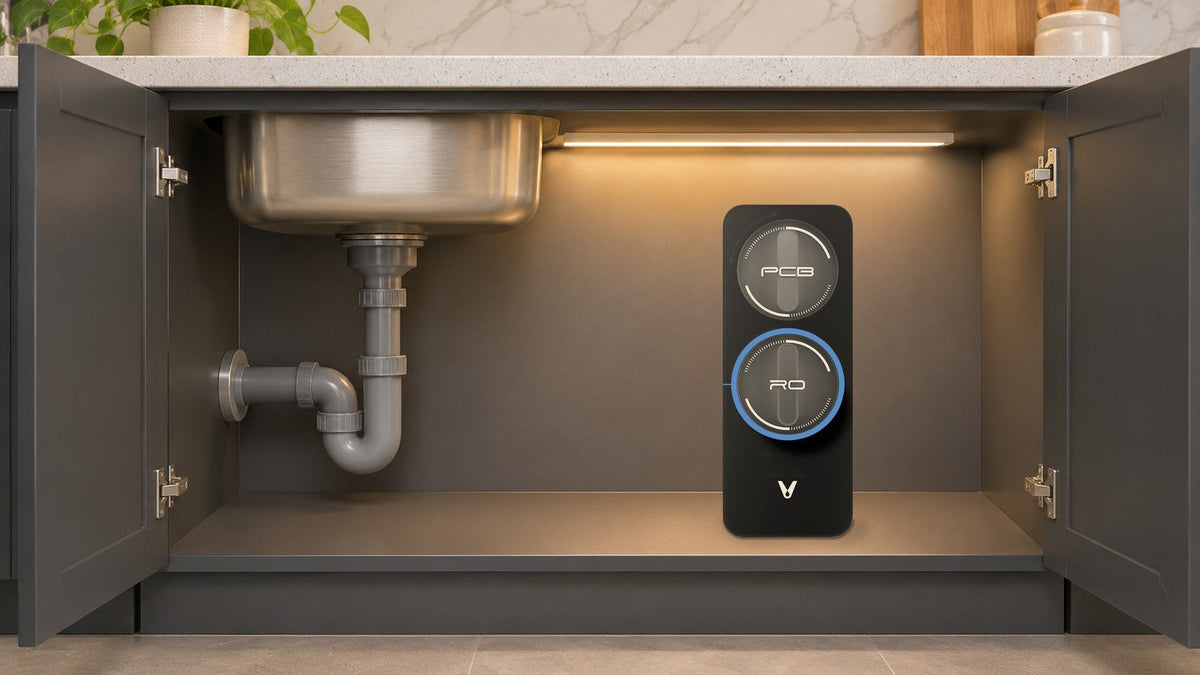
Glancing at the faucet is the simplest routine. On the Viomi M1, the HD touchscreen faucet can show TDS for both the incoming tap water and the purified water. The Viomi V8 PRO and Viomi V6 PRO show real-time TDS on an LED smart faucet. Replacement timing stays in view the same way: filter life appears on all three faucets, and the Viomi app tracks water use and sends replacement reminders. All three are tankless, nine-stage systems, so purified water reaches the faucet without passing through a storage tank.

The TDS reading speaks to dissolved solids, the same measure behind the required claim on every 58 record, and the filter-life readout speaks to the cartridges. Between them, a household keeps the two parts of an RO system that matter most for upkeep in view without extra equipment.

Frequently Asked Questions
How is the daily production rate on a 58 listing measured?
It comes from the standard's protocol, with test water containing 750 mg/L of sodium chloride and production measured under defined fill conditions, then averaged and expressed as volume per 24 hours. For systems without a storage tank, the measurement is adapted to the tankless design.
Does a 58 listing cover the carbon filters in the system?
The contaminant claims on a 58 row are tested with pre- and postfilters removed, so they describe the membrane stage. Aesthetic claims such as chlorine taste and odor are made under NSF/ANSI 42 and appear in that section of the database.
Why does the arsenic claim come with a note about the water supply?
RO handles the pentavalent form of arsenic well and the trivalent form poorly, so the claim is limited to pentavalent arsenic at or below a stated concentration. The note tells the buyer that the claim applies only to water shown to meet that condition.
If two brands list the same replacement module, are the systems the same?
The records show the same module, production figure and claims on each row, and that is as far as they go. For ownership, the module code on the row for a given system is the replacement that keeps it in its listed configuration.
Does a nitrate claim also cover nitrite?
On a 58 record, yes: the standard requires nitrate and nitrite to be tested together, and both must pass for the single "Nitrate/Nitrite" claim to appear.
What an RO Listing Settles Before the Install
An NSF/ANSI 58 record answers the questions a badge leaves open. The model and module columns fix the configuration, including the part to reorder. The daily production rate describes output under the standard's test. The claims line names each certified contaminant, and the asterisks and bracketed notes set the conditions, from the arsenic form and limit to the lead-content finding for the water-contact parts. Read in that order, one record tells a buyer whether a system's certified claims include the contaminant in their water test, and which module belongs to the certified configuration.
Share:
Florida Municipal and Well Water Filter Planning Paths
California Water Filter Registration and Certification: What Has to Match