

A Florida home on a utility supply can plan its filters from records the utility already publishes, while a home on a private well plans from a lab sample, because the owner is the one responsible for testing that water. The two paths collect different paperwork, in a different order, and they settle where treatment goes on different grounds. On city water, each goal is matched to a point inside the house; on a well, planning starts at the wellhead and works inward.
For brand-by-brand comparisons across both paths, the overview of water filter system brands for Florida lists the main options. Which part of that list applies to a particular house depends on the records each path produces.
Telling Which Path Your Address Is On
The simplest sign is the water bill. A charge for water from a city, county or utility authority is a strong sign the home is on a public system, and community water systems publish an annual water quality report. A pump, a pressure tank and a well cap, with no water service bill, are signs of a private well, though some of these belong to irrigation wells, so the deciding fact is which source feeds the kitchen's cold tap, as the home's water records or plumbing show. Statewide, about 88% of residents are served by public water systems, and the other 12% get their water from limited-use systems and private wells, according to the Florida Department of Health (page updated October 2026).
Some Florida properties have both: city water at the taps and a separate well that runs only the sprinklers. In that case, the drinking-water plan follows the supply that reaches the kitchen faucet, and the irrigation well stays outside it.
City Water: The Paperwork to Collect
Most of what a city-water household needs for a first filter plan is already published or on file. The task is to pull it together and note the few details that change the choice of equipment.
| Document | Where it comes from | What to note for filter planning |
|---|---|---|
| Water bill | The utility | The exact utility name, since neighboring areas can have different suppliers |
| Annual water quality report | The utility, sent each year by July 1 | The disinfectant used (chlorine or chloramine), any result the household wants to act on, and the dates the results cover |
| Utility water-quality pages or FAQ | The utility's website | Hardness and other figures the report may not list, with the date viewed |
| Current notices | The utility's website and alert channels | Short-term instructions, which sit apart from the annual report |
| Building or association rules (condos and townhomes) | The property manager | What plumbing work inside the unit needs approval |
| House plumbing details | The owner's records or a home inspection | Age of the plumbing, the location of the main shutoff, and room under the kitchen sink |
The disinfectant line deserves the closest reading, because it decides what a kitchen carbon stage is working against every day. A utility that uses free chlorine, such as the Orlando Utilities Commission, poses a simpler taste problem for a carbon filter than one that uses chloramine, which is covered in more depth in the guide to filters for chloramine removal. OUC's own water services page (accessed November 2026) answers "Does OUC use chloramines?" with "No." Hardness tells the household whether scale on fixtures is a whole-house project, and any other result in the report tells it which reduction claims to look for at the kitchen tap.
The U.S. Environmental Protection Agency requires community water systems to deliver the annual report, and "reports must be sent by your water supplier each year by July 1" (EPA).
City Water: Where Treatment Goes in the House
On a utility supply, water arrives already treated and under pressure, so filtering is a matter of matching each goal to a location. After the main line enters the house, the water splits into branches, and the table follows those locations.
| Location in the house | What can be installed there | Goal it serves |
|---|---|---|
| Main line, where water enters the house | A softener for hardness; a whole-house carbon filter for disinfectant taste; a sediment filter for particles | Scale on fixtures and appliances, taste at every tap, or grit |
| Hot-water branch at the water heater | Usually nothing separate; it receives whatever the main line has treated | Hot water shares any main-line treatment |
| Kitchen sink, cold line | Under-sink filter on the existing faucet, or RO with its own faucet | Drinking and cooking water |
| Optional line to a compatible refrigerator or ice maker | A connection from the kitchen RO system | Filtered ice and chilled water |
The goal decides the location. Scale that shows up on shower glass and in the water heater is a main-line project, while the water a family drinks and cooks with is handled at the kitchen sink, and many homes plan the two separately.
Kitchen Systems for a Utility Supply
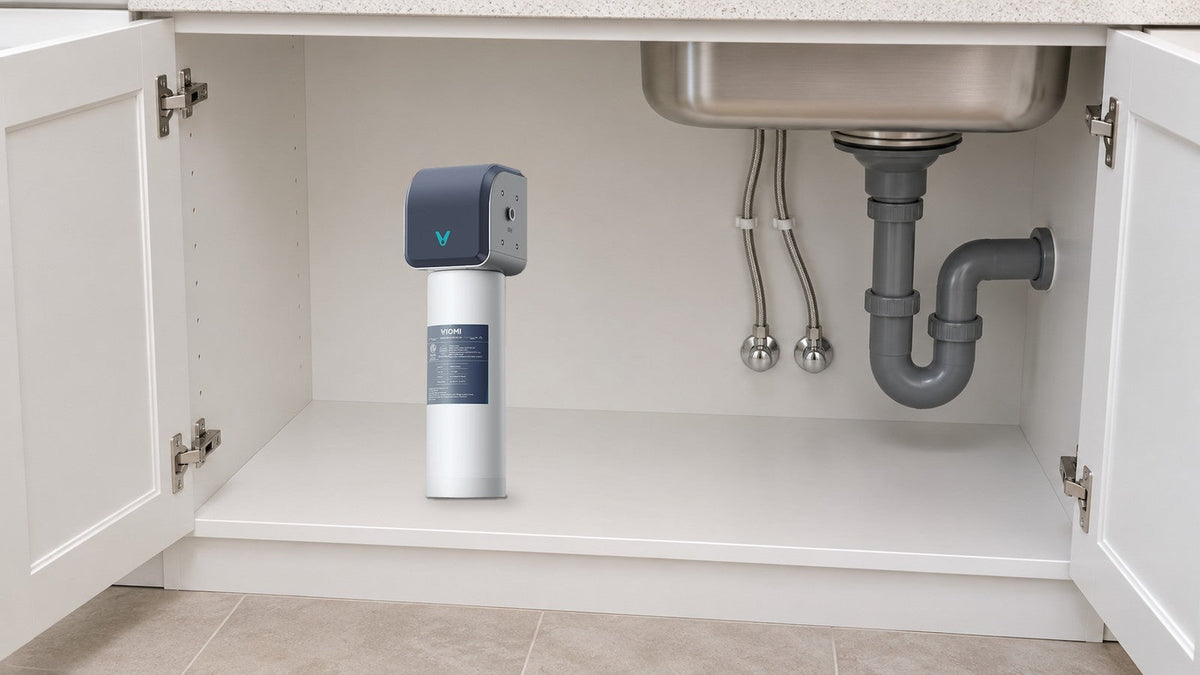
At the kitchen sink, the first decision is whether the household wants reverse osmosis (RO) with its own faucet or a filter on the faucet it already has. For RO, the Viomi V6 PRO is a tankless system, which leaves more of the cabinet free than a unit with a storage tank, and SGS testing shows it targets lead, PFAS (PFOS and PFOA) and nitrate among other contaminants. Its LED faucet shows the water's TDS and the remaining filter life, so the next cartridge change is visible at the sink.

The second decision is about taste. Households that want minerals back in the glass for coffee, tea or cooking can choose the Viomi M1, which adds selected minerals after the RO stage and sends filter reminders through its app.
Where the household wants to keep its existing faucet, a carbon stage on that faucet's supply is the usual answer to chlorine taste, and the Viomi Under-Sink Water Filtration System (VM-IUO1PCW-L-US) provides it from under the sink, with a cartridge rated for up to 12 months on municipal water that twists out by hand.
Private Well: The Records and Tests to Gather
A private well has no annual report and no utility behind it, so the paperwork is built by the owner. The records below are the ones that shape treatment decisions.
| Record or test | Who provides it | How often |
|---|---|---|
| Well permit and completion report | The regional water management district, or the county health department or other local agency it delegates to | Once, when the well is built or modified |
| Bacteria and nitrate test | A state-certified laboratory, with sampling guidance from the county health department | At least once a year |
| Lead test | A state-certified laboratory | Every three years for most homes |
| Additional tests suited to the property | The county health department advises which ones | As advised, and when taste, odor or color changes |
| Test after flooding | The county health department and a certified laboratory | After floodwater reaches the wellhead |
| Treatment equipment records | The installer | At each service visit |
The construction records tell an installer how deep the well is and how it was built. Well construction in Florida is typically overseen by the five water management districts, some of which have delegated permitting to county health departments or other local agencies, Orange County's among them (Florida Department of Health, accessed November 2026). Rules differ by district. In the Southwest Florida Water Management District, for example, wells must be built by a Florida-licensed water well contractor, apart from a narrow homeowner exception for small wells that still needs a permit, and the applicant must "submit a well completion report, or as-built, within 30 days" of finishing the work (Southwest Florida Water Management District, 2020).
The tests are the owner's to schedule. Florida does not require routine sampling of a private home well, yet the Department of Health "strongly recommends that you test your water for bacteria and nitrate at least once per year," suggests a lead test every three years for most homeowners, and points owners to a state-certified laboratory, with the county health department helping to read the results. If floodwater reaches the well, the department's flooded well guidance (uploaded August 2025) points owners to the county health department for instructions on sampling for bacteria.
Private Well: Where Treatment Goes After the Pump
On a well, treatment begins much closer to the source, because the water reaches the house untreated. Which equipment goes in, and in what order, comes from the lab results. A water treatment professional matches the measured water, the well's flow and the household's demand to the inlet requirements of each piece of equipment, and adds pretreatment where one stage needs the water conditioned before it.
| Location | What may go there | What decides it |
|---|---|---|
| Wellhead and pump | Well cap and pump upkeep | The condition of the well, as the contractor finds it |
| Pressure tank | No treatment; it stores pressurized water for the house | Household demand |
| Main line after the pressure tank | Treatment chosen from the results, which can include sediment filtration, iron or sulfur removal, softening or disinfection, arranged in the order the installer sets for that combination | The lab report, each unit's inlet requirements and the professional's design |
| Household branches | Hot water, kitchen and other taps | Treatment on the main line has already been applied |
Drinking water at the kitchen comes last on this path, after the household knows what the lab found and what the main-line treatment handles. Planning it earlier means choosing equipment before the water has been described, which is the step the well path is designed to avoid. The yearly bacteria and nitrate test keeps the basic picture of the well current; checking a specific piece of treatment equipment is a separate test, planned with the installer around that equipment's target.
FAQ
Can a Florida home have city water and a well at the same time?
Some properties do, with a well that serves only the irrigation system while the house runs on city water. The two stay on separate plumbing, and the drinking-water plan follows the city supply.
Does a utility's annual report say anything about a private well nearby?
The report describes the public system that bills the household. A private well next door draws from its own borehole, so its condition shows up only in that owner's lab results.
Who can build a well in Florida?
Permits come from the regional water management district or, where it has delegated the job, a county health department or other local agency, and the rules on who may do the work vary by district. In the Southwest Florida Water Management District, a licensed water well contractor builds the well except in a narrow homeowner case, and the completion report becomes part of the well's records.
How often does a Florida utility publish its water report?
Once a year. Community water systems must send the report to customers by July 1, and a report usually covers a calendar year of monitoring; Orange County Utilities' 2025 report, for example, is based on results from January 1 to December 31, 2025. Notices about short-term events are issued separately, as they happen.
What changes when a home switches from a well to city water?
The planning path changes with it. The annual water quality report replaces the lab report as the main document, whole-house well equipment may no longer be needed, and the kitchen filter is chosen around the utility's disinfectant and the household's drinking-water goals.
Next Steps on Each Florida Path
- Settle which source feeds the kitchen's cold tap, using the water bill, the well equipment and the home's water records as clues, before comparing any equipment.
- On city water, gather the annual report and the utility's own water-quality pages from the paperwork table, and note the disinfectant, the hardness where it is published and any result worth acting on.
- Decide which goals belong at the main line and which belong at the kitchen sink, using the order of points in the house as a guide.
- On a well, collect the permit and completion report from the agency that handles well permits locally, the water management district or the county health department or other local agency it delegates to, and book a bacteria and nitrate test before talking to installers.
- Ask the county health department which further tests suit the property, and have the treatment train designed from those results, starting at the pump.
- Keep each year's report or lab result with the equipment records, so the next decision starts from data the household already has.
Share:
How to Read Under-Sink Water Filter Reviews Without Mixing Up the Evidence
Reading an NSF/ANSI 58 Listing Beyond the Badge