

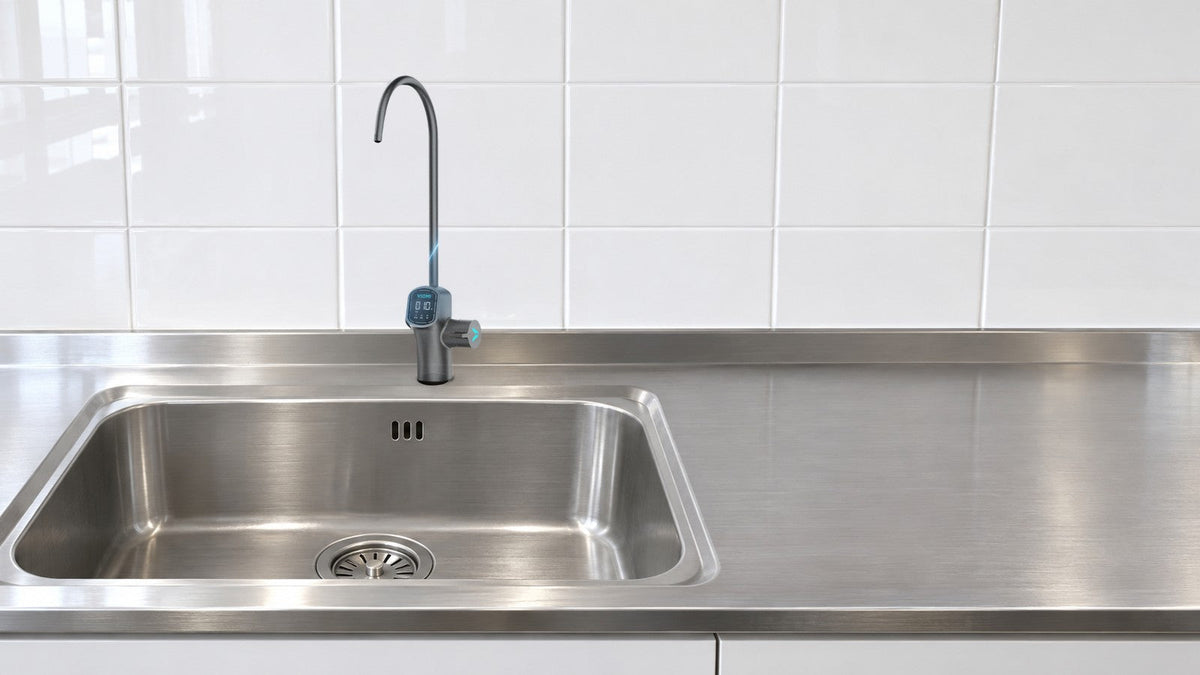
When bacteria are the reason a household chose reverse osmosis (RO), keeping the water path clean after installation means maintaining every part the water touches on a set schedule: pre-filters and membrane on the manufacturer's interval, any storage tank on its sanitizing schedule, and the faucet as needed. Tank-based systems carry that extra tank step, which AquaTru schedules once a year with the VOC filter change and Culligan describes as typically annual. Tankless systems send water from the filters straight to the faucet, so the tank step drops out of the routine entirely.
For the bacteria evidence each RO brand publishes, see the comparison of RO water filter brands for bacteria removal.
The Water Path, Segment by Segment
| Segment of the water path | Upkeep step | When it happens | Example source |
|---|---|---|---|
| Sediment and carbon pre-filters | Replace the cartridges | APEC ROES-50: every 6 to 12 months | APEC owner's manual |
| RO membrane | Replace, then drain the first water | APEC ROES-50: drain the first full tank after a new membrane | APEC owner's manual |
| Post carbon filter | Replace | APEC ROES-50: every 2 to 4 years, best done with the membrane | APEC owner's manual |
| Storage tank (tank-based systems) | Sanitize; keep the stored water turning over | AquaTru Under Sink: once a year at the VOC filter change; iSpring RCC series: empty and refill at least monthly | AquaTru product page; iSpring manual |
| Drain tubing | Check the tubing | Culligan Aquasential RO: annual service list | Culligan owner's guide |
| Faucet and aerator | Wipe the faucet; clean the aerator screen | As needed; regularly for the aerator | Culligan owner's guide; EPA |
Cartridge Changes as a Hygiene Step
The CDC's guidance on choosing home water filters says any filter needs maintenance to keep working properly and to prevent germs from growing in it, which includes changing filters on the manufacturer's schedule. The same guidance suggests wearing gloves while changing filters and washing hands afterward, and Kinetico's K5 manual adds, for owners who change their own cartridges, to wash hands thoroughly and avoid touching any internal portions of the system. EPA's fact sheet on home filters for PFAS makes the general point under the heading "Maintenance is Critical," adding that filters are only effective if they are maintained according to the manufacturer's instructions.
The first water after a change is handled by each design's own instructions. APEC's ROES-50 manual calls for draining the first full tank after a new membrane goes in, and Kinetico's K5 manual pairs each cartridge change with a full sanitizing of the system, done by the local dealer or with Kinetico's sanitization kit. On APEC's ROES-50, the three pre-filters are replaced every 6 to 12 months, and the manual describes them as the stage that protects the membrane.
Intervals vary by stage and by water source. On a typical five-stage tank system such as iSpring's RCC series, the sediment cartridge is rated for up to 6 months, the two carbon stages and the post carbon filter for up to 1 year, and the membrane for up to 3 years. Well water can shorten that: APEC notes that pre-filters on a private well may need replacing sooner than 12 months because of heavier sediment. A cartridge can also be due before the calendar says so, and iSpring suggests changing filters near the end of their cycle if flow drops noticeably or the water picks up an unpleasant taste or odor. Kinetico takes the other direction on its K5, recommending annual cartridge replacement even if the system has not shut off; when the K5's MACguard filter does shut the system off, Kinetico recommends calling the local authorized dealer, who changes the cartridges and sanitizes the system.
Seals are part of the same routine on systems with traditional filter housings. APEC recommends replacing the filter housing O-rings every year or when the three pre-filters are replaced, and iSpring's RCC manual lists O-ring replacement every 3 years. The membrane itself runs longer: APEC gives 2 to 4 years on city water, depending on water quality, usage and pre-filter upkeep.
Storage Tanks and Their Sanitizing Schedule
A storage tank holds treated water between draws, so tank-based RO systems include it in the upkeep routine. Among the systems cited here, several schedules land on once a year: AquaTru times its Under Sink sanitizer to the annual VOC filter change, a step done by unscrewing the TruPure RO Sanitizer, adding the sanitizing solution and following the steps in order, Express Water's manual recommends sanitizing once every 12 months, and Culligan's Aquasential RO guide says filter changes and sanitizing should typically be done annually, preferably by the local Culligan dealer, adding that high sediment, chlorine, turbidity or hardness in the local water may call for more frequent service. iSpring's RCC series manual approaches the tank from the usage side instead, suggesting the tank be emptied and refilled at least once a month so the stored water does not sit for long. Express Water's manual also notes that sanitizing can be done as often as needed, since the right frequency depends on the incoming water in a given area.
On dealer-serviced systems such as Culligan's and Kinetico's, sanitizing is part of the service visit; on AquaTru's Under Sink, it is a yearly step done at home alongside the VOC filter change.
Where a Tankless Layout Shortens the Routine
The Viomi V8 PRO and Viomi V6 PRO run a short automatic flush every 12 hours, sending the rinse water to the drain without anyone pressing a button, so the flush runs on its own schedule.

Cartridge changes are the main scheduled job on these systems, and the system flags them in advance. The control panel lights turn orange 10 to 15 days before a change is due, which gives room to plan the next cartridge order, and the swap is a twist and pull without tools. The Viomi M1 uses the same tankless layout, with filter life on its touchscreen faucet and reminders in the Viomi app; its PCB filter lasts up to 2 years and its RO filter up to 4 years.

Faucet, Spout and Tubing
The faucet is the last surface the water touches. Culligan's owner's guide lists cleaning the faucet with a soft cloth, avoiding abrasive cleaners, as an as-needed task. EPA's lead guidance recommends regularly cleaning a faucet's aerator screen, where sediment and debris can collect, and on an RO faucet with a screen at the outlet, that cleaning fits naturally into a cartridge-change day.
Tubing shows up in the service lists too. Culligan's annual service list includes checking TDS reduction performance, the drain tubing, the storage tank's pre-charge pressure and the system's flow rates, including the air gap, and a cartridge change is a convenient moment to look along the connections under the sink for drips.
Coming Back After Time Away
Tank-based manuals cover time away in detail. APEC asks owners to turn off the cold water supply to the RO system during a vacation or extended leave, and to drain the system and storage tank completely in very cold or freezing weather. iSpring's RCC manual asks owners to close the feed water adapter and empty the tank before leaving. On the return side, iSpring's guidance is specific: if the system has gone unused for more than a week and its filters were not sealed and stored, it recommends replacing the filters.
FAQ
Should the first water from a new RO membrane be poured out?
On APEC's ROES-50, it should: the manual says to drain the first full tank of water through the faucet after a new membrane is installed, and the second tank is ready for use.
Who sanitizes a dealer-serviced RO system?
On the systems cited here, usually the dealer. Culligan recommends having the local Culligan dealer perform the sanitization, and Kinetico's K5 manual describes the dealer changing the cartridges and sanitizing the whole system on a service call, with a sanitization kit from the dealer for owners who change cartridges themselves.
Does a tankless RO system need tank sanitizing?
It does not. Cartridge changes, any flushing the system does on its own, and cleaning the faucet remain part of the routine, each on its own schedule.
Does a remineralization stage have its own schedule?
On systems with a separate mineral cartridge, it does. APEC's ROES-PH75 manual lists its stage-6 mineral filter for replacement every 6 to 12 months, on the same rhythm as the three pre-filters, so a single service day can cover all four cartridges.
Is cleaning the faucet part of RO upkeep?
Culligan's owner's guide includes wiping the faucet with a soft cloth, and on a faucet with an aerator screen, EPA recommends cleaning that screen regularly.
A Household Plan for RO Upkeep
- Use the intervals listed for each stage of the system in use, and where the system has a filter-life display or reminder, let it flag the change as the date approaches.
- Match the tank work to the system: a dealer visit where the dealer handles sanitizing, or a yearly home step timed with a cartridge change where the manual calls for it.
- Keep gloves and a soft cloth with the spare cartridges, so a change day also covers the faucet and aerator.
For a fuller look at day-to-day maintenance workloads by brand, see the comparison of the easiest RO systems to maintain.
Share:
Water Filter Certification Terms: What Each Layer of a Listing Tells You
Las Vegas RO and Scale Control: Defining Each Project's Scope